I Will Not Retreat a Single Inch: Reformers Make Themselves Heard

This lesson was reported from:
A chapter of The United States: An Open Ended History, a free online textbook.  Adapted in part from open sources.

For Your Consideration:
  1. Generally speaking, what did abolitionists believe?  Identify one abolitionist and his or her strategies for achieving this goal.
  2. What was the Underground Railroad?
  3. What happened at Seneca Falls in 1848?
  4. What is a nativist? 
  5. What was Liberia?

Stirrings of Reform

The democratic upheaval in politics exemplified by Jackson’s election was merely one phase of the long American quest for greater rights and opportunities for all citizens.  These reformers dedicated their lives – often risked them – to make life as you know it possible….  to give Jefferson’s phrase “all men are created equal” the meaning you understand today – they took his exclusion of women, the poor, people of color, immigrants and others as a challenge, asking “Why not me too?”

The Abolitionists

In national politics, Southerners chiefly sought protection and enlargement of the interests represented by the cotton/slavery system. They sought territorial expansion because the wastefulness of cultivating a single crop, cotton, rapidly exhausted the soil, increasing the need for new fertile lands. Moreover, new territory would establish a basis for additional slave states to offset the admission of new free states.  In the 1830s Northern opposition to slavery became fierce, even if it was still a minority view.  The goal of the antislavery movement was abolition, or the end of slavery, and those who opposed slavery were called abolitionists.

An earlier antislavery movement, an offshoot of the American Revolution, had won its last victory in 1808 when Congress abolished the slave trade with Africa. Thereafter, opposition came largely from the Quakers, who kept up a mild but ineffectual protest. Meanwhile, the cotton gin and westward expansion into the Mississippi delta region created an increasing demand for slaves.

The abolitionist movement that emerged in the early 1830s was combative, uncompromising, and insistent upon an immediate end to slavery. This approach found a leader in William Lloyd Garrison, a young man from Massachusetts, who combined the heroism of a martyr with the crusading zeal of a demagogue. On January 1, 1831, Garrison produced the first issue of his newspaper, The Liberator, which bore the announcement: “I shall strenuously contend for the immediate enfranchisement of our slave population. … On this subject, I do not wish to think, or speak, or write, with moderation. … I am in earnest—I will not equivocate—I will not excuse—I will not retreat a single inch—AND I WILL BE HEARD.”

Garrison_Liberator_Banner
William Lloyd Garrison and the masthead of his antislavery newspaper, The Liberator.

Garrison’s sensational methods awakened Northerners to the evil in an institution many had long come to regard as unchangeable. He sought to hold up to public gaze the most repulsive aspects of slavery and to castigate slave holders as torturers and traffickers in human life. He recognized no rights of the masters, acknowledged no compromise, tolerated no delay. Other abolitionists, unwilling to subscribe to his law-defying tactics, held that reform should be accomplished by legal and peaceful means. Garrison was joined by another powerful voice, that of Frederick Douglass, an escaped slave who galvanized Northern audiences.

800px-Frederick_Douglass_portrait
Frederick Douglass (1818–1895), a former slave whose stirring memoir, Narrative of the Life of Frederick Douglass, an American Slave (1845), became a bestseller, which aided the cause of abolition by humanizing African-Americans.

One activity of the movement involved helping slaves escape to safe refuges in the North or over the border into Canada. The Underground Railroad, an elaborate network of secret routes, was firmly established in the 1830s in all parts of the North. In Ohio alone, from 1830 to 1860, as many as 40,000 fugitive slaves were helped to freedom. The number of local antislavery societies increased at such a rate that by 1838 there were about 1,350 with a membership of perhaps 250,000.

ch09_map1
Map of various Underground Railroad escape routes.
800px-Harriet_Tubman
A conductor on the Underground Railroad, Harriet Tubman made 13 trips to the South, helping to free over 70 people. She led people to the northern free states and Canada. This helped Harriet Tubman gain the name “Moses of Her People.”

Most Northerners nonetheless either held themselves aloof from the abolitionist movement or actively opposed it. In 1837, for example, a mob attacked and killed the antislavery editor Elijah P. Lovejoy in Alton, Illinois.

As the Abolition movement became stronger in America, it was expressed in public debate and in petition. During one year, 1830, an anti-slavery petition drive delivered 130,000 petitions to Congress.  Pro-slavery forces responded with a series of gag rules that automatically “tabled” all petitions or debate around the subject of limiting slavery, preventing them from being read or discussed.  Rather than suppress anti-slavery petitions, however, the gag rules only served to offend Americans from Northern states, and dramatically increase the number of petitions.

Former President John Quincy Adams, elected to the House of Representatives in 1830, fought this so‑called gag rule as a violation of the First Amendment, finally winning its repeal in 1844.

Women’s Rights

Barred from politics and most professions, many women found their voice in church groups, especially those associated with the abolition movement.  Calling for the end of slavery brought many women to a realization of their own unequal position in society. From colonial times, unmarried women had enjoyed many of the same legal rights as men, although custom required that they marry early. With matrimony, women virtually lost their separate identities in the eyes of the law. Women were not permitted to vote. Their education in the 17th and 18th centuries was limited largely to reading, writing, music, dancing, and needlework.

ElizabethCadyStanton-1848-Daniel-Henry
Elizabeth Cady Stanton in 1848 with two of her three sons.

The awakening of women began with the visit to America of Frances Wright, a Scottish lecturer and journalist, who publicly promoted women’s rights throughout the United States during the 1820s. At a time when women were often forbidden to speak in public places, Wright not only spoke out, but shocked audiences by her views advocating the rights of women to seek information on birth control and divorce. By the 1840s an American women’s rights movement emerged. Its foremost leader was Elizabeth Cady Stanton.

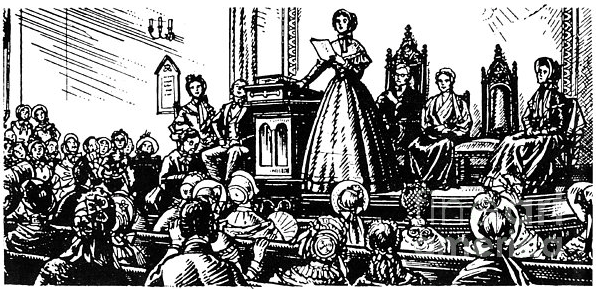
In 1848 Cady Stanton and her colleague Lucretia Mott organized a women’s rights convention—the first in the history of the world—at Seneca Falls, New York. Delegates drew up a “Declaration of Sentiments,” demanding equality with men before the law, the right to vote, and equal opportunities in education and employment. The resolutions passed unanimously with the exception of the one for women’s suffrage, which won a majority only after an impassioned speech in favor by Frederick Douglass, the black abolitionist.
0365e4e9855679b8aa7161333eb87199
The Seneca Falls Convention was the first women’s rights convention. It advertised itself as “a convention to discuss the social, civil, and religious condition and rights of woman.” Held in Seneca Falls, New York, it spanned two days over July 19–20, 1848. Attracting widespread attention, it was soon followed by other women’s rights conventions.

At Seneca Falls, Cady Stanton gained national prominence as an eloquent writer and speaker for women’s rights. She had realized early on that without the right to vote, women would never be equal with men. Taking the abolitionist William Lloyd Garrison as her model, she saw that the key to success lay in changing public opinion, and not in party action. Seneca Falls became the catalyst for future change. Soon other women’s rights conventions were held, and other women would come to the forefront of the movement for their political and social equality.

In 1848 also, Ernestine Rose, a Polish immigrant, was instrumental in getting a law passed in the state of New York that allowed married women to keep their property in their own name. Among the first laws in the nation of this kind, the Married Women’s Property Act encouraged other state legislatures to enact similar laws.

In 1869 Elizabeth Cady Stanton and another leading women’s rights activist, Susan B. Anthony, founded the National Woman Suffrage Association (NWSA), to promote a constitutional amendment for women’s right to the vote. These two would become the women’s movement’s most outspoken advocates. Describing their partnership, Cady Stanton would say, “I forged the thunderbolts and she fired them.”

Education

Public education was common in New England, though it was class-based, with the working class receiving minimum benefits. Schools taught religious values, including corporal punishment and public humiliation.

The spread of suffrage had already led to a new concept of education. Clear-sighted statesmen everywhere understood that universal suffrage required a tutored, literate electorate. Workingmen’s organizations demanded free, tax-supported schools open to all children. Gradually, in one state after another, legislation was enacted to provide for such free instruction.  States in the South, however, frequently resisted this impulse for both poor whites and free blacks – more education would have meant less control for the traditional wealthy planter class.

McGuffey's_Primer_1836
McGuffey’s Primer was a common American textbook. This edition dates from 1836.

Horace Mann was considered “The Father of American Education.” He wanted to develop a school that would help to get rid of the differences between boys and girls when it came to education. He also felt that this could help keep the crime rate down. He was the first Secretary for the Board of Education in Massachusetts in 1837-1848. He also helped to establish the first school for the education of teachers in America in 1839.

Elsewhere, other educational reforms were taking place during the same period. In 1833 Oberlin College had in attendance 29 men and 15 women. Oberlin college came to be known the first college that allowed women attend. Within five years, thirty-two boarding schools enrolled Indian students. They substituted English for American Indian languages and taught Agriculture alongside the Christian Gospel.

Asylum Movement
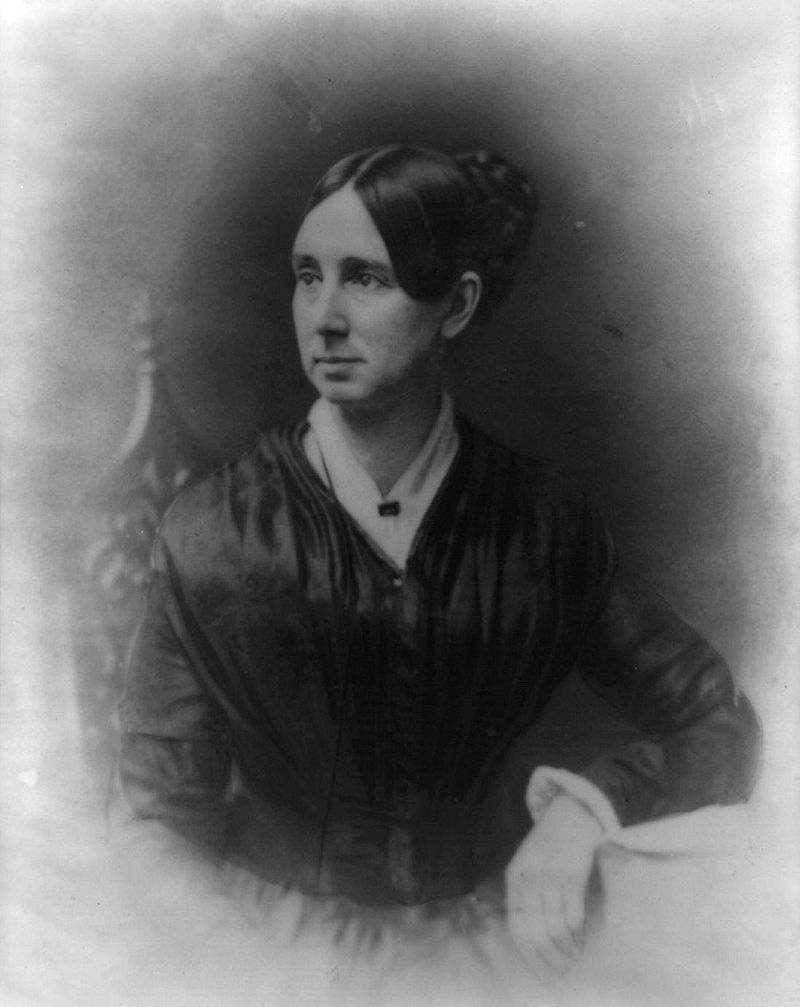
800px-Dix-Dorothea-LOC
Dorothea Dix was an American activist on behalf of the indigent mentally ill who, through a vigorous program of lobbying state legislatures and the United States Congress, created the first generation of American mental asylums.

Other reformers addressed the problems of prisons and care for the insane. Efforts were made to turn prisons, which stressed punishment, into penitentiaries where the guilty would undergo rehabilitation. In Massachusetts, Dorothea Dix led a struggle to improve conditions for mentally ill persons, who typically were kept confined in wretched prisons alongside actual criminals. After winning improvements in Massachusetts, she took her campaign to the South, where nine states established hospitals for the insane between 1845 and 1852.

Transcendentalism
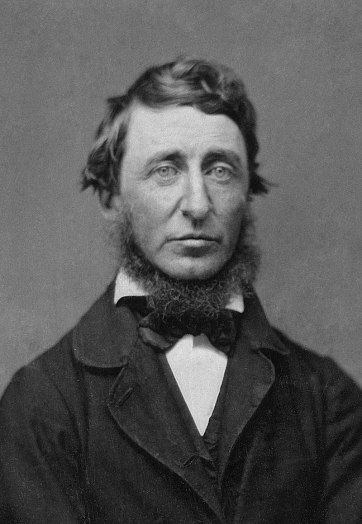
800px-Benjamin_D._Maxham_-_Henry_David_Thoreau_-_Restored_-_greyscale_-_straightened
Henry David Thoreau was an American essayist, poet, philosopher, abolitionist, naturalist, tax resister, critic, surveyor, and historian. A leading transcendentalist, Thoreau is best known for his book Walden, a reflection upon simple living in natural surroundings, and his essay “Civil Disobedience,” an argument for disobedience to an unjust state.

In the early 1800s, while the Second Great Revival was shaking the country, some people in New England chose another way to faith. Many of them were reading the German Idealists and the Higher Criticism, and some of them had read new English-language translations of Hindu scripture. They were descendants of the people who had come to America to purify their faith. Some of these decided to go further. They called themselves transcendentalists, because they thought they “transcended” any petty doctrine. The Transcendental Club was founded in 1836.

The writer Ralph Waldo Emerson was a major theorist in the movement. He held that God was one, and not the three persons seen in Christian theology. Nor was God a personal being. The great ideas and loves of human beings persisted after their deaths, creating a vast Oversoul. There was no perpetuation of the individual soul. Individuals could move toward the inevitable perfection of their species, and to become one with the Oversoul. Other individuals who held some of Emerson’s beliefs included the feminist Margaret Fuller, Bronson Alcott (whose daughter was the author Louisa May Alcott) and Henry David Thoreau. Different members of the group experimented with vegetarianism, communism, pacifism, free-love, and other non-mainstream practices. Although they differed widely from their revivalist neighbors, many of them also held millenarian views: if only human beings became truly kind and wise, they could create an earthly paradise.

Temperance

Attitudes toward alcohol in America have always been complex, but perhaps no more so than in the mid 1800s.  Alcohol was a major source of government tax revenue, and a social force holding communities together. Yet drunkenness, particularly of the poor, began to be commented upon by the middle and upper classes during the late 1700s and 1800s, especially as drinking came to be associated with recent German and Irish immigrants – lesser Americans. During presidential elections, drunkenness was encouraged by political campaigns, and votes were often exchanged for drinks. Many churches came to believe that taverns encouraged business on Sundays, the one day without work, and that people who would have otherwise gone to church spent their money at the bar. As a result of these beliefs, groups began forming in several states to reduce the consumption of alcohol. Although the Temperance movement began with the intent of limiting use, some temperance leaders such as Connecticut minister Lyman Beecher began urging fellow citizens to abstain from drinking in 1825. In 1826, the American Temperance Society formed in a resurgence of religion and morality. By the late 1830s, the American Temperance Society had membership of 1,500,000, and many Protestant churches began to preach temperance.

800px-The_Drunkard's_Progress_-_Color
The Drunkard’s Progress: by Nathaniel Currier 1846, warns that moderate drinking leads, step-by-step, to total disaster.

Immigration

Americans found themselves divided in other, more complex ways. The large number of Catholic immigrants in the first half of the 19th century, primarily Irish and German, triggered a backlash among native-born Protestant Americans. Immigrants brought strange new customs and religious practices to American shores. They competed with the native-born for jobs in cities along the Eastern seaboard. The coming of universal white male suffrage in the 1820s and 1830s increased their political clout. Displaced patrician politicians blamed the immigrants for their fall from power. The Catholic Church’s failure to support the temperance movement gave rise to charges that Rome was trying to subvert the United States through alcohol.

The most important of the nativist – or anti-immigrant – organizations that sprang up in this period was a secret society, the Order of the Star-Spangled Banner, founded in 1849. When its members refused to identify themselves, they were swiftly labeled the “Know-Nothings.” In a few years, they became a national organization with considerable political power.

bl1341-1
The Native American Party, renamed the American Party in 1855 and commonly known as the Know Nothing movement, was an American nativist political party that operated nationally in the mid-1850s. It was primarily anti-Catholic, xenophobic, and hostile to immigration, starting originally as a secret society. The movement briefly emerged as a major political party in the form of the American Party. Adherents to the movement were to reply “I know nothing” when asked about its specifics by outsiders, thus providing the group with its common name.

The Know-Nothings advocated an extension in the period required for naturalized citizenship from five to 21 years. They sought to exclude the foreign-born and Catholics from public office. In 1855 they won control of legislatures in New York and Massachusetts; by then, about 90 U.S. congressmen were linked to the party.

In the early 19th century, a variety of organizations were established that advocated relocation of black people from the United States to places where they would enjoy greater freedom; some endorsed colonization, while others advocated emigration. During the 1820s and 1830s the American Colonization Society (A.C.S.) was the primary vehicle for proposals to “return” black Americans to freedom in Africa, regardless of whether they were native-born in the United States. It had broad support nationwide among white people, including prominent leaders such as Abraham Lincoln, Henry Clay and James Monroe, who considered this preferable to emancipation. Clay said that due to

“unconquerable prejudice resulting from their color, they [the blacks] never could amalgamate with the free whites of this country. It was desirable, therefore, as it respected them, and the residue of the population of the country, to drain them off.”

Many African Americans opposed colonization, and simply wanted to be given the rights of free citizens in the United States.
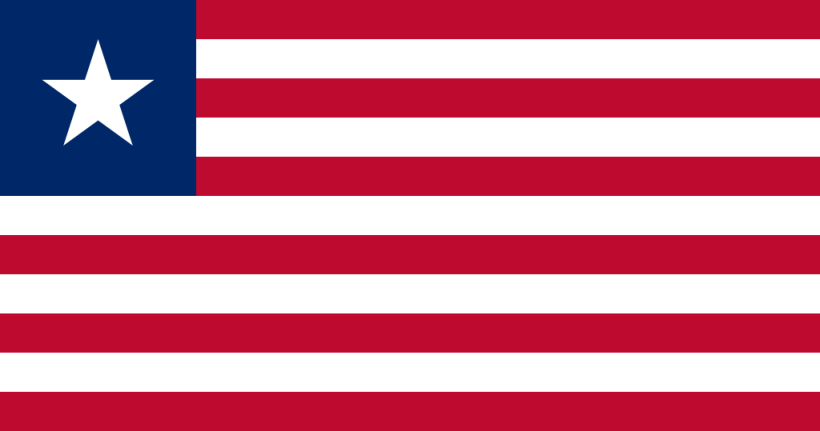
1024px-Flag_of_Liberia.svg
The Liberian Flag.

After attempts to plant small settlements on the coast of west Africa, the A.C.S. established the colony of Liberia in 1821–22. Over the next four decades, it assisted thousands of former slaves and free black people to move there from the United States. The tropical disease they encountered was extreme, and most migrants died fairly quickly.  American support for colonization waned gradually through the 1840s and 1850s, largely because of the efforts of abolitionists to promote emancipation of slaves and the granting of United States citizenship. The Americo-Liberians established an elite who ruled Liberia continuously until the military coup of 1980.

The article was adapted in part from:

  1. Nationalism and Division
  2. Westward Expansion and Regional Differences

Manifest Destiny, Westward Expansion, and the Conquest of Mexico

This lesson was reported from:
A chapter of The United States: An Open Ended History, a free online textbook.  Adapted in part from open sources.

For Your Consideration:
  1. Why did the Mexican government encourage Americans to move to Texas? What caused these Americans to revolt against Mexico?
  2. What was Manifest Destiny? Did all people at the time agree with this idea?
  3. Why didn’t Texas immediately join the United States?
  4. How did the Mexican-American War begin?
  5. Why did a number of Northerners – such as Henry David Thoreau, John Quincy Adams, and Frederick Douglass – oppose the war?
  6. What did the Treaty of Guadalupe Hidalgo do?

Texas

Comancheria
The Comancheria is the name commonly given to the region of New Mexico, west Texas and nearby areas occupied by the Comanche before the 1860s. They were dominate power in the region and are sometimes called an empire, though they were regarded as little more than bandits at the time.

Mexico obtained independence from Spain in 1821, and briefly experimented with monarchy, becoming a republic in 1824. This early period of Mexican history was characterized by considerable instability.  In the 1820s and 30s, the northern Mexican region of Texas was very sparsely populated, with fewer than 3,500 non-Native American residents, and only about 200 soldiers, which made it extremely vulnerable to attacks by the Comanche, Apache, and Navajo – who also claimed the land as their own. These indigenous people, especially the Comanche, took advantage of the weakness of the newly independent Mexico to undertake large-scale raids over hundreds of miles against Mexican targets to acquire livestock for their own use and to supply an expanding market in Texas and the US.

In the hopes that an influx of settlers could control the Indian raids, the bankrupt Mexican government liberalized immigration policies for the region. Finally able to settle legally in Texas, Americans from the United States soon vastly outnumbered the Tejanos, or Mexican citizens of Texas. Most of the immigrants came from the southern United States. Many were slave owners, and most brought with them significant prejudices against other races, attitudes often applied to the Tejanos.

Mexican authorities became increasingly concerned about the stability of the region – now because of the Americans in their midst. After Mexico abolished slavery in 1829, the American population in Texas teetered on the brink of revolt. Alarmed, the Mexican government implemented a new round of restrictions, which, among other things, prohibited further immigration to Texas from the United States, increased taxes, and reiterated the ban on slavery.  Settlers simply circumvented or ignored the laws. By 1834, an estimated 30,000 Americans lived in Texas, compared to only 7,800 Mexican-born residents. By the end of 1835, almost 5,000 enslaved Africans and African Americans lived in Texas, making up 13 percent of the non-Indian population.

800px-FalloftheAlamo
The Battle of the Alamo was a pivotal event in the Texas Revolution. Following a 13-day siege, Mexican troops under President General Antonio López de Santa Anna launched an assault on the Alamo Mission near modern-day San Antonio, Texas, United States, killing the Texian defenders. Buoyed by a desire for revenge, the Texians defeated the Mexican Army at the Battle of San Jacinto, on April 21, 1836, ending the revolution.

The Republic of Texas declared independence from the Republic of Mexico on March 2, 1836. At the time the vast majority of the population favored the annexation of the Republic by the United States. Fearing a repeat of the Missouri crisis, the leadership of both major U.S. political parties, the Democrats and the Whigs, opposed the introduction of Texas, a vast slave-holding region, into the volatile political climate of the pro- and anti-slavery sectional controversies in Congress. Moreover, they wished to avoid a war with Mexico, whose government refused to acknowledge the sovereignty of its rebellious northern province.

Manifest Destiny

For individual settlers, the decision to move west was typically driven by the desire for economic opportunity.  But how did Americans justify their right to take lands from Native Americans, Mexicans, and others who might already live in the west?

In the 19th century, manifest destiny was a widely held belief in the United States that its settlers were destined to expand across the entire continent of North America. A term coined by journalist John L. O’Sullivan in 1845 to describe a set of attitudes that had already existed for some time before, there are three basic themes to manifest destiny:

  • the virtue of the American people and their institutions;
  • the mission to spread these institutions, thereby redeeming and remaking the world in the image of the United States;
  • the destiny under God to do this work.

O’Sullivan wrote: “And that claim is by the right of our manifest destiny to overspread and to possess the whole of the continent which Providence has given us for the development of the great experiment of liberty and federated self-government entrusted to us.”

800px-American_Progress_(John_Gast_painting)
American Progress, (1872) by John Gast, is an allegorical representation of the modernization of the new west. Columbia, a personification of the United States, is shown leading civilization westward with the American settlers. She is shown bringing light from the East into the West, stringing telegraph wire, holding a school textbook that will instill knowledge,[1] and highlights different stages of economic activity and evolving forms of transportation.
O’Sullivan’s original conception of manifest destiny was not a call for territorial expansion by force. He believed that the expansion of the United States would happen without the direction of the U.S. government or the involvement of the military. After Americans immigrated to new regions, they would set up new democratic governments, and then seek admission to the United States, as Texas had done. In 1845, O’Sullivan predicted that California would follow this pattern next, and that Canada would eventually request annexation as well. 

Ironically, O’Sullivan’s term became popular only after it was criticized by Whig opponents of the Polk administration. On January 3, 1846, Representative Robert Winthrop ridiculed the concept in Congress, saying “I suppose the right of a manifest destiny to spread will not be admitted to exist in any nation except the universal Yankee nation.” Winthrop was the first in a long line of critics who suggested that advocates of manifest destiny were citing “Divine Providence” for justification of actions that were motivated by chauvinism and self-interest. Despite this criticism, expansionists embraced the phrase, which caught on so quickly that its origin was soon forgotten.

The Mexican-American War

800px-Mexico_1824_(equirectangular_projection)
Mexico in 1824.

For almost a decade, Texas remained an independent republic, largely because its annexation as a huge new slave state would disrupt the increasingly precarious balance of political power in the United States. In 1845, President James K. Polk, narrowly elected on a platform of westward expansion, brought the Republic of Texas into the Union as the 28th state. Polk’s move was the first gambit in a larger design. Texas claimed that its border with Mexico was the Rio Grande River; Mexico argued that the border stood 150 miles to the north along the Nueces River. Meanwhile, American settlers were flooding into the territories of New Mexico and California, citing manifest destiny as their justification to do so.

333px-Wpdms_republic_of_texas.svg
The Republic of Texas: The present-day outlines of the individual U.S. states are superimposed on the boundaries of 1836–1845.

U.S. attempts to purchase from Mexico the New Mexico and California territories failed. In 1846, President Polk ordered General Taylor and his forces south to the Rio Grande, entering deep into the territory that Mexico claimed as their own.

Regarding the beginning of the war, Ulysses S. Grant, who had opposed the war but served as an army lieutenant in Taylor’s Army, claims in his Personal Memoirs (1885) that the main goal of the U.S. Army’s advance from Nueces River to Rio Grande was to provoke the outbreak of war without attacking first – to make the whole war seem defensive, rather than as a war of conquest against a weaker nation.

“We were sent to provoke a fight, but it was essential that Mexico should commence it. It was very doubtful whether Congress would declare war; but if Mexico should attack our troops, the Executive could announce, “Whereas, war exists by the acts of, etc.,” and prosecute the contest with vigor. Once initiated there were but few public men who would have the courage to oppose it….

Mexico showing no willingness to come to the Nueces to drive the invaders from her soil, it became necessary for the ‘invaders’ to approach to within a convenient distance to be struck. Accordingly, preparations were begun for moving the army to the Rio Grande… It was desirable to occupy a position near the largest centre of population possible to reach, without absolutely invading territory to which we set up no claim whatever.

Eleven American soldiers were killed in this initial conflict, provoked by the Americans.  Just as Grant described, Polk claimed the need to avenge the honor of these fallen men and pushed for open warfare against Mexico – a full invasion by the better equipped, better organized U.S. army commenced.  His message to Congress on May 11, 1846, claimed that “Mexico has passed the boundary of the United States, has invaded our territory and shed American blood upon American soil.”

American troops occupied the lightly populated territory of New Mexico, then supported a revolt of settlers in California. A U.S. force under Zachary Taylor invaded Mexico, winning victories at Monterrey and Buena Vista, but failing to bring the Mexicans to the negotiating table.

Mexico was not inclined nor able to negotiate. In 1846 alone, the presidency changed hands four times, the war ministry six times, and the finance ministry sixteen times. Mexican public opinion and all political factions agreed that selling the territories to the United States would tarnish the national honor. Mexicans who opposed direct conflict with the United States were viewed as traitors.

800px-Battle_of_Churubusco2
This lithograph from 1847 depicting the Battle of Churubusco suggests the lopsided nature of many of the conflicts in the Mexican-American War.

Opposition to the War

In the United States, increasingly divided by sectional rivalry, the war was a partisan issue. Most Whigs in the North and South opposed it; most Democrats supported it.  Southern Democrats supported it in hope of adding slave-owning territory to the South and avoiding being overwhelmed in the Senate by the faster-growing North.

Northern antislavery elements feared the expansion of the Southern Slave Power; Whigs generally wanted to strengthen the economy with industrialization, not expand it with more land. Among the most vocal opposing the war in the House of Representatives was John Quincy Adams of Massachusetts. Adams had first voiced concerns about expanding into Mexican territory in 1836 when he opposed Texas annexation. He continued this argument in 1846 for the same reason. War with Mexico would add new slavery territory to the nation. When the vote to go to war with Mexico came to a vote on May 13, Adams spoke a resounding “No!” in the chamber. Only 13 others followed his lead.

Frederick_Douglass_by_Samuel_J_Miller,_1847-52
Ex-slave Frederick Douglass opposed the war and was dismayed by the weakness of the anti-war movement. “The determination of our slave holding president, and the probability of his success in wringing from the people, men and money to carry it on, is made evident by the puny opposition arrayed against him. None seem willing to take their stand for peace at all risks.”

Northern abolitionists attacked the war as an attempt by slave-owners to strengthen the grip of slavery and thus ensure their continued influence in the federal government. Prominent artists and writers opposed the war.

The Transcendentalist writers Henry David Thoreau and Ralph Waldo Emerson attacked the popular war. Thoreau, who served jail time for refusing to pay his taxes in opposition, composed an essay on how to resist such a large-scale injustice as the war.  That essay is now known as Civil Disobedience. Emerson was succinct, predicting that, “The United States will conquer Mexico, but it will be as a man who swallowed the arsenic which brings him down in turn. Mexico will poison us.” Events proved him right, as arguments over the expansion of slavery in the lands seized from Mexico would fuel the drift to civil war just a dozen years later.

Democratic Representative David Wilmot introduced the Wilmot Proviso, which would prohibit slavery in new territory acquired from Mexico. Wilmot’s proposal passed the House but not the Senate, and it spurred further hostility between the factions.

The End of the War

The Battle of Chapultepec was an encounter between the Mexican Army and the United States on the castle of Chapultepec which sits high atop a cliff. At this time, this castle was a renowned military school. After the battle, which ended in the American capture of Mexico City, the legend of “Los Niños Héroes” was born. Although the story is unconfirmed by historians, six military cadets between the ages of 13 and 17 are said to have stayed in the school instead of evacuating, choosing instead to stand their ground for the honor of Mexico. Rather than surrender to the U.S. Army, some of military cadets leaped from the castle walls. One cadet wrapped himself in the Mexican flag and jumped to his death. These Niños Héroes (hero children) became icons in Mexico’s pantheon of heroes.

Outnumbered militarily and with many of its large cities occupied, Mexico could not defend itself; the country was also faced with many internal divisions. The Treaty of Guadalupe Hidalgo, signed on February 2, 1848, ended the war. The treaty gave the U.S. undisputed control of Texas, established the U.S.-Mexican border at the Rio Grande, and ceded to the United States the present-day states of California, Nevada, and Utah, most of New Mexico, Arizona, and Colorado, and parts of Texas, Oklahoma, Kansas, and Wyoming (together, so-called Mexican Cession). In return, Mexico received $15 million (approximately $424 million today) – less than half the amount the U.S. had attempted to offer Mexico for the land before the opening of hostilities.

The acquisition was a source of controversy, especially among U.S. politicians who had opposed the war from the start. A leading antiwar U.S. newspaper, the Whig National Intelligencer, sardonically concluded that “We take nothing by conquest … Thank God.”

800px-Mexican_Cession_in_Mexican_View
Mexican territorial claims relinquished under the Treaty of Guadalupe Hidalgo in white.

Before ratifying the treaty, the U.S. Senate made two modifications: changing the wording of Article IX (which guaranteed Mexicans living in the purchased territories the right to become U.S. citizens) and striking out Article X (which conceded the legitimacy of land grants made by the Mexican government).  As a result, the majority of Mexicans who suddenly found themselves living in the United States would come to be considered foreigners in their own home and would ultimately lose their land to American settlers who flooded the Mexican Cession over the next generation.

800px-War_News_from_Mexico
War News from Mexico (1848).

The war was a decisive event for the U.S., marking a significant waypoint for the nation as a growing military power, and a milestone in the U.S. narrative of Manifest Destiny. The war did not resolve the issue of slavery in the U.S. but rather in many ways inflamed it, as potential westward expansion of the institution of slavery became an increasingly central and heated theme in national debates preceding the American Civil War. By extending the nation from coast to coast, the Mexican–American War was a next step in the huge migrations to the West of Americans, which culminated in transcontinental railroads and the Indian wars later in the same century.

The military defeat and loss of territory was a disastrous blow to Mexico, causing the country to enter a period of self-examination as its leaders sought to identify and address the reasons that had led to such a debacle.  The war remains a painful historical event for the country.

In Mexico City’s Chapultepec Park, the Niños Héroes (Monument to the Heroic Cadets) commemorates the heroic sacrifice of the six teenaged military cadets who fought to their deaths rather than surrender to American troops during the Battle of Chapultepec Castle. The monument is an important patriotic site in Mexico. On March 5, 1947, nearly one hundred years after the battle, U.S. President Harry S. Truman placed a wreath at the monument and stood for a moment of silence.

The United States has no national memorial to the war, which remains largely unknown to most Americans.

The article was adapted in part from:

  1. Texas Annexation
  2. Manifest Destiny
  3. The Mexican-American War
  4. Sectional Conflict

Andrew Jackson, For and Against the Common Man

This lesson was reported from:
A chapter of The United States: An Open Ended History, a free online textbook.  Adapted in part from open sources.

For Your Consideration:
  1. Why was the election of 1824 so controversial?
  2. What is nullification? How did Andrew Jackson respond to South Carolina’s attempts to nullify the tariff?
  3. Why didn’t President Jackson like the national bank? What did he do to kill it?
  4. What was the Indian Removal Act?
  5. What was the Trail of Tears?

The 1824 Election and Presidency of John Q. Adams

With the dissolution of the Federalist Party, there were no organized political parties for the 1824 presidential election, and four Democratic-Republicans vied for the office. The Tennessee legislature and a convention of Pennsylvania Democratic-Republicans had nominated General-turned-Senator Andrew Jackson. The Congressional Democratic-Republican caucus selected Treasury Secretary William H. Crawford. Secretary of State John Q. Adams, son of the former President Adams, and House Speaker Henry Clay also joined the contest.

When the electoral votes were cast and counted, no candidate had a majority of votes. Jackson had won the most votes, but Constitutionally, a plurality was not good enough, and the vote for the top three candidates went to the House of Representatives. Clay, with the least amount of votes, was ineligible, but still wielded a lot of power as speaker of the house. And since Clay had a personal dislike of Jackson and supported many of Adams’ policies, which were similar to his American System, Clay threw his support to Adams. Thanks to this support, Adams won the presidency, much to the chagrin of Jackson, who had won the most electoral and popular votes. After Adams appointed Clay as secretary of state, Jackson’s supporters protested that a corrupt bargain had been struck – that Jackson had been robbed of his rightful victory because of dishonest, behind-the-scenes deals made by the elite Adams and Clay.

The 1824 election enabled the resurgence of political parties in America. Jackson’s followers, members of the Democratic Party, were known as Jacksonians; Adams, Clay, and their supporters established the National Republican Party. Partisan politics was back in style in Washington, DC.

During Adams’s administration, new party alignments appeared. Adams’s followers, some of whom were former Federalists, took the name of “National Republicans” as emblematic of their support of a federal government that would take a strong role in developing an expanding nation. Though he governed honestly and efficiently, Adams was not a popular president. He failed in his effort to institute a national system of roads and canals. His coldly intellectual temperament did not win friends. Jackson, by contrast, had enormous popular appeal and a strong political organization. His followers coalesced to establish the Democratic Party, claimed direct lineage from the Democratic-Republican Party of Jefferson, and in general advocated the principles of small, decentralized government.

These factors meant that in the election of 1828, Jackson defeated Adams by an overwhelming electoral majority.

20

Jackson—Tennessee politician, fighter in wars against Native Americans on the Southern frontier, and hero of the Battle of New Orleans during the War of 1812—drew his support from poorer white men. He came to the presidency on a rising tide of enthusiasm for popular democracy. The election of 1828 was a significant benchmark in the trend toward broader voter participation. By then most states had either enacted universal white male suffrage or minimized property requirements. In 1824 members of the Electoral College in six states were still selected by the state legislatures. By 1828 presidential electors were chosen by popular vote in every state but Delaware and South Carolina. These developments were the products of a widespread sense that the people should rule and that government by traditional elites had come to an end.  Of course, the nation’s definition of “the people” did not include African Americans, Native Americans, or women of any race.

Nullification Crisis

Toward the end of his first term in office, Jackson was forced to confront the state of South Carolina, the most important of the emerging Deep South cotton states, on the issue of the protective tariff. Business and farming interests in the state had hoped that the president would use his power to modify the 1828 act that they called the Tariff of Abominations. In their view, all its benefits of protection went to Northern manufacturers, leaving agricultural South Carolina poorer. In 1828, the state’s leading politician—and Jackson’s vice president until his resignation in 1832—John C. Calhoun had declared in his South Carolina Exposition and Protest that states had the right to nullify oppressive national legislation.

In 1832, Congress passed and Jackson signed a bill that revised the 1828 tariff downward, but it was not enough to satisfy most South Carolinians. The state adopted an Ordinance of Nullification, which declared both the tariffs of 1828 and 1832 null and void within state borders. Its legislature also passed laws to enforce the ordinance, including authorization for raising a military force and appropriations for arms. Nullification – a state’s right to ignore federal laws with which it disagreed – was a long-established theme of protest against perceived excesses by the federal government. Jefferson and Madison had proposed it in the Kentucky and Virginia Resolutions of 1798, to protest the Alien and Sedition Acts. The Hartford Convention of 1814 had invoked it to protest the War of 1812. Never before, however, had a state actually attempted nullification. The young nation faced its most dangerous crisis yet.

In response to South Carolina’s threat, Jackson sent seven small naval vessels and a man-of-war to Charleston in November 1832. On December 10, he issued a resounding proclamation against the nullifiers. South Carolina, the president declared, stood on “the brink of insurrection and treason,” and he appealed to the people of the state to reassert their allegiance to the Union. He also let it be known that, if necessary, he personally would lead the U.S. Army to enforce the law.

When the question of tariff duties again came before Congress, Jackson’s political rival, Senator Henry Clay, a great advocate of protection but also a devoted Unionist, sponsored a compromise measure. Clay’s tariff bill, quickly passed in 1833, specified that all duties in excess of 20 percent of the value of the goods imported were to be reduced year by year, so that by 1842 the duties on all articles would reach the level of the moderate tariff of 1816. At the same time, Congress passed a Force Act, authorizing the president to use military power to enforce the laws.

South Carolina had expected the support of other Southern states, but instead found itself isolated. (Its most likely ally, the state government of Georgia, wanted, and got, U.S. military force to remove Native-American tribes from the state.) Eventually, South Carolina rescinded its action. Both sides, nevertheless, claimed victory. Jackson had strongly defended the Union. But South Carolina, by its show of resistance, had obtained many of its demands and had demonstrated that a single state could force its will on Congress.

The Bank War

Although the nullification crisis possessed the seeds of civil war, it was not as critical a political issue as a bitter struggle over the continued existence of the nation’s central bank, the second Bank of the United States. The first bank, established in 1791 under Alexander Hamilton’s guidance, had been chartered for a 20-year period. Though the government held some of its stock, the bank, like the Bank of England and other central banks of the time, was a private corporation with profits passing to its stockholders. Its public functions were to act as a depository for government receipts, to make short-term loans to the government, and above all to establish a sound currency by refusing to accept at face value notes (paper money) issued by state-chartered banks in excess of their ability to redeem.

King_Andrew_the_First_(political_cartoon_of_President_Andrew_Jackson)
King Andrew the First is a famous American political cartoon created by an unknown artist around 1833. The cartoon depicts Andrew Jackson, the 7th United States president, as a monarch holding a veto bill and trampling on the Constitution and on internal improvements of the national bank.

To the Northeastern financial and commercial establishment, the central bank was a needed enforcer of prudent monetary policy, but from the beginning it was resented by Southerners and Westerners who believed their prosperity and regional development depended upon ample money and credit. The Republican Party of Jefferson and Madison doubted its constitutionality. When its charter expired in 1811, it was not renewed.

For the next few years, the banking business was in the hands of state-chartered banks, which issued currency in excessive amounts, creating great confusion and fueling inflation. It became increasingly clear that state banks could not provide the country with a reliable currency. In 1816 a second Bank of the United States, similar to the first, was again chartered for 20 years. From its inception, the second bank was unpopular in the newer states and territories, especially with state and local bankers who resented its virtual monopoly over the country’s credit and currency, but also with less prosperous people everywhere, who believed that it represented the interests of the wealthy few.

On the whole, the bank was well managed and rendered a valuable service; but Jackson long had shared the Republican distrust of the financial establishment. Elected as a tribune of the people, he sensed that the bank’s aristocratic manager, Nicholas Biddle, was an easy target. When the bank’s supporters in Congress pushed through an early renewal of its charter, Jackson responded with a stinging veto that denounced monopoly and special privilege. The effort to override the veto failed.

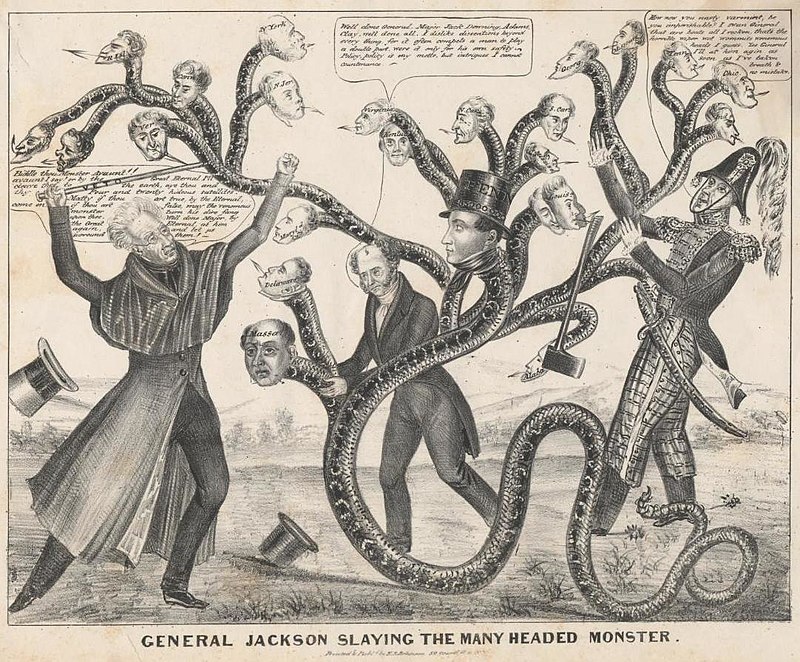
800px-General_Jackson_Slaying_the_Many_Headed_Monster_(cropped)
A political cartoon depicting Jackson battling the many-headed monster of the bank.

In the presidential campaign of 1832, the bank question revealed a fundamental division. Established merchant, manufacturing, and financial interests favored sound money. Regional bankers and entrepreneurs on the make wanted an increased money supply and lower interest rates. Other debtor classes, especially farmers, shared those sentiments. Jackson and his supporters called the central bank a “monster” and coasted to an easy reelection victory over Henry Clay.

The president interpreted his triumph as a popular mandate to crush the central bank irrevocably. In September 1833 he ordered an end to deposits of government money in the bank, and gradual withdrawals of the money already in its custody. The government deposited its funds in selected state banks, characterized as “pet banks” by the opposition.

For the next generation the United States would get by on a relatively unregulated state banking system, which helped fuel westward expansion through cheap credit but kept the nation vulnerable to periodic panics. During the Civil War, the United States initiated a system of national charters for local and regional banks, but the nation returned to a central bank only with the establishment of the Federal Reserve system in 1913.

The Trail of Tears

In the 1820s, President Monroe’s secretary of war, John C. Calhoun, pursued a policy of removing the remaining tribes from the old Southwest and resettling them beyond the Mississippi. Jackson continued this policy as president. In 1830 Congress passed the Indian Removal Act, providing funds to transport the eastern tribes beyond the Mississippi. In 1834 a special Native-American territory was set up in what is now Oklahoma. In all, the tribes signed 94 treaties during Jackson’s two terms, ceding millions of hectares to the federal government and removing dozens of tribes from their ancestral homelands.

The United States, as it expanded to the west, forcibly removed or killed many Native Americans from their lands as it violated the treaties and Indian rights which both parties had agreed upon. In this way, the concerns of white landowners were considered above the interests of the Indians. In Georgia, for instance, the governor ordered the Cherokee to vacate their lands so the territory would be able to be redistributed to poor Georgians. The Cherokee refused, as they contended that a treaty with the United States that had been signed earlier guaranteed their right to the land. Through a friend of the tribe, they brought their case all the way to the Supreme Court.

In 1832, when Andrew Jackson was President, the Supreme Court ruled that Georgia had acted unconstitutionally. However, Jackson refused to enforce the Court’s ruling. Meanwhile, Congress had passed the Indian Removal Act, which granted reservation land to Native Americans who relocated to territory west of the Mississippi. Under the law, Native Americans could have stayed and became citizens of their home states. The removal was supposed to be peaceful and by their own will, but Jackson forced them to go west.

The Cherokee were forced out of Georgia and had to endure a brutal and deadly trip to the area comprising present-day Oklahoma, a journey which they called the Trail of Tears. Between 2,000 and 4,000 of the 16,000 migrating Cherokees died during the journey, including women, children, and elderly members of the tribe. The conditions were horrible. They were exposed to disease and starvation on their way to the makeshift forts that they would live in. The Cherokees weren’t the only tribe that was forced to leave their homelands. The Choctaws, Creeks, Seminoles, and Chickasaws were also forced to migrate west. The Choctaws were forced to move first in the winter of 1831 and 1832 and many would die on the forced march. The Creek nation would resist the government in Alabama until 1836 but the army eventually pushed them towards Oklahoma. In the end the Natives forced to move traded about 100 million acres for about 32 million acres and about 65 million dollars total for all Native tribes forced to move. This forced relocation of the American Indians was only a chapter in the cruelty given to the Natives by the American government. These forced migrations would have a terrible effect on the Natives as many were victim to disease, starvation, and death.

Trails_of_Tears_en
Map of United States Indian Removal, 1830–1838. Oklahoma, the federally dedicated Indian Territory, is depicted in light yellow-green.

Seminole Wars

800px-Osceola
In 1836, Osceola led a small group of warriors in the Seminole resistance during the Second Seminole War, when the United States tried to remove the tribe from their lands in Florida to Indian Territory west of the Mississippi River. Osceola led the Seminole resistance to removal until he was captured on October 21, 1837, by deception, under a flag of truce, when he came forward for peace talks.

The Seminole Nation in Florida also resisted forced migration. Osceola who was the leader of the Seminoles waged a fierce guerrilla war against federal troops in 1835. The Seminole forces included Creeks, Seminoles, and even African Americans. Osceola would be captured by the US Army under a false white flag of truce. He would die in a POW camp in 1838. However, the Seminoles continued to fight under Chief Coacoochee and other leaders. Finally, in 1842, after much violence on both side, the US would cease its removal efforts. Some Seminoles would remain in Florida to this day near the Everglades.

The article was adapted in part from:

  1. Nationalism and Division
  2. Westward Expansion and Regional Differences

The Era of Good Feelings and Others Who Were Not So Lucky

This lesson was reported from:
A chapter of The United States: An Open Ended History, a free online textbook.  Adapted in part from open sources.

For Your Consideration:
  1. What was the point of the tariffs passed under the American System?
  2. Who liked these tariffs, and who did not?
  3. What did canals and railroads do for the United States?
  4. What was the argument that led to the Missouri Compromise?
  5. How did the Missouri Compromise resolve this dispute?

The Era of Good Feelings

The War of 1812 was, in a sense, a second war of independence that confirmed once and for all the American break with England. With its conclusion, many of the serious difficulties that the young republic had faced since the Revolution disappeared. National union under the Constitution brought a balance between liberty and order. With a low national debt and a continent awaiting exploration, the prospect of peace, prosperity, and social progress opened before the nation.

National pride and the lull in partisanship following the collapse of the Federalist Party led to a period often called the Era of Good Feelings.

Independence_Day_Celebration_in_Centre_Square
Independence Day Celebration in Centre Square by John Lewis Krimmel (1787–1821). Watercolor with pencil and ink on paper, 1819.

American System

Riding on the wave of newfound national pride, politicians such as Henry Clay of Kentucky, John C. Calhoun of South Carolina, and John Q. Adams of Massachusetts, following in Alexander Hamilton’s footsteps, pushed an agenda to strengthen and unify the nation. The system, which came to be known as the American System, called for high tariffs to protect American industry and high land prices to generate additional federal revenue. The plan also called for strengthening the nation’s infrastructure, such as roads and canals, which would be financed by tariffs and land revenue. The improvements would make trade easier and faster. Finally, the plan called for maintaining the Second Bank of the United States (chartered in 1816 for 20 years) to stabilize the currency and the banking system, as well as the issuance of sovereign credit. Congress also passed a protective tariff to aid industries that had flourished during the war of 1812 but were now threatened by the resumption of over seas trade. The Tariff of 1816 levied taxes on imported woolens and cottons, as well as on iron, leather, hats, papers, and sugar.

Although portions of the system were adopted (for example, 20-25% taxes on foreign goods, which encouraged consumption of relatively cheaper American goods), others met with roadblocks. Only two major infrastructure achievements were made in the form of the Cumberland Road and the Erie Canal. The Cumberland Road stretched between Baltimore and the Ohio River, facilitating ease of travel, trade, and providing a gateway to the West for settlement. The Erie Canal extended from the Hudson River at Albany, New York, to Buffalo, New York, at Lake Erie, thus vastly improving the speed and efficiency of water travel in the northeast.

Opposition to the American System mostly came from the West and the South. Clay argued, however, that the West should support the plan because urban workers in the northeast would be consumers of Western food, and the South should support it because of the market for the manufacture of cotton in northeastern factories. The South, however, strongly opposed tariffs and had a strong British market for cotton anyway.

In short, the American System met with mixed results over the 1810s and 1820s due to various obstacles, but in the end, American industry benefited, and growth ensued.

800px-Henry_Clay_-_Project_Gutenberg_eText_16960
The Monkey System or Every One For Himself. Henry Clay says “Walk in and see the new improved grand original American System!” The cages are labeled: “Home, Consumption, Internal, Improv”. This 1831 cartoon ridiculing Clay’s American System depicts monkeys, labeled as being different parts of a nation’s economy, stealing each other’s resources (food) with commentators describing it as either great or a humbug.

Technology

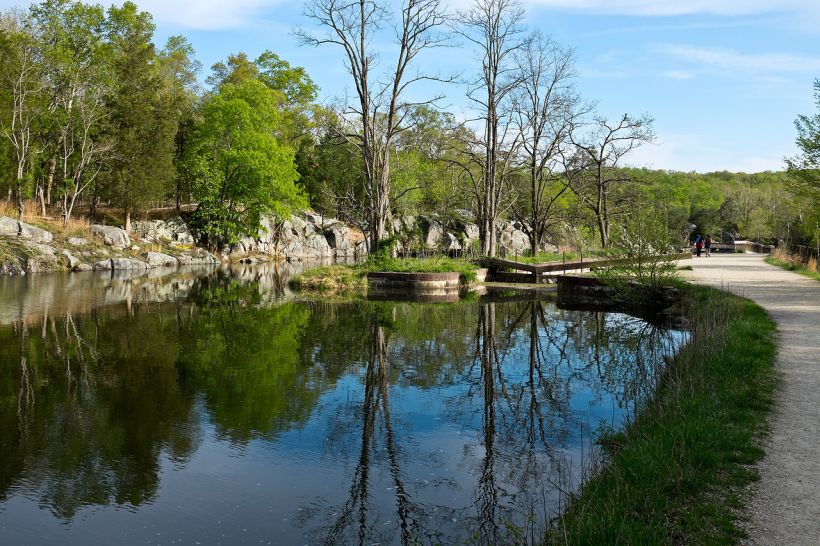
During the early part of the 19th century individual states were finally able to build better infrastructure. The 1790s had seen the construction of two toll roads, Pennsylvania’s Philadelphia and Lancaster Turnpike and New York State’s Great Western Turnpike. Now states such as Virginia, North Carolina, and Massachusetts built canals, vast artificial waterways to move vast quantities of goods and people. Unlike the rivers, canals were maintained without shallows or rapids through the use of locks and dams to maintain water height. Whereas steamboats had to fight the current, canal boats were drawn by horses or oxen along their placid way. In 1817 New York State authorized construction of the great Erie Canal. With the aid of roads, steamships and canals, people and goods could be swept from inner towns to the great East Coast markets, and to ships going abroad.

The increased levels of trade and manufacturing resulted in what has been termed the Market Revolution – no longer were individual Americans subsisting or trading only on a local level, but increasing numbers of them were driven by the promise of profit that could result from long distance, large scale trade.  This would give rise to the first true factories, as well as to the idea that people might work in factories for wages, rather than make their own hours on their own farms.

OldC&OCanalAtGeorgetown-LARGE
The C & O Canal at Georgetown, near Washington, DC. Notice the towpath beside the canal along which donkeys or horses would pull boats.

The Second Great Awakening

By the end of the 18th century, many educated Americans no longer professed traditional Christian beliefs. In reaction to the secularism of the age, a religious revival spread westward in the first half of the 19th century.

This “Second Great Awakening” consisted of several kinds of activity, distinguished by locale and expression of religious commitment. In New England, the renewed interest in religion inspired a wave of social activism. In western New York, the spirit of revival encouraged the emergence of new denominations. In the Appalachian region of Kentucky and Tennessee, the revival strengthened the Methodists and the Baptists, and spawned a new form of religious expression—the camp meeting.

In contrast to the Great Awakening of the 1730s, the revivals in the East were notable for the absence of hysteria and open emotion. Rather, unbelievers were awed by the “respectful silence” of those bearing witness to their faith. The evangelical enthusiasm in New England gave rise to interdenominational missionary societies, formed to evangelize the West. Members of these societies not only acted as apostles for the faith, but as educators, civic leaders, and exponents of Eastern, urban culture. Publication and education societies promoted Christian education. Most notable among them was the American Bible Society, founded in 1816. Social activism inspired by the revival gave rise to groups working toward the abolition of slavery and the Society for the Promotion of Temperance, as well as to efforts to reform prisons and care for the handicapped and mentally ill.

Western New York, from Lake Ontario to the Adirondack Mountains, had been the scene of so many religious revivals in the past that it was known as the “Burned-Over District.”  Two important religious denominations in America—the Mormons and the Seventh Day Adventists—got their start here.  After a great deal of violence and persecution from more traditional Christians, Mormons would find their way west, isolating themselves in the relative safety of the remote Salt Lake region.

In the Appalachian region, the revival took on characteristics similar to the Great Awakening of the previous century. But here, the center of the revival was the camp meeting, a religious service of several days’ length, for a group that was obliged to take shelter on the spot because of the distance from home. Pioneers in thinly populated areas looked to the camp meeting as a refuge from the lonely life on the frontier. The sheer exhilaration of participating in a religious revival with hundreds and perhaps thousands of people inspired the dancing, shouting, and singing associated with these events. Probably the largest camp meeting was at Cane Ridge, Kentucky, in August 1801; between 10,000 and 25,000 people attended.

Methodist_camp_meeting_(1819_engraving)
An engraving of a Methodist camp meeting in 1819.

The Second Great Awakening exercised a profound impact on American history. The numerical strength of the Baptists and Methodists rose relative to that of the denominations dominant in the colonial period—Anglicans, Presbyterians, and Congregationalists. The growing differences within American Protestantism reflected the growth and diversity of an expanding nation.

Extension of slavery

Slavery, which up to now had received little public attention, began to assume much greater importance as a national issue. In the early years of the republic, when the Northern states were providing for immediate or gradual emancipation of the slaves, many leaders had supposed that slavery would die out. In 1786 George Washington wrote that he devoutly wished some plan might be adopted “by which slavery may be abolished by slow, sure, and imperceptible degrees.” Virginians Jefferson, Madison, and Monroe and other leading Southern statesmen made similar statements.

The Northwest Ordinance of 1787 had banned slavery in the Northwest Territory. As late as 1808, when the international slave trade was abolished, there were many Southerners who thought that slavery would soon end. The expectation proved false, for during the next generation, the South became solidly united behind the institution of slavery as new economic factors made slavery far more profitable than it had been before 1790.

Chief among these was the rise of a great cotton-growing industry in the South, stimulated by the introduction of new types of cotton and by Eli Whitney’s invention in 1793 of the cotton gin, which separated the seeds from cotton. At the same time, the Industrial Revolution, which made textile manufacturing a large-scale operation, vastly increased the demand for raw cotton. And the opening of new lands in the West after 1812 greatly extended the area available for cotton cultivation. Cotton culture moved rapidly from the Tidewater states on the East Coast through much of the lower South to the delta region of the Mississippi and eventually to Texas.

Sugar cane, another labor‑intensive crop, also contributed to slavery’s extension in the South. The rich, hot lands of southeastern Louisiana proved ideal for growing sugar cane profitably. By 1830 the state was supplying the nation with about half its sugar supply. Finally, tobacco growers moved westward, taking slavery with them.

As the free society of the North and the slave society of the South spread westward, it became politically necessary to maintain a rough equality among the new states carved out of western territories. In 1818, when Illinois was admitted to the Union, 10 states permitted slavery and 11 states prohibited it; but balance was restored after Alabama was admitted as a slave state. Population was growing faster in the North, which permitted Northern states to have a clear majority in the House of Representatives. However, equality between the North and the South was maintained in the Senate.

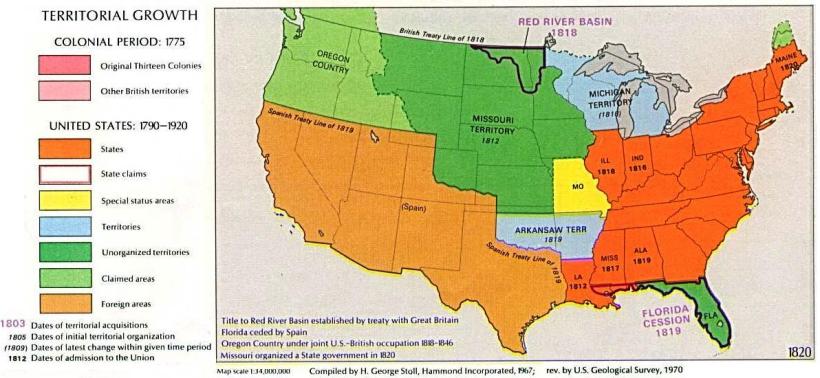
In 1819 Missouri, which had 10,000 slaves, applied to enter the Union. Northerners rallied to oppose Missouri’s entry except as a free state, and a storm of protest swept the country. For a time Congress was deadlocked, but Henry Clay arranged the so-called Missouri Compromise: Missouri was admitted as a slave state at the same time Maine came in as a free state. In addition, Congress banned slavery from the territory acquired by the Louisiana Purchase north of Missouri’s southern boundary. At the time, this provision appeared to be a victory for the Southern states because it was thought unlikely that this “Great American Desert” would ever be settled. The controversy was temporarily resolved, but Thomas Jefferson wrote to a friend that “this momentous question, like a fire bell in the night, awakened and filled me with terror. I considered it at once as the knell of the Union.”

USA_Territorial_Growth_1820_alt
The United States in 1819. The Missouri Compromise prohibited slavery in the unorganized territory of the Great Plains (upper dark green) and permitted it in Missouri (yellow) and the Arkansas Territory (lower blue area).

The article was adapted in part from:

  1. The Formation of a National Government
  2. Westward Expansion and Regional Differences

Foreign Adventures in the New Republic

This lesson was reported from:
A chapter of The United States: An Open Ended History, a free online textbook.  Adapted in part from open sources.

For Your Consideration:
  1. What did the Alien and Sedition Acts do? (Name at least two things)
  2. How did Madison and Jefferson respond?
  3. What happened in the case of Marbury v Madison?
  4. What factors caused the use of slavery to increase in the early 1800s?
  5. Why did Jefferson purchase Louisiana?

Growing Conflict with Britain

As Jefferson began his second term in 1805, he declared American neutrality in the struggle between Great Britain and France. Although both sides sought to restrict neutral shipping to the other, British control of the seas made its interdiction and seizure much more serious than any actions by Napoleonic France. British naval commanders routinely searched American ships, seized vessels and cargoes, and took off sailors believed to be British subjects. They also frequently impressed American seamen into their service.

When Jefferson issued a proclamation ordering British warships to leave U.S. territorial waters, the British reacted by impressing more sailors. Jefferson then decided to rely on economic pressure; in December 1807 Congress passed the Embargo Act, forbidding all foreign commerce. The law required strong police authority that vastly increased the powers of the national government. Economically, it was disastrous. In a single year American exports fell to one-fifth of their former volume. Shipping interests were almost ruined by the measure; discontent rose in New England and New York. Agricultural interests suffered heavily also. Prices dropped drastically when the Southern and Western farmers could not export their surplus grain, cotton, meat, and tobacco.

Ograbme
A political cartoon showing merchants dodging the “Ograbme”, which is “Embargo” spelled backwards. The embargo was also ridiculed in the New England press as Dambargo, Mob-Rage, or Go-bar-’em. The tortoise here represents the supposed solution to a problem that actually comes back to “bite you in the butt.”

The embargo failed to starve Great Britain into a change of policy. As the grumbling at home increased, Jefferson turned to a milder measure, which partially conciliated domestic shipping interests. In early 1809 he signed the Non-Intercourse Act permitting commerce with all countries except Britain or France and their dependencies.

James Madison succeeded Jefferson as president in 1809. Relations with Great Britain grew worse, and the two countries moved rapidly toward war. The president laid before Congress a detailed report, showing several thousand instances in which the British had impressed American citizens. In addition, northwestern settlers had suffered from attacks by Indians whom they believed had been incited by British agents in Canada. In turn, many Americans favored conquest of Canada and the elimination of British influence in North America, as well as vengeance for impressment and commercial repression. By 1812, war fervor was dominant. On June 18, the United States declared war on Britain.

The War of 1812

The nation went to war bitterly divided. While the South and West favored the conflict, New York and New England opposed it because it interfered with their commerce. The U.S. military was weak. The army had fewer than 7,000 regular soldiers, distributed in widely scattered posts along the coast, near the Canadian border, and in the remote interior. The state militias were poorly trained and undisciplined.

Hostilities began with an invasion of Canada, which, if properly timed and executed, would have brought united action against Montreal. Instead, the entire campaign miscarried and ended with the British occupation of Detroit. The U.S. Navy, however, scored successes. In addition, American privateers, swarming the Atlantic, captured 500 British vessels during the fall and winter months of 1812 and 1813.

The campaign of 1813 centered on Lake Erie. General William Henry Harrison—who would later become president—led an army of militia, volunteers, and regulars from Kentucky with the object of reconquering Detroit. On September 12, while he was still in upper Ohio, news reached him that Commodore Oliver Hazard Perry had annihilated the British fleet on Lake Erie. Harrison occupied Detroit and pushed into Canada, defeating the fleeing British and their Indian allies on the Thames River. The entire region now came under American control.

The British fleet harassed the Eastern seaboard with orders to “destroy and lay waste.” On the night of August 24, 1814, an expeditionary force routed American militia, marched to Washington, D.C., and left the city in flames. President James Madison fled to Virginia.

1024px-The_President's_House_by_George_Munger,_1814-1815_-_Crop
The White House ruins after the conflagration of August 24, 1814.

Take a tour of the White House of today, rebuilt, remodeled, and expanded.

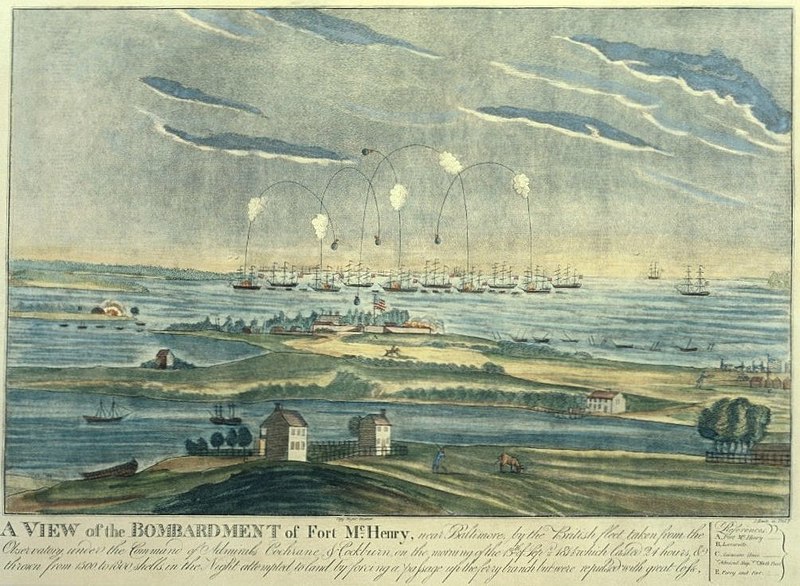
The British moved on to their major target, the heavily fortified major city of Baltimore. The British naval guns, mortars and new “Congreve rockets” had a longer range than the American cannon onshore. The ships mostly stood out of range of the Americans, who returned very little fire.  All the lights were extinguished in Baltimore the night of the attack, and the fort was bombarded for 25 hours. The only light was given off by the exploding shells over Fort McHenry, which defended the city, illuminating the flag that was still flying over the fort. The sight inspired the American lawyer Francis Scott Key to write “Defence of Fort M’Henry,” a poem that was later set to music as “The Star-Spangled Banner”.

800px-Ft._Henry_bombardement_1814
An artist’s rendering of the bombardment at Fort McHenry. Francis Scott Key watched from a U.S. truce ship and was inspired to write the four-stanza poem he originally titled “The Defence of Fort McHenry”. The poem was later set to music and named “The Star-Spangled Banner,” which was adopted as the national anthem in 1931.

Native Americans During the War of 1812

In years leading up to and during the War of 1812, Native Americans continued to resist American expansion into their territories.  Native groups made alliances with either the British or the Americans during the war in an attempt to advance their own goals or improve their own situations.  As a result,

Tecumseh02
Tecumseh.

Tecumseh was a Shawnee warrior and chief, who became the primary leader of a large, multi-tribal confederacy in the early 19th century. Born in the Ohio Country (present-day Ohio), and growing up during the American Revolutionary War and the Northwest Indian War, Tecumseh was exposed to warfare and envisioned the establishment of an independent Indian nation east of the Mississippi River under British protection. He worked to recruit additional members to his tribal confederacy from the southern United States.

Tecumseh was among the most celebrated Indian leaders in history and was known as a strong and eloquent orator who promoted tribal unity. He was also ambitious, willing to take risks, and make significant sacrifices to repel the Americans from Indian lands in the Old Northwest Territory. In 1808, with his brother Tenskwatawa (“The Prophet”), Tecumseh founded the Indian village the Americans called Prophetstown, located north of present-day Lafayette, Indiana. Prophetstown grew into a large, multi-tribal community and a central point in Tecumseh’s political and military alliance.

Tecumseh’s confederation fought the United States during Tecumseh’s War, but he was unsuccessful in getting the U.S. government to rescind the Treaty of Fort Wayne (1809) and other land-cession treaties which stripped natives of their claims to their ancestral homelands. In 1811, as he traveled south to recruit more allies, his brother Tenskwatawa initiated the Battle of Tippecanoe against William Henry Harrison’s army, but the Indians retreated from the field and the Americans burned Prophetstown. Although Tecumseh remained the military leader of the pan-Indian confederation, his plan to enlarge the Indian alliance was never fulfilled.

Tecumseh and his confederacy continued to fight the United States after forming an alliance with Great Britain in the War of 1812. During the war, Tecumseh’s confederacy helped in the capture of Fort Detroit. However, after U.S. naval forces took control of Lake Erie in 1813, the British and their Indian allies retreated into Upper Canada, where the American forces engaged them at the Battle of the Thames on October 5, 1813, where Tecumseh was killed. His death and the end of the war caused the pan-Indian alliance to collapse. Within a few years, the remaining tribal lands in the Old Northwest were ceded to the U.S. government and subsequently opened for new settlement and most of the American Indians eventually moved west, across the Mississippi River. Since his death Tecumseh has become an iconic folk hero in American, Aboriginal, and Canadian history.

Death_of_Tecumseh
Death of Tecumseh, Frieze of the United States Capitol rotunda.

Further south, the British began aiding the Creek Indians in modern day Alabama and Georgia. In March 1814, General Andrew Jackson and General John Coffee led a force comprised of about 2,000 Tennessee militiamen, Choctaw, Cherokee, and U.S. regulars in a war against the Creek Indians. Out of 1,000 Creeks, led by Chief Menawa, 800 were killed at the Battle of Horseshoe Bend. Only 49 of Jackson’s forces were killed. Jackson pursued the remaining Creeks until they surrendered, ultimately signing the Treaty of Fort Jackson, which limited their territory and independence.

The Treaty of Ghent

British and American negotiators conducted talks in Europe. The British envoys decided to concede, however, when they learned of Macdonough’s victory on Lake Champlain. Faced with the depletion of the British treasury due in large part to the heavy costs of the Napoleonic Wars, the negotiators for Great Britain accepted the Treaty of Ghent in December 1814. It provided for the cessation of hostilities, the restoration of conquests, and a commission to settle boundary disputes. Unaware that a peace treaty had been signed, the two sides continued fighting into 1815 near New Orleans, Louisiana. Led by General Andrew Jackson, the United States scored the greatest land victory of the war in the Battle of New Orleans, ending for once and for all any British hopes of reestablishing continental influence south of the Canadian border.

lossy-page1-1024px-The_Battle_of_New_Orleans._January_1815._Copy_of_engraving_by_H._B._Hall_after_W._Momberger.,_ca._1900_-_1982_-_NARA_-_531091.tif
Andrew Jackson’s unlikely victory against a superior British force at the Battle of New Orleans came in January 1815, weeks after the official end of the war. It turned him into a household name.

While the British and Americans were negotiating a settlement, Federalist delegates selected by the legislatures of Massachusetts, Rhode Island, Connecticut, Vermont, and New Hampshire gathered in Hartford, Connecticut to express opposition to “Mr. Madison’s war.” New England had managed to trade with the enemy throughout the conflict, and some areas actually prospered from this commerce. Nevertheless, the Federalists claimed that the war was ruining the economy. With a possibility of secession from the Union in the background, the Hartford Convention proposed a series of constitutional amendments that would protect New England interests. Instead, the end of the war, punctuated by the smashing victory at New Orleans, stamped the Federalists with a stigma of disloyalty from which they never recovered.  The Federalists’ opposition to the War of 1812 and the Hartford Convention had terminally damaged the party.

The First Seminole War

In Southern Georgia, Chief Neamathla of the Miccosukee tribe – part of the larger Seminole cultural group – at Fowltown was engaged in a land dispute with General Edmund Pendleton Gaines, the American commander at Fort Scott. The land had been ceded by the Creek at the Treaty of Fort Jackson. However, the Miccosukee considered itself a different tribe. It held that the Creek did not have right to cede Miccosukee land. In November 1817, a force of 250 men was sent by General Gaines to capture Neamathla, but was driven back. A second attempt in the same month succeeded, and the Miccosukee were driven from Fowltown.

Seminole village
A modern depiction of a classic Seminole village.

A week after the attack on Fowltown, a military boat transporting supplies, sick soldiers, and the families of soldiers to Fort Scott (it is not clear if children were on board) was attacked on the Apalachicola River. Most of the passengers on board were killed, with one woman captured and six survivors making it to Fort Scott.

General Gaines had been ordered not to invade Spanish Florida save for small incursions. After word of the Scott massacre reached Washington, DC, Gaines was ordered to invade Spanish-colonized Florida in pursuit of Seminoles, but not to attack Spanish installations. However, Gaines had been ordered to eastern Florida to deal with piracy issues there, so Secretary of War John C. Calhoun ordered General Andrew Jackson to lead the invasion.

General Jackson gathered his forces at Fort Scott in March 1818. His fighters were 800 regulars, 1,000 Tennessee volunteers, 1,000 Georgia militia, and 1,400 friendly Creek warriors. Jackson’s force entered Florida on March 13, following the Apalachicola River and constructing Fort Gadsden. The Indian town of Tallahassee was burned on March 31 and the town of Miccosukee was taken the next day. The American and Creek forces left 300 Indian homes devastated in their wake, reaching and capturing the Spanish fort of St. Marks on April 6.

765228024The American force left St. Marks and continued to attack Indian villages. It captured Alexander George Arbuthnot, a Scottish trader who worked out of the Bahamas and supplied the Indians, and Robert Ambrister, a former Royal Marine and self-appointed British agent, as well as the Indian leaders Josiah Francis and Homathlemico. All four were eventually executed. Jackson’s forces also attacked villages occupied by runaway slaves along the Suwannee River.

Having declared victory, Jackson sent the Georgia militia and Creek warriors home, sending the remaining army back to St. Marks, where he left a garrison before returning to Fort Gadsden. On May 7, he marched a force of 1,000 to Pensacola where he believed the Indians were gathering and being supplied by the Spanish. The governor of West Florida raised a protest, insisting that the Indians there were mostly women and children. When Jackson reached Pensacola on May 23, the governor and the Spanish garrison retreated to Fort Barrancas. After a day of exchanging cannon fire, the Spanish surrendered.

The governments of Great Britain and Spain both expressed outrage over the invasion. However, Spain was unable to defend or control the territory, as several local uprisings and rebellions made clear. The Spanish Crown agreed to cede Florida to the United States per the Adams–Onís Treaty of 1819, and the transfer took place in 1821.

The Monroe Doctrine

On December 2, 1823, President Monroe introduced the most famous aspect of his foreign policy in his State of the Union Address to Congress. The Monroe Doctrine, as it came to be called, stated that any further attempts by European powers to interfere in the affairs of the nations of the Western hemisphere (namely Latin America) would be seen as an act of aggression against the United States, requiring a U.S. response. The Monroe Doctrine came about as a result of U.S. and British fears the Spain would attempt to restore its power over former colonies in Latin America. President Monroe essentially sent notice the Americas, both North and South, were no longer open to colonization by European powers.

The fact that the U.S. was still a young nation with very little naval power meant that the warning went largely ignored by the major powers. Despite this, the British approved of the policy and largely enforced it as part of the Pax Britannica, whereby the British Navy secured the neutrality of the high seas. It was mainly through this support, rather than the Monroe Doctrine exclusively, which secured and maintained the sovereignty of Latin American nations.

Monroe-Doctrine-Post
The United States would invoke the Monroe Doctrine repeatedly through the next century, as reflected from this cartoon from around the year 1900.

The article was adapted in part from:
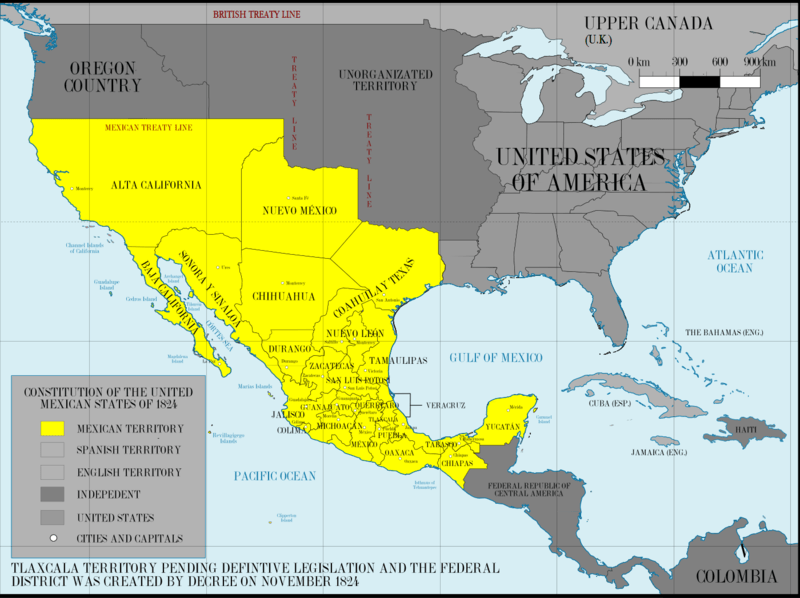
  1. The Formation of a National Government
  2. Tecumseh

Adams, Jefferson, and Competing Visions for the New Republic

This lesson was reported from:
A chapter of The United States: An Open Ended History, a free online textbook.  Adapted in part from open sources.

For Your Consideration:
  1. What did the Alien and Sedition Acts do? (Name at least two things)
  2. How did Madison and Jefferson respond?
  3. What happened in the case of Marbury v Madison?
  4. What factors caused the use of slavery to increase in the early 1800s?
  5. Why did Jefferson purchase Louisiana?

The Adams Presidency

800px-John_Trumbull_-_John_Adams_-_Google_Art_Project_(498015)
John Adams, 2nd President of the United States.

Washington announced his retirement in 1796, firmly declining to serve for more than eight years as the nation’s head. Thomas Jefferson of Virginia (Republican) and John Adams (Federalist) vied to succeed him. Adams won a narrow election victory.

Adams faced serious international difficulties. France, at war with Britain and angered by the fact that the U.S. refused to cut off ties with Britain, began to seize American merchant ships there. By 1797 France had snatched 300 American ships and broken off diplomatic relations with the United States. When Adams sent three commissioners to Paris to negotiate, agents of Foreign Minister Charles Maurice de Talleyrand (whom Adams labeled X, Y, and Z in his report to Congress) informed the Americans that negotiations could only begin if the United States loaned France $12 million and bribed officials of the French government. American hostility to France rose to an excited pitch. Federalists called for war.

These events – the so-called XYZ Affair – led to the strengthening of the fledgling U.S. Armies and Navy.Congress authorized the acquisition of twelve frigates, and made other appropriations to increase military readiness. Despite calls for a formal war declaration, Adams remembered Washington’s farewell address, which warned against getting involved in European conflict, and steadfastly refused to ask Congress for one.

1024px-Property_protected_à_la_françoise
A political cartoon depicts the XYZ Affair – America is a female being plundered by Frenchmen. (1798)

In 1799, after a series of sea battles with the French, war seemed inevitable. In this crisis, Adams rejected the guidance of Hamilton, who wanted war, and reopened negotiations with France. Napoleon, who had just come to power, received them cordially. The danger of conflict subsided with the negotiation of the Convention of 1800, which formally released the United States from its 1778 defense alliance with France. However, reflecting American weakness, France refused to pay $20 million in compensation for American ships taken by the French Navy.

Thomas_Jefferson_by_Rembrandt_Peale,_1800
Vice President Thomas Jefferson actively worked against his own president, arguing that states had the right to nullify or ignore those federal laws with which they disagreed.

Hostility to France led the Federalist controlled Congress to pass the Alien and Sedition Acts, which had severe repercussions for American civil liberties. The Naturalization Act, which changed the requirement for citizenship from five to 14 years, was targeted at Irish and French immigrants suspected of supporting the Republicans. The Alien Act, operative for two years only, gave the president the power to expel or imprison aliens in time of war. The Sedition Act forbid writing, speaking, or publishing anything of “a false, scandalous, and malicious” nature against the president or Congress. The few convictions won under it created martyrs to the cause of civil liberties and aroused support for the Republicans.

The acts met with resistance. Jefferson – Adams’s own vice-president – and James Madison sponsored the passage of the Kentucky and Virginia Resolutions by the legislatures of these two states in November and December 1798. As extreme declarations of states’ rights, the resolutions asserted that states could ignore federal actions if they disagreed with them.  This concept of nullification would be used later for the Southern states’ resistance to protective tariffs (favored by the North), and, more ominously, slavery.

Industry and Slavery

Powerloom_weaving_in_1835
A Roberts loom in a weaving shed in 1835. Textiles were the leading industry of the Industrial Revolution and mechanized factories, powered by a central water wheel or steam engine, were the new workplace.

In the 1790s certain New England weavers began building large, automated looms, driven by water power. To house them they created the first American factories. Working the looms required less skill and more speed than household laborers could provide. The looms needed people brought to them; and they also required laborers who did not know the origin of the word sabotage. These factories sought out young women.

The factory owners said they wanted to hire these women just for a few years, with the ideal being that they could raise a dowry for their wedding. They were carefully supervised, with their time laid out for them. Some mill owners created evening classes to teach these women how to write and how to organize a household.

The factories provided a cheaper source of cotton cloth, sent out on ships and on roads improved by a stronger government. For the first time some people could afford more than two outfits, work and Sunday best. They also provided an outlet for cotton from the slave states in the South. Cotton was at that time one among many crops. Many slaves had to work to separate cotton from the seeds of the cotton plant, and to ship it to cloth-hungry New England. This was made simpler by Eli Whitney’s invention of the cotton gin in 1793. Cotton became a profitable crop, and many Southern farms now made it their only crop. Growing and picking cotton was long, difficult labor, and the Southern plantation made it the work for slaves. Northern factories became part of the economy of slavery.

eli-whitney-and-the-cotton-gin-8
Two slaves operate one of Eli Whitney’s cotton gins. Whitney invented his cotton gin in 1793. He began to work on this project after moving to Georgia in search of work. Whitney created two cotton gins: a small one that could be hand-cranked and a large one that could be driven by a horse or water power. Thanks to the cotton gin, the production of raw cotton doubled each decade after 1800.

This renewed reliance on slavery went against the trend in other parts of the country. Vermont had prohibited slavery in its state constitution in 1777. Pennsylvania passed laws for the gradual abolition of the condition in 1780, and New York State in 1799. Education, resources, and economic development created the beginnings of industrialization in many Northern states and plantations and slavery and less development in states in the Deep South.

The Election of 1800

By 1800 the American people were ready for a change. Under Washington and Adams, the Federalists had established a strong government, but sometimes they had followed policies that alienated large groups. For example, in 1798 they had enacted a tax on houses, land, and slaves, affecting every property owner in the country.

The campaign of 1800 was bitter – Jefferson’s allies suggested that President Adams of having a “hideous hermaphroditical character, which has neither the force and firmness of a man, nor the gentleness and sensibility of a woman.”  Adams’s supporters called Vice President Jefferson “a mean-spirited, low-lived fellow, the son of a half-breed Indian squaw, sired by a Virginia mulatto father.”  The two men didn’t speak to each other for another decade.

The Constitution originally called for the individual with the most votes in an election to become President, and for the runner-up to become Vice President. George Washington, who had approved of this system, had justified it by the belief that it worked against factionalism in political parties. However, it had already resulted in the alienation of Vice President Thomas Jefferson under the Adams administration.

In 1800, Thomas Jefferson and Aaron Burr ran against Adams and his running mate. The two Republican candidates would have preferred for Jefferson to become President and Burr to become Vice President. But the Electoral College vote was tied between the two of them. The Federalist-controlled House of Representatives was called upon to chose between them. It had to vote thirty-six times before Jefferson was chosen to be President, and then only with the reluctant agreement of Alexander Hamilton – to stop Burr, who had refused to concede the presidency to Jefferson as planned. Congress later approved a Constitutional amendment allowing for separate balloting for President and Vice President in the Electoral College.

800px-Duel_between_Aaron_Burr_and_Alexander_Hamilton
Vice President Aaron Burr bore a grudge against Hamilton for this. In 1804, when the two ran for Governor of New York, they dueled, and Burr killed Hamilton.

In Jefferson’s inaugural address, the first such speech in the new capital of Washington, D.C., he promised “a wise and frugal government” that would preserve order among the inhabitants but leave people “otherwise free to regulate their own pursuits of industry, and improvement.”  He also spoke of reconciliation after the bitter campaign saying, “We have called by different names brethren of the same principle. We are all Republicans, we are all Federalists.”

Marbury v. Madison

On March 2, 1801, just two days before his presidential term was to end, Adams nominated nearly 60 Federalist supporters to circuit judge and justice of the peace positions the Federalist-controlled Congress had newly created. These appointees—whom Jefferson’s supporters derisively referred to as “the Midnight Judges”—included William Marbury, an ardent Federalist and a vigorous supporter of the Adams presidency.

On March 4, 1801, Thomas Jefferson was sworn in and became the 3rd President of the United States. As soon as he was able, Jefferson instructed his new Secretary of State, James Madison, to withhold the undelivered appointments. In Jefferson’s opinion, the commissions were void because they had not been delivered in time.  Without the commissions, the appointees were unable to assume the offices and duties to which they had been appointed. In December 1801, Marbury filed suit against Madison in the Supreme Court, asking the Court to force Madison to deliver Marbury’s commission. This lawsuit resulted in the case of Marbury v. Madison.

The Court did not order Madison to comply. Marshall examined the law Congress had passed that gave the Supreme Court jurisdiction over types of cases like Marbury’s, and found that it had expanded the definition of the Supreme Court’s jurisdiction beyond what was originally set down in the U.S. Constitution. Marshall then struck down the law. This is the origin of the concept of judicial review – the idea that American courts have the power to strike down laws or actions of the government found to violate the Constitution.  If the Supreme Court has a super power, it is this, and they discovered it here.

800px-Plaque_of_Marbury_v._Madison_at_SCOTUS_Building
Inscription on the wall of the Supreme Court Building from Marbury v. Madison, in which Chief Justice John Marshall outlined the concept of judicial review.

The Louisiana Purchase

One of Jefferson’s acts doubled the area of the country. At the end of the Seven Years’ War, France had ceded its territory west of the Mississippi River to Spain. Access to the port of New Orleans near its mouth was vital for the shipment of American products from the Ohio and Mississippi river valleys. Shortly after Jefferson became president, Napoleon forced a weak Spanish government to cede this great tract, the Louisiana Territory, back to France. The move filled Americans with apprehension and indignation. French plans for a huge colonial empire just west of the United States seriously threatened the future development of the United States. Jefferson asserted that if France took possession of Louisiana, “from that moment we must marry ourselves to the British fleet and nation.”

Napoleon, however, lost interest after the French were expelled from Haiti by a slave revolt. Knowing that another war with Great Britain was impending, he resolved to fill his treasury and put Louisiana beyond the reach of Britain by selling it to the United States. His offer presented Jefferson with a dilemma: The Constitution conferred no explicit power to purchase territory. At first the president wanted to propose an amendment, but delay might lead Napoleon to change his mind. Advised that the power to purchase territory was an implied power, suggested by the enumerated power to make treaties, Jefferson relented, saying that “the good sense of our country will correct the evil of loose construction when it shall produce ill effects.”

All of this sidestepped the question of whether this land was France’s to sell in the first place – barely any of it was occupied by French people let alone the French army.  Instead, it was filled with millions of Native Americans living across hundreds of independent tribes, most of whom had likely never heard of France or the United States.

The United States obtained the “Louisiana Purchase” for $15 million in 1803. It contained more than 2,600,000 square kilometers as well as the port of New Orleans. Once the natives who occupied it had been conquered and removed, the nation would gain a sweep of rich plains, mountains, forests, and river systems that within 80 years would become its heartland—and a breadbasket for the world.

800px-United_States_1805-01-1805-07
The 1803 Louisiana Purchase totaled 827,987 square miles (2,144,480 square kilometers), doubling the size of the United States.

Jefferson commissioned the  Lewis and Clark Expedition (1) to explore and map the newly acquired territory, (2) to find a practical route across the western half of the continent, and (3) to establish an American presence in this territory before Britain and other European powers tried to claim it. The campaign’s secondary objectives were scientific and economic: (4) to study the area’s plants, animal life, and geography, and (5) to establish trade with local American Indian tribes.

From May 1804 to September 1806, the Corps of Discovery under the command of Captain Meriwether Lewis and his close friend Second Lieutenant William Clark, was the first American expedition to cross the western portion of the United States. Also along for the mission was York, Clark’s slave, who who carried a gun and hunted on behalf of the expedition and was also accorded a vote during group decisions, more than half a century before African Americans could actually participate in American democracy.  Along the way, the Corps picked up they met a French-Canadian fur trapper named Toussaint Charbonneau, and his teenage Shoshone wife Sacagawea, who had purchased as a slave and who was pregnant with their child.  The Shoshone lived in the Rocky Mountains, and Sacagawea’s knowledge of nature, geography, language, and culture proved to be invaluable to the expedition.

Lewis_and_clark-expedition
Lewis and Clark on the Lower Columbia depicts the meeting between the Corps of Discovery and the Chinook people on the Lower Columbia River in October 1805.  Sacagawea is depicted with arms outstretched.

The Corps met their objective of reaching the Pacific, mapping, and establishing their presence for a legal claim to the land. They established diplomatic relations and trade with at least two dozen indigenous nations. They did not find a continuous waterway to the Pacific Ocean (mostly because one does not exist!) but located an Indian trail that led from the upper end of the Missouri River to the Columbia River which ran to the Pacific Ocean. They gained information about the natural habitat, flora and fauna, bringing back various plant, seed and mineral specimens. They mapped the topography of the land, designating the location of mountain ranges, rivers and the many Indian tribes during the course of their journey. They also learned and recorded much about the language and customs of the American Indian tribes they encountered, and brought back many of their artifacts, including bows, clothing and ceremonial robes.

The article was adapted in part from:

  1. The Formation of a National Government
  2. The Early Years of the Republic
  3. The Lewis and Clark Expedition

President Washington and the Origins of Party Politics

This lesson was reported from:
A chapter of The United States: An Open Ended History, a free online textbook.  Adapted in part from open sources.

For Your Consideration:
  1. Name one presidential tradition that originated with George Washington.
  2. How did the Federalists differ from the Democratic-Republicans?
  3. What was the Compromise of 1790?
  4. Describe one American reaction to the events of the French Revolution.
  5. Compare and contrast the government response to Shays’ Rebellion and the Whiskey Rebellion.

President Washington

One of the last acts of the Congress of the Confederation was to arrange for the first presidential election, setting March 4, 1789, as the date that the new government would come into being. One name was on everyone’s lips for the new chief of state—George Washington. He was unanimously chosen president and took the oath of office at his inauguration on April 30, 1789. In words spoken by every president since, Washington pledged to execute the duties of the presidency faithfully and, to the best of his ability, to “preserve, protect, and defend the Constitution of the United States.”

Washington's_Inauguration
George Washington’s inauguration as the first President of the United States which took place in New York City on April 30, 1789.

When Washington took office, the new Constitution enjoyed neither tradition nor the full backing of organized public opinion. The new government had to create its own machinery and legislate a system of taxation that would support it. Until a judiciary could be established, laws could not be enforced. The army was small. The navy had ceased to exist.

Congress quickly created the departments of State and Treasury, with Thomas Jefferson and Alexander Hamilton as their respective secretaries. Departments of War and Justice were also created. Since Washington preferred to make decisions only after consulting those men whose judgment he valued, the American presidential Cabinet came into existence, consisting of the heads of all the departments that Congress might create. Simultaneously, Congress provided for a federal judiciary—a Supreme Court, with one chief justice and five associate justices, three circuit courts, and 13 district courts.

Meanwhile, the country was growing steadily and immigration from Europe was increasing. Americans were moving westward: New Englanders and Pennsylvanians into Ohio; Virginians and Carolinians into Kentucky and Tennessee. Good farms were to be had for small sums; labor was in strong demand. The rich valley stretches of upper New York, Pennsylvania, and Virginia soon became great wheat-growing areas.

Although many items were still homemade, the Industrial Revolution was dawning in the United States. Massachusetts and Rhode Island were laying the foundation of important textile industries; Connecticut was beginning to turn out tinware and clocks; New York, New Jersey, and Pennsylvania were producing paper, glass, and iron. Shipping had grown to such an extent that on the seas the United States was second only to Britain. Even before 1790, American ships were traveling to China to sell furs and bring back tea, spices, and silk.

Washington’s two-term administration set many policies and traditions that survive today. He was again unanimously elected in 1792. But after his second term expired, Washington again voluntarily relinquished power, thereby establishing an important precedent that was to serve as an example for the United States and also for other future republics. Washington also abjured titles. He didn’t want to be called “Your Excellency” or “Your Majesty.” He insisted on being called “Mr. President,” and referred to as “The President of the United States”. Because of his central role in the founding of the United States, Washington is often called the “Father of his Country.” Scholars rank him with Abraham Lincoln among the greatest of United States presidents.

Hamilton vs. Jefferson: Strong or Weak Central Government?

Over the course of Washington’s two terms as president, rivalries arose between his closest advisers, particularly between Secretary of State Thomas Jefferson and Secretary of the Treasury Alexander Hamilton. Out of these developments evolved two new political parties: The Federalists, who shared the same name as the earlier pro-ratification party, and the Democratic-Republican Party, also known as the Jeffersonian party, or as the Anti-Federalists.

722px-Federalist_Cockade.svg
Federalists used a black and white cockade as a symbol.

Led by Alexander Hamilton, the Federalists represented the interests of trade and manufacturing, which they saw as forces of progress in the world. They believed these could be advanced only by a strong central government capable of establishing sound public credit and a stable currency. Openly distrustful of the latent radicalism of the masses, they could nonetheless credibly appeal to workers and artisans. Their political stronghold was in the New England states. Seeing England as an example the United States should try to emulate, they favored good relations with their former mother country.

The Democratic-Republicans, led by Thomas Jefferson, spoke primarily for agricultural interests and values. They distrusted bankers, cared little for commerce and manufacturing, and believed that freedom and democracy flourished best in a rural society composed of self-sufficient farmers. They felt little need for a strong central government; in fact, they tended to see it as a potential source of oppression. Thus they favored states’ rights. They were strongest in the South and in the West.

722px-Tricolour_Cockade.svg
Republicans used a red, white, and blue cockade as a symbol.

The conflict between the Federalist party and the Democratic-Republican party can be seen in the debate on how to pay off Revolutionary War debts. Alexander Hamilton and the Federalists wanted to put state debts and federal debts into one huge national debt. The Treasury would issue bonds that rich people would buy, thereby giving the rich a tangible stake in the success of the national government.  When the new federal government had succeeded in paying off this debt, it would increase confidence in the stability of the central government, encouraging foreign governments to loan money to the U.S. Hamilton also proposed a National Bank to help stabilize the national economy. This private Bank of the United States would serve as a place to put the government’s money, increasing central financial power and economic control.

Jefferson did not agree with Hamilton’s idea of a national bank. Jefferson’s faction envisioned an America more similar to ancient Athens or pre-Imperial Rome, with independent farming households following their own interests and nurturing liberty. Jefferson believed America should teach people to be self-sufficient farmers, and he wanted the federal government to stop interfering in state matters. In the end, in what came to be known as the Compromise of 1790, Jefferson agreed to Hamilton’s plan in exchange for Hamilton’s agreement to locate the government’s permanent capital in the South, on the Potomac River in what would become Washington, D.C.

The good credit established by this deal later allowed Jefferson to borrow in Europe to finance the Louisiana Purchase in 1803, as well as to borrow to finance the War of 1812.

Compromise_of_1790
Jefferson and Hamilton met in private with James Madison to hammer out the deal that came to be known as the Compromise of 1790.

The French Revolution

The French Revolution broke out in 1789, a few months after the American Constitution had gone into effect. At first, as France overthrew the monarchy and declared itself a republic, many Americans supported the revolution. They believed their own revolt against England had spurred France to republicanism. But as the Reign of Terror began, and thousands of French aristocrats went to the guillotine, many Americans were shocked at the revolution’s excesses. By the mid-1790s, as France went to war against neighboring monarchies, the revolution polarized American public opinion. Federalists viewed England, France’s traditional enemy, as the bastion of stable government against a growing tide of French anarchy. Members of the emerging Democratic Republican Party, on the other hand, who took their party’s name in part from the French Republic, believed the Terror to be a temporary excess and continued to view England as the true enemy of liberty.

President Washington’s policy was neutrality. He knew that England, France, or even Spain, would be happy to eat up American resources and territory. The United States in the 1790s was still new and frail. He hoped that America could stay out of European conflicts until it was strong enough to withstand any serious foreign threat. Yet both England and France found opportunities to each use American resources against the other.

Hamilton and Jefferson clashed here as well. The former argued that the mutual defense treaty that the United States had signed with France in 1778 was no longer binding, as the French regime that had made that treaty no longer existed. The latter disagreed. But Washington sided with Hamilton, issuing a formal Proclamation of Neutrality in 1793. Washington repeated his belief in neutrality and argued against factionalism in his Farewell Address of 1796.

That same year, Citizen Edmund Charles Genêt arrived as the French minister to the United States. He soon began issuing commissions to captains of American ships who were willing to serve as privateers for France. This blatant disregard of American neutrality angered Washington, who demanded and got Genêt’s recall.

The British Royal Navy, meanwhile, began a policy of impressment – forcing ordinary sailors into military service, including sailors on American merchant ships. Many English sailors had been lured into the American merchant service by high wages and comparatively good standards of living, and England needed these sailors to man its own fleet, on which England’s national security depended. This violation of the American flag, however, infuriated Americans, as did the fact that England had not yet withdrawn its soldiers from posts in the Northwest Territory, as required by the Treaty of Paris of 1783.

1812-impressment-pyle-l
British officers inspect a group of American sailors for impressment into the British navy, ca. 1810, in a drawing by Howard Pyle. The practice angered Americans – and was left unaddressed by the Jay Treaty, angering them further.

In response, President Washington sent Supreme Court Chief Justice John Jay to negotiate a treaty with England. But Jay had little leverage with which to negotiate: the final treaty did require immediate English evacuation of the frontier forts, but it said nothing about the matter of impressments. The Jay Treaty provoked an outcry among American citizens, and although the Senate ratified it narrowly, the debate it sparked was the final blow which solidified the Federalist and Republican factions into full-scale political parties, Federalists agreeing to the treaty, and Republicans viewing it as a sell-out to England (and against France).

The Whiskey Rebellion

Whiskey_Insurrection
“Famous Whiskey Insurrection in Pennsylvania,” an 1880 illustration of a tarred and feathered tax collector being made to ride the rail.

The Whiskey Rebellion of 1794 proved to be one of the most visible challenges of Washington’s time in office. The new Republic needed funds. This motivated Alexander Hamilton to press Congress to pass an excise tax on the sale of whiskey. Rural Pennsylvania farmers, who had never known a centralized American authority, were horrified by a call on what they considered their own profit and refused to pay the tax. A mob of 500 men attacked a tax collector’s house. In response, Washington and Hamilton led an army of 15,000 men to quell the rebellion, an army larger than the force Washington had commanded in the American Revolution. When the army showed up, the rebels dispersed.

In leading the militia against the Whiskey Rebellion, Washington became one of only two sitting U.S. presidents to exercise battlefield authority.

The suppression of the Whiskey Rebellion met with widespread popular approval. This was the first time the new government had been directly opposed, and through a clear show of federal authority, Washington established the principle that federal law is the supreme law of the land, and demonstrated that the federal government had both the ability and willingness to suppress violent resistance to the nation’s laws. The government’s response to the rebellion was, therefore, viewed by the Washington administration as a success, a view that has generally been endorsed by historians.

After crushing the Whiskey Rebellion, Washington publicly blamed the Democratic-Republican Party for the rebellion, and Jefferson began to view Washington as “the head of a party” rather than “the head of a nation.” Hamilton’s followers, who coalesced into the Federalist Party, were thrilled by Washington’s remarks, and the party sought to closely associate itself with Washington.

The article was adapted in part from:

  1. The Formation of a National Government
  2. The Early Years of the Republic
  3. The Whiskey Rebellion

The Constitution: A Second Draft of American Democracy

This lesson was reported from:
A chapter of The United States: An Open Ended History, a free online textbook.  Adapted in part from open sources.

For Your Consideration:
  1. What was the goal of the Constitutional Convention?
  2. Name and describe one compromise at the convention.
  3. What are checks and balances?
  4. Who were the Federalists and what did they believe?
  5. What is the Bill of Rights, and what is one right it protects?

Constitutional Convention

By the time the Northwest Ordinance was enacted, American leaders were in the midst of drafting a new and stronger constitution to replace the Articles of Confederation. Already a legend in his own lifetime, George Washington was a vocal critic of the Articles, had written accurately that the states were united only by a “rope of sand.” Disputes between Maryland and Virginia over navigation on the Potomac River led to a conference of representatives of five states at Annapolis, Maryland, in 1786. One of the delegates, Alexander Hamilton of New York, convinced his colleagues that commerce was bound up with large political and economic questions. What was required was a fundamental rethinking of the Confederation.

The Annapolis conference issued a call for all the states to appoint representatives to a convention to be held the following spring in Philadelphia. The Continental Congress was at first indignant over this bold step, but it acquiesced after Washington gave the project his backing and was elected a delegate. During the next fall and winter, elections were held in all states but Rhode Island.

A remarkable gathering of notables assembled at what came to be called the Constitutional Convention – a gathering of delegates with the goal of creating a new plan of government for the United States – in May 1787. The state legislatures sent leaders with experience in colonial and state governments, in Congress, on the bench, and in the army. Washington, regarded as the country’s first citizen because of his integrity and his military leadership during the Revolution, was chosen as presiding officer.

1024px-Scene_at_the_Signing_of_the_Constitution_of_the_United_States
The signing of the Constitution of the United States

From Pennsylvania came Benjamin Franklin, nearing the end of an extraordinary career of public service and scientific achievement. From Virginia came James Madison, a practical young statesman, a thorough student of politics and history, and, according to a colleague, “from a spirit of industry and application … the best-informed man on any point in debate.” He would be recognized as the “Father of the Constitution.”

From New York came Alexander Hamilton, who had proposed the meeting. Absent from the Convention were Thomas Jefferson, who was serving as minister representing the United States in France, and John Adams, serving in the same capacity in Great Britain. Youth predominated among the 55 delegates—the average age was 42.

Congress had authorized the Convention merely to draft amendments to the Articles of Confederation but, as Madison later wrote, the delegates, “with a manly confidence in their country,” simply threw the Articles aside and went ahead with the building of a wholly new form of government.

1024px-Independence_Hall_10
Independence Hall’s Assembly Room, where the delegates worked through summer heat in 1787.

They recognized that the paramount need was to reconcile two different powers—the power of local control, which was already being exercised by the 13 semi-independent states, and the power of a central government. They adopted the principle that the functions and powers of the national government—being new, general, and inclusive—had to be carefully defined and stated, while all other functions and powers were to be understood as belonging to the states. But realizing that the central government had to have real power, the delegates also generally accepted the fact that the government should be authorized, among other things, to coin money, to regulate commerce, to declare war, and to make peace.

Debate and Compromise

The 18th-century statesmen who met in Philadelphia were adherents of Montesquieu’s concept of the separation of powers in politics. This principle was supported by colonial experience and strengthened by the writings of Montesquieu, with which most of the delegates were familiar. These influences led to the conviction that three equal and coordinate branches of government should be established. Legislative, executive, and judicial powers were to be so harmoniously balanced that no one could ever gain control. The delegates agreed that the legislative branch, like the colonial legislatures and the British Parliament, should be bicameral, consisting of two houses.

On these points there was unanimity within the assembly. But sharp differences also arose. Representatives of the small states—New Jersey, for instance—objected to changes that would reduce their influence in the national government by basing representation upon population rather than upon statehood, as was the case under the Articles of Confederation.

On the other hand, representatives of large states, like Virginia, argued for proportionate representation. This debate threatened to go on endlessly until Roger Sherman came forward with a plan that came to be known as the Great Compromise – for representation in proportion to the population of the states in one house of Congress, the House of Representatives, and equal representation in the other, the Senate.

JohnDickinson4
Quaker John Dickinson argued forcefully against slavery during the Convention. Once Delaware’s largest slaveholder, he had freed all of his slaves by 1787.

Almost every succeeding question raised new divisions, to be resolved only by new compromises. Northerners wanted slaves counted when determining each state’s tax share, but not in determining the number of seats a state would have in the House of Representatives. According to the Three-Fifths Compromise reached with little dissent, tax levies and House membership would be apportioned according to the number of free inhabitants plus three-fifths of the slaves.

Laboring through a hot Philadelphia summer, the convention finally achieved a draft incorporating in a brief document the organization of the most complex government yet devised – one which could only carry out enumerated powers, those powers listed in the Constitution. It would have full power to levy taxes, borrow money, establish uniform duties and excise taxes, coin money, regulate interstate commerce, fix weights and measures, grant patents and copyrights, set up post offices, and build post roads. It also was authorized to raise and maintain an army and navy, manage Native-American affairs, conduct foreign policy, and wage war. It could pass laws for naturalizing foreigners and controlling public lands; it could admit new states on a basis of absolute equality with the old. The power to pass all necessary and proper laws for executing these clearly defined powers rendered the federal government able to meet the needs of later generations and of a greatly expanded body politic.

The principle of separation of powers had already been given a fair trial in most state constitutions and had proved sound. Accordingly, the convention set up a governmental system with separate legislative, executive, and judiciary branches, each with powers of checks and balances to limit each other. Thus congressional enactments were not to become law until approved by the president. And the president was to submit the most important of his appointments and all his treaties to the Senate for confirmation. The president, in turn, could be impeached and removed by Congress. The judiciary was to hear all cases arising under federal laws and the Constitution; in effect, the courts were empowered to interpret both the fundamental and the statute law. But members of the judiciary, appointed by the president and confirmed by the Senate, could also be impeached by Congress.

checks

Ratification and the Bill of Rights

rising-sun-chair2
The Rising Sun Chair George Washington used during the Constitutional Convention.

On September 17, 1787, after 16 weeks of deliberation, the finished Constitution was signed by 39 of the 42 delegates present. Franklin, pointing to the half‑sun painted in brilliant gold on the back of Washington’s chair, said:

I have often in the course of the session … looked at that [chair] behind the president, without being able to tell whether it was rising or setting; but now, at length, I have the happiness to know that it is a rising, and not a setting, sun.

The convention was over; the members “adjourned to the City Tavern, dined together, and took a cordial leave of each other.” Yet a crucial part of the struggle for a more perfect union remained to be faced. The consent of popularly elected state conventions was still required before the document could become effective.

The convention had decided that the Constitution would take effect upon ratification by conventions in nine of the 13 states. By June 1788 the required nine states had ratified the Constitution, but the large states of Virginia and New York had not. Most people felt that without their support the Constitution would never be honored. To many, the document seemed full of dangers: Would not the strong central government that it established tyrannize them, oppress them with heavy taxes, and drag them into wars?

Differing views on these questions brought into existence two parties, the Federalists, who favored a strong central government, and the Antifederalists, who preferred a loose association of separate states. Impassioned arguments on both sides were voiced by the press, the legislatures, and the state conventions.

In Virginia, the Antifederalists attacked the proposed new government by challenging the opening phrase of the Constitution: “We the People of the United States.” Without using the individual state names in the Constitution, the delegates argued, the states would not retain their separate rights or powers. Virginia Antifederalists were led by Patrick Henry, who became the chief spokesman for back-country farmers who feared the powers of the new central government. Wavering delegates were persuaded by a proposal that the Virginia convention recommend a bill of rights, and Antifederalists joined with the Federalists to ratify the Constitution on June 25.

An_Advertisement_of_The_Federalist_-_Project_Gutenberg_eText_16960
An advertisement for The Federalist, 1787, using the pseudonym “Philo-Publius.”

In New York, Alexander Hamilton, John Jay, and James Madison pushed for the ratification of the Constitution in a series of essays known as The Federalist Papers. The essays, published in New York newspapers, provided a now-classic argument for a central federal government, with separate executive, legislative, and judicial branches that checked and balanced one another. With The Federalist Papers influencing the New York delegates, the Constitution was ratified on July 26.

Fear of a strong central government was only one concern among those opposed to the Constitution; of equal concern to many was the fear that the Constitution did not protect individual rights and freedoms sufficiently. Virginian George Mason, author of Virginia’s Declaration of Rights of 1776, was one of three delegates to the Constitutional Convention who had refused to sign the final document because it did not enumerate individual rights. Together with Patrick Henry, he campaigned vigorously against ratification of the Constitution by Virginia. Indeed, five states, including Massachusetts, ratified the Constitution on the condition that such amendments be added immediately.

When the first Congress convened in New York City in September 1789, the calls for amendments protecting individual rights were virtually unanimous. Congress quickly adopted 12 such amendments; by December 1791, enough states had ratified 10 amendments to make them part of the Constitution. Collectively, they are known as the Bill of Rights. Among their provisions: freedom of speech, press, religion, and the right to assemble peacefully, protest, and demand changes (First Amendment); protection against unreasonable searches, seizures of property, and arrest (Fourth Amendment); due process of law in all criminal cases (Fifth Amendment); right to a fair and speedy trial (Sixth Amendment); protection against cruel and unusual punishment (Eighth Amendment); and provision that the people retain additional rights not listed in the Constitution (Ninth Amendment).

Since the adoption of the Bill of Rights, only 17 more amendments have been added to the Constitution. Although a number of the subsequent amendments revised the federal government’s structure and operations, most followed the precedent established by the Bill of Rights – they expanded rather than limited individual rights and freedoms, in particular to the women and people of color who had originally been excluded when Jefferson wrote the words “All men are created equal…”

The article was adapted in part from:
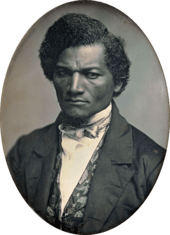
  1. The Formation of a National Government

A New Nation in Crisis: Shays Rebellion and the U.S. Under the Articles

This lesson was reported from:
A chapter of The United States: An Open Ended History, a free online textbook.  Adapted in part from open sources.

For Your Consideration:
  1. What were the Articles of Confederation?
  2. What was one weakness of the Articles of Confederation?
  3. What did the Northwest Ordinance say about slavery?
  4. Why was Daniel Shays upset?
  5. Why wasn’t the government easily able to stop Shays’ Rebellion?

The Articles of Confederation

The struggle with England had done much to change colonial attitudes. Local assemblies had rejected the Albany Plan of Union in 1754, refusing to surrender even the smallest part of their autonomy to any other body, even one they themselves had elected. But in the course of the Revolution, mutual aid had proved effective, and the fear of relinquishing individual authority had lessened to a large degree.

John Dickinson produced the “Articles of Confederation and Perpetual Union” in 1776. The Continental Congress adopted them in November 1777, and they went into effect in 1781, having been ratified by all the states. Reflecting the fragility of a nascent sense of nationhood, the Articles provided only for a very loose union. The national government lacked the authority to set up tariffs, to regulate commerce, and to levy taxes. It possessed scant control of international relations: A number of states had begun their own negotiations with foreign countries. Nine states had their own armies, several their own navies, and there was no U.S. army. In the absence of a sound common currency, the new nation conducted its commerce with a curious hodgepodge of coins and a bewildering variety of state and national paper bills, all fast depreciating in value.

weakness of the articles
The Articles of Confederation were meant to create a weak national government. However, as time went on, these weaknesses came to threaten the very existence of the United States.

Westward Expansion

With the end of the Revolution, the United States again had to face the old unsolved Western question, the problem of expansion, with its complications of land, fur trade, Indians, settlement, and local government. Lured by the richest land yet found in the country, pioneers poured over the Appalachian Mountains and beyond. By 1775 the far-flung outposts scattered along the waterways had tens of thousands of settlers. Separated by mountain ranges and hundreds of kilometers from the centers of political authority in the East, the inhabitants established their own governments. Settlers from all the Tidewater states pressed on into the fertile river valleys, hardwood forests, and rolling prairies of the interior. By 1790 the population of the trans-Appalachian region numbered well over 120,000.

Before the war, several colonies had laid extensive and often overlapping claims to land beyond the Appalachians. To those without such claims this rich territorial prize seemed unfairly apportioned. Maryland, speaking for the latter group, introduced a resolution that the western lands be considered common property to be parceled by the Congress into free and independent governments. This idea was not received enthusiastically. Nonetheless, in 1780 New York led the way by ceding its claims. In 1784 Virginia, which held the grandest claims, relinquished all land north of the Ohio River. Other states ceded their claims, and it became apparent that Congress would come into possession of all the lands north of the Ohio River and west of the Allegheny Mountains. This common possession of millions of hectares was the most tangible evidence yet of nationality and unity, and gave a certain substance to the idea of national sovereignty. At the same time, these vast territories were a problem that required solution.

Northwest-territory-usa-1787
Northwest Territory created by the Northwest Ordinance (1787).

The Confederation Congress established a system of limited self-government for this new national Northwest Territory. The Northwest Ordinance of 1787 provided for its organization, initially as a single district, ruled by a governor and judges appointed by the Congress. When this territory had 5,000 free male inhabitants of voting age, it was to be entitled to a legislature of two chambers, itself electing the lower house. In addition, it could at that time send a nonvoting delegate to Congress. Three to five states would be formed as the territory was settled. Whenever any one of them had 60,000 free inhabitants, it was to be admitted to the Union “on an equal footing with the original states in all respects.” The ordinance guaranteed civil rights and liberties, encouraged education, and prohibited slavery or other forms of involuntary servitude.

The new policy repudiated the time-honored concept that colonies existed for the benefit of the mother country, were politically subordinate, and peopled by social inferiors. Instead, it established the principle that colonies (“territories”) were an extension of the nation and entitled, not as a privilege but as a right, to all the benefits of equality.

State Constitutions

The success of the Revolution gave Americans the opportunity to give legal form to their ideals as expressed in the Declaration of Independence, and to remedy some of their grievances through state constitutions. As early as May 10, 1776, Congress had passed a resolution advising the colonies to form new governments “such as shall best conduce to the happiness and safety of their constituents.” Some of them had already done so, and within a year after the Declaration of Independence, all but three had drawn up constitutions.

The new constitutions showed the impact of democratic ideas. None made any drastic break with the past, since all were built on the solid foundation of colonial experience and English practice. But each was also animated by the spirit of republicanism, an ideal that had long been praised by Enlightenment philosophers.

Naturally, the first objective of the framers of the state constitutions was to secure those “unalienable rights” whose violation had caused the former colonies to repudiate their connection with Britain. Thus, each constitution began with a declaration or bill of rights. Virginia’s, which served as a model for all the others, included a declaration of principles: popular sovereignty, rotation in office, freedom of elections, and an enumeration of fundamental liberties: moderate bail and humane punishment, speedy trial by jury, freedom of the press and of conscience, and the right of the majority to reform or alter the government.

Other states enlarged the list of liberties to freedom of speech, of assembly, and of petition. Their constitutions frequently included such provisions as the right to bear arms, to a writ of habeas corpus, to inviolability of domicile, and to equal protection under the law. Moreover, all prescribed a three-branch structure of government—executive, legislative, and judiciary—each checked and balanced by the others. Pennsylvania’s constitution was the most radical. In that state, Philadelphia artisans, Scots-Irish frontiersmen, and German-speaking farmers had taken control. The provincial congress adopted a constitution that permitted every male taxpayer and his sons to vote, required rotation in office (no one could serve as a representative more than four years out of every seven), and set up a single-chamber legislature.

The state constitutions had some glaring limitations, particularly by more recent standards. Constitutions established to guarantee people their natural rights did not secure for everyone the most fundamental natural right—equality. The colonies south of Pennsylvania excluded their slave populations from their inalienable rights as human beings. Women had no political rights. No state went so far as to permit universal male suffrage, and even in those states that permitted all taxpayers to vote (Delaware, North Carolina, and Georgia, in addition to Pennsylvania), office-holders were required to own a certain amount of property.

Shays’ Rebellion

Economic difficulties after the war prompted calls for change to this precarious system. The end of the war had a severe effect on merchants who supplied the armies of both sides and who had lost the advantages deriving from participation in the British mercantile system. The states gave preference to American goods in their tariff policies, but these were inconsistent, leading to the demand for a stronger central government to implement a uniform policy.

Farmers probably suffered the most from economic difficulties following the revolution. The supply of farm produce exceeded demand; taxes, even on small landowners, were actually higher under many new state governments than they were under the British. Small farmers wanted economic reforms to avoid foreclosure on their property and imprisonment for debt, as was the law at the time. Courts were clogged with suits for payment filed by their creditors. All through the summer of 1786, popular conventions and peaceful gatherings in several states demanded tax and monetary reform.

Protesters watching a debtor in a scuffle with a tax collector by the courthouse at Springfield, Massachusetts.

That autumn, groups of farmers in Massachusetts under the leadership of a former army captain, Daniel Shays, began to forcibly prevent the county courts from sitting and passing further judgments for debt – which would have resulted in the loss of property, livelihood, and the right to vote for Shays and many of his followers. In January 1787, a ragtag army of 1,200 farmers moved toward the federal arsenal at Springfield. The rebels, armed chiefly with staves and pitchforks, were repulsed by a small state militia force; General Benjamin Lincoln then arrived with reinforcements – privately funded by wealthy creditors in Boston – and routed the remaining Shaysites, whose leader escaped to Vermont. The government captured 14 rebels and sentenced them to death.  After the defeat of the rebellion, a newly elected legislature, whose majority sympathized with the rebels, met some of their demands for debt relief. The new governor even pardoned many of the resistance leaders, though not Daniel Shays – who lived out the rest of his life as a poor farmer outside of Massachusetts.

800px-Daniel_Shays_and_Job_Shattuck
Contemporary engraving depicting Daniel Shays (left) and Job Shattuck, another rebel leader; the artist intentionally rendered them in an unflattering way.

From the perspective of the wealthy, landowning founders of the new nation, anarchy threatened – the poor had effectively risen up and achieved many of their goals after resorting to armed violence. The U.S. government, under the Articles, was unable to raise an army. It was unable to reinforce the Massachusetts state militia, which had only just barely contained the violence.  And now the state government was in the hands of many of who were sympathetic to the lower classes.

Thomas Jefferson was serving as ambassador to France at the time and refused to be alarmed by Shays’ Rebellion. He argued in a letter to James Madison on January 30, 1787 that occasional rebellion serves to preserve freedoms. “The tree of liberty must be refreshed from time to time with the blood of patriots and tyrants. It is its natural manure.” In contrast, George Washington had been calling for constitutional reform for many years, and he wrote in a letter to Henry Lee, “Let us have a government by which our lives, liberties, and properties will be secured, or let us know the worst at once.”

Shortly after Shays’ Rebellion broke out, delegates from five states met in Annapolis, Maryland from September 11-14, 1786, and they concluded that vigorous steps were needed to reform the federal government, but they disbanded because of a lack of full representation and authority, calling for a convention of all the states to be held in Philadelphia in May 1787.

The article was adapted in part from:

  1. The Formation of a National Government
  2. Shays’ Rebellion

The Revolutionary War: With a Little Help from our Friends

This lesson was reported from:
A chapter of The United States: An Open Ended History, a free online textbook.  Adapted in part from open sources.

For Your Consideration:
  1. What happened at Valley Forge, Pennsylvania?
  2. Describe one role patriot women played during the Revolutionary War.
  3. Why was French help necessary for an American victory in the war?
  4. What happened at Yorktown?
  5. What were the terms of the Treaty of Paris of 1783?

Defeats and victories

Although the Americans suffered severe setbacks for months after independence was declared, their tenacity and perseverance eventually paid off. During August 1776, in the Battle of Long Island in New York, Washington’s position became untenable, and he executed a masterly retreat in small boats from Brooklyn to the Manhattan shore. British General William Howe twice hesitated and allowed the Americans to escape. By November, however, Howe had captured Fort Washington on Manhattan Island. New York City would remain under British control until the end of the war.

That December, Washington’s forces were near collapse, as supplies and promised aid failed to materialize. Howe again missed his chance to crush the Americans by deciding to wait until spring to resume fighting. On the night of December 25–26, 1776, Washington crossed the Delaware River, north of Trenton, New Jersey. In the early-morning hours of December 26, his troops surprised the British garrison there, taking more than 900 prisoners.

1024px-Washington_Crossing_the_Delaware_by_Emanuel_Leutze,_MMA-NYC,_1851
Washington Crossing the Delaware commemorates General George Washington during his famous crossing of the Delaware River with the Continental Army on the night of December 25–26, 1776, during the American Revolutionary War.

In September 1777, however, Howe defeated the American army at Brandywine in Pennsylvania and occupied Philadelphia, forcing the Continental Congress to flee. Washington had to endure the bitterly cold winter of 1777‑1778 at Valley Forge, Pennsylvania, lacking adequate food, clothing, and supplies. Local farmers and merchants exchanged their goods for British gold and silver rather than for dubious paper money issued by the Continental Congress and the states.

A reproduction hut at Valley Forge
A reproduction of a soldier’s hut at Valley Forge.

With disease and hunger rampant, Valley Forge was the lowest ebb for Washington’s Continental Army.  While the winter itself was not particularly harsh, many soldiers remained unfit for duty, owing to the lack of proper clothing and uniforms.  Years later, General Marquis de Lafayette, an early French ally to the American cause, who was present at Valley Forge, recalled that “the unfortunate soldiers were in want of everything; they had neither coats, hats, shirts, nor shoes; their feet and legs froze till they had become almost black, and it was often necessary to amputate them.”

While formal politics and warfare did not include women, ordinary domestic behaviors became charged with political significance as women confronted the Revolution. Women in the era of the Revolution were responsible for managing the household.  Halting previously everyday activities, such as drinking British tea or ordering clothes from Britain, demonstrated Colonial opposition during the years leading up to and during the war.

Patriot women continued a long tradition of weaving, and spun their own cloth to make clothing for their families. In addition to the boycotts of British textiles, the Homespun Movement served the Continental Army by producing needed clothing and blankets.

Some women were economically unable to maintain their households in their husband’s absence or wished to be by their side. Known as camp followers, these women followed the Continental Army, serving the soldiers and officers as washerwomen, cooks, nurses, seamstresses, supply scavengers, and occasionally as soldiers and spies. The women that followed the army were at times referred to as “necessary nuisances” and “baggage” by commanding officers, but at other times were widely praised. These women helped the army camps run smoothly. Prostitutes were also present, but they were a worrisome presence to military leaders particularly because of the possible spread of venereal diseases.

Wives of some of the superior officers (Martha Washington, for example) visited the camps frequently. Unlike poorer women present in the army camps, the value of these well-to-do women to the army was symbolic or spiritual, rather than practical. Their presence was a declaration that everyone made sacrifices for the war cause.

Franco-American Alliance

In France, enthusiasm for the American cause was high: The French intellectual world was itself stirring against feudalism and privilege. However, the Crown lent its support to the colonies for geopolitical rather than ideological reasons: The French government had been eager for reprisal against Britain ever since France’s defeat in 1763. To further the American cause, Benjamin Franklin was sent to Paris in 1776. His wit, guile, and intellect soon made their presence felt in the French capital, and played a major role in winning French assistance.

800px-Benjamin_Franklin's_Reception_at_the_Court_of_France_1778
Benjamin Franklin’s reception at the Court of France in 1778.

France began providing aid to the colonies in May 1776, when it sent 14 ships with war supplies to America. In fact, most of the gunpowder used by the American armies came from France. After Britain’s defeat at Saratoga, France saw an opportunity to seriously weaken its ancient enemy and restore the balance of power that had been upset by the French and Indian War. On February 6, 1778, the colonies and France signed a Treaty of Amity and Commerce, in which France recognized the United States and offered trade concessions. They also signed a Treaty of Alliance, which stipulated that if France entered the war, neither country would lay down its arms until the colonies won their independence, that neither would conclude peace with Britain without the consent of the other, and that each guaranteed the other’s possessions in America. This was the only bilateral defense treaty signed by the United States or its predecessors until 1949.

The Franco-American alliance soon broadened the conflict. In June 1778 British ships fired on French vessels, and the two countries went to war. In 1779 Spain, hoping to reacquire territories taken by Britain in the Seven Years’ War, entered the conflict on the side of France, but not as an ally of the Americans. In 1780 Britain declared war on the Dutch, who had continued to trade with the Americans. The combination of these European powers, with France in the lead, was a far greater threat to Britain than the American colonies standing alone.

Surrender at Yorktown

In July 1780 France’s King Louis XVI had sent to America an expeditionary force of 6,000 men under the Comte Jean de Rochambeau. In addition, the French fleet harassed British shipping and blocked reinforcement and resupply of British forces in Virginia. French and American armies and navies, totaling 18,000 men, parried with British General Cornwallis all through the summer and into the fall.

Soldier_in_the_Continental_Army_from_1st_Rhode_Island_Regiment
Continental soldiers at Yorktown; on the left, an African-American soldier of the 1st Rhode Island Regiment.  Most blacks fought on the patriot side; recent research concludes there were about 9000 black Patriot soldiers, counting the Continental Army and Navy, and state militia units, as well as privateers, wagoneers in the Army, servants to officers, and spies.

A series of battles left Cornwallis’s armies in retreat toward Yorktown, Virginia, where they expected to be rescued by a British fleet. The fleet showed up, but so did a larger French fleet, so the British fleet retreated out to sea after a brief battle, leaving Cornwallis trapped between the American and French armies on land and the French fleet at sea. Finally, on October 19, 1781, General Cornwallis surrendered his army of 8,000 British soldiers.

The British had asked for the traditional honors of war, which would allow the army to march out with flags flying, bayonets fixed, and the band playing an American or French tune as a tribute to the victors. However, Washington firmly refused to grant the British the honors that they had denied the defeated American army the year before at the Siege of Charleston. Consequently, the British and Hessian troops marched with flags furled and muskets shouldered.

Cornwallis refused to attend the surrender ceremony, citing illness. Instead, Brigadier General Charles O’Hara led the British army onto the field. O’Hara first attempted to surrender to Rochambeau, who shook his head and pointed to Washington. O’Hara then offered his sword to Washington, who also refused and motioned to Benjamin Lincoln, his own second-in-command. The surrender finally took place when Washington’s second-in-command accepted the sword of Cornwallis’ deputy.

800px-Surrender_of_Lord_Cornwallis
Surrender of Lord Cornwallis by John Trumbull, depicts the British surrendering to Benjamin Lincoln, flanked by French (left) and American troops. Oil on canvas, 1820.

For the next year, scattered fighting continued, but back in Britain, the British were crushed by this defeat. Before long, Parliament voted to cease all offensive operations in “the colonies.”

Although Cornwallis’s defeat did not immediately end the war, a new British government decided to pursue peace negotiations in Paris in early 1782, with the American side represented by Benjamin Franklin, John Adams, and John Jay. Signed on September 3, 1783 the Treaty of Paris acknowledged the independence, freedom, and sovereignty of the 13 former colonies, now states. The new United States stretched west to the Mississippi River, north to Canada, and south to Florida, which was returned to Spain.

At the conclusion of the war in 1783 large numbers of loyalists and their families relocated to the home country of England and or to the still-British colony of Canada.

The article was adapted in part from:

  1. The American Revolution
  2. The Road to Revolution
  3. The Road to Independence
  4. History of the United States
  5. Women in the American Revolution