The Philippines in the American Empire

This lesson is continued from The Brutality of the Philippine-American War.  It is a part of a larger unit on the Philippines: At the Crossroads of the World.  It is also written to be utilized independently.
This lesson was reported from:
Adapted in part from open sources.

American Criticism

  1. What does Mark Twain think about the idea of American Empire?  Do you agree?
  2. The political cartoon at the end of this section makes the argument that the United States has always been about expansion by any means necessary, whether they be financial, diplomatic, or conquest.  In contrast to Mark Twain’s point of view, “Empire is American, the author is arguing – just ask the Native Americans or the Mexicans.  How do you respond to this argument?
  3. In the Twenty-First Century, does the United States have an empire?

Image result for filipino water cure

Not all Americans cheered the conquest of the Philippines by the United States.

The American Anti-Imperialist League was an organization established on June 15, 1898, to argue and campaign against the American annexation of the Philippines. The Anti-Imperialist League opposed colonial expansion, believing that imperialism violated the fundamental principle that just republican government must derive from “consent of the governed.” The League argued that such activity would necessitate the abandonment of American ideals of self-government and non-intervention—ideals expressed in the United States Declaration of IndependenceGeorge Washington’s Farewell Address and Abraham Lincoln’s Gettysburg Address.

Perhaps one America’s greatest celebrities at the time was the author Mark Twain, a fierce critic of the U.S. war in the Philippines, who wrote:

“…I have seen that we do not intend to free, but to subjugate the people of the Philippines. We have gone to conquer, not to redeem… And so I am an anti-imperialist. I am opposed to having the [American] eagle put its talons on any other land.”
Image result for mark twain
Mark Twain, fierce opponent of American annexation of the Philippines.

On October 6, 1900, he published an editorial in the New York World:

“There is the case of the Philippines. I have tried hard, and yet I cannot for the life of me comprehend how we got into that mess. Perhaps we could not have avoided it—perhaps it was inevitable that we should come to be fighting the natives of those islands—but I cannot understand it, and have never been able to get at the bottom of the origin of our antagonism to the natives. I thought we should act as their protector—not try to get them under our heel. We were to relieve them from Spanish tyranny to enable them to set up a government of their own, and we were to stand by and see that it got a fair trial. It was not to be a government according to our ideas, but a government that represented the feeling of the majority of the Filipinos, a government according to Filipino ideas. That would have been a worthy mission for the United States. But now—why, we have got into a mess, a quagmire from which each fresh step renders the difficulty of extrication immensely greater. I’m sure I wish I could see what we were getting out of it, and all it means to us as a nation.”

On October 15, Twain continued in the New York Times:

“We have pacified some thousands of the islanders and buried them; destroyed their fields; burned their villages, and turned their widows and orphans out-of-doors; furnished heartbreak by exile to some dozens of disagreeable patriots; subjugated the remaining ten millions by Benevolent Assimilation, which is the pious new name of the musket… And so, by these providences of god — and the phrase is the government’s, not mine — we are a World Power.”

Despite articulate voices like Twain’s, the Anti-Imperialist League was ultimately defeated in the battle of public opinion by a new wave of politicians who successfully advocated the virtues of American territorial expansion in the aftermath of the Spanish–American War – after all, the Republican Party, the party that most strongly advocated for empire, held the White House through the Philippine-American War, despite the best efforts of the League, all the way until 1912.

Image result for mark twain anti imperialist league

See more of the imperialist vs. anti-imperialist debate with Stereoscopic Visions of War and Empire.

Read more at “The White Man’s Burden”: Kipling’s Hymn to U.S. Imperialism.

Decline and Fall of the First Philippine Republic

  1. Do you take Aguinaldo’s Proclamation of Formal Surrender statement to be sincere – or something he was compelled to say by his captors?
  2. In your opinion, did the Filipino resistance ever have a chance of success?  Did the loss of life that resulted from this conflict accomplish anything?
A group of Filipino combatants laying down their weapons during their surrender, circa 1900.

While this argument played out in American newspapers and polling booths, the Philippine Army continued suffering defeats from the better armed United States Army during the conventional warfare phase.  This steady string of setbacks forced Philippine President Emilio Aguinaldo to continually change his base of operations, which he did for nearly the length of the entire war.

On March 23, 1901, General Frederick Funston and his troops captured Aguinaldo in Palanan, Isabela, with the help of some Filipinos (called the Macabebe Scouts after their home locale) who had joined the Americans’ side. The Americans pretended to be captives of the Scouts, who were dressed in Philippine Army uniforms. Once Funston and his “captors” entered Aguinaldo’s camp, they immediately fell upon the guards and quickly overwhelmed them and the weary Aguinaldo.

aguinaldo capture
On March 23, 1901, Aguinaldo was celebrating his birthday when he was captured by Filipino troops in service of the Americans. (Diorama in Ayala Museum, Makati, Philippines, 2018.)

On April 1, 1901, at the Malacañan Palace in Manila, Aguinaldo swore an oath accepting the authority of the United States over the Philippines and pledging his allegiance to the American government. On April 19, he issued a Proclamation of Formal Surrender to the United States, telling his followers to lay down their weapons and give up the fight. “Let the stream of blood cease to flow; let there be an end to tears and desolation,” Aguinaldo said. “The lesson which the war holds out and the significance of which I realized only recently, leads me to the firm conviction that the complete termination of hostilities and a lasting peace are not only desirable but also absolutely essential for the well-being of the Philippines.”

The capture of Aguinaldo dealt a severe blow to the Filipino cause, but not as much as the Americans had hoped. General Miguel Malvar took over the leadership of the Filipino government, or what remained of it. He originally had taken a defensive stance against the Americans, but now launched all-out offensive against the American-held towns in the Batangas region. General Vicente Lukbán in Samar, and other army officers, continued the war in their respective areas.

General Bell relentlessly pursued Malvar and his men, forcing the surrender of many Filipino soldiers. Finally, Malvar surrendered, along with his sick wife and children and some of his officers, on April 16, 1902. By the end of the month nearly 3,000 of Malvar’s men had also surrendered. With the surrender of Malvar, the Filipino war effort began to dwindle even further.

Official End to the War

  1. Who gets to decide when a war is over?
  2. Why was Sakay labelled a bandit and executed when Aguinaldo and Malvar were both allowed to surrender peacefully?

The Philippine Organic Act—approved on July 1, 1902—ratified President McKinley’s previous executive order which had established the Second Philippine Commission. The act also stipulated that a legislature would be established composed of a popularly elected lower house, the Philippine Assembly, and an upper house consisting of the Philippine Commission. The act also provided for extending the United States Bill of Rights to Filipinos. On July 2, the United States Secretary of War telegraphed that since the insurrection against the United States had ended and provincial civil governments had been established throughout most of the Philippine archipelago, the office of military governor was terminated. On July 4, Theodore Roosevelt, who had succeeded to the U.S. Presidency after the assassination of President McKinley, proclaimed an amnesty to those who had participated in the conflict.

After military rule was terminated on July 4, 1902, the Philippine Constabulary was established as an archipelago-wide police force to control brigandage and deal with the remnants of the insurgent movement. The Philippine Constabulary gradually took over the responsibility for suppressing guerrilla and bandit activities from United States Army units. Remnants of the Katipunan and other resistance groups remained active fighting the United States military or Philippine Constabulary for nearly a decade after the official end of the war.  After the close of the war, however, Governor General Taft preferred to rely on the Philippine Constabulary and to treat the irreconcilables as a law enforcement concern rather than a military concern requiring the involvement of the American army.

Image result for sakay
Macario Sakay.

In 1902, Macario Sakay formed another government, the Republika ng Katagalugan, in Rizal Province. This republic ended in 1906 when Sakay and his top followers were arrested and executed the following year by the American authorities.

In 1905, Filipino labour leader Dominador Gómez was authorised by Governor-General Henry Clay Ide to negotiate for the surrender of Sakay and his men. Gómez met with Sakay at his camp and argued that the establishment of a national assembly was being held up by Sakay’s intransigence, and that its establishment would be the first step toward Filipino independence. Sakay agreed to end his resistance on the condition that a general amnesty be granted to his men, that they be permitted to carry firearms, and that he and his officers be permitted to leave the country. Gómez assured Sakay that these conditions would be acceptable to the Americans, and Sakay’s emissary, General León Villafuerte, obtained agreement to them from the American Governor-General.

Sakay believed that the struggle had shifted to constitutional means, and that the establishment of the assembly was a means to winning independence. As a result, he surrendered on 20 July 1906, descending from the mountains on the promise of an amnesty for him and his officials, and the formation of a Philippine Assembly composed of Filipinos that would serve as the “gate of freedom.” With Villafuerte, Sakay travelled to Manila, where they were welcomed and invited to receptions and banquets. One invitation came from the Constabulary Chief, Colonel Harry H. Bandholtz; it was a trap, and Sakay along with his principal lieutenants were disarmed and arrested while the party was in progress.

At his trial, Sakay was accused of “bandolerismo under the Brigandage Act of Nov. 12, 1902, which interpreted all acts of armed resistance to American rule as banditry.” The American colonial Supreme Court of the Philippines upheld the decision. Sakay was sentenced to death, and hanged on 13 September 1907. Before his death, he made the following statement:

Death comes to all of us sooner or later, so I will face the LORD Almighty calmly. But I want to tell you that we are not bandits and robbers, as the Americans have accused us, but members of the revolutionary force that defended our mother country, the Philippines! Farewell! Long live the Republic and may our independence be born in the future! Long live the Philippines!

He was buried at Manila North Cemetery later that day.

Philippine Independence and Sovereignty (1946)

  1. When was the Philippines granted self-government?
  2. What conditions did the United States attach to this independence?  In light of these conditions, was this true Philippine independence?
quezon
Upon the occupation of the Philippines in 1898, the Americans claimed that the Filipinos were ill-equipped for total independence, that they needed tutoring on how to run their own affairs. By 1934, because of economic and immigration pressures created by the Great Depression, the United States finally allowed a Filipino to take charge of the colony. A national election was held, and on November 15, 1935, Manuel Quezon became president – a president who still largely answered to the Americans. (Diorama in the Ayala Museum, Makati, Philippines.)

On January 20, 1899, President McKinley appointed the First Philippine Commission (the Schurman Commission), a five-person group headed by Dr. Jacob Schurman, president of Cornell University, to investigate conditions in the islands and make recommendations. In the report that they issued to the president the following year, the commissioners acknowledged Filipino aspirations for independence; they declared, however, that the Philippines was not ready for it. Specific recommendations included the establishment of civilian government as rapidly as possible (the American chief executive in the islands at that time was the military governor), including establishment of a bicameral legislature, autonomous governments on the provincial and municipal levels, and a new system of free public elementary schools.

From the very beginning, United States presidents and their representatives in the islands defined their colonial mission as tutelage: preparing the Philippines for eventual independence. Except for a small group of “retentionists,” the issue was not whether the Philippines would be granted self-rule, but when and under what conditions. Thus political development in the islands was rapid and particularly impressive in light of the complete lack of representative institutions under the Spanish. 

By the 1930s, there were three main groups lobbying for Philippine independence –  Great Depression-era American farmers competing against tariff-free Filipino sugar and coconut oil; those upset with large numbers of Filipino immigrants who could move easily to the United States, in their changing the U.S.’s racial character and competing with American-born workers; and Filipinos seeking Philippine independence.

The Tydings–McDuffie Act (officially the Philippine Independence Act; Public Law 73-127) approved on March 24, 1934, provided for self-government of the Philippines and for Filipino independence (from the United States) after a period of ten years. World War II intervened, bringing the Japanese occupation between 1941 and 1945. In 1946, the Treaty of Manila (1946) between the governments of the U.S. and the Republic of the Philippines provided for the recognition of the independence of the Republic of the Philippines and the relinquishment of American sovereignty over the Philippine Islands.
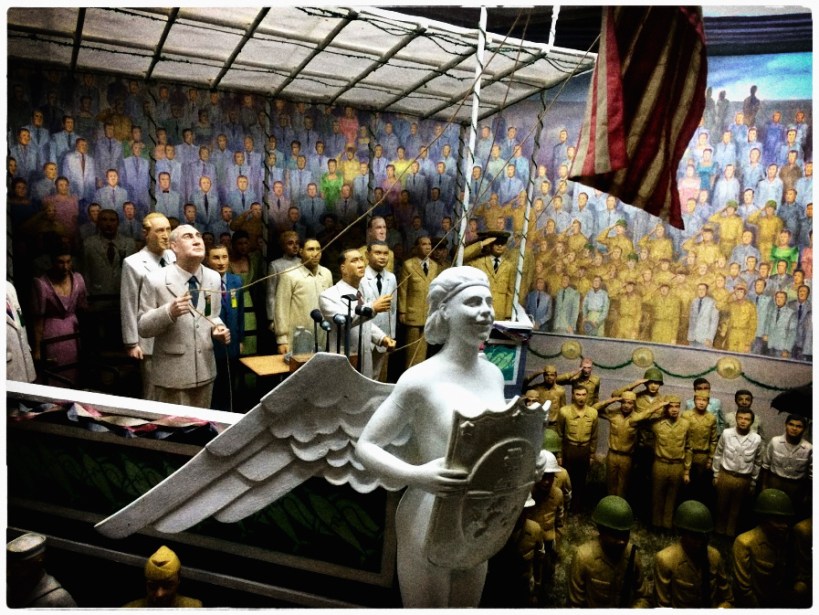
independence
In a ceremony on July 4, 1946, the U.S. flag was lowered in Manila for the last time while the Philippine flag was raised over a newly independent nation. (Diorama in the Ayala Museum, Makati, Philippines, 2018.)

However, before the 1946 Treaty was authorized, a secret agreement was signed between Philippine President Osmena and US President Truman. President Osmena “supported U.S. rights to bases in his country by backing them publicly and by signing a secret agreement.” This culminated in the Military Bases Agreement, which was signed and submitted for Senate approval in the Philippines by Osmena’s successor, President Manuel Roxas.

As a result of this agreement, the U.S. retained dozens of military bases in Philippines, including a few major ones. It further required U.S. citizens and corporations be granted equal access with Filipinos to Philippine minerals, forests, and other natural resources. In hearings before the U.S. Senate Committee on Finance, Assistant Secretary of State for Economic Affairs William L. Clayton described the law as “clearly inconsistent with the basic foreign economic policy of this country” and “clearly inconsistent with our promise to grant the Philippines genuine independence.

Despite these inconsistencies, President Roxas did not have objections to most of the United States’ proposed military bases agreement in 1947. Below are some of the demands Roxas approved.

  1. The United States would acquire the military bases for ninety-nine years (Article 29)
  2. Clark Air Base would cover 130,000 acres, Olongapo City will be integrated into the Subic Naval Base, and areas surrounding the bases will be under US authority (Article 3)
  3. The Philippines should seek U.S. approval before granting base rights to third nations (Article 25)

On March 17, Roxas submitted the Military Bases Agreement to the Philippine Senate for approval. The Military Bases Agreement was approved by the Philippine Senate on March 26, 1947, with all eighteen present senators in favor. Three senators did not attend the session in protest.

Philippine Senator Tomas Confesor stated that the military bases were “established here by the United States, not so much for the benefit of the Philippines as for their own.” He cautioned his fellow senators: “We are within the orbit of expansion of the American empire. Imperialism is not yet dead.”

childrenofthesunreturning
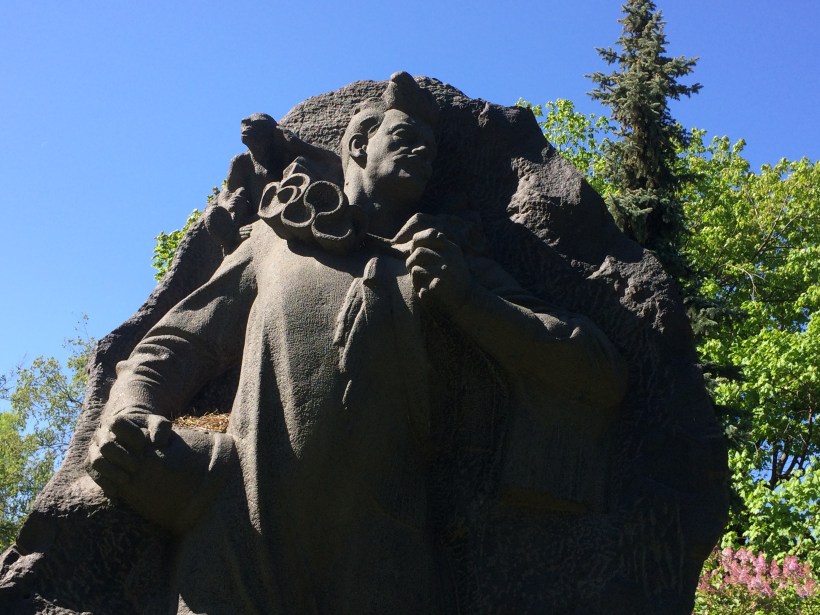
This statue, Children of the Sun Returning, stands in Subic Bay, a former U.S. naval base retained under the Military Bases Agreement.  It commemorates the 1992 withdrawal of U.S. forces from the Philippines, nearly a century after the Philippine-American War and nearly fifty years after the ostensible independence of that country.  The Filipinos in the sculpture are removing the symbolic blindfolds of colonialism.  The inscription reads in part: “We, the Children of the Sun, had lost our way. Apathy blinded us, stripped us of our power… The skies darkened and the Earth shook.  Pinatubo (a nearby volcano) taught us humility before nature and then the Americans were gone as well.  Nature and man took our jobs, our wealth, our security.  November 24, 1992… A day of reckoning – a defining moment when we found within ourselves the true spirit of the Filipino for it was then that we threw off the blinds that had entrapped us and reached out to one another, bound together by a dream of the future… The Children of the Sun had returned.” (Subic Bay, Philippines, 2018.)

Activities

  1. There is a long tradition of resistance to colonial rule in the Philippines. 
    Juan Sumuory is celebrated in the Gallery of Heroes. (Manila, Philippines, 2018.)

    Couple of this with the country’s strong Catholicism – with its tradition of sainthood and martyrdom – and you have nation that is very aware of those who have sacrificed to advance the cause of the Filipino.  Manila’s Rizal Park features the Gallery of Heroes, a row of bust sculpture monuments of historical Philippine heroes.  These include:  Andres Bonifacio, Juan Sumuroy, Aman Dangat, Marcelo H. Del Pilar, Gregorio Aglipay, Sultan Kudarat,  Juan Luna, Melchora Aquino, Rajah Sulayman, and Gabriela Silang.  Choose one of these personalities to commemorate in your own classroom.  Write a brief description of their accomplishments to accompany a piece of artwork that celebrates their life for those who aren’t aware.

  2. Jose Rizal never specifically advocated violence or even open revolt against
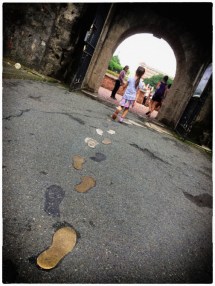
    Untitled-1
    Jose Rizal famously declined the Spanish offer of a carriage ride to his execution site. Instead, he walked, and today, bronze footprints mark his path from Fort Santiago to today’s Rizal Park, a memorial that literally allows one to walk in the footsteps of a national hero.

    the Spanish, pushing instead for political reforms within the colonial structure.  He wrote with such clarity and passion, however, that he become a symbol to revolutionaries – and this is why the colonial authorities decided he needed to die, in a plan that ultimately backfired, transforming him into a martyr.  Debate with your class – “Does a national hero need to be a warrior – a violent figure?  If not, why are so many warriors celebrated the world over as national heroes?”

  3. Rudyard Kipling wrote a famous poem about the U.S. and its conquest of the Philippines.  It is called “The White Man’s Burden.”  The poem became so famous that it became the subject of parody as well.  Read both the poem and one of its parodies and discuss it with your classmates using the included questions to help guide you.
  4. Stereoscopic Visions of War and Empire – This exhibit juxtaposes the visual message presented by the stereoscopic images with excerpts from the letters written by U.S. soldiers that were first published in local newspapers and later collected in the Anti-Imperialist League’s pamphlet, allowing us to get a glimpse of the Philippine-American War as it was presented to Americans at home, reading the news or entertaining friends in their parlors.
  5. In The Trenches: Harper’s Weekly Covers the Philippine-American War – How did the American media cover the war in the Philippines?  An excerpt from “In The Trenches” by John F. Bass, originally published in Harper’s Weekly.

Read more on this subject -> The Origins of the Philippine-American War  ◦  The Brutality of the Philippine-American War  ◦  The Philippines in the American Empire  ◦  “The White Man’s Burden”: Kipling’s Hymn to U.S. Imperialism  ◦  Stereoscopic Visions of War and Empire  ◦  In The Trenches: Harper’s Weekly Covers the Philippine-American War Ninoy and Marcos – “A Pact with the Devil is No Pact at All.”

FURTHER READING

History of the Philippines: From Indios Bravos to Filipinos by Luis Francia.

In the twenty-first century, the Philippines faces many challenges.  It is also one of the most stunningly beautiful places you could ever visit, filled with some of friendliest people you will ever meet. (El Nido, Philippines, 2018.)

THIS LESSON WAS INDEPENDENTLY FINANCED BY OPENENDEDSOCIALSTUDIES.ORG.

If you value the free resources we offer, please consider making a modest contribution to keep this site going and growing.

The Brutality of the Philippine-American War

This lesson is continued from The Origins of the Philippine-American War.  It is a part of a larger unit on the Philippines: At the Crossroads of the World.  It is also written to be utilized independently.
This lesson was reported from:
Adapted in part from open sources.
war
The Philippine-American War pitted one time allies in the overthrow of Spain against each other.  Spain negotiated a separate peace with the United States in the Treaty of Paris, ceding colonial rule of the Philippine Islands to the Americans rather than granting the Filipinos independence.  The American government accepted this new imperial role, and set about subduing any Filipinos who resisted.  In this scene, the city of Iloilo is captured from Filipino forces by Americans led by Brigadier General Marcus Miller, with no loss of American lives. (Diorama in the Ayala Museum, Makati, Philippines, 2018.)

Waging the American War

  1. How did the Americans justify their takeover of the Philippines?  Are you convinced by this argument?
  2. In your opinion, did American conduct during the war match these justifications?  Why or why not?
  3. How did the American military attempt to counter rumors of their brutality?

Annexation of the Philippines as a colony of the United States was often justified by those in the U.S. government and media on moral and racial grounds. The U.S. was simply doing its duty as an advanced, Western nation, spreading civilization, democracy, and capitalism to primitive Asians who enjoyed none of these things and were too simple to be trusted with self-government.  Historian Stuart Creighton Miller writes that in this view, “Americans altruistically went to war with Spain to liberate Cubans, Puerto Ricans, and Filipinos from their tyrannical yoke. If they lingered on too long in the Philippines, it was to protect the Filipinos from European predators waiting in the wings for an American withdrawal and to tutor them in American-style democracy.”  Implicit in this attitude were notions of racial superiority and the inherent superiority of white America over primitive people of color.

The ugly reality of Americans colonial mission was laid bare by Dean Worcester, an American colonial official, who wrote in his memoirs that the Filipinos were “treacherous, arrogant, stupid and vindictive, impervious to gratitude, incapable of recognizing obligations. Centuries of barbarism have made them cunning and dishonest. We cannot safely treat them as equals, for the simple and sufficient reason that they could not understand it. They do not know the meaning of justice and good faith. They do not know the difference between liberty and license…. These Filipinos must be taught obedience and be forced to observe, even if they cannot comprehend, the practices of civilization.”

whitemansburden
One popular defense of the U.S. conquest of the Philippines was to say that the U.S. didn’t really want this role – they were stuck with the responsibility, as poet Rudyard Kipling put it, this “White Man’s Burden,” to help the poor, benighted Filipinos.  Never mind that the Filipinos didn’t seem to want the “help” that was being offered.

On February 11, 1899—only one week after the first shots of the war were fired—American naval forces destroyed the city of Iloilo with bombardment by the USS Petrel and the USS Baltimore. The city was then captured by ground forces led by Brigadier General Marcus Miller, with no loss of American lives.

Gregorio del Pilar, only 24 years old at the time of his death in 1899, belonged to a whole generation of high school and college graduates who, despite their youth, were pressed into leadership roles during the revolution.  Sent to negotiate an honorable peace with American General Otis, he was rebuffed and told peace could be achieved only though the “complete submission” of the Filipino people.  Angered, he set about defending a mountain pass, stalling American troops in hot pursuit of President Aguinaldo.  He succeeded, but died, hit in the neck by an American sharpshooter. (Diorama in the Ayala Museum, Makati, Philippines, 2018.)

Months later, after finally securing Manila from Filipino control, American forces moved northwards, engaging in combat at the brigade and battalion level in pursuit of the fleeing insurgent forces and their commanders. In response to the use of guerilla warfare tactics by Filipino forces beginning in September 1899, American military strategy shifted to a suppression footing. Tactics became focused on the control of key areas with internment and segregation of the civilian population in “zones of protection” from the guerrilla population (foreshadowing the Strategic Hamlet Program that would be utilized decades later, during the Vietnam War). Due to unsanitary conditions, many of the interned civilians died from dysentery.

General Otis gained notoriety for some of his actions in the Philippines. Although multiple orders were given to Otis from Washington to avoid military conflict, he did very little to prevent the breakout of war. Otis refused to accept anything but unconditional surrender from the Philippine Army. He often made major military decisions without first consulting leadership in Washington. He acted aggressively in dealing with the Filipinos under the assumption that their resistance would collapse quickly. 

A member of the American colonial government offered an alternative theory on what Bell was achieving, noting in his official report that far from breaking the spirit of the Filipino people, the blanket policy of violence and destruction was:

… sowing the seeds for a perpetual revolution. If these things need be done, they had best be done by native troops so that the people of the U.S.. will not be credited therewith.
American Soldiers Inspect Insurgent Casualties
American soldiers survey the bodies of fallen Filipino soldiers.

Otis also played a large role in suppressing information about American military tactics from the media. When letters describing American atrocities reached the American media, the War Department became involved and demanded that Otis investigate their authenticity. Each press clipping was forwarded to the original writer’s commanding officer, who would then convince or force the soldier to write a retraction of the original statements.

Meanwhile, Otis claimed that Filipino insurgents tortured American prisoners in “fiendish fashion.” During the closing months of 1899, Aguinaldo attempted to counter Otis’ account by suggesting that neutral parties—foreign journalists or representatives of the International Committee of the Red Cross—inspect his military operations. Otis refused, but Aguinaldo managed to smuggle four reporters—two English, one Canadian, and one Japanese—into the Philippines. The correspondents returned to Manila to report that American captives were “treated more like guests than prisoners,” were “fed the best that the country affords, and everything is done to gain their favor.” The story went on to say that American prisoners were offered commissions in the Filipino army and that three had accepted. The four reporters were expelled from the Philippines as soon as their stories were printed.

U.S. Navy Lieutenant J.C. Gilmore, whose release was forced by American cavalry pursuing Aguinaldo into the mountains, insisted that he had received “considerable treatment” and that he was no more starved than were his captors. Otis responded to publication of two articles concerning this by ordering the “capture” of the two authors, and that they be “investigated,” therefore questioning their loyalty.

When F.A. Blake of the International Committee of the Red Cross arrived at Aguinaldo’s request, Otis kept him confined to Manila, where Otis’ staff explained all of the violations of international humanitarian law perpetrated by Filipino soldiers. Blake managed to slip away from an escort and venture into the field. Blake never made it past American lines, but even within American lines he saw burned out villages and “horribly mutilated bodies, with stomachs slit open and occasionally decapitated.” Blake waited to return to San Francisco, where he told one reporter that “American soldiers are determined to kill every Filipino in sight.”

H.L. Wells, a staunch imperialist writing in the New York Evening Post, excused the troubling American racial theories that contributed to the often callous violence that characterized the Philippine-American War “There is no question that our men do ‘shoot niggers’ somewhat in the sporting spirit, but that is because war and their environments have rubbed off the thin veneer of civilization…Undoubtedly, they do not regard the shooting of Filipinos just as they would the shooting of white troops. This is partly because they are “only niggers,” and partly because they despise them for their treacherous servility…The soldiers feel they are fighting with savages, not with soldiers.”

Manila In Ruins
A burned district of Manila following combat between American and Filipino troops, 1899.

Waging the Filipino War

  1. How was the class structure of Filipino society a challenge to carrying out the war against the Americans?
  2. What was strategy of the Filipino war effort before the U.S. election of 1900?  How and why did it change after the election?
Philippine-American War
Filipino insurgents pose with their weapons, including bolo knives, circa 1900.

Estimates of the Filipino forces vary between 80,000 and 100,000, with tens of thousands of auxiliaries. Most of the forces were armed only with bolo knives, bows and arrows, spears and other primitive weapons which were vastly inferior to those of the American forces.

A fairly rigid caste system existed in the Philippines during the Spanish colonial era. The goal, or end-state, sought by the First Philippine Republic was a sovereign, independent, stable nation led by an oligarchy composed of members of the educated class (known as the ilustrado class). Local chieftains, landowners, businessmen and cabezas de barangay were the principales who controlled local politics. The war was at its peak when ilustradosprincipales, and peasants were unified in opposition to annexation by the United States. The peasants, who represented the majority of the fighting forces, had interests different from their ilustrado leaders and the principales of their villages – they were more likely to favor redistribution of land, tax reforms, and greater democracy, whereas the Filipino elites were more likely to favor a plan in which they replaced the Spanish elites, leaving the broader social order intact. Coupled with the ethnic and geographic fragmentation, aligning the interests of people from different social castes was a daunting task. The challenge for Aguinaldo and his generals was to sustain unified Filipino public opposition; this was the revolutionaries’ strategic center of gravity.

Filipino Officers And Leaders
Several Filipino leaders, including President Emilio Aguinaldo (bottom row, third from right), pose for a photo. Cavite. 1898.  The Filipino leadership was clearly wealthier and more educated than the average villager or soldier.
Image result for filipino concentration camps
American media tended to print photos that emphasized the primitive nature of Filipinos and the impoverished, backwards nature of the Philippines.  This better suited the narrative that the United States was “saving” the Philippines out of some sense of duty.

The Filipino operational center of gravity was the ability to sustain its force of 100,000 irregulars in the field. The Filipino general Francisco Macabulos described the Filipinos’ war aim as, “not to vanquish the U.S. Army but to inflict on them constant losses.” In the early stages of the war, the Philippine Revolutionary Army employed the conventional military tactics characteristic of an organized armed resistance. The hope was to inflict enough American casualties to result in McKinley’s defeat by William Jennings Bryan in the 1900 presidential election. Bryan, who held strong anti-imperialist views, would then hopefully withdraw the American forces from the Philippines.

McKinley’s election victory in 1900 was demoralizing for the insurgents, and convinced many Filipinos that the United States would not depart soon – after all, the war was McKinley’s and the American people had just reelected him, thereby approving his actions. This, coupled with a series of devastating losses on the battlefield against American forces equipped with superior technology and training, convinced Aguinaldo that he needed to change his approach. Beginning on September 14, 1899, Aguinaldo accepted the advice of General Gregorio del Pilar and authorized the use of guerilla warfare tactics in subsequent military operations in Bulacan.

For most of 1899, the revolutionary leadership had viewed guerrilla warfare strategically only as a tactical option of final recourse, not as a means of operation which better suited their disadvantaged situation. On November 13, 1899, Emilio Aguinaldo decreed that guerrilla war would henceforth be the strategy. This made American occupation of the Philippine archipelago all the more difficult over the next few years. In fact, during just the first four months of the guerrilla war, the Americans had nearly 500 casualties.  The Philippine Army began staging bloody ambushes and raids, such as the guerrilla victories at PayeCatubigMakahambusPulang LupaBalangiga and Mabitac. At first, it even seemed as if the Filipinos would fight the Americans to a stalemate and force them to withdraw.

American Atrocities

  1. Describe the actions of the Americans that might be labeled atrocities.
  2. Imagine that an invading force was doing this sort of thing in your town – would this make you more or less likely to cooperate with them?
  3. Imagine you are a soldier and your commanding officer has ordered you to burn down a village, then administer the water cure to anyone you capture in the process.  What do you do?
  4. If the goal of a war is to win, should there be rules in war?  What should those rules be?  How should captured enemy soldiers be captured?  Should it matter if they wear a uniform?  Should civilians be harmed?
  5. What should happen to commanders or soldiers who break any rules you established in the previous question?
Image result for filipino concentration camps
In an effort to curb guerrilla warfare, Filipino civilians were moved into concentrations camps.

Following Aguinaldo’s capture by the Americans on March 23, 1901, Miguel Malvar assumed command of the Philippine revolutionary forces. Batangas and Laguna provinces were the main focus of Malvar’s forces at this point in the war, and they continued to employ guerrilla warfare tactics.

In late 1901, Brigadier General J. Franklin Bell took command of American operations in Batangas and Laguna provinces.  Writing about his approach to the war, Bell said, “All consideration and regard for the inhabitants of this place cease from the day I become commander.  I have the force and authority to do whatever seems to me good and especially to humiliate all those in this Province who have any pride….”

In response to Malvar’s guerrilla warfare tactics, Bell employed counterinsurgency tactics (described by some as a scorched earth campaign) that took a heavy toll on guerrilla fighters and civilians alike. “Zones of protection” were established, and civilians were given identification papers and forced into concentration camps (called reconcentrados) which were surrounded by free-fire zones. At the Lodge Committee, in an attempt to counter the negative reception in America to General Bell’s camps, Colonel Arthur Wagner, the US Army’s chief public relations office, insisted that the camps were to “protect friendly natives from the insurgents, and assure them an adequate food supply” while teaching them “proper sanitary standards.” Wagner’s assertion was undermined by a letter from a commander of one of the camps, who described them as “suburbs of Hell.”

On December 13, Bell announced that the killing of American troops would be paid back in kind. Whenever such an event occurred, Bell proposed to select a prisoner “by lot from among the officers or prominent citizens” and have him executed. On December 15, Bell announced that “acts of hostility or sabotage” would result in the “starving of unarmed hostile belligerents.” The warning to Malvar was clear: he either had to give up the struggle or the “detainees” would face mass starvation. To show that he meant it, on December 20 Bell ordered all rice and other food lying outside the camps to be confiscated or destroyed. Wells were poisoned and all farm animals were slaughtered.

By December 25, 1901, nearly the entire populations of Batangas and Laguna provinces had gathered into the reconcentrados. Families had to bring everything they could carry because anything left behind—including houses, gardens, carts, poultry and animals—was subject to confiscation or destruction by the U.S. Army. The reconcentrados were overcrowded, which led to disease and death. Between January and April 1902, 8,350 prisoners of approximately 298,000 died, and some camps experienced mortality rates as high as 20 percent.

Civilians became subject to a curfew, after which all persons found outside of camps without identification could be shot on sight. Men were rounded up for questioning, tortured, and summarily executed.” Methods of torture such as the water cure were frequently employed during interrogation, and entire villages were burned or otherwise destroyed.

Throughout the war, American soldiers and other witnesses sent letters home which described some of the atrocities committed by American forces. For example, In November 1901, the Manila correspondent of the Philadelphia Ledger wrote:

“The present war is no bloodless, opera bouffe engagement; our men have been relentless, have killed to exterminate men, women, children, prisoners and captives, active insurgents and suspected people from lads of ten up, the idea prevailing that the Filipino as such was little better than a dog… Our soldiers have pumped salt water into men to make them talk, and have taken prisoners people who held up their hands and peacefully surrendered, and an hour later, without an atom of evidence to show that they were even insurrectos, stood them on a bridge and shot them down one by one, to drop into the water below and float down, as examples to those who found their bullet-loaded corpses.”

Reports were received from soldiers returning from the Philippines that, upon entering a village, American soldiers would ransack every house and church and rob the inhabitants of everything of value, while those who approached the battle line waving a flag of truce were fired upon.

Some of the authors were critical of leaders such as General Otis and the overall conduct of the war. When some of these letters were published in newspapers, they would become national news, which would force the War Department to investigate. Two such letters included:

  • A soldier from New York: “The town of Titatia was surrendered to us a few days ago, and two companies occupy the same. Last night one of our boys was found shot and his stomach cut open. Immediately orders were received from General Wheaton to burn the town and kill every native in sight; which was done to a finish. About 1,000 men, women and children were reported killed. I am probably growing hard-hearted, for I am in my glory when I can sight my gun on some dark skin and pull the trigger.”
  • Corporal Sam Gillis: “We make everyone get into his house by seven p.m., and we only tell a man once. If he refuses we shoot him. We killed over 300 natives the first night. They tried to set the town on fire. If they fire a shot from the house we burn the house down and every house near it, and shoot the natives, so they are pretty quiet in town now.”

General Otis’ investigation of the content of these letters often consisted of sending a copy of them to the author’s superior and having him force the author to write a retraction. When a soldier refused to do so, as Private Charles Brenner of the Kansas regiment did, he was court-martialed. In the case of Private Brenner, the charge was “for writing and conniving at the publication of an article which…contains willful falsehoods concerning himself and a false charge against Captain Bishop.” Not all such letters that discussed atrocities were intended to criticize General Otis or American actions. Many portrayed U.S. actions as the result of Filipino provocation and thus entirely justified.

Image result for filipino water cure
Soldiers from the 35th US Volunteer Infantry subject a Filipino to the ‘water cure’ – the victim has the mouth forced or wedged open, the nose closed with pincers and a funnel or strip of cloth forced down the throat into which tremendous amounts of water are poured. The stomach fills until near bursting and is sometimes beaten until the victim vomits and the torture begins again.

Filipino atrocities

  1. Why is it important for the Americans to claim that Filipinos were at least as brutal as they were?
  2. There was surely violence on both sides of this conflict.  Is the American violence, carried out by a more powerful invading force, different from that carried out by Filipinos? 
  3. Examine the cover of Life Magazine from May 22, 1902.  It appears to be a realistic drawing at first, but it is actually a political cartoon.  What does it mean?
Enraged by a guerrilla massacre of U.S. troops on the Island of Samar, General Jacob H. Smith retaliated by carrying out an indiscriminate attack upon its inhabitants. His order “KILL EVERY ONE OVER TEN” became a caption in the New York Journal cartoon on May 5, 1902. The Old Glory draped an American shield on which a vulture replaced the bald eagle. The bottom caption exclaimed, “Criminals Because They Were Born Ten Years Before We Took the Philippines.” Published in the New York Journal-American, May 5, 1902. Smith was eventually court-martialed by the American military and forced to retire.

U.S. Army General Otis alleged that Filipino insurgents tortured American prisoners in “fiendish fashion.” According to Otis, many were buried alive or were placed up to their necks in ant hills. He claimed others had their genitals removed and stuffed into their mouths and were then executed by suffocation or bleeding to death. It was also reported that Spanish priests were horribly mutilated before their congregations, and natives who refused to support Emilio Aguinaldo were slaughtered by the thousands. American newspaper headlines announced the “Murder and Rapine” by the “Fiendish Filipinos.” General “Fighting Joe” Wheeler insisted that it was the Filipinos who had mutilated their own dead, murdered women and children, and burned down villages, solely to discredit American soldiers.

In January 1899, the New York World published a story by an anonymous writer about an American soldier, Private William Lapeer, who had allegedly been deliberately infected with leprosy. The story has no basis in fact however, and the name Lapeer itself is probably a punStories in other newspapers described deliberate attacks by Filipino sharpshooters upon American surgeons, chaplains, ambulances, hospitals, and wounded soldiers. An incident was described in the San Francisco Call that occurred in Escalante, Negros Occidental, where several crewmen of a landing party from the CS Recorder were fired upon and later cut into pieces by Filipino insurgents, while the insurgents were displaying a flag of truce.

Other events dubbed atrocities included those attributed by the Americans to General Vicente Lukban, the Filipino commander who allegedly masterminded the Balangiga massacre in Samar province, a surprise Filipino attack that killed almost fifty American soldiers. Media reports stated that many of the bodies were mutilated. The attack itself triggered American reprisals in Samar, ordered by General Jacob Hurd Smith, who reportedly ordered his men to kill everyone over ten years old. To his credit, Major Littleton Waller countermanded it to his own men. Smith was court-martialed for this order and found guilty in 1902, which ended his career in the U.S. Army. Waller was acquitted of killing eleven Filipino guides.

Sergeant Hallock testified in the Lodge Committee that natives were given the water cure, “… in order to secure information of the murder of Private O’Herne of Company I, who had been not only killed, but roasted and otherwise tortured before death ensued.”

1902 Life magazine cover, depicting water curing by U.S. Army troops in the Philippines

On the Filipino side, information regarding atrocities comes from the eyewitnesses and the participants themselves. In his History of the Filipino People Teodoro Agoncillo writes that the Filipino troops could match and even exceed American brutality on some prisoners of war. Kicking, slapping, and spitting at faces were common. In some cases, ears and noses were cut off and salt applied to the wounds. In other cases, captives were buried alive. These atrocities occurred regardless of Aguinaldo’s orders and circulars concerning the good treatment of prisoners.

Dean Worcester, an official in the American colonial government, recounts two specific Filipino atrocities as follows:

A detachment, marching through Leyte, found an American who had disappeared a short time before crucified, head down. His abdominal wall had been carefully opened so that his intestines might hang down in his face. Another American prisoner, found on the same trip, had been buried in the ground with only his head projecting. His mouth had been propped open with a stick, a trail of sugar laid to it through the forest, and a handful thrown into it. Millions of ants had done the rest.

Casualties

  1. Why is there so much debate over the number of Filipinos dead?
  2. Why is there reason to be skeptical over numbers provided by the U.S. government?
  3. Should famine and disease caused by the conduct of a war be considered a form of violence?  Is this kind of death different from one that occurs during a shooting or a bombing?

The total number of Filipino who died remains a matter of debate. Some modern sources cite a figure of 200,000 total Filipino civilians dead with most losses attributable to famine, and disease.  Some estimates reach 1,000,000 million dead. In 1908 Manuel Arellano Remondo, in General Geography of the Philippine Islands, wrote: “The population decreased due to the wars, in the five-year period from 1895 to 1900, since, at the start of the first insurrection, the population was estimated at 9,000,000, and at present (1908), the inhabitants of the Archipelago do not exceed 8,000,000 in number.” Another expert estimates that at least 16,000~20,000 Filipino soldiers and 34,000 civilians were killed directly, with up to an additional 200,000 civilian deaths, mostly from a cholera epidemic. Filipino historian E. San Juan, Jr. argues that 1.4 million Filipinos died during the war, and that constitutes an act of genocide on the part of the United States. The United States Department of State states that the war “resulted in the death of over 4,200 American and over 20,000 Filipino combatants,” and that “as many as 200,000 Filipino civilians died from violence, famine, and disease.”

That story is told in The Philippines in the American Empire

Activities

  1. There is a long tradition of resistance to colonial rule in the Philippines. 
    Juan Sumuory is celebrated in the Gallery of Heroes. (Manila, Philippines, 2018.)

    Couple of this with the country’s strong Catholicism – with its tradition of sainthood and martyrdom – and you have nation that is very aware of those who have sacrificed to advance the cause of the Filipino.  Manila’s Rizal Park features the Gallery of Heroes, a row of bust sculpture monuments of historical Philippine heroes.  These include:  Andres Bonifacio, Juan Sumuroy, Aman Dangat, Marcelo H. Del Pilar, Gregorio Aglipay, Sultan Kudarat,  Juan Luna, Melchora Aquino, Rajah Sulayman, and Gabriela Silang.  Choose one of these personalities to commemorate in your own classroom.  Write a brief description of their accomplishments to accompany a piece of artwork that celebrates their life for those who aren’t aware.

  2. Jose Rizal never specifically advocated violence or even open revolt against
    Untitled-1
    Jose Rizal famously declined the Spanish offer of a carriage ride to his execution site. Instead, he walked, and today, bronze footprints mark his path from Fort Santiago to today’s Rizal Park, a memorial that literally allows one to walk in the footsteps of a national hero.

    the Spanish, pushing instead for political reforms within the colonial structure.  He wrote with such clarity and passion, however, that he become a symbol to revolutionaries – and this is why the colonial authorities decided he needed to die, in a plan that ultimately backfired, transforming him into a martyr.  Debate with your class – “Does a national hero need to be a warrior – a violent figure?  If not, why are so many warriors celebrated the world over as national heroes?”

  3. Rudyard Kipling wrote a famous poem about the U.S. and its conquest of the Philippines.  It is called “The White Man’s Burden.”  The poem became so famous that it became the subject of parody as well.  Read both the poem and one of its parodies and discuss it with your classmates using the included questions to help guide you.
  4. Stereoscopic Visions of War and Empire – This exhibit juxtaposes the visual message presented by the stereoscopic images with excerpts from the letters written by U.S. soldiers that were first published in local newspapers and later collected in the Anti-Imperialist League’s pamphlet, allowing us to get a glimpse of the Philippine-American War as it was presented to Americans at home, reading the news or entertaining friends in their parlors.
  5. In The Trenches: Harper’s Weekly Covers the Philippine-American War – How did the American media cover the war in the Philippines?  An excerpt from “In The Trenches” by John F. Bass, originally published in Harper’s Weekly.

Read more on this subject -> The Origins of the Philippine-American War  ◦  The Brutality of the Philippine-American War  ◦  The Philippines in the American Empire  ◦  “The White Man’s Burden”: Kipling’s Hymn to U.S. Imperialism  ◦  Stereoscopic Visions of War and Empire  ◦  In The Trenches: Harper’s Weekly Covers the Philippine-American War Ninoy and Marcos – “A Pact with the Devil is No Pact at All.”

FURTHER READING

History of the Philippines: From Indios Bravos to Filipinos by Luis Francia.

pasig
The Philippine-American War ended more than a century ago, but much of the nation is still gripped by the poverty and dramatic income inequality that characterizes many former colonies around the world. Why do you think the effects of colonization tend to linger long after the empire itself has crumbled? (Pasig River, Manila, Philippines, 2018.)

THIS LESSON WAS INDEPENDENTLY FINANCED BY OPENENDEDSOCIALSTUDIES.ORG.

If you value the free resources we offer, please consider making a modest contribution to keep this site going and growing.

The Philippines: At the Crossroads of the World

LESSON PLANS

“I have asked myself many times: Is the Filipino worth suffering, or even dying, for? Is he not a coward who would readily yield to any colonizer, be he foreign or homegrown? Is a Filipino more comfortable under an authoritarian leader because he does not want to be burdened with the freedom of choice? Is he unprepared, or worse, ill-suited for presidential or parliamentary democracy?
I have carefully weighed the virtues and the faults of the Filipino and I have come to the conclusion that he is worth dying for because he is the nation’s greatest untapped resource.” – Ninoy Aquino
  • Islands in a Friendly Sea: Some Basics of Filipino History and Culture (Free online text suited for middle or high school classroom use, guided reading questions, and suggested activities): Who are the Filipinos?  What is their history and culture?  How has it been shaped by island geography?  By contact with the outside world?
  • Manila at the Crossroads of World Trade (Free online text suited for middle or high school classroom use, guided reading questions, and suggested activities): For more than three centuries, Manila was one of the crown jewels of the Spanish Empire, sitting at the intersection of global trade between Asia, the Americas, and Europe.  How did this global trade shape the Philippines – and how did the Philippines shape global trade?
  • The Origins of the Philippine-American War (Free online text suited for middle or high school classroom use, guided reading questions, and suggested activities): How did the Filipinos gain independence from Spain, only to have it snatched away by their alleged ally, the United States?  How does this experience resonate in both Philippine and U.S. history?
  • The Brutality of the Philippine-American War (Free online text suited for middle or high school classroom use, guided reading questions, and suggested activities): Why was the Philippine-American War so violent?  Did this violence help or hinder the goals of each side?  Should there be rules that govern the conduct of war?
  • The Philippines in the American Empire (Free online text suited for middle or high school classroom use, guided reading questions, and suggested activities): After nearly 400 years, how did independence finally come to the Philippines?  Was the United States conquest of the Philippines an anomaly in its history, or was it business as usual?
  • “The White Man’s Burden”: Kipling’s Hymn to U.S. Imperialism (Free online text suited for middle or high school classroom use, guided reading questions, and suggested activities): Full text of this imperialist poem, as well as an answer in the form of an anti-imperialist parody.
  • Stereoscopic Visions of War and Empire (Free online text suited for middle or high school classroom use, guided reading questions, and suggested activities): This exhibit juxtaposes the visual message presented by the stereoscopic images with excerpts from the letters written by U.S. soldiers that were first published in local newspapers and later collected in the Anti-Imperialist League’s pamphlet, allowing us to get a glimpse of the Philippine-American War as it was presented to Americans at home, reading the news or entertaining friends in their parlors.
  • In The Trenches: Harper’s Weekly Covers the Philippine-American War (Free online text suited for middle or high school classroom use, guided reading questions, and suggested activities):  How did the American media cover the war in the Philippines?  An excerpt from “In The Trenches” by John F. Bass, originally published in Harper’s Weekly.
  • Ninoy and Marcos – “A Pact with the Devil is No Pact at All.” (Free online text suited for middle or high school classroom use, guided reading questions, and suggested activities):  Benigno “Ninoy” Aquino, Cory Aquino, and the People Power Revolution toppled the kleptocratic Marcos regime through nonviolence, answering with their lives the question, “Is the Filipino worth dying for?”

THIS UNIT WAS INDEPENDENTLY FINANCED BY OPENENDEDSOCIALSTUDIES.ORG.

If you value the free resources we offer, please consider making a modest contribution to keep this site going and growing.

Islands in a Friendly Sea: Some Basics of Filipino History and Culture

This lesson was reported from:
Adapted in part from open sources.

Balangays and Barangays

  1. What is a balangay? 
  2. What is a barangay?
Image result for balangay
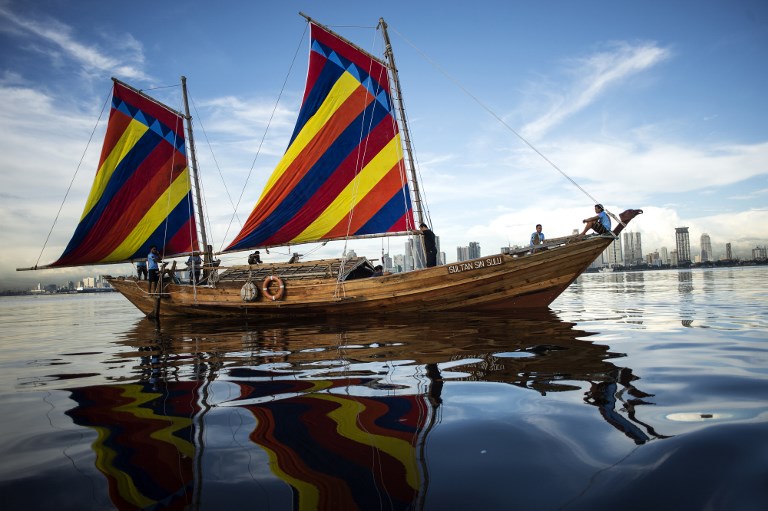
A balangay is traditional Filipino ship, made of wooden planks and pins.  It is used for everything from fishing to hauling cargo, travel and conducting war, and it was likely the boat that carried the original settlers of the Philippines to the islands in ancient times.

The balangay is a boat used by native Filipinos for at least 2,000 years.  The balangay could cross open ocean – with navigation techniques involving the sun, the stars, the wind, cloud formations, wave patterns, and bird migrations.  The word barangay – a variant – is also the word used to describe the basic unit of Filipino political organization, with a meaning similar to clan, before the arrival of the Spanish.  Members of a barangay – typically 30 to 100 families – owed their allegiance to a datu, or chief, who ruled in conjunction with other datus.  So, poetically you could think of your community as the people who were in the same boat as you.

While this system fell away under Spanish rule, the word barangay is still used to describe a neighborhood in the Philippines, an evocative double meaning in a nation so oriented to the sea.

There are a number of distinctions between the modern barangay or Barrio, and the city-states and independent principalities encountered by the Spanish when they first arrived in 1521 and established relatively permanent settlements in 1574. The most glaring difference would be that the modern entity represents a geographical entity, the pre-colonial barangays represented loyalty to a particular head (datu). Even during the early days of Spanish rule, it was not unusual for people living beside each other to actually belong to different barangays.

The barangay of precolonial times was either independent, or belonged to what was only a loose confederation of several barangays, over which the rulers picked among themselves who would be foremost – known as the Pangulo or Rajah. In most cases, his function was to make decisions which would involve multiple barangays, such as disputes between members of two different barangays. Internally, each datu retained his jurisdiction.

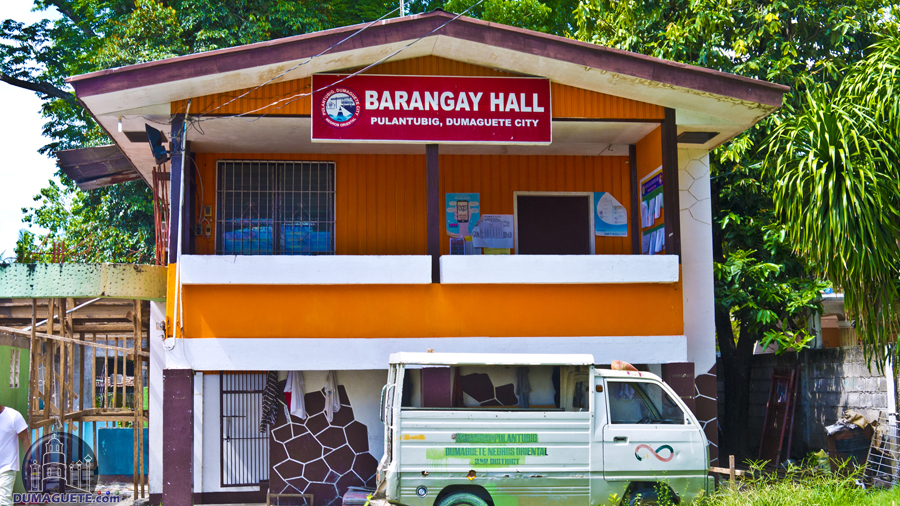
Image result for barangay
The barangay hall is typically a combination of city hall and community center.

timelineWho are the Filipinos?

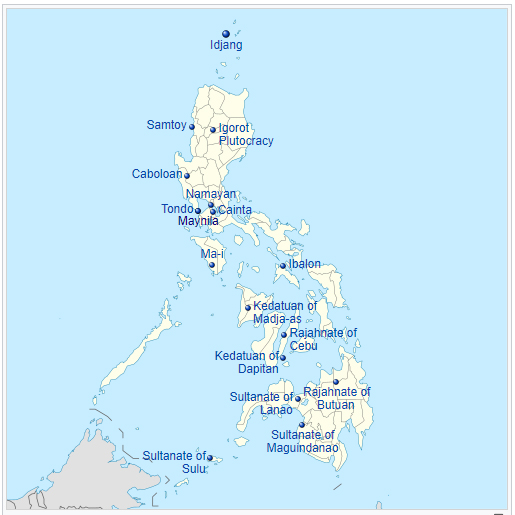
  1. Consider the map of the Philippines – how does the country’s unique geography lend itself to the diversity of its population?
Image result for philippines gold chain ayala
This ten pound pure gold halter is one of the most spectacular artifacts ever found in the Philippines.  It is believed by some to be an Upavita, a ceremonial sacred thread worn members of the Brahmin class of India after a purification ritual – its existence demonstrates the influence of Hinduism and Indian culture in the early Philippines. (Ayala Museum, Makati, Philippines, 2018.)

There is no easy way to describe Filipino culture – no one settled definition – because the Philippines are a particularly diverse nation spread across some 7,000 islands, with hundreds of distinct languages and dialects, thousands of years worth of history, trade, and colonization serving to add color and flavor to what seems like a simple question.

Prior to the advent of European colonialism in the 1500s CE, much Southeast Asia including the Philippines was under the influence of greater India.  India was a wealthy society with well-developed technology and religions.  Indians spread throughout southeast Asia as professionals, traders, priests and warriors, bringing with them a written language (Sanskrit) and religion (Hinduism or Buddhism).


Image result for philippines gold chain ayala
Detail of the sacred thread, woven entirely from gold.

Numerous Indianized principalities and empires flourished for centuries in areas that would become modern Thailand, Indonesia, Malaysia, Singapore, Philippines, Cambodia and Vietnam.  Artwork, philosophy, models for royalty and class structure, as well as written languages in these lands were all influenced by India, similar to the way that Greek culture was a guiding influence on later European societies.  However, each of these countries adapted, blended, and assimilated this Indian influence in its own unique way, giving rise to the great diversity of cultures seen even just in the islands that make up the modern Philippines.

Locations of pre-colonial Polities and Kingdoms.
Locations of pre-colonial Filipino Polities and Kingdoms (900 CE to 1565 CE).

By 1000 BCE, the inhabitants of the Philippine archipelago had developed into four distinct kinds of peoples: tribal groups, such as the AetasHanunooIlongots and the Mangyan who depended on hunter-gathering and were concentrated in forests; warrior societies, such as the Isneg and Kalinga who practiced social ranking and ritualized warfare and roamed the plains; the petty plutocracy of the Ifugao Cordillera Highlanders, who occupied the mountain ranges of Luzon; and the harbor principalities of the estuarine civilizations that grew along rivers and seashores while participating in trans-island maritime trade. It was also during the first millennium BC that early metallurgy was said to have reached the archipelagos of maritime Southeast Asia via trade with India.

Piloncitos, small bead-like gold bits, each about the size of a corn kernel, are considered to be the earliest coin used for trade starting around the 9th Century CE by ancient Filipinos.  This one is marked with Baybayin, and a prehispanic Filipino alphabet.

Around 300–700 CE, the seafaring peoples of the islands traveling in balangays began to trade with the Indianized kingdoms in the Malay Archipelago and the nearby East Asian principalities, adopting influences from both Buddhism and Hinduism.

The Boxer Codex

  1. What is the Boxer Codex, and what can it tell us about the Philippines?
  2. Describe the general social structure of the prehispanic Philippines.  In what ways is it similar to or different from the social structure in your own society?
  3. Consider your status in your own society – to which corresponding class would you belong in ancient Filipino society?  Justify your answer.  Is this different from the class you WISH you belonged to?
  4. Can identify any foreign influence assimilated into the social structure of the Filipinos?
Image result for boxer codex
An illustration from the Boxer Codex depicting a Spanish ship greeted by natives of the Mariana Islands, near the Philippines, naked and seemingly bearing gifts.  The Boxer Codex is one of the earliest attempts to describe Filipino daily life in detail.

The Philippines were ruled as a colony of Spain for 333 years.  This colonial experience transformed the culture and social structure of the islands dramatically, as Spaniards converted Filipinos to Christianity, reorganized barangays into barrios that suited Spanish political needs, and reorganized farming and land use according to their own economic needs.  The diverse languages and traditions of prehispanic Filipinos did not disappear completely, by any means, and much can be learned by talking to and studying the way of life practiced in various parts of the modern Philippines.

However, another important way that historians and anthropologists can gain greater insight into what the Philippines were like before the Spanish arrived is via the Boxer Codex, an illustrated manuscript commissioned by the Spanish around 1590.  The Boxer Codex depicts the TagalogsVisayansZambals, Cagayanes or possibly Ibanags and Negritos of the Philippines in vivid color.  The technique of the paintings, as well as the use of Chinese paper, ink, and paints, suggests that the unknown artist may have been Chinese.  Since Spanish colonial governors were required to submit written reports on the territories they governed, it is likely that the manuscript was written under the orders of the governor.  While it is written from an outsider’s perspective and contains many cultural biases that the Spanish carried with them, it is still an invaluable tool: this richly illustrated document provides a window into Filipino society at a time when the Spanish themselves were trying to gain a clear picture of it.

Social Hierarchy of Pre-colonial Polities


Class Title Description
Maginoo (Ruling Class)
RajaLakan,
Paramount Leader of the confederacy of barangay states. In a confederacy forged by alliances among polities, the datu would convene to choose a paramount chief from among themselves; their communal decision would be based on a datu’s prowess in battle, leadership, and network of allegiances.
Boxer codex.jpg 
Datu
Datus were maginoo with personal followings (dulohan or barangay). His responsibilities included: governing his people, leading them in war, protecting them from enemies and settling disputes. He received agricultural produce and services from his people, and distributed irrigated land among his barangay with a right of usufruct.
Visayans 3.png
Maginoo
Maginoo comprised the ruling class of Tagalogs. Ginoo was both honorific for both men and women.Panginoon were maginoo with many slaves and other valuable property like houses and boats . Lineage was emphasized over wealth; the nouveau riche were derogatorily referred to as maygintawo (fellow with a lot of riches).

Members included: those who could claim noble lineage, members of the datu’s family.

Sultan Powerful governor of a province within the caliphate or dynasties of Islamic regions. Their position was inherited by a direct descent in a royal bloodline who could claim the allegiances of the datu. Sultans took on foreign relations with other states, and could declare war or allow subordinate datus to declare war if need be. The sultan had his court, a prime minister (gugu), an heir to the throne (Rajah Muda or crown prince), a third-ranking dignitary (Rajah Laut, or sea lord) and advisers (pandita).
Timawa and Maharlika (Middle Class and Freemen Visayans 2.png
Timawa
The timawa class were free commoners of Luzon and the Visayas who could own their own land and who did not have to pay a regular tribute to a maginoo, though they would, from time to time, be obliged to work on a datu’s land and help in community projects and events. They were free to change their allegiance to another datu if they married into another community or if they decided to move.

In Luzon, their main responsibility to the datu was agricultural labor, but they could also work in fisheries, accompany expeditions, and row boats. They could also perform irregular services, like support feasts or build houses

In Visayas, they paid no tribute and rendered no agricultural labor. They were seafaring warriors who bound themselves to a datu.

Members included: illegitimate children of maginoo and slaves and former alipin who paid off their debts

Cagayan Warrior.png 
Maharlika
Members of the Tagalog warrior class known as maharlika had the same rights and responsibilities as the timawa, but in times of war they were bound to serve their datu in battle. They had to arm themselves at their own expense, but they did get to keep the loot they won – or stole, depending on which side of the transaction you want to look at. Although they were partly related to the nobility, the maharlikas were technically less free than the timawas because they could not leave a datu’s service without first hosting a large public feast and paying the datu between 6 and 18 pesos in gold – a large sum in those days.
Naturales 1.png 
Alipin/Uripon (Slaves)
Alipin Namamahay Today, the word alipin means slave and that’s how the Spaniards translated it, too, but the alipins were not really slaves in the Western sense of the word. They were not bought and sold in markets with chains around their necks. A better description would be to call them debtors.  Slaves who lived in their own houses apart from their creditor. If the alipin’s debt came from insolvency or legal action, the alipin and his debtor agreed on a period of indenture and an equivalent monetary value in exchange for it. The alipin namamahay was allowed to farm a portion of barangay land, but he was required to provide a measure of threshed rice or a jar of rice wine for his master’s feasts. He came whenever his master called to harvest crops, build houses, row boats, or carry cargo.Members included: those who have inherited debts from namamahay parents, timawa who went into debt, and former alipin saguiguilid who married.
Alipin Saguiguilid Slaves who lived in their creditor’s house and were entirely dependent on him for food and shelter. Male alipin sagigilid who married were often raised to namamahay status, because it was more economical for his master (as opposed to supporting him and his new family under the same roof). However, female alipin sagigilid were rarely permitted to marry.Members included: children born in debtor’s house and children of parents who were too poor to raise them.

The Laguna Copperplate

  1. What is the Laguna Copperplate?  How does it further illuminate our understanding of early Filipino social structure?
  2. Do you have documents that perform similar functions in your own society?  What are they?
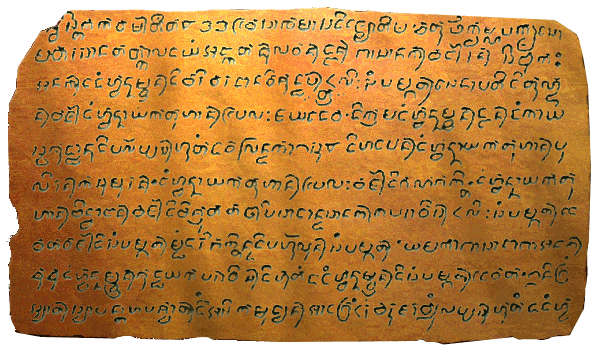
The Laguna Copperplate, a legal document inscribed on a copper plate in 900 AD, is the earliest known written document found in the Philippines.  The document states that it releases its bearers, the children of Namwaran, from a debt in gold amounting to 1 kati and 8 suwarnas (865 grams; 27.8 troy ounces).

The Laguna Copperplate Inscription was found in 1989 near the mouth of the Lumbang River near Laguna de Bay, by a man who was dredging sand to turn into concrete. Suspecting that the artifact might have some value, the man sold it to an antique dealer who, having found no buyers, eventually sold it to the National Museum of the Philippines, where it was assigned to Alfredo E. Evangelista, head of its anthropology department.

The text reads:

Line Transliteration Original translation by Antoon Postma (1991) Notes
1 swasti shaka warshatita 822 waisakha masa ding jyotishachaturthikrishnapaksha so- Hail! In the Saka-year 822; the month of March–April; according to the astronomer: the fourth day of the dark half of the moon; on
2 -mawara sana tatkala dayang angkatan lawan dengannya sanak barngaran si bukah Monday. At that time, Lady Angkatan together with her relative, Bukah by name,
3 anakda dang hwan namwaran di bari waradana wi shuddhapat(t)ra ulih sang pamegat senapati di tundu- the child of His Honor Namwaran, was given, as a special favor, a document of full acquittal, by the Chief and Commander of Tundun
4 n barja(di) dang hwan nayaka tuhan pailah jayadewa. di krama dang hwan namwaran dengan dang kaya- representing the Leader of Pailah, Jayadewa. This means that His Honor Namwran, through the Honorable Scribe
5 stha shuddha nu di parlappas hutangda wale(da)nda kati 1 suwarna 8 di hadapan dang hwan nayaka tuhan pu- was totally cleared of a salary-related debt of 1 kati and 8 suwarna (weight of gold): in the presence of His Honor the Leader of Puliran,
6 liran ka sumuran. dang hwan nayaka tuhan pailah barjadi ganashakti. dang hwan nayaka tu- Kasumuran; His Honor the Leader of Pailah, representing Ganasakti; (and) His Honor the Leader
7 han binwangan barjadi bishruta tathapi sadanda sanak kaparawis ulih sang pamegat de- of Binwangan, representing Bisruta. And, with his whole family, on orders of the Chief of Dewata
8 wata [ba]rjadi sang pamegat medang dari bhaktinda di parhulun sang pamegat. ya makanya sadanya anak representing the Chief of Mdang, because of his loyalty as a subject (slave?) of the Chief, therefore all the descendants
9 chuchu dang hwan namwaran shuddha ya kaparawis di hutangda dang hwan namwaran di sang pamegat dewata. ini gerang of his Honor Namwaran have been cleared of the whole debt that His Honor owed the Chief of Dewata. This (document) is (issued) in case
10 syat syapanta ha pashchat ding ari kamudyan ada gerang urang barujara welung lappas hutangda dang hwa … there is someone, whosoever, some time in the future, who will state that the debt is not yet acquitted of His Honor… * Line 10 of the LCI ends mid-sentence.

A year later, linguist Antoon Postma noted that the inscription was similar to the ancient Indonesian script of Kawi. Postma translated the script and found the document dated itself to the Saka year 822, an old Hindu calendar date which corresponds to 900 AD, making the Laguna Copperplate the earliest example of writing ever found in the Philippines. The document pre-dated the arrival of Ferdinand Magellan in 1521 and is from about the same time as the mention of the first known mention of Philippines in world history, in the official Chinese Song dynasty History of Song for the year 972.

Image result for laguna copperplate inscription
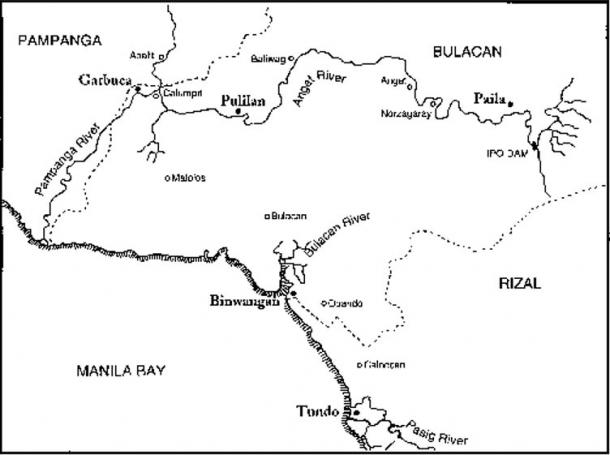
Place names mentioned in the Laguna Copperplate Inscription.

The text of the Laguna Copperplate offers us a window into Tondo culture, an ancient Filipino barangay that thrived along the Pasig River, not far from modern Metro Manila.  Because it is written in Kawi, an Indonesian script, and uses several Sanskrit loan-words, it demonstrates just how connected the Philippines were with other ancient societies in Southeast Asia.

IMG_2018
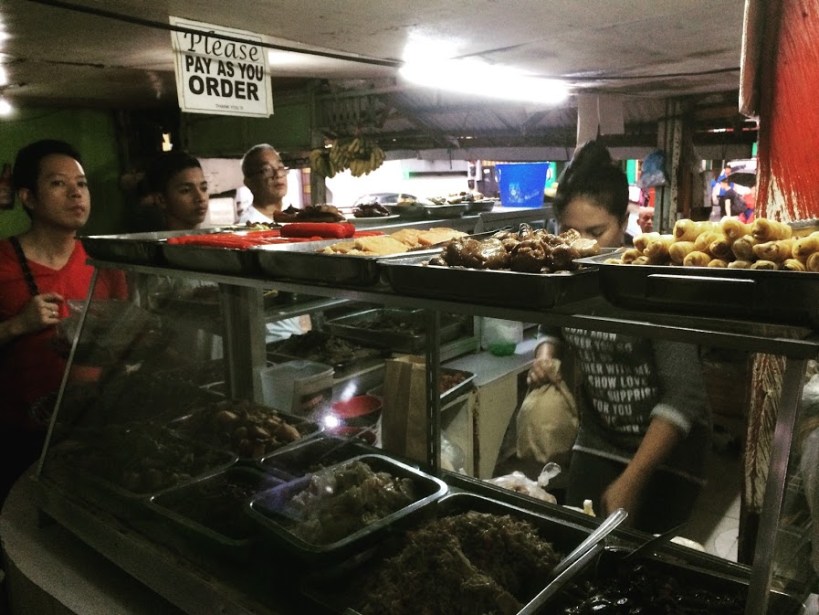
A turo turo is a special kind of Filipino restaurant.  Food is prepared in advance, and customers point, point – turo, turo in Tagalog – to the dishes they want to order. In a turo turo, one can find many of the Philippines’ most popular foods – and a great primer on its history. (Pasig City, Philippines, 2018.)
Available in the turo turo: Adobo is a popular dish in Philippine cuisine that usually involves pork or chicken marinated in vinegar, soy sauce, garlic, and black peppercorns. It has sometimes been considered as the unofficial national dish in the Philippines. Early Filipinos often cooked by immersion in vinegar and salt to preserve the food longer in the island heat.

New Voices, New Flavors

  1. What outside cultures have contributed to the notion of what a Filipino is?  Describe ways in which these newcomers have shaped the Philippines.

Trade and interactions with China have also shaped the culture of the Philippines since ancient times.  Starting in the 900s CE, trade with China become more regular, leading to increased access to Chinese goods as well as intermarriage between Chinese merchants and local Filipino women.  This exchange would culminate in the Manila galleon route during the Spanish colonial period. The arrival of the Spaniards to the Philippines attracted new waves of immigrants from China, and maritime trade flourished during the Spanish period. The Spanish recruited thousands of Chinese migrant workers called sangleys to build the colonial infrastructure in the islands. Many Chinese immigrants converted to Christianity, intermarried with the locals, and adopted Hispanized names and customs and became assimilated.

Image result for lumpia
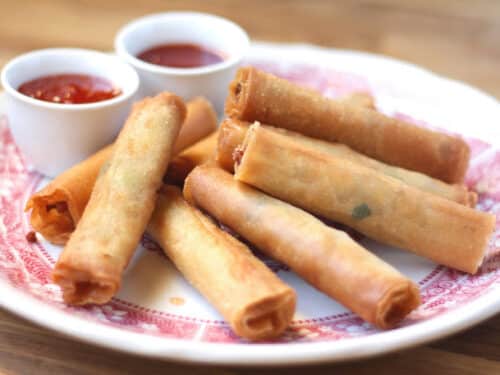
Available in the turo turo: Lumpia are made from meat and vegetables, rolled in a crepe-like shell and usually fried.  They were brought to the Philippines by merchants from China’s Fujian province and have become a favorite Filipino snack.

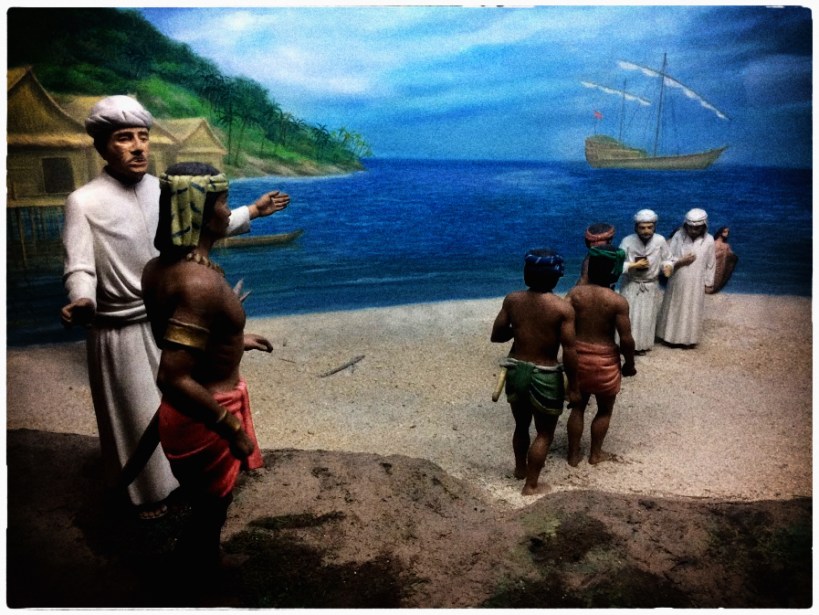
Trade brought Arab and Malay merchants to the Philippines, especially in the southern islands of Mindanao and Palawan.  These traders brought with them their religion – Islam, which continues to be a crucial part of Filipino identity in these islands, where as much as 10% of the population is Muslim.  In fact, it is possible that if the Spanish had arrived much later, Islam could have become the dominant religion of the Philippines; while the independent-minded barangays were conquered one by one by the Spanish, the Muslim sultanates of that existed upon their arrival were united by a cohesive religious identity that contributed to an increased ability to resist Spanish attempts to dominate these islands.

philippinearab
Arab traders have been visiting Philippines for nearly 2000 years. After the advent of Islam, in 1380, Karim ul’ Makhdum, the first Muslim missionary to reach the Sulu Archipelago, brought Islam to what is now the Philippines, first arriving in Jolo. Subsequent visits of Arab Muslim missionaries strengthened the Muslim faith in the Philippines, concentrating in the south and reaching as far north as Manila. (Diorama in the Ayala Museum, Makati, Philippines, 2018.)
Image result for philippine satti
Available in the turo, turo: Satti is skewered, barbecued meat carried throughout the islands of Southeast Asia by Muslim traders.

The arrival of Portuguese explorer Ferdinand Magellan in 1521 began a period of European colonization. During the period of Spanish colonialism the Philippines was part of the Viceroyalty of New Spain, which was governed and controlled from Mexico City. Early Spanish settlers were mostly explorers, soldiers, government officials and religious missionaries born in Spain and Mexico who worked to convert the Philippines into a country that is today 83% Catholic.

2018-06-12 16.33.37
The death of Ferdinand Magellan while engaged in combat with the warriors of Lapu-Lapu became a potent symbol for later Filipino nationalists chaffing under the rule of the Spanish. (Diorama in the Ayala Museum, Makati, Philippines, 2018.)
A lush carving depicting the Virgin Mary – an important symbol for Filipino Catholics – adorns the 400 year old door of San Agustin Church.  The first San Agustin Church was the first religious structure constructed by the Spaniards on the island of Luzon. Made of bamboo and nipa, it was completed in 1571, but destroyed by fire in December 1574 during the attempted invasion of Manila by the forces of the Chinese pirate Limahong. A second wooden structure built on the same site. was destroyed in February 1583, by a fire that started when a candle ignited drapery on the funeral bier during services for Spanish Governor-General Gonzalo Ronquillo de Peñalosa.  The Spanish rebuilt the church using stone beginning in 1586. (Intramuros, Manila, Philippines, 2018.)

The Peninsulares (governors born in Spain), mostly of Castilian ancestry, settled in the islands to govern their territory. Most settlers married the daughters of rajahsdatus and sultans to reinforce the colonization of the islands. The Ginoo and Maharlika castes (royals and nobles) in the Philippines prior to the arrival of the Spanish formed the privileged Principalía (nobility) during the Spanish period.

Image result for longganisa
Available in the turo turo: Longganisa is a (usually, but not always) sweet sausage of Spanish origin eaten widely across the Philippines, with lots of varieties suited to local tastes across difference islands.  Here, it is served with eggs and rice for breakfast, but it be eaten at any meal.  In addition, as part of the Colombian Exchange, Spanish colonizers brought with them produce from the Americas like chili peppers, tomatoes, corn, potatoes, and the method of sautéing with garlic and onions.
Introduced from Spain, Lechón is a whole roasted pig, prepared throughout the year for any special occasion, during festivals, and the holidays. After seasoning, the pig is cooked by skewering the entire animal, entrails removed, on a large rotisserie stick and cooking for several hours in a pit filled with charcoal. The process of cooking and basting usually results in making the pork skin crisp and is a distinctive feature of the dish.

In modern times, the Philippines was an American colony and protectorate, meaning that English became the language of business and education, and the economy and culture of the Philippines was influenced heavily by this interaction.

The jeepney is the most popular form of public transportation in the Philippines and a relic of U.S. occupation.  Surplus Jeeps left behind by the U.S. military upon Philippine independence were transformed – their bodies were extended to increase passenger capacity and decorated in vibrant colors with chrome-plated ornaments on the sides and hood.  Thus was born a unique form of Filipino transportation. (Pasig City, Philippines, 2018.)
Image result for jollibee
Not available in the turo turo: The Americans inspired an abiding love of fried chicken and a distinctive, sweet style of spaghetti.  While you might be able to get each of those at the turo turo, Jollibee is a homegrown Filipino fast food restaurant with more locations across the country than McDonalds – they seem to have the market cornered.

Activities

  1. Seek out some Filipino recipes.  There are also plenty of cooking tutorial videos online.  Visit an Asian grocery store, purchase the necessary ingredients, and actually make a Filipino dish for dinner.  And don’t forget dessert – halo halo is one of my favorites (only the Filipinos would think to put raw beans in an icy desert).
  2. There is a long tradition of resistance to colonial rule in the Philippines. 
    Juan Sumuory is celebrated in the Gallery of Heroes. (Manila, Philippines, 2018.)

    Couple of this with the country’s strong Catholicism – with its tradition of sainthood and martyrdom – and you have nation that is very aware of those who have sacrificed to advance the cause of the Filipino.  Manila’s Rizal Park features the Gallery of Heroes, a row of bust sculpture monuments of historical Philippine heroes.  These include:  Andres Bonifacio, Juan Sumuroy, Aman Dangat, Marcelo H. Del Pilar, Gregorio Aglipay, Sultan Kudarat,  Juan Luna, Melchora Aquino, Rajah Sulayman, and Gabriela Silang.  Choose one of these personalities to commemorate in your own classroom.  Write a brief description of their accomplishments to accompany a piece of artwork that celebrates their life for those who aren’t aware.

FURTHER READING

History of the Philippines: From Indios Bravos to Filipinos by Luis Francia.


Today, the Philippines is increasingly urbanized.  Manila, the capital, is one of the most densely populated cities on the planet. (Manila, Philippines, 2018.)

THIS LESSON WAS INDEPENDENTLY FINANCED BY OPENENDEDSOCIALSTUDIES.ORG.

If you value the free resources we offer, please consider making a modest contribution to keep this site going and growing.

Manila at the Crossroads of World Trade

READ: DO:
A) Growth Mentality Trace the world’s modern sea routes
B) The Manila Galleon Understand the origins of your own stuff
C) The San Diego Consider the winners and losers of globalized trade
This lesson was reported from:
Adapted in part from open sources.

This lesson is a companion to Potosi and the Globalization of an Empire.  It can also be used independently. This text is adapted in part from open sources.

Growth Mentality

  1. What spurred Spain to fund Columbus’s initial expedition?
  2. Why was the silver mined in Potosi of special interest to the Spanish?
2018-06-12 16.36.42
Trade between Filipinos and Chinese predates the arrival of the Spanish by centuries.  (From a diorama in the Ayala Museum, Makati, Philippines, 2018.)

Schoolchildren learn that Columbus sailed under the flag of Spain, and that his venture was funded on the audacious notion that a lucrative trade route with the far east might be established with an easy trip west.  Columbus grossly misjudged the diameter of the Earth, it turns out, though his mistake became one of the most consequential in all of world history, bringing the Eastern and Western Hemispheres into direct contact for the first time, opening the Americas for European conquest and colonization, and inaugurating a period of social, economic, and environmental exchange through which we are still living in the early the early 21st century.

But the Spanish wanted more.  They never gave up on that tantalizing promise of a western trade route with Asia, especially after the initial plunder of the Aztec and the Inca in the early 1500s.

The Spanish continued to extract raw materials from indigenous labor their American colonies, most notably silver from the great mine at Potosi, in modern Bolivia.  Silver mines were opened here in 1545 and soon accounted for fully half of the silver produced in the world on an annual basis.  On its own, the silver mined at Potosi was of little use to Spanish.  The rich don’t love money, but what it can buy for them.  In this case, much of the silver mined at Potosi made its way to Ming China – via the Manila Galleon.

Cerro Rico in Potosi, Bolivia.  This mountain produced an estimated 60% of all silver mined in the world during the second half of the 16th century.

The Manila Galleon

2018-06-12 16.33.37
The death of Ferdinand Magellan while engaged in combat with the warriors of Lapu-Lapu became a potent symbol for later Filipino nationalists chaffing under the rule of the Spanish. (From a diorama in the Ayala Museum, Makati, Philippines, 2018.)
  1. What challenges and what discoveries on behalf of the Spanish led to the opening of the Manila Galleon route?
  2. Did the wealth generated by this trade route benefit all parties equally?  Why or why not?  Consider the Spanish, the Chinese, and Filipinos in your answer, describing the role of each.
  3. Consider modern trade in the same way – does it benefit all parties equally?

In 1521, just after the conquest of the Aztec in Mexico, and just before the conquest of the Inca in Peru, a Spanish expedition led by Ferdinand Magellan sailed west across the Pacific using the westward trade winds. The expedition arrived in the Philippines, finding there a diverse assortment of tribal groups, Muslim sultanates, and most enticing to the Spanish, a small community of Chinese merchants.  Magellan promptly claimed the archipelago for Spain.

Although he died there after involving himself in a local conflict, one of Magellan’s ships made it back to Spain by continuing westward around the tip of Africa.  In the decades that followed, other Spanish sailors figured out how to sail east – rising eastward winds at the 38th parallel north,  off the coast of Japan – back over the Pacific toward Mexico, a journey that under the best of conditions took four months, but sometimes as long as six.  This is an incredibly long time to go without taking on fresh water or food.

route

The goods arrived in Acapulco and were transported by land across Mexico to the port of Veracruz on the Gulf of Mexico, where they were loaded onto the Spanish treasure fleet bound for Spain. From the early days of exploration, the Spanish knew that the American continent was much narrower across the Panamanian isthmus than across Mexico. They tried to establish a regular land crossing there, but the thick jungle and malaria made it impractical.

This route was a vital alternative to the even riskier trip west across the Indian Ocean, and around the Cape of Good Hope, which was reserved to Portugal according to the Treaty of Tordesillas and fraught with European privateers who might commandeer the Spaniard’s valuable cargo.

View of Manila, c. 1665, complete with galleons in the bay.  Notice the fortified, walled Spanish city – Intramuros – in the center, near the Pasig River.  On peninsula in the foreground is Cavite, a shipyard and military outpost that continues to serve the Philippine navy today.

As it was, the city of Manila, representing wealth and a formidable European foothold in Asia, became a regional hub of trade and a target for foreign powers.  At various times, has Manila come under attack by the Chinese, the Dutch, the English, the Americans, and the Japanese.  In 1574, a fleet of Chinese pirates led by Limahong attacked the city and destroyed it before the Spaniards drove them away.  The colony was rebuilt by the survivors. These attacks prompted the construction of a walled, stone city – today known as Intramuros – to anchor and secure the eastern end of Spain’s trade route.

Fort Santiago is a citadel first built by Spanish conquistador, Miguel López de Legazpi for the new established city of Manila in the Philippines. The defense fortress is part of the structures of the walled city of Manila referred to as Intramuros. (Manila, Philippines, 2018.)

The first Manila Galleon made the round trip between Acapulco and Manila in 1565, with galleons making the same circuit nearly every year until Mexican Independence in the early 1800s.  This trade route, whose main hub was Manila, marked a new chapter in globalization, linking the labor and products of Asia, the Americas, and Europe.  While this is a remarkable achievement, it is important to remember that it came about through tremendous hardship, brutality, and exploitation at almost every turn.

Related image
A reconstructed galleon, typical of the sort that would have plied the Pacific route between Manila and Acapulco.

Potosi silver – mined, refined, and transported by native slaves under horrendous conditions – was taken by llama and mule train to the Pacific coast.  From there, the silver was transported by ship up the coast to the port of Acapulco (in present-day Mexico), and from there on to Manila in the Philippines.  This silver was in high demand by the Chinese, who based their monetary system on this precious metal.

Wary of outsiders, the Chinese spurned European attempts to establish trading posts in their home territory.  As a result, the Asian end of the galleon trade was supplied by merchants largely from port areas of Fujian in southern China, who traveled with the blessing of the Chinese Emperor to Manila to sell the Spaniards spices, porcelainivorylacquerware, processed silk cloth, and other valuable commodities.  These are the same products – so valuable in Europe – that in ancient times fueled the Silk Road; the same ones that nearly a century earlier tempted Columbus and other men hungry for profit.

2018-06-12 16.41.26.jpg
In Manila, Filipino laborers load an Acapulco-bound galleon under supervision from Spanish managers, who reaped a disproportionate percentage of the profits.  (From a diorama in the Ayala Museum, Makati, Philippines, 2018.)

As a result, every available corner of the galleon was dedicated to carrying its profitable cargo – reports even suggest that cisterns meant to carry fresh water were sometimes given over to commercial product – and hygiene was poor.  Historian Jan DeVries found that some 2 million men made trading voyages to Asia between 1580 and 1795, but only 920,412 survived: an overall survival rate of just 46%. On the Manila Galleon route, a large number of these men were Filipino, who worked under these harsh conditions for pay that you and I would find appalling – but which represented to them a tremendous windfall, the likes of which were otherwise hard to come by under the poverty of Spanish rule.

Related image
This cross-section of a Spanish galleon hints at the tightly-packed conditions endured by the largely Filipino crews that plied the Manila-Acapulco route.

“In Manila, life was leisurely, even beautiful,” writes David Z. Morris, describing the height of the galleon trade as experienced by the Spanish elite. “The work of administering the galleons took up only two or three months of a year, with the rest of the colonists’ time given purely to lavish parties, carriage rides, and social intrigue. The Spanish were singularly indolent occupiers, developing no aspect of the local economy except the galleon trade.”

The elegant courtyards of Intramuros in Manila bring to mind nothing short of Madrid or Venice – cities of wealth and European culture.  Such was the world of the Spanish colonizer as a result of the lucrative galleon trade, but inaccessible to the vast majority of Filipinos. (Manila, Philippines, 2018.)

By contrast, little of this wealth made its way into the hands of Filipinos.  The Spanish cultivated a deliberate policy of exclusion toward their colonized subjects – prohibiting their education in the Spanish language as means to hold Filipinos from professional jobs and more cosmopolitan views of the world, encouraging Filipino submission through the careful application and withholding of Catholic teachings, and establishing large Spanish-owned estates in the countryside, reducing the Filipino to little more than an unskilled laborer and a tenant in his own homeland, even as its resources were enriched the Spanish conquerors.

From time to time during more than 300 years of Spanish rule, Filipinos openly rebelled against this injustice.  Manila proved to be too lucrative a prize, however, and the Spanish would not let it go so easily, even after Spain’s American colonies achieved independence in the early 1800s.  During these centuries, tens of thousands of Filipinos went abroad – settling at the other end of the galleon route, in Acapulco, in Mexico City, in California, seeking greater opportunity outside of the repressive structures that the Spanish had erected to maintain their domination over Manila.

The San Diego

  1. Why is the discovery and recovery of the San Diego valuable to historians?

Formerly known as San Antonio, the San Diego was a trading ship built in Cebu by Filipino workers under the supervision of European boat-builders. It was docked at the port of Cavite to undergo reconditioning and repair, but at the end of October 1600, under threat of an impending Dutch attack on Manila, it was hastily converted into a warship and renamed.

Sea Battle San Diego Eendracht 1600.jpg
An Illustration of the sinking of the Spanish flagship San Diego after a battle with the Dutch ship Eendracht in Manila Bay in 1600.

On December 14, 1600, the fully laden San Diego was engaged by the Dutch warship Mauritius under the command of Admiral Olivier van Noort a short distance away from Fortune Island, Nasugbu, Philippines. Since San Diego couldn’t handle the extra weight of her cannons, which led to a permanent list and put the cannon portholes below sea level, she was sunk without firing a single shot in response. The Dutch were later reported firing upon and hurling lances at the survivors attempting to climb aboard the Mauritius.

Nearly 400 years later, in 1992, the wreck was discovered by an underwater archaeologist.  A total of 34,407 artifacts were recovered from the shipwreck, including more than five hundred blue-and-white Chinese ceramics in the form of plates, dishes, bottles, kendis, and boxes which may be ascribed to the Wan Li Period of the Ming Dynasty; more than seven hundred and fifty Chinese, Thai, Burmese, and Spanish or Mexican stoneware jars; over seventy Philippine-made earthenware potteries influenced by European stylistic forms and types; parts of Japanese samurai swords; fourteen bronze cannons of different types and sizes; parts of European muskets; stone and lead cannonballs; metal navigational instruments and implements; silver coins from the mint at Potosi; two iron anchors; animal bones and teeth (pig and chicken); and seed and shell remains (prunes, chestnuts, and coconut), all of which shed invaluable light on the physical reality of a Manila Galleon.


Activities

  1. Design a chart that lists the items in the room around you by their locations of manufacture.  Check labels on the items themselves or, when all else fails, ask Google.
  2. Speculate/Research: Choose one of the items that you use every day.  Who physically made this item – were they rich or poor, young or old, male or female?  Under what conditions do they live and work?  Was this item cheap or expensive – why?  Who got most of the money that you or your parents paid – the worker or the corporation whose logo appears on the item?  Consider yourself, the worker, and the corporation – who are the economic winners and losers in this system?  How would your life and the lives of Filipino workers be different if this trade connection did not exist?
  3. Research: What are the primary exports of your country to the Philippines and the rest of the world?  What are the Philippines’s primary exports to your country?   What is the estimated value of trade in both directions?  What kind of modern cultural exchange might accompany this economic exchange? 
  4. Use www.marinetraffic.com/ to examine cargo shipping around the globe.  What patterns do you notice?  Where are the ships most densely clustered?  Find a large port near your hometown – where are these ships coming from and going to?  Can you determine roughly how long it takes for a ship to travel between the Philippines and the US?  Choose several ships and check back in on them over the coming days or weeks – do you notice a route or a pattern for this specific ship, how long it takes to complete this pattern, and so on?
  5. Compare and contrast trade along the Manila Galleon route with modern trade networks.  How have changes in technology changed both how goods are traded – and what is traded?  Does more or less international trade happen now?  Does more or less cultural exchange happen now?  Is trade a force for good or ill in the world?
  6. For Discussion: What kind of resources are involved in the manufacture and transportation of new goods?  Are there more responsible ways to consume?   Ways to avoid consumption all together?

FURTHER READING

History of the Philippines: From Indios Bravos to Filipinos by Luis Francia.

1493: Uncovering the New World Columbus Created by Charles C. Mann.

The bangka outrigger boat is ubiquitous in the modern Philippines, used for purposes as varied as trade, fishing, and ferrying. (Taal Lake, Philippines, 2018.) 

THIS LESSON WAS INDEPENDENTLY FINANCED BY OPENENDEDSOCIALSTUDIES.ORG.

If you value the free resources we offer, please consider making a modest contribution to keep this site going and growing.

The Great Tokyo Air Raid

Introduction

On the night of March 9, 1945 the United States Army Air Forces (USAAF) conducted a devastating firebombing raid on Tokyo, the Japanese capital city. This attack was code-named Operation Meetinghouse by the USAAF and is known as the Great Tokyo Air Raid in Japan. During the raid, bombs dropped from 279 Boeing B-29 Superfortress heavy bombers burned out much of eastern Tokyo. More than 88,000 and possibly over 100,000 Japanese, mostly civilians, were killed and one million left homeless, making it the single most destructive air attack of World War II. The Japanese air and civil defenses proved inadequate, and only 14 American aircraft and 96 airmen were lost.

Black and white photo of people walking along a road passing through a large area of destroyed buildings
A road passing through a part of Tokyo which was destroyed in the March 10, 1945 air raid.

In many parts of the world, World War II is remembered as a patriotic event – a tie that binds nations together, bringing out a peoples’ best qualities such as heroism, sacrifice, and determination.  Such is the case in Russia, where it is remembered literally as the Great Patriotic War. In the United States, the conflict is sometimes termed “the good war,” fought by “the greatest generation.”

But World War II is also notable its sheer ferocity.  Brutality became a science on all sides, systematized and streamlined for maximum effect, cranked out on an industrial scale.  Perhaps no nation committed so fully to this pursuit than the war’s eventual victor, the United States.  With its clockwork air war, refined via the experimental process and statistical analysis, the United States exhibited a chilling commitment to total war against the civilian populations of its enemies.

There is case to be made that this was war – that if the United States had not been so aggressive against Japan and Germany, those nations might have unleashed similar barbarity on the American people.  The ends may justify the means…

But it is also worth considering a question posed by Robert McNamara, one of the architects of the bombing campaign against Japan. “What makes it immoral if you lose and not immoral if you win?” he asked.

Charred remains of Japanese civilians after the firebombing of Tokyo on the night of March 9-10, 1945.

The U.S. government rightfully condemns the atrocities committed by the Japanese against the civilian populations of China or the Philippines, but it is loathe to grapple with the morality its own actions during the war.  This is largely because in the 21st century, the U.S. military continues to rely on many of the same techniques that helped to defeat Japan and Germany so many years ago – that is, the domination of the enemy and any attached civilization populations from the air, be it with incendiary bombs, Agent Orange, napalm, so-called smart missiles, or remotely controlled drones.

To recant on the morality of area bombing of Japan would be to call all of these subsequent strategies into question.

But a free society should never fear honest questions about its conduct – unless it fears the answers.

READ: DO:
A) Early Incendiary Raids Plan your own Bombing Raid
B) The Attack Roleplay as a Japanese Citizen
C) On the Ground
D) Casualties
E) Reaction
This lesson was reported from:
Adapted in part from open sources.

A) Early incendiary raids

  1. How would you describe the planning and preparation that went into the deployment of incendiary bombs against Japan?
  2. What is the difference between precision bombing and area bombing?  How well did precision bombing seem to work in practice?  In your opinion, knowing that this will greatly increase the civilian death tool, is this justification to switch to a policy of area bombing?

In June 1944 the USAAF’s XX Bomber Command began a campaign against Japan using B-29 Superfortress bombers flying from airfields in China. Tokyo was beyond the range of Superfortresses operating from China, and was not attacked. This changed in October 1944, when the B-29s of the XXI Bomber Command began moving into airfields in the Mariana Islands. These islands were close enough to Japan for the B-29s to conduct a sustained bombing campaign against Tokyo and most other Japanese cities. The first Superfortress flight over Tokyo took place on November 1, when a reconnaissance aircraft photographed industrial facilities in city.

Black and white photograph of a World War II-era bomber releasing bombs. The bombs are falling in a scattered pattern.
A B-29 dropping conventional bombs over Japan. Note that the bombs are being scattered by the wind, a common occurrence which made precision bombing difficult.

The attack on Tokyo was an intensification of the air raids on Japan which had commenced in June 1944. Prior to this operation, the USAAF had focused on a precision bombing campaign against Japanese industrial facilities.  Precision bombing refers to the attempted aerial bombing of a target with some degree of accuracy, with the aim of maximizing target damage while limiting collateral damage – destroying a single building in a built up area while causing minimal damage to the surrounding neighborhood.

Because of factors like altitude, wind, and limitations in military technology, these attacks were generally unsuccessful, which contributed to the decision to shift to area bombing – the indiscriminate bombing of city blocks or even whole cities – in this case, using firebombs. The operation during the early hours of March 10 was the first major firebombing raid against a Japanese city, and the USAAF units employed significantly different tactics than those used in precision raids including bombing by night. The extensive destruction caused by the raid led these tactics to become standard for the USAAF’s B-29s until the end of the war.


USAAF planners began assessing the feasibility of a firebombing campaign against Japanese cities in 1943. Japan’s main industrial facilities were vulnerable to such attacks as they were concentrated in several large cities, and a high proportion of production took place in homes and small factories in urban areas. The planners estimated that incendiary bomb attacks on Japan’s six largest cities could cause physical damage to almost 40 percent of industrial facilities and result in the loss of 7.6 million man-months of labor. It was also estimated that these attacks would kill over 500,000 people, render about 7.75 million homeless and force almost 3.5 million to be evacuated. 

The plans for the strategic bombing offensive against Japan developed in 1943 specified that it would transition from a focus on the precision bombing of industrial targets to area bombing from around halfway in the campaign, which was forecast to be in March 1945. The British and American bombing campaign against Germany also included frequent area bombing of cities, which resulted in the deaths of hundreds of thousands of civilians and massive firestorms in cities such as Hamburg and Dresden.

2018-06-27 16.37.10
Two M69 incendiaries in the Edo-Tokyo Museum, 2018.  These would have been dropped as part of a larger cluster. (Tokyo, Japan, 2018.)

Image result for world war ii incendiary bombIn preparation for firebombing raids, the USAAF tested the effectiveness of incendiary bombs on the adjoining German and Japanese-style domestic set-piece building complexes at the Dugway Proving Ground during 1943. These trials demonstrated that M69 incendiaries were particularly effective at starting uncontrollable fires. These weapons were dropped from B-29s in clusters, and used napalm as their incendiary filler. After the bomb struck the ground, a fuse ignited a charge which first sprayed napalm from the weapon, and then ignited it.


Several raids were conducted to test the effectiveness of firebombing against Japanese cities.  On 3 January, 97 Superfortresses were dispatched on a firebombing raid against Nagoya. This attack started some fires, which were soon brought under control by Japanese firefighters. The success in countering the raid led the Japanese to become over-confident about their ability to protect cities against incendiary raids. The next firebombing raid was directed against Kobe on February 4, and bombs dropped from 69 B-29s started fires which destroyed or damaged 1,039 buildings.

On February 19 the Twentieth Air Force issued a new targeting directive for XXI Bomber Command. While the Japanese aviation industry remained the primary target, the directive placed a stronger emphasis on firebombing raids against Japanese cities. The directive also called for a large-scale trial incendiary raid as soon as possible. This attack was made against Tokyo on 25 February. A total of 231 B-29s were dispatched, of which 172 arrived over the city; this was XXI Bomber Command’s largest raid up to that time. The attack was conducted in daylight, with the bombers flying in formation at high altitudes. It caused extensive damage, with almost 28,000 buildings being destroyed. This was the most destructive raid to have been conducted against Japan, and LeMay and the Twentieth Air Force judged that it demonstrated that large-scale firebombing raids were an effective tactic.

The failure of a precision bombing attack on an aircraft factory in Tokyo on March 4 marked the end of the period in which XXI Bomber Command primarily conducted such raids. Civilian casualties during these operations had been relatively low; for instance, all the raids against Tokyo prior to March 10 caused 1,292 deaths in the city.

B) The Attack

  1. Describe the technical aspects of the U.S. attack on Tokyo.  How much of the attack was improvised, and how much of it was carefully orchestrated?

On March 8 LeMay issued orders for a major firebombing attack on Tokyo the next night. The raid was to target a rectangular area north-eastern Tokyo designated Zone I by the USAAF which measured approximately 4 miles (6.4 km) by 3 miles (4.8 km).  It was mainly residential and, with a population of around 1.1 million, was one of the most densely populated urban areas in the world.  Zone I contained few militarily significant industrial facilities, though there were a large number of small factories which supplied Japan’s war industries. The area was highly vulnerable to firebombing, as most buildings were constructed from wood and bamboo and were closely spaced. The orders for the raid issued to the B-29 crews stated that the main purpose of the attack was to destroy the many small factories located within the target area, but also noted that it was intended to cause civilian casualties as a means of disrupting production at major industrial facilities.

The B-29s in the squadrons which were scheduled to arrive over Tokyo first were armed with M47 bombs; these weapons used napalm and were capable of starting fires which required mechanized firefighting equipment to control. The bombers in the other units were loaded with clusters of M69s. The planes were each loaded with between five and seven tons of bombs.

The attack on Tokyo commenced at 12:08 am local time on March 10.  Pathfinder bombers simultaneously approached the target area at right angles to each other. Their M47 bombs rapidly started fires in an X shape, which was used to direct the attacks for the remainder of the force. Each of XXI Bomber Command’s wings and their subordinate groups had been briefed to attack different areas within the X shape to ensure that the raid caused widespread damage. As the fires expanded, the American bombers spread out to attack unaffected parts of the target area. Power’s B-29 circled Tokyo for 90 minutes, with a team of cartographers who were assigned to him mapping the spread of the fires.

Firebombing of Tokyo.jpg
Tokyo burns under B-29 firebomb assault.  This photo is from the May 26, 1945 attack.

The raid lasted for approximately two hours and forty minutes. Visibility over Tokyo decreased over the course of the raid due to the extensive smoke over the city. This led some American aircraft to bomb parts of Tokyo well outside the target area. The heat from the fires also resulted in the final waves of aircraft experiencing heavy turbulence. Some American airmen also needed to use oxygen masks when the odor of burning flesh entered their aircraft.

A total of 279 B-29s attacked Tokyo. As expected by LeMay, the defense of Tokyo was not effective. Many American units encountered considerable antiaircraft fire, but it was generally either aimed at altitudes above or below the bombers and reduced in intensity over time as many gun positions were overrun by fires.  Nevertheless, the Japanese gunners shot down 12 B-29s.

Tokyo-kushu-hikaku.jpg

C) On the ground

  1. What was the effect of the attack?
  2. Should civilians be considered as fair targets in time of war?

Widespread fires rapidly developed across north-eastern Tokyo. Within 30 minutes of the start of the raid the situation was beyond the fire department’s control. An hour into the raid the fire department abandoned its efforts to stop the conflagration. Instead, the firemen focused on guiding people to safety and rescuing those trapped in burning buildings. Over 125 firemen and 500 civil guards who had been assigned to help them were killed, and 96 fire engines destroyed.

Driven by the strong wind, the large numbers of small fires started by the American incendiaries rapidly merged into major blazes. These formed firestorms which quickly advanced in a north-westerly direction and destroyed or damaged almost all the buildings in their path. By an hour after the start of the attack most of eastern Tokyo had either been destroyed or was being affected by fires.

This Tokyo residential section was virtually destroyed.

Civilians who stayed at their homes or attempted to fight the fire had virtually no chance of survival. Historian Richard B. Frank has written that “the key to survival was to grasp quickly that the situation was hopeless and flee.” Soon after the start of the raid news broadcasts began advising civilians to evacuate as quickly as possible, but not all did so immediately.

Thousands of the evacuating civilians were killed. Families often sought to remain with their local neighborhood associations, but it was easy to become separated in the conditions. Few families managed to stay together throughout the night. Escape frequently proved impossible, with roads being rapidly cut by the fires. In many cases entire families were killed.

Many of those who attempted to evacuate to the large parks which had been created as refuges against fires following the 1923 Great Kantō earthquake were killed when the conflagration moved across these open spaces. Others sheltered in solid buildings, such as schools or theatres, and in canals. These were not proof against the firestorm, with smoke inhalation and heat killing large numbers of people in schools. Many of the people who attempted to shelter in canals were killed by smoke or when the passing firestorm sucked oxygen out of the area. However, these bodies of water provided safety to thousands of others. The fire finally burnt itself out during mid-morning on March 10.

Image result for tokyo air raid color

D) Casualties

  1. Why is it hard to estimate the total loss of life during the Tokyo attack of March 9-10?
  2. American coverage of the bombing of Tokyo – during the war and ever since – typically features photos like the one immediately above.  Why wouldn’t war time leaders want to show Americans photos like the one immediately below? 
  3. Look in any American textbook you can find – are there any photos like the one below?  Should students be spared seeing the human cost of their country’s wars?

The large scale population movements out of and into Tokyo in the period before the raid, deaths of entire communities and destruction of records mean that it is not possible to know exactly how many died. Most of the bodies which were recovered were buried in mass graves during the days after the raid without being identified. Many bodies of people who had died while attempting to shelter in rivers were swept into the sea and never recovered.

The charred body of a woman who was carrying a child on her back.

Estimates of the number of people killed in the bombing of Tokyo on 10 March differ. Following the raid 79,466 bodies were recovered and recorded. Many other bodies were not recovered, however, and the city’s director of health estimated that 83,600 people were killed and another 40,918 wounded. The Tokyo fire department put the casualties at 97,000 killed and 125,000 wounded, and the Tokyo Metropolitan Police Department believed that 124,711 people had been killed or wounded. Following the war, the United States Strategic Bombing Survey estimated that 87,793 people had been killed and 40,918 injured. The Survey also stated that the majority of the casualties were women, children and elderly people.

American casualties were 96 airmen killed or missing, and 6 wounded or injured.

Black and white map of Tokyo shaded with the areas of the city which were destroyed in different air raids
A map showing the areas of Tokyo which were destroyed during World War II. The area burnt out during the raid on March 9-10 is marked in black.

The raid also caused widespread destruction. Police records show that 267,171 buildings were destroyed, and 1,008,005 survivors were rendered homeless. This represents a quarter of all buildings in Tokyo at the time. Most buildings in the Asakusa, Fukagawa, Honjo, Joto and Shitaya wards were destroyed, and seven other districts of the city experienced the loss of around half their buildings. Parts of another 14 wards suffered damage. Overall, 15.8 square miles (41 km2) of Tokyo was burnt out. The number of people killed and area destroyed was the largest of any single air raid of World War II, including the atomic bombings of Hiroshima and Nagasaki.

While today, those atomic bombings are widely recognized to be uniquely devastating acts – inaccurately remembered as knock-out blows that ended the war, and worthy subject of another lesson – it is important to think of them in the context of the larger fire bombing campaign against Japanese cities.  By the time Hiroshima was bombed on August 6, 1945, the Americans had been destroying whole Japanese cities – and their civilian inhabitants – on a regular basis for nearly six months.

liberty.jpg
Wartime U.S. propaganda often emphasized the otherness of the Japanese, portraying them as less than human.

E) Reactions

  1. In your opinion, was the attack on Tokyo a success?
  2. Imagine you are the President of the United States during World War II – how many Japanese deaths are acceptable to save one American life?
  3. How would you respond to McNamara’s question?

LeMay considered the operation to have been a significant success on the basis of reports made by the airmen involved and the extensive damage shown in photographs taken by reconnaissance aircraft on March 10. The aircrew who conducted the attack were also pleased with its results. The raid was followed by similar attacks against Nagoya on the night of March 11/12, Osaka in the early hours of March 14, Kobe on March 17/18, and Nagoya again on March 18/19. An unsuccessful night precision raid was also conducted against an aircraft engine factory in Nagoya on March 23/24. The firebombing attacks ended only because XXI Bomber Command’s stocks of incendiaries were exhausted.

Image result for tokyo firebombing

Further incendiary attacks were conducted against Tokyo, with the final taking place on the night of May 25/26. By this time, 50.8 percent of the city had been destroyed and more than 4 million people left homeless. Further heavy bomber raids against Tokyo were judged to not be worthwhile, and it was removed from XXI Bomber Command’s target list. By the end of the war, 75 percent of the sorties conducted by XXI Bomber Command had been part of firebombing operations. Few concerns were raised in the United States during the war about the morality of the 10 March attack on Tokyo or the other firebombing raids directed against Japanese cities.

Image result for dwelling of remembrance tokyo
The Dwelling of Remembrance memorial in Yokoamicho Park, Tokyo. (Tokyo, Japan, 2018.)

Following the war the bodies which had been buried in mass graves were exhumed and cremated. The ashes were interred at a charnel house in Yokoamicho Park which had originally been established to hold the remains of 58,000 victims of the 1923 earthquake. A Buddhist service has been conducted to mark the anniversary of the raid on 10 March each year since 1951. A number of small neighbourhood memorials were established across the affected area in the years after the raid.

Few other memorials were erected to commemorate the attack in the decades after the war. Efforts began in the 1970s to construct an official Tokyo Peace Museum to mark the raid, but the Tokyo Metropolitan Assembly cancelled the project in 1999. Instead, the Dwelling of Remembrance memorial to civilians killed in the raid was built in Yokoamicho Park. This memorial was dedicated in March 2001. The citizens who had been most active in campaigning for the Tokyo Peace Museum established the privately-funded Center of the Tokyo Raids and War Damage, which opened in 2002.

One man who helped to plan the attack on Tokyo was Robert McNamara, an American whose job it was to maximize the destructiveness of U.S. air raids on Japan.

“We burned to death 100,000 Japanese civilians in Tokyo — men, women and children,” he recalled later in life. “LeMay said, ‘If we’d lost the war, we’d all have been prosecuted as war criminals.’ And I think he’s right. He — and I’d say I — were behaving as war criminals.”

“What makes it immoral if you lose and not immoral if you win?” he asked.

As noted in his New York Times obituary, McNamara, who could effectively organize the complex attack described above found this latter question impossible to answer.


Activities

  1. In a small group, plan your own strategic bombing strike against an enemy city.  Your goal is to win the war.  Assign each of the following targets a priority rating of one through ten, one being an unacceptable target for attack, to be avoided, and ten being the highest priority for destruction.  You may use numbers more than once, but be sure to explain your rationale for assigning each number.
    • A steel mill
    • A government office
    • A military base
    • A military hospital
    • A factory canning food
    • An elementary school
    • A high school
    • A railroad yard
    • A dam
    • Workers’ housing near a factory
  2. OWI Leaflet #2106 – a warning dropped over Japanese cities on August 1, 1945 in the run up to the atomic bombing of Hiroshima.

    The U.S. military preceded many of its bombing raids by raining cautionary leaflets over Japanese cities.  Its Japanese text carried the following warning: “Read this carefully as it may save your life or the life of a relative or friend. In the next few days, some or all of the cities named on the reverse side will be destroyed by American bombs. These cities contain military installations and workshops or factories which produce military goods. We are determined to destroy all of the tools of the military clique which they are using to prolong this useless war. But, unfortunately, bombs have no eyes. So, in accordance with America’s humanitarian policies, the American Air Force, which does not wish to injure innocent people, now gives you warning to evacuate the cities named and save your lives. America is not fighting the Japanese people but is fighting the military clique which has enslaved the Japanese people. The peace which America will bring will free the people from the oppression of the military clique and mean the emergence of a new and better Japan. You can restore peace by demanding new and good leaders who will end the war. We cannot promise that only these cities will be among those attacked but some or all of them will be, so heed this warning and evacuate these cities immediately.”  Imagine that you are resident of Tokyo and you find this message in your backyard.  Do you believe it?  What options for action do you reasonably have? What do you do?  Write a short story following this scenario.


THIS LESSON WAS INDEPENDENTLY FINANCED BY OPENENDEDSOCIALSTUDIES.ORG.

If you value the free resources we offer, please consider making a modest contribution to keep this site going and growing.

Tokyo has rebounded.  Japan is now one of the world’s most prosperous economies, achieving through peace and commerce what it could not through war and conquest. (Shibuya, Japan, 2018.)

You can actually visit parts of the world featured in this lesson:

Solemn Feats of the Atomic Tourist – A travel journal documenting a two week educational trip to Kyoto, Hiroshima, and Nagasaki, made in an effort to better understand the legacy of the atomic bombing of Japan, originally published as a zine in 2012.

Who Caused the Cold War?

This lesson was reported from:
Adapted in part from open sources.

The Cold War was a state of geopolitical tension after World War II between powers in the Eastern Bloc (the Soviet Union and its satellite states) and powers in the Western Bloc (the United States, its NATO allies and others). Historians do not fully agree on the dates, but a common timeframe is the period between 1947, the year the Truman Doctrine, a U.S. foreign policy pledging to aid nations threatened by Soviet expansionism, was announced, and either 1989, when communism fell in Eastern Europe, or 1991, when the Soviet Union collapsed. The term “cold” is used because there was no large-scale fighting directly between the two sides, but they each supported major regional wars known as proxy wars.

The “Big Three” at the Yalta Conference: Winston ChurchillFranklin D. Roosevelt and Joseph Stalin, 1945.

The Cold War split the temporary wartime alliance against Nazi Germany, leaving the Soviet Union and the United States as two superpowers with profound economic and political differences.

The USSR was a Marxist–Leninist state led by its Communist Party, which in turn was dominated by a leader with different titles over time, and a small committee called the Politburo. The Party controlled the press, the military, the economy and many organizations. It also controlled the other states in the Eastern Bloc, and funded Communist parties around the world.

At the end of World War II, the Soviet Union’s primary goals were (in no particular order):

  1. The spread of socialism as a moral imperative.  A major tenet of communist ideology is that capitalism is unjust – it denies basic necessities like shelter, food, and healthcare to workers, concentrating a society’s wealth instead in the hands of an elite, wealthy group of business owners.  What is more, the United States, both in rhetoric and in action, took steps to bolster and spread this capitalist system (paired with democracy when convenient) around the world.  It is important to understand that many Soviets really, sincerely believed in this cause was one of good versus evil, and that they were on the right side of history.
  2. A geographic buffer of friendly, socialist nations, primarily in Eastern Europe, providing the USSR with military and economic security.  All of this was meant to promote stability and even prosperity for the Soviet people.  This goal included keeping a post-World War II Germany weak – Europe’s second largest economy had been a major driver behind two wars in as many generations, costing the Soviet Union nearly 30 million lives in World War II alone.  The Soviets doubted whether a strong Germany could be a peaceful one.
  3. Balance with the United States, which as the leading capitalist nation and the world’s sole nuclear power, was regarded as not only hostile, but as an active threat.  It is also important to remember that during the Russian Revolution, the United States had militarily opposed the communists, and for nearly twenty years, until the rise of the Nazi military threat, had refused to acknowledge their legitimacy as the government of the Soviet Union – in short, the U.S. had been opposed to the very existence of the USSR for most of its history.  In particular, Joseph Stalin, the leader of the Soviet Union during the initial years of the Cold War, was suspicious – some would say paranoid – about the hostility of the outside world toward the Soviet Union – and willing to take dramatic actions to secure its interests.
EasternBloc BorderChange38-48.svg
Post-war territorial changes in Europe and the formation of the Eastern Bloc, the so-called ‘Iron Curtain’.

In opposition stood the capitalist West, led by the United States, a federal republic with a two-party presidential system. The First World nations of the Western Bloc were generally liberal democratic with a free press and independent organizations, but were economically and politically entwined with a network of banana republics and other authoritarian regimes throughout the Third World, most of which were the Western Bloc’s former colonies.

At the end of World War II, the United State’s primary goals were (in no particular order):

  1. Economic growth for the United States through free trade.  The U.S. sought to eliminate trade barriers to create markets for American agricultural and industrial products, as well as to ensure access to raw materials (such as oil) demanded by U.S. consumers.  The Great Depression (1929-1940) had really only ended with the coming of World War II, and American politicians and businessmen were determined that the end of the war not mean a reversal of American fortunes – what was good for business was good for the country.
  2. Supporting anti-communist governments abroad, whether democratic or not.  U.S. rhetoric emphasized the spread of democracy and the importance of individual freedoms such as the ones outlined in the U.S. Bill of Rights.  In reality, during the Cold War, the United States was typically far less concerned about the will of the citizens of foreign countries, and more interested in supporting anti-communist governments, coups, and rebels around the world, either through open military support, financial support, or covert action, regardless of their record on democracy or human rights.
  3. Balancing the strength of the Soviet Union in areas such as geographic influence, nuclear weapons, and general military power.  U.S. politicians frequently cited Soviet emphasis on collective management of the economy over individual rights and freedoms (such as in the U.S. system) as evidence of tyranny – and even evil.  The Soviet Union was perceived to be aggressive and expansionist, with immediate aims to take over the world.  U.S. President Franklin Roosevelt died in April, 1945, just months before the end of World War II, at a time before the wartime alliance was really tested by differing post-war goals.  However, his successor, Harry Truman, is widely considered to have believed in a tougher anti-Soviet position than Roosevelt.


Historians still bitterly dispute just how and why this tense state of affairs persisted for more than four decades.  Was it inevitable?  Could certain choices by either side have deescalated or even avoided the conflict all together?

Read the following four situation summaries, which are written as objectively as possible.  For each scenario answer the following three questions:

  1. Summarize the scenario from the point of view of the Soviet Union, making them the “good guys” of the story, taking into consideration that country’s goals (as enumerated above).  Do the same for the United States.
  2. In your opinion, who was the primary aggressor in this situation – the United States, the Soviet Union, or are they both equally to blame?  Why?
  3. What lessons might the Soviet Union and the United States draw about each other from this experience?  Can the other side be trusted?  Is the other side being confrontational?  Expansionist?  

Situation A: Atomic Diplomacy, 1945

(Adapted from “Milestones in the History of U.S. Foreign Relations” by the Historian of the U.S. Department of State)
Image result for hiroshima atomic bomb explosion
Atomic bombing of Nagasaki on August 9, 1945, six miles from the epicenter.

During the Second World War, the United States, Britain, Germany and the U.S.S.R. were all engaged in scientific research to develop the atomic bomb. By mid-1945, however, only the United States had succeeded, and it used two atomic weapons on the cities of Hiroshima and Nagasaki to bring a rapid and conclusive end to the war with Japan. U.S. officials did not debate at length whether to use the atomic bomb against Japan, but argued that it was a means to a faster end to the Pacific conflict that would ensure fewer conventional war casualties. They did, however, consider the role that the bomb’s impressive power could play in postwar U.S. relations with the Soviet Union.

A nuclear bomb victim lies in quarantine on the island of Ninoshima in Hiroshima, Japan, 9,000-meter (9,843-yard) from the epicenter on Aug. 7, 1945, one day after the bombing by the United States.

While presiding over the U.S. development of nuclear weapons, President Franklin Roosevelt made the decision not to inform the Soviet Union of the technological developments. After Roosevelt’s death, President Harry Truman had to decide whether to continue this policy of guarding nuclear information. Ultimately, Truman mentioned the existence of a particularly destructive bomb to Soviet Premier Joseph Stalin at the Allied meeting at Potsdam, but he did not provide specifics about the weapon or its uses. By mid-1945, it was clear the Soviet Union would enter into the war in the Pacific and thereby be in a position to influence the postwar balance of power in the region. U.S. officials recognized there was little chance of preventing this, although they preferred a U.S.-led occupation of Japan rather than a co-occupation as had been arranged for Germany. Some U.S. policymakers hoped that the U.S. monopoly on nuclear technology and the demonstration of its destructive power in Japan might influence the Soviets to make concessions, either in Asia or in Europe. Truman did not explicitly threaten Stalin with the bomb, recognizing instead that its existence alone would limit Soviet options and be considered a threat to Soviet security.

Image result for truman potsdam
Joseph Stalin, Harry Truman meeting, and Winston Churchill at the Potsdam Conference, 1945.

Scholars debate the extent to which Truman’s mention of the bomb at Potsdam and his use of the weapon in Japan represent atomic diplomacy. In 1965, historian Gar Alperovitz published a book which argued that the use of nuclear weapons on the Japanese cities of Hiroshima and Nagasaki was intended to gain a stronger position for postwar diplomatic bargaining with the Soviet Union, as the weapons themselves were not needed to force the Japanese surrender. Other scholars disagree, and suggest that Truman thought the bomb necessary to achieve the unconditional surrender of recalcitrant Japanese military leaders determined to fight to the death. Even if Truman did not intend to use the implied threat of the weapon to gain the upper hand over Stalin, the fact of the U.S. atomic monopoly following the successful atomic test at Alamogordo, New Mexico in July of 1945 seemed to have bolstered his confidence at subsequent meetings, making him more determined to obtain compromises from the Soviet government. Even so, if U.S. officials hoped that the threat of the bomb would soften Soviet resistance to American proposals for free elections in Eastern Europe or reduced Soviet control over the Balkans, they were disappointed, as the security issues raised by the dawn of the atomic age likely made the Soviet Union even more anxious to protect its borders with a controlled buffer zone.

Image result for truman atomic bomb quotes

In the years that immediately followed the Second World War, the U.S. confidence in its nuclear monopoly had ramifications for its diplomatic agenda. The fact of the bomb was useful in ensuring that Western Europe would rely on the United States to guarantee its security rather than seeking an outside accommodation with the Soviet Union, because even if the United States did not station large numbers of troops on the continent, it could protect the region by placing it under the American “nuclear umbrella” of areas that the United States professed to be willing to use the bomb to defend. The U.S. insistence on hegemony in the occupation and rehabilitation of Japan stemmed in part from the confidence of being the sole nuclear power and in part from what that nuclear power had gained: Japan’s total surrender to U.S. forces. Though it inspired greater confidence in the immediate postwar years, the U.S. nuclear monopoly was not of long duration; the Soviet Union successfully exploded its first atomic bomb in 1949.

Situation B: The Truman Doctrine, 1947

(Adapted from “Milestones in the History of U.S. Foreign Relations” by the Historian of the U.S. Department of State)

With the Truman Doctrine, President Harry S. Truman established that the United States would provide political, military and economic assistance to all democratic nations under threat from external or internal authoritarian forces. The Truman Doctrine effectively reoriented U.S. foreign policy, away from its usual stance of withdrawal from regional conflicts not directly involving the United States, to one of possible intervention in far away conflicts.

The Truman Doctrine arose from a speech delivered by President Truman before a joint session of Congress on March 12, 1947. The immediate cause for the speech was a recent announcement by the British Government that, as of March 31, it would no longer provide military and economic assistance to the Greek Government in its civil war against the Greek Communist Party. Truman asked Congress to support the Greek Government against the Communists. He also asked Congress to provide assistance for Turkey, since that nation, too, had previously been dependent on British aid.

Image result for truman doctrine

At the time, the U.S. Government believed that the Soviet Union supported the Greek Communist war effort and worried that if the Communists prevailed in the Greek civil war, the Soviets would ultimately influence Greek policy. In fact, Soviet leader Joseph Stalin had deliberately refrained from providing any support to the Greek Communists and had forced Yugoslav Prime Minister Josip Tito to follow suit, much to the detriment of Soviet-Yugoslav relations. However, a number of other foreign policy problems also influenced President Truman’s decision to actively aid Greece and Turkey. In 1946, four setbacks, in particular, had served to effectively torpedo any chance of achieving a durable post-war rapprochement with the Soviet Union: the Soviets’ failure to withdraw their troops from northern Iran in early 1946 (as per the terms of the Tehran Declaration of 1943); Soviet attempts to pressure the Iranian Government into granting them oil concessions while supposedly fomenting irredentism by Azerbaijani separatists in northern Iran; Soviet efforts to force the Turkish Government into granting them base and transit rights through the Turkish Straits; and, the Soviet Government’s rejection of the Baruch plan for international control over nuclear energy and weapons in June 1946.

cold warIn light of the deteriorating relationship with the Soviet Union and the appearance of Soviet meddling in Greek and Turkish affairs, the withdrawal of British assistance to Greece provided the necessary catalyst for the Truman Administration to reorient American foreign policy. Accordingly, in his speech, President Truman requested that Congress provide $400,000,000 worth of aid to both the Greek and Turkish Governments and support the dispatch of American civilian and military personnel and equipment to the region.

Truman justified his request on two grounds. He argued that a Communist victory in the Greek Civil War would endanger the political stability of Turkey, which would undermine the political stability of the Middle East. This could not be allowed in light of the region’s immense strategic importance to U.S. national security. Truman also argued that the United States was compelled to assist “free peoples” in their struggles against “totalitarian regimes,” because the spread of authoritarianism would “undermine the foundations of international peace and hence the security of the United States.” In the words of the Truman Doctrine, it became “the policy of the United States to support free peoples who are resisting attempted subjugation by armed minorities or by outside pressures.”

Image result for truman doctrine
Truman Doctrine Cartoon by Granger, 1947.

Truman argued that the United States could no longer stand by and allow the forcible expansion of Soviet totalitarianism into free, independent nations, because American national security now depended upon more than just the physical security of American territory. Rather, in a sharp break with its traditional avoidance of extensive foreign commitments beyond the Western Hemisphere during peacetime, the Truman Doctrine committed the United States to actively offering assistance to preserve the political integrity of democratic nations when such an offer was deemed to be in the best interest of the United States.

Situation C: The Marshall Plan

One of a number of posters created to promote the Marshall Plan in Europe. Note the pivotal position of the American flag.
(Adapted from “The Marshall Plan” by the Historian of the U.S. Department of State)

In the immediate post-World War II period, Europe remained ravaged by war and thus susceptible to exploitation by an internal and external Communist threat. In a June 5, 1947, speech to the graduating class at Harvard University, Secretary of State George C. Marshall issued a call for a comprehensive program to rebuild Europe.

The Marshall Plan was an American initiative to aid Western Europe, in which the United States gave over $13 billion (nearly $110 billion in 2016 US dollars)[2] in economic assistance to help rebuild Western European economies after the end of World War II. The plan was in operation for four years beginning on April 3, 1948.  The Marshall Plan’s official mission was to give a boost to the European economy: to promote European production, to bolster European currency, and to facilitate international trade, especially with the United States, whose economic interest required Europe to become wealthy enough to import US goods. Another unofficial goal of the Marshall Plan was the containment of growing Soviet influence in Europe, evident especially in the growing strength of communist parties in Czechoslovakia, France, and Italy.  The Marshall Plan required a lessening of interstate barriers, a dropping of many regulations, and encouraged an increase in productivitytrade union membership, as well as the adoption of modern business procedures.  


Countries that received Marshall Plan aid. The red columns show the relative amount of total aid received per nation.

The Marshall Plan aid was divided amongst the participant states roughly on a per capita basis. A larger amount was given to the major industrial powers, as the prevailing opinion was that their resuscitation was essential for general European revival. Somewhat more aid per capita was also directed towards the Allied nations, with less for those that had been part of the Axis or remained neutral. The largest recipient of Marshall Plan money was the United Kingdom (receiving about 26% of the total), followed by France (18%) and West Germany (11%). Some eighteen European countries received Plan benefits.

Although offered participation, the Soviet Union refused Plan benefits, and also blocked benefits to Eastern Bloc countries, such as Hungary and Poland. In a statement, the Soviet Union argued that through the Marshall Plan, “the bosses of Wall Street” were “tak[ing] the place of Germany, Japan and Italy […] the American plan for the enslavement of Europe.”  The Soviets further described the world now breaking down “into basically two camps—the imperialist and antidemocratic camp on the one hand, and the antiimperialist and democratic camp on the other.”

US aid to Greece under the Marshall Plan.

The years 1948 to 1952 saw the fastest period of growth in European history. Industrial production increased by 35%. Agricultural production substantially surpassed pre-war levels. The poverty and starvation of the immediate postwar years disappeared, and Western Europe embarked upon an unprecedented two decades of growth that saw standards of living increase dramatically. Additionally, the long-term effect of economic integration raised European income levels substantially, by nearly 20 percent by the mid-1970s. There is some debate among historians over how much this should be credited to the Marshall Plan. Most reject the idea that it alone miraculously revived Europe, as evidence shows that a general recovery was already underway.


The political effects of the Marshall Plan may have been just as important as the economic ones. Marshall Plan aid allowed the nations of Western Europe to relax austerity measures and rationing, reducing discontent and bringing political stability. The communist influence on Western Europe was greatly reduced, and throughout the region, communist parties faded in popularity in the years after the Marshall Plan. The trade relations fostered by the Marshall Plan helped forge the North Atlantic alliance that would persist throughout the Cold War in the form of NATO. At the same time, the nonparticipation of the states of the Eastern Bloc was one of the first clear signs that the continent was now divided.

Situation D: The Berlin Blockade, 1948-1949

(Adapted from “Milestones in the History of U.S. Foreign Relations” by the Historian of the U.S. Department of State)
Post-war Allied occupation zones in Germany.

At the end of the Second World War, U.S., British, and Soviet military forces divided and occupied Germany. Also divided into occupation zones, Berlin was located far inside Soviet-controlled eastern Germany. The United States, United Kingdom, and France controlled western portions of the city, while Soviet troops controlled the eastern sector. As the wartime alliance between the Western Allies and the Soviet Union ended and friendly relations turned hostile, the question of whether the western occupation zones in Berlin would remain under Western Allied control or whether the city would be absorbed into Soviet-controlled eastern Germany led to the first Berlin crisis of the Cold War. The crisis started on June 24, 1948, when Soviet forces blockaded rail, road, and water access to Allied-controlled areas of Berlin. The United States and United Kingdom responded by airlifting food and fuel to Berlin from Allied airbases in western Germany. The crisis ended on May 12, 1949, when Soviet forces lifted the blockade on land access to western Berlin.

U.S. Navy and Air Force aircrafts unload at Tempelhof Airport during the Berlin Airlift.

The crisis was a result of competing occupation policies and rising tensions between Western powers and the Soviet Union. After the end of the Second World War, the future of postwar Germany was plagued by the divisions within and between Allied powers. The only decision of significance that emerged from wartime planning was the agreement of zones of occupation. Even after the end of hostilities, the problem of what to do about Germany was not successfully addressed at the July 1945 Potsdam Conference. Not only was there a lack of consistency in the political leadership and policymaking among the British and the Americans, occupation policy on the ground also confronted unforeseen challenges. Two and a half million Berliners, spread between four zones of occupation, faced profound privations: Allied bombing had reduced the city to rubble, shelter and warmth were scarce, the black market dominated the city’s economic life, and starvation loomed. While mired in such conditions, Berlin emerged as a forward salient in the Western struggle against the Soviet Union.

The year 1947 saw major shifts in occupation policy in Germany. On January 1, the United States and United Kingdom unified their respective zones and formed Bizonia, which caused tensions between East and West to escalate. In March, the breakdown of the Moscow Conference of Foreign Ministers and the enunciation of the Truman Doctrine served to harden the lines of an increasingly bipolar international order. In June, Secretary of State George Marshall announced the European Recovery Program. The purpose of the Marshall Plan—as the program came to be called—was not only to support economic recovery in Western Europe, but also to create a bulwark against Communism by drawing participating states into the United States’ economic orbit.

In early 1948, the United States, United Kingdom, and France secretly began to plan the creation of a new German state made up of the Western Allies’ occupation zones. In March, when the Soviets discovered these designs, they withdrew from the Allied Control Council, which had met regularly since the end of the war in order to coordinate occupation policy between zones. In June, without informing the Soviets, U.S. and British policymakers introduced the new Deutschmark to Bizonia and West Berlin. The purpose of the currency reform was to wrest economic control of the city from the Soviets, enable the introduction of Marshall Plan aid, and curb the city’s black market. Soviet authorities responded with similar moves in their zone. Besides issuing their own currency, the Ostmark, the Soviets blocked all major road, rail, and canal links to West Berlin, thus starving it of electricity, as well as a steady supply of essential food and coal.

The United States and United Kingdom had few immediate options if hostilities broke out. Because of the draw down in U.S. and British combat forces since the end of the Second World War, the Red Army stationed in and around Berlin dwarfed the Western Allied military presence. On June 13, 1948, the administrator of U.S.-occupied Germany General Lucius Clay reported to Washington that “There is no practicability in maintaining our position in Berlin and it must not be evaluated on that basis…. We are convinced that our remaining in Berlin is essential to our prestige in Germany and in Europe. Whether for good or bad, it has become a symbol of the American intent.” The Truman administration agreed. Based upon written agreements with the Soviet Union in 1945, the only connections to Berlin left to the Western Allies were air corridors from West Germany used to supply Berlin by air. The administration calculated that if the Soviets opposed the airlift with force, it would be an act of aggression against an unarmed humanitarian mission and the violation of an explicit agreement. Thus, the onus of igniting a conflict between the former allies would be on the aggressor.

The only three permissible air corridors to Berlin.
Berliners watching a C-54 land at Tempelhof Airport (1948).

The United States launched “Operation Vittles” on June 26, with the United Kingdom following suit two days later with “Operation Plainfare.” Despite the desire for a peaceful resolution to the standoff, the United States also sent to the United Kingdom B-29 bombers, which were capable of carrying nuclear weapons. The beginning of the airlift proved difficult and Western diplomats asked the Soviets to seek a diplomatic solution to the impasse. The Soviets offered to drop the blockade if the Western Allies withdrew the Deutschmark from West Berlin.

Loading milk on a West Berlin-bound aircraft.

Even though the Allies rebuffed the Soviet offer, West Berlin’s position remained precarious, and the standoff had political consequences on the ground. In September 1948, the Socialist Unity Party of Germany (SED), the German Communist Party of the Soviet zone of occupation, marched on the Berlin City Council and forced it to adjourn. Fearing that the Western Allies might halt the airlift and cede West Berlin to the Soviets, 300,000 West Berliners gathered at the Reichstag to show their opposition to Soviet domination. The turnout convinced the West to keep the airlift and the Deutschmark.

In time, the airlift became ever more efficient and the number of aircraft increased. At the height of the campaign, one plane landed every 45 seconds at Tempelhof Airport. By spring 1949, the Berlin Airlift proved successful. The Western Allies showed that they could sustain the operation indefinitely. At the same time, the Allied counter-blockade on eastern Germany was causing severe shortages, which, Moscow feared, might lead to political upheaval.

On May 11, 1949, Moscow lifted the blockade of West Berlin. The Berlin Crisis of 1948–1949 solidified the division of Europe. Shortly before the end of the blockade, the Western Allies created the North Atlantic Treaty Organization (NATO). Two weeks after the end of the blockade, the state of West Germany was established, soon followed by the creation of East Germany. The incident solidified the demarcation between East and West in Europe; it was one of the few places on earth that U.S. and Soviet armed forces stood face-to-face. It also transformed Berlin, once equated with Prussian militarism and Nazism, into a symbol of democracy and freedom in the fight against Communism.

Activities

  1. Identify a situation from later in the Cold War.  Explain how both the United States and the Soviet Union might have viewed their actions as justified in the grander scheme of their goals as identified in this article.

Further Reading

For the Soul of Mankind by Martin Leffler.

The Decision to Use the Atomic Bomb by Gar Alperovitz.


THIS LESSON WAS MADE POSSIBLE THROUGH GENEROUS SUPPORT AND COOPERATION FROM ROSSOTRUDNICHESTVO.

One of the most positive expressions of the Cold War was the space race, commemorated here in The Monument to the Conquerors of Space, erected in Moscow in 1964 to celebrate achievements of the Soviet people in space exploration. It depicts a starting rocket that rises on its exhaust plume. The monument is 107 meters (351 feet) tall, has 77° incline, and is made of titanium. (Moscow, Russia, 2018.)

You can actually visit parts of the world featured in this lesson:

  • A Guided Tour of Moscow is a curated photo essay for use in middle and high school social studies classrooms.  The essay offers a brief, completely non-comprehensive overview of Russian history and culture circa 2017 and is meant to present these topics in an unconventional way – that is, as if the student were travelling through, wandering, and exploring Moscow on their own.  Explore Red Square and Gorky Park, commute through the Moscow Metro, and participate in the 2017 Victory Day celebrations commemorating the end of World War II.
  • Live From Moscow, 2018:


The Material Culture of the Soviet Union

This lesson was reported from:
Adapted in part from open sources.
  1. What is material culture?
  2. Why did transition of socialism to capitalism have such a dramatic impact on the material culture of Russia?
  3. Consider the vending machines which utilize a communal glass instead of cans or bottles.  What does this suggest about Soviet culture?  About the Soviet use of resources?

MOSCOW, RUSSIA – Somewhere out beyond Moscow’s Third Ring Road, a group of enthusiastic amateur archivists has undertaken a truly heroic project – to collect all of the loose odds and ends of the Soviet Union’s twentieth century material culture.  They have rented an old warehouse complex south of Kuzminki Park, packed it beyond capacity with everything from kitchen appliances to Soviet-era arcade games, and called it the Museum of Industrial Culture.

IMG_1608.jpg

The men behind the project are gregarious old putterers – fix-it men with an especially keen eye for design and detail. They greet me warmly and charge nothing for entry – this is an especially grand act of love, a hobby that has outgrown the shed out back – though they will gladly accept donations. During my visit, these friendlier old tinkerers are engaged in various restoration and conservation projects – getting that old Soviet dirt bike running, feeding the guard dogs some kind of ad hoc mash, sorting through new acquisitions.

What appears to be an expansive mess on first glance is actually carefully organized. There’s a clean and simple logic that becomes mostly apparent.  All of the old Soviet cars, trucks, and buses are out back – along with several partial jet fuselages, one passenger, one fighter. There is a case full of old food packaging along that narrow aisle, and another whole section with toys in various shades of condition from well-loved to just sad. Some of the arcade games still turn on, and visitors are encouraged to play.


I do not have the touch for the shooting game, much to the curator’s amusement. In my defense, I am neither a hunter of animals or a gamer of games. This large cabinet – dating from the 1980s – works on infrared technology, like an old television remote installed in the barrel of Red Ryder bb gun. There isn’t really a screen or graphics as anyone from the twenty-first century would understand them. Instead, the gun triggers incandescent light bulbs that toggle on and off as you “shoot” them.

It’s very analog, and I think I may have blown a fuse because everything on the machine suddenly goes dark. I back away with a smile and a “Spasibo.”

You can learn more about Soviet-era arcade games here.

IMG_1588.jpg

Lined up in the shade outside is a row of Soviet-style vending machines – which dispense beverages into the buyer’s own personal cup.  If you’re thirsty and you didn’t bring a cup, you can use the communal one that is chained to the machine. That’s a fantastic vector for disease and also a great way to conserve precious resources like aluminum, glass, and plastic.


There’s nothing too obscure for these guys – there are various specimens of many styles of the metal grating that still guard windows on the Soviet-era apartment buildings throughout the city.  They’ve got 1980s computer equipment and old maps showing train routes throughout the USSR. They even have those coin operated mechanical animals that sit outside supermarkets. Whole bins of specialized Soviet screws and fasteners.

Nothing here is sorted chronologically, and there is almost no signage. I bet these men could tell me stories about every item in their collection, but I don’t speak Russian and they don’t seem to speak English. All of that context would be fascinating – it is a conversation I’d love to be a part of and a book I’d die to read… But just handling these things – getting right up beside them, squinting to decide whether that weird device is a 1960s vacuum cleaner or a men’s electric razor?  Smelling the leaky oil from that Dnepr M-72 motorcycle’s crankcase – these men are cataloging the loose ruins of an entire society…


They are archaeologists working in the recent past, collecting the things that the rest of the world has called obsolete.  What most Russians have discarded and replaced, they have rescued and preserved.

This is a barely-living history, full of the granular details that no one bothers to note – because they’re so mundane, so omnipresent that no one in the future could possibly find them interesting, right?  I mean everyone uses a typewriter for important papers, and we all consult the phone book from time to time, when we’re not too busy reading the newspaper…

Those things once seemed like they were so obvious, so unimprovable that they would just be around forever. Today, your smartphone or your car seem that way…  But one day, your great-grandkids or some future archaeologist will be confounded by the material traces of your life.

The old saying is, “The clothes make the man.”

You could also say, “All of the clothes, all of the cars, the toys, the tools – these make the society.”

This is the Museum of Industrial Culture in Moscow, Russia.

It is the work of a few impassioned collectors – men working to preserve the material culture of the Soviet Union.

Material culture is a term used to describe the physical objects that make up everyday life.  Material culture is what packs this unassuming warehouse.

IMG_1614.jpgThe Soviet Union dissolved in 1991, and with it all of the state-run industries that held a monopoly on the ordinary consumer products that make up this museum’s collection.

In the new, post-Soviet 90s, those state-run industries suddenly faced competition from the capitalist companies of the West.  In an effort to shift Russia’s economy from socialism to capitalismthese industries were quickly auctioned off, making certain insiders quite wealthy.  This process was painful for many average Russians, however, who lost jobs, benefits, and their lifestyle during this dramatic period.  Practically overnight, the government got out of manufacturing.

In terms of these products that fill these shelves: who wanted a Lada when suddenly you could buy a VW? Or that crummy arcade game when there was Nintendo?  There was no longer a great demand for goods largely considered inferior to their Western counterparts.

The Soviet system of government was gone, for better or worse, and so too was the material culture that had defined Russian life for generations.

Most every item in this museum was discontinued – a mass extinction of mass  production.


In the twenty-first century, the economy has gradually recovered. With prosperity, Russians have cast off their aging Soviet possessions, consigning them to landfills, to memory…

And to this museum – a work-in-progress which seeks to turn that material culture into a proper history of the Soviet experience.

Listen to a 99% Invisible podcast – Unsung Icons of Soviet Design – discussing some of the items featured in this museum.

Activities

  1. What do your shoes say about you?  What about your car?  Your cell phone?  Create a virtual Museum of Industrial Culture documenting the material culture of your classroom, bedroom, or home.  Write informational signs describing the items featured in your museum – including the brands, marketing campaigns, and social meaning each item confers on its owner.
  2. Create a students’ paradise in your own classroom.  When you walked in today, your classroom was likely organized according to a capitalist model, in which each individual student controls his or her own school supplies. Create an inventory of all of the supplies brought to class today – the sum total of all of the pencils, pens, erasers, calculators, notebooks, etc…  If these supplies were divided evenly between all classmates, how many of each would an individual student receive?  Which classmates are better off under this new distribution of supplies?  Which are worse off?  Which system is more fair?  Which system would lead to a more productive classroom?
  3. Imagine that you have been commissioned by the Museum of Industrial Culture to write English-language signs explaining the function and history of the items in their collection.  Use the Internet to research Soviet products that might be found in the Museum of Industrial Culture.  Find pictures to accompany the text and create a virtual traveling exhibition in your classroom.

THIS LESSON WAS MADE POSSIBLE THROUGH GENEROUS SUPPORT AND COOPERATION FROM ROSSOTRUDNICHESTVO.
 The main building of Moscow State University, one Moscow’s Seven Sisters – stunning Soviet-era skyscrapers built in part with the slave labor of German POWs – was built in an attempt to modernize the capital, transforming it into a world class city with its own distinctly Russian style of architecture.  They are not so easy to cast aside, even if you wanted to. (Moscow, Russia, 2018.)

You can actually visit parts of the world featured in this lesson:

  • A Guided Tour of Moscow is a curated photo essay for use in middle and high school social studies classrooms.  The essay offers a brief, completely non-comprehensive overview of Russian history and culture circa 2017 and is meant to present these topics in an unconventional way – that is, as if the student were travelling through, wandering, and exploring Moscow on their own.  Explore Red Square and Gorky Park, commute through the Moscow Metro, and participate in the 2017 Victory Day celebrations commemorating the end of World War II.
  • Live From Moscow, 2018:

May 11, 2018: Life and Death in Moscow, Russia

In Moscow, the sun rises at 4:30 this time of year.  It doesn’t set until nearly. 9 pm.  That`s a lot of daylight, and I have made it my business to use every minute of it to explore, sometimes to the detriment of keeping up with this blog.

F236680A-20F0-4906-BB87-45D8F3053F79.jpeg

This morning`s run took me to Moscow’s most elite address – Novodevichy Cemetery, a stunning ramshackle necropolis that holds more than century’s worth of famous Russians.

Most famous among Novodevichy’s luminaries are none of than Boris Yeltsin and Nikita Khrushchev.  Stalin’s wife is also buried here, alongside hundreds of Russian poets, actors, musicians, soldiers, and cosmonauts.  In the Soviet era, the only honor higher than burial here was to be interred in the walls of the Kremlin itself…

The whole necropolis feels a little bit like a costume party in a really big, slightly overgrown backyard… Except everyone came dressed as an abstract, stone version of themselves.  Soviet life emphasized the elevation of the common man, but there is nothing common about these monuments, which seem to be in an arms race to outdo each other…  Luckily, this arm race is different from the Cold War – no one gets hurt because they’re already dead…

I feel like this is one of the most intimate windows into the hope, dreams, and values of Russia’s most accomplished elite.  The soldier’s monuments ripple with military imagery – helicopters, derrigibles, and even ICBMs carved in lurid detail into the granite.  One mathematician’s grave is covered with formulas, both solved and incomplete.  Some guy has a tombstone that depicts both a Viking ship riding a choppy wave and a flying saucer over the cratered surface of some far off world.  Yeltin’s grave is a giant stone depiction of a rippling Russian flag that looks a bit like a cake that someone dropped a bowling ball into.  There is even a guy who is depicted in stone with a frilly collar and a monkey on his shoulder…  This graveyard hints at so many untold stories of Soviet life and aspirations…  Today I am left wondering, but I vow to understand…

82BAE0EE-BD65-4643-86BD-BEC3378E9F08.jpeg

After a fantastic lunch and even better conversation with my friend Viktor, I visited the massive GUM department store.   The building dates to the late Nineteenth Century, just like the cemetery.  It is a stunning old building on Red Square that in Soviet times was distinguished not only by its size and location but by the fact that it rarely experienced shortages of consumer goods. As a result, lines of eager customers from all over Moscow would sometimes stretch well into the square outside.

The history and architecture make GUM well worth the visit, but I have to say that the whole place is full of people with too much money and not enough imagination…  I’m just not all that impressed by international luxury brands.

In the end, though there’s not much difference between GUM and Novodevichy Cemetery, is there?

IMG_1564.jpg

Both are parade grounds for different kinds of vanity…  But I’ll give the folks buried at Novodevichy the benefit of the doubt…  The sometimes excessive opulence of their tombs was likely chosen for them by others; the shoppers at GUM don’t have that excuse!

May 7, 2018: Stories

How we choose to tell our stories sometimes matters more than the story itself.
If there is a theme for today, that is it.


Spent the morning at RT studios. In case you haven’t caught it somewhere on the high end of your satellite TV package, RT is a Russian news service that broadcasts in the English language. If you ever want to know how Russia is talking about Syria, Trump, or any of the other Russia-proximate stories that seem to dominate the American news cycle these days, RT is the place to find out. It isn’t a propaganda vehicle, per se. And yet, most of their coverage has a way of looking slightly off model to the American viewer.
But in truth, I think that is just how things look from this side of the planet.
Everyone we meet is very earnest – idealistic, even. They are excited about reporting the news. But the media’s relationship to power in this country is very different from America. Whereas there is an expectation in the US that the media should adopt a skeptical, even adversarial posture relative to the government, there is no strong tradition of this in Russia. None.
Not in czarist times. Not in Soviet. Maybe briefly in 90s, but all that got them was chaos, corruption, and unpredictability. And that is a high price to pay for an independent media.
Maybe Russians are naive for believing what they see on TV. Or maybe they are more sophisticated than the average American for taking it with a grain of salt.
So RT is telling a Russian story. But that doesn’t necessarily mean it is propaganda. Or maybe it is propaganda, but that doesn’t mean that it is not also true.
The same could be said for the story told in the Victory Museum, which we visit after a fine lunch in restaurant devoted to Soviet-era nostalgia. Just as certain Americans remember the racially polarized, repressive 50s with fondness, despite those negatives, there is a big market here for golden warm memories of years past…


The Victory Museum outlines the broad strokes of Russia’s World War II experience – its struggle for survival against the Nazis, to whom it nearly succumbed. Most of the world had their money on the Nazis. It looked like Russia’s number was up. But through superhuman sacrifice – to the tune of more than 20 million lives – the Russians prevailed, breaking the back of the German army before a single boot hit the sand at Normandy.
Is the version of events portrayed in the museum self-serving? Sure. It leaves out many of the more egregious Soviet actions – the retribution against Nazi collaborators, for example… The ways in which the very telegraphed Nazi attack still managed to catch Stalin off guard…
But to be fair, most American stories about the war ignore the Russians more or less entirely. The invasion of Normandy is D-Day, which decided the war in Europe. We sort of saved the Russians, to hear it laid out in most history books or Hollywood films.
So we all tell stories.