Manifest Destiny, Westward Expansion, and the Conquest of Mexico

This lesson was reported from:
A chapter of The United States: An Open Ended History, a free online textbook.  Adapted in part from open sources.

For Your Consideration:
  1. Why did the Mexican government encourage Americans to move to Texas? What caused these Americans to revolt against Mexico?
  2. What was Manifest Destiny? Did all people at the time agree with this idea?
  3. Why didn’t Texas immediately join the United States?
  4. How did the Mexican-American War begin?
  5. Why did a number of Northerners – such as Henry David Thoreau, John Quincy Adams, and Frederick Douglass – oppose the war?
  6. What did the Treaty of Guadalupe Hidalgo do?

Texas

Comancheria
The Comancheria is the name commonly given to the region of New Mexico, west Texas and nearby areas occupied by the Comanche before the 1860s. They were dominate power in the region and are sometimes called an empire, though they were regarded as little more than bandits at the time.

Mexico obtained independence from Spain in 1821, and briefly experimented with monarchy, becoming a republic in 1824. This early period of Mexican history was characterized by considerable instability.  In the 1820s and 30s, the northern Mexican region of Texas was very sparsely populated, with fewer than 3,500 non-Native American residents, and only about 200 soldiers, which made it extremely vulnerable to attacks by the Comanche, Apache, and Navajo – who also claimed the land as their own. These indigenous people, especially the Comanche, took advantage of the weakness of the newly independent Mexico to undertake large-scale raids over hundreds of miles against Mexican targets to acquire livestock for their own use and to supply an expanding market in Texas and the US.

In the hopes that an influx of settlers could control the Indian raids, the bankrupt Mexican government liberalized immigration policies for the region. Finally able to settle legally in Texas, Americans from the United States soon vastly outnumbered the Tejanos, or Mexican citizens of Texas. Most of the immigrants came from the southern United States. Many were slave owners, and most brought with them significant prejudices against other races, attitudes often applied to the Tejanos.

Mexican authorities became increasingly concerned about the stability of the region – now because of the Americans in their midst. After Mexico abolished slavery in 1829, the American population in Texas teetered on the brink of revolt. Alarmed, the Mexican government implemented a new round of restrictions, which, among other things, prohibited further immigration to Texas from the United States, increased taxes, and reiterated the ban on slavery.  Settlers simply circumvented or ignored the laws. By 1834, an estimated 30,000 Americans lived in Texas, compared to only 7,800 Mexican-born residents. By the end of 1835, almost 5,000 enslaved Africans and African Americans lived in Texas, making up 13 percent of the non-Indian population.

800px-FalloftheAlamo
The Battle of the Alamo was a pivotal event in the Texas Revolution. Following a 13-day siege, Mexican troops under President General Antonio López de Santa Anna launched an assault on the Alamo Mission near modern-day San Antonio, Texas, United States, killing the Texian defenders. Buoyed by a desire for revenge, the Texians defeated the Mexican Army at the Battle of San Jacinto, on April 21, 1836, ending the revolution.

The Republic of Texas declared independence from the Republic of Mexico on March 2, 1836. At the time the vast majority of the population favored the annexation of the Republic by the United States. Fearing a repeat of the Missouri crisis, the leadership of both major U.S. political parties, the Democrats and the Whigs, opposed the introduction of Texas, a vast slave-holding region, into the volatile political climate of the pro- and anti-slavery sectional controversies in Congress. Moreover, they wished to avoid a war with Mexico, whose government refused to acknowledge the sovereignty of its rebellious northern province.

Manifest Destiny

For individual settlers, the decision to move west was typically driven by the desire for economic opportunity.  But how did Americans justify their right to take lands from Native Americans, Mexicans, and others who might already live in the west?

In the 19th century, manifest destiny was a widely held belief in the United States that its settlers were destined to expand across the entire continent of North America. A term coined by journalist John L. O’Sullivan in 1845 to describe a set of attitudes that had already existed for some time before, there are three basic themes to manifest destiny:

  • the virtue of the American people and their institutions;
  • the mission to spread these institutions, thereby redeeming and remaking the world in the image of the United States;
  • the destiny under God to do this work.

O’Sullivan wrote: “And that claim is by the right of our manifest destiny to overspread and to possess the whole of the continent which Providence has given us for the development of the great experiment of liberty and federated self-government entrusted to us.”

800px-American_Progress_(John_Gast_painting)
American Progress, (1872) by John Gast, is an allegorical representation of the modernization of the new west. Columbia, a personification of the United States, is shown leading civilization westward with the American settlers. She is shown bringing light from the East into the West, stringing telegraph wire, holding a school textbook that will instill knowledge,[1] and highlights different stages of economic activity and evolving forms of transportation.
O’Sullivan’s original conception of manifest destiny was not a call for territorial expansion by force. He believed that the expansion of the United States would happen without the direction of the U.S. government or the involvement of the military. After Americans immigrated to new regions, they would set up new democratic governments, and then seek admission to the United States, as Texas had done. In 1845, O’Sullivan predicted that California would follow this pattern next, and that Canada would eventually request annexation as well. 

Ironically, O’Sullivan’s term became popular only after it was criticized by Whig opponents of the Polk administration. On January 3, 1846, Representative Robert Winthrop ridiculed the concept in Congress, saying “I suppose the right of a manifest destiny to spread will not be admitted to exist in any nation except the universal Yankee nation.” Winthrop was the first in a long line of critics who suggested that advocates of manifest destiny were citing “Divine Providence” for justification of actions that were motivated by chauvinism and self-interest. Despite this criticism, expansionists embraced the phrase, which caught on so quickly that its origin was soon forgotten.

The Mexican-American War
800px-Mexico_1824_(equirectangular_projection)
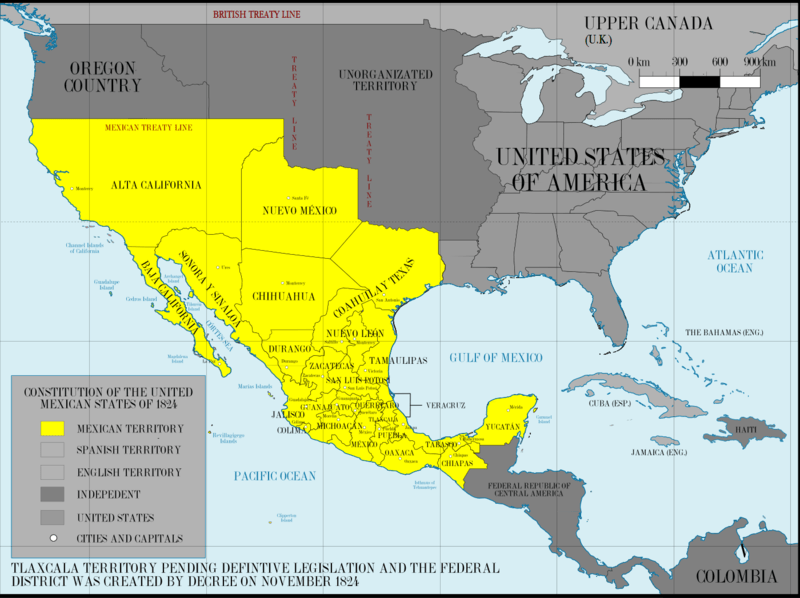
Mexico in 1824.

For almost a decade, Texas remained an independent republic, largely because its annexation as a huge new slave state would disrupt the increasingly precarious balance of political power in the United States. In 1845, President James K. Polk, narrowly elected on a platform of westward expansion, brought the Republic of Texas into the Union as the 28th state. Polk’s move was the first gambit in a larger design. Texas claimed that its border with Mexico was the Rio Grande River; Mexico argued that the border stood 150 miles to the north along the Nueces River. Meanwhile, American settlers were flooding into the territories of New Mexico and California, citing manifest destiny as their justification to do so.

333px-Wpdms_republic_of_texas.svg
The Republic of Texas: The present-day outlines of the individual U.S. states are superimposed on the boundaries of 1836–1845.

U.S. attempts to purchase from Mexico the New Mexico and California territories failed. In 1846, President Polk ordered General Taylor and his forces south to the Rio Grande, entering deep into the territory that Mexico claimed as their own.

Regarding the beginning of the war, Ulysses S. Grant, who had opposed the war but served as an army lieutenant in Taylor’s Army, claims in his Personal Memoirs (1885) that the main goal of the U.S. Army’s advance from Nueces River to Rio Grande was to provoke the outbreak of war without attacking first – to make the whole war seem defensive, rather than as a war of conquest against a weaker nation.

“We were sent to provoke a fight, but it was essential that Mexico should commence it. It was very doubtful whether Congress would declare war; but if Mexico should attack our troops, the Executive could announce, “Whereas, war exists by the acts of, etc.,” and prosecute the contest with vigor. Once initiated there were but few public men who would have the courage to oppose it….

Mexico showing no willingness to come to the Nueces to drive the invaders from her soil, it became necessary for the ‘invaders’ to approach to within a convenient distance to be struck. Accordingly, preparations were begun for moving the army to the Rio Grande… It was desirable to occupy a position near the largest centre of population possible to reach, without absolutely invading territory to which we set up no claim whatever.

Eleven American soldiers were killed in this initial conflict, provoked by the Americans.  Just as Grant described, Polk claimed the need to avenge the honor of these fallen men and pushed for open warfare against Mexico – a full invasion by the better equipped, better organized U.S. army commenced.  His message to Congress on May 11, 1846, claimed that “Mexico has passed the boundary of the United States, has invaded our territory and shed American blood upon American soil.”

American troops occupied the lightly populated territory of New Mexico, then supported a revolt of settlers in California. A U.S. force under Zachary Taylor invaded Mexico, winning victories at Monterrey and Buena Vista, but failing to bring the Mexicans to the negotiating table.

Mexico was not inclined nor able to negotiate. In 1846 alone, the presidency changed hands four times, the war ministry six times, and the finance ministry sixteen times. Mexican public opinion and all political factions agreed that selling the territories to the United States would tarnish the national honor. Mexicans who opposed direct conflict with the United States were viewed as traitors.

800px-Battle_of_Churubusco2
This lithograph from 1847 depicting the Battle of Churubusco suggests the lopsided nature of many of the conflicts in the Mexican-American War.

Opposition to the War

In the United States, increasingly divided by sectional rivalry, the war was a partisan issue. Most Whigs in the North and South opposed it; most Democrats supported it.  Southern Democrats supported it in hope of adding slave-owning territory to the South and avoiding being overwhelmed in the Senate by the faster-growing North.

Northern antislavery elements feared the expansion of the Southern Slave Power; Whigs generally wanted to strengthen the economy with industrialization, not expand it with more land. Among the most vocal opposing the war in the House of Representatives was John Quincy Adams of Massachusetts. Adams had first voiced concerns about expanding into Mexican territory in 1836 when he opposed Texas annexation. He continued this argument in 1846 for the same reason. War with Mexico would add new slavery territory to the nation. When the vote to go to war with Mexico came to a vote on May 13, Adams spoke a resounding “No!” in the chamber. Only 13 others followed his lead.
Frederick_Douglass_by_Samuel_J_Miller,_1847-52
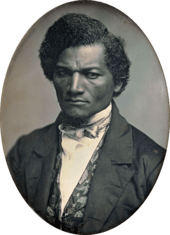
Ex-slave Frederick Douglass opposed the war and was dismayed by the weakness of the anti-war movement. “The determination of our slave holding president, and the probability of his success in wringing from the people, men and money to carry it on, is made evident by the puny opposition arrayed against him. None seem willing to take their stand for peace at all risks.”

Northern abolitionists attacked the war as an attempt by slave-owners to strengthen the grip of slavery and thus ensure their continued influence in the federal government. Prominent artists and writers opposed the war.

The Transcendentalist writers Henry David Thoreau and Ralph Waldo Emerson attacked the popular war. Thoreau, who served jail time for refusing to pay his taxes in opposition, composed an essay on how to resist such a large-scale injustice as the war.  That essay is now known as Civil Disobedience. Emerson was succinct, predicting that, “The United States will conquer Mexico, but it will be as a man who swallowed the arsenic which brings him down in turn. Mexico will poison us.” Events proved him right, as arguments over the expansion of slavery in the lands seized from Mexico would fuel the drift to civil war just a dozen years later.

Democratic Representative David Wilmot introduced the Wilmot Proviso, which would prohibit slavery in new territory acquired from Mexico. Wilmot’s proposal passed the House but not the Senate, and it spurred further hostility between the factions.

The End of the War

The Battle of Chapultepec was an encounter between the Mexican Army and the United States on the castle of Chapultepec which sits high atop a cliff. At this time, this castle was a renowned military school. After the battle, which ended in the American capture of Mexico City, the legend of “Los Niños Héroes” was born. Although the story is unconfirmed by historians, six military cadets between the ages of 13 and 17 are said to have stayed in the school instead of evacuating, choosing instead to stand their ground for the honor of Mexico. Rather than surrender to the U.S. Army, some of military cadets leaped from the castle walls. One cadet wrapped himself in the Mexican flag and jumped to his death. These Niños Héroes (hero children) became icons in Mexico’s pantheon of heroes.

Outnumbered militarily and with many of its large cities occupied, Mexico could not defend itself; the country was also faced with many internal divisions. The Treaty of Guadalupe Hidalgo, signed on February 2, 1848, ended the war. The treaty gave the U.S. undisputed control of Texas, established the U.S.-Mexican border at the Rio Grande, and ceded to the United States the present-day states of California, Nevada, and Utah, most of New Mexico, Arizona, and Colorado, and parts of Texas, Oklahoma, Kansas, and Wyoming (together, so-called Mexican Cession). In return, Mexico received $15 million (approximately $424 million today) – less than half the amount the U.S. had attempted to offer Mexico for the land before the opening of hostilities.

The acquisition was a source of controversy, especially among U.S. politicians who had opposed the war from the start. A leading antiwar U.S. newspaper, the Whig National Intelligencer, sardonically concluded that “We take nothing by conquest … Thank God.”

800px-Mexican_Cession_in_Mexican_View
Mexican territorial claims relinquished under the Treaty of Guadalupe Hidalgo in white.

Before ratifying the treaty, the U.S. Senate made two modifications: changing the wording of Article IX (which guaranteed Mexicans living in the purchased territories the right to become U.S. citizens) and striking out Article X (which conceded the legitimacy of land grants made by the Mexican government).  As a result, the majority of Mexicans who suddenly found themselves living in the United States would come to be considered foreigners in their own home and would ultimately lose their land to American settlers who flooded the Mexican Cession over the next generation.

800px-War_News_from_Mexico
War News from Mexico (1848).

The war was a decisive event for the U.S., marking a significant waypoint for the nation as a growing military power, and a milestone in the U.S. narrative of Manifest Destiny. The war did not resolve the issue of slavery in the U.S. but rather in many ways inflamed it, as potential westward expansion of the institution of slavery became an increasingly central and heated theme in national debates preceding the American Civil War. By extending the nation from coast to coast, the Mexican–American War was a next step in the huge migrations to the West of Americans, which culminated in transcontinental railroads and the Indian wars later in the same century.

The military defeat and loss of territory was a disastrous blow to Mexico, causing the country to enter a period of self-examination as its leaders sought to identify and address the reasons that had led to such a debacle.  The war remains a painful historical event for the country.

In Mexico City’s Chapultepec Park, the Niños Héroes (Monument to the Heroic Cadets) commemorates the heroic sacrifice of the six teenaged military cadets who fought to their deaths rather than surrender to American troops during the Battle of Chapultepec Castle. The monument is an important patriotic site in Mexico. On March 5, 1947, nearly one hundred years after the battle, U.S. President Harry S. Truman placed a wreath at the monument and stood for a moment of silence.

The United States has no national memorial to the war, which remains largely unknown to most Americans.

The article was adapted in part from:

  1. Texas Annexation
  2. Manifest Destiny
  3. The Mexican-American War
  4. Sectional Conflict

A New Nation in Crisis: Shays Rebellion and the U.S. Under the Articles

This lesson was reported from:
A chapter of The United States: An Open Ended History, a free online textbook.  Adapted in part from open sources.

For Your Consideration:
  1. What were the Articles of Confederation?
  2. What was one weakness of the Articles of Confederation?
  3. What did the Northwest Ordinance say about slavery?
  4. Why was Daniel Shays upset?
  5. Why wasn’t the government easily able to stop Shays’ Rebellion?

The Articles of Confederation

The struggle with England had done much to change colonial attitudes. Local assemblies had rejected the Albany Plan of Union in 1754, refusing to surrender even the smallest part of their autonomy to any other body, even one they themselves had elected. But in the course of the Revolution, mutual aid had proved effective, and the fear of relinquishing individual authority had lessened to a large degree.

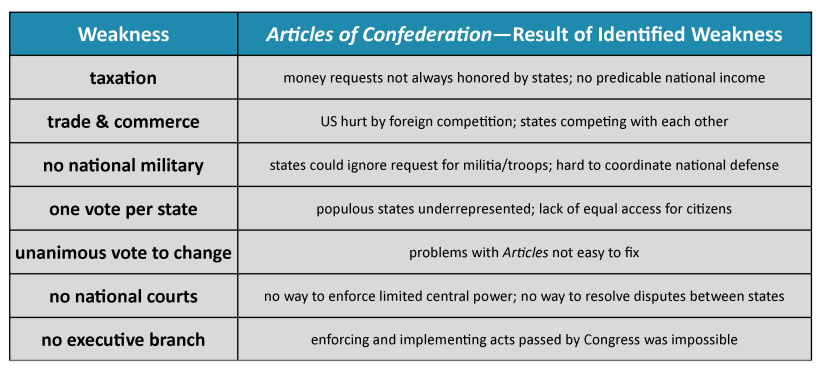
John Dickinson produced the “Articles of Confederation and Perpetual Union” in 1776. The Continental Congress adopted them in November 1777, and they went into effect in 1781, having been ratified by all the states. Reflecting the fragility of a nascent sense of nationhood, the Articles provided only for a very loose union. The national government lacked the authority to set up tariffs, to regulate commerce, and to levy taxes. It possessed scant control of international relations: A number of states had begun their own negotiations with foreign countries. Nine states had their own armies, several their own navies, and there was no U.S. army. In the absence of a sound common currency, the new nation conducted its commerce with a curious hodgepodge of coins and a bewildering variety of state and national paper bills, all fast depreciating in value.

weakness of the articles
The Articles of Confederation were meant to create a weak national government. However, as time went on, these weaknesses came to threaten the very existence of the United States.

Westward Expansion

With the end of the Revolution, the United States again had to face the old unsolved Western question, the problem of expansion, with its complications of land, fur trade, Indians, settlement, and local government. Lured by the richest land yet found in the country, pioneers poured over the Appalachian Mountains and beyond. By 1775 the far-flung outposts scattered along the waterways had tens of thousands of settlers. Separated by mountain ranges and hundreds of kilometers from the centers of political authority in the East, the inhabitants established their own governments. Settlers from all the Tidewater states pressed on into the fertile river valleys, hardwood forests, and rolling prairies of the interior. By 1790 the population of the trans-Appalachian region numbered well over 120,000.

Before the war, several colonies had laid extensive and often overlapping claims to land beyond the Appalachians. To those without such claims this rich territorial prize seemed unfairly apportioned. Maryland, speaking for the latter group, introduced a resolution that the western lands be considered common property to be parceled by the Congress into free and independent governments. This idea was not received enthusiastically. Nonetheless, in 1780 New York led the way by ceding its claims. In 1784 Virginia, which held the grandest claims, relinquished all land north of the Ohio River. Other states ceded their claims, and it became apparent that Congress would come into possession of all the lands north of the Ohio River and west of the Allegheny Mountains. This common possession of millions of hectares was the most tangible evidence yet of nationality and unity, and gave a certain substance to the idea of national sovereignty. At the same time, these vast territories were a problem that required solution.

Northwest-territory-usa-1787
Northwest Territory created by the Northwest Ordinance (1787).

The Confederation Congress established a system of limited self-government for this new national Northwest Territory. The Northwest Ordinance of 1787 provided for its organization, initially as a single district, ruled by a governor and judges appointed by the Congress. When this territory had 5,000 free male inhabitants of voting age, it was to be entitled to a legislature of two chambers, itself electing the lower house. In addition, it could at that time send a nonvoting delegate to Congress. Three to five states would be formed as the territory was settled. Whenever any one of them had 60,000 free inhabitants, it was to be admitted to the Union “on an equal footing with the original states in all respects.” The ordinance guaranteed civil rights and liberties, encouraged education, and prohibited slavery or other forms of involuntary servitude.

The new policy repudiated the time-honored concept that colonies existed for the benefit of the mother country, were politically subordinate, and peopled by social inferiors. Instead, it established the principle that colonies (“territories”) were an extension of the nation and entitled, not as a privilege but as a right, to all the benefits of equality.

State Constitutions

The success of the Revolution gave Americans the opportunity to give legal form to their ideals as expressed in the Declaration of Independence, and to remedy some of their grievances through state constitutions. As early as May 10, 1776, Congress had passed a resolution advising the colonies to form new governments “such as shall best conduce to the happiness and safety of their constituents.” Some of them had already done so, and within a year after the Declaration of Independence, all but three had drawn up constitutions.

The new constitutions showed the impact of democratic ideas. None made any drastic break with the past, since all were built on the solid foundation of colonial experience and English practice. But each was also animated by the spirit of republicanism, an ideal that had long been praised by Enlightenment philosophers.

Naturally, the first objective of the framers of the state constitutions was to secure those “unalienable rights” whose violation had caused the former colonies to repudiate their connection with Britain. Thus, each constitution began with a declaration or bill of rights. Virginia’s, which served as a model for all the others, included a declaration of principles: popular sovereignty, rotation in office, freedom of elections, and an enumeration of fundamental liberties: moderate bail and humane punishment, speedy trial by jury, freedom of the press and of conscience, and the right of the majority to reform or alter the government.

Other states enlarged the list of liberties to freedom of speech, of assembly, and of petition. Their constitutions frequently included such provisions as the right to bear arms, to a writ of habeas corpus, to inviolability of domicile, and to equal protection under the law. Moreover, all prescribed a three-branch structure of government—executive, legislative, and judiciary—each checked and balanced by the others. Pennsylvania’s constitution was the most radical. In that state, Philadelphia artisans, Scots-Irish frontiersmen, and German-speaking farmers had taken control. The provincial congress adopted a constitution that permitted every male taxpayer and his sons to vote, required rotation in office (no one could serve as a representative more than four years out of every seven), and set up a single-chamber legislature.

The state constitutions had some glaring limitations, particularly by more recent standards. Constitutions established to guarantee people their natural rights did not secure for everyone the most fundamental natural right—equality. The colonies south of Pennsylvania excluded their slave populations from their inalienable rights as human beings. Women had no political rights. No state went so far as to permit universal male suffrage, and even in those states that permitted all taxpayers to vote (Delaware, North Carolina, and Georgia, in addition to Pennsylvania), office-holders were required to own a certain amount of property.

Shays’ Rebellion

Economic difficulties after the war prompted calls for change to this precarious system. The end of the war had a severe effect on merchants who supplied the armies of both sides and who had lost the advantages deriving from participation in the British mercantile system. The states gave preference to American goods in their tariff policies, but these were inconsistent, leading to the demand for a stronger central government to implement a uniform policy.

Farmers probably suffered the most from economic difficulties following the revolution. The supply of farm produce exceeded demand; taxes, even on small landowners, were actually higher under many new state governments than they were under the British. Small farmers wanted economic reforms to avoid foreclosure on their property and imprisonment for debt, as was the law at the time. Courts were clogged with suits for payment filed by their creditors. All through the summer of 1786, popular conventions and peaceful gatherings in several states demanded tax and monetary reform.

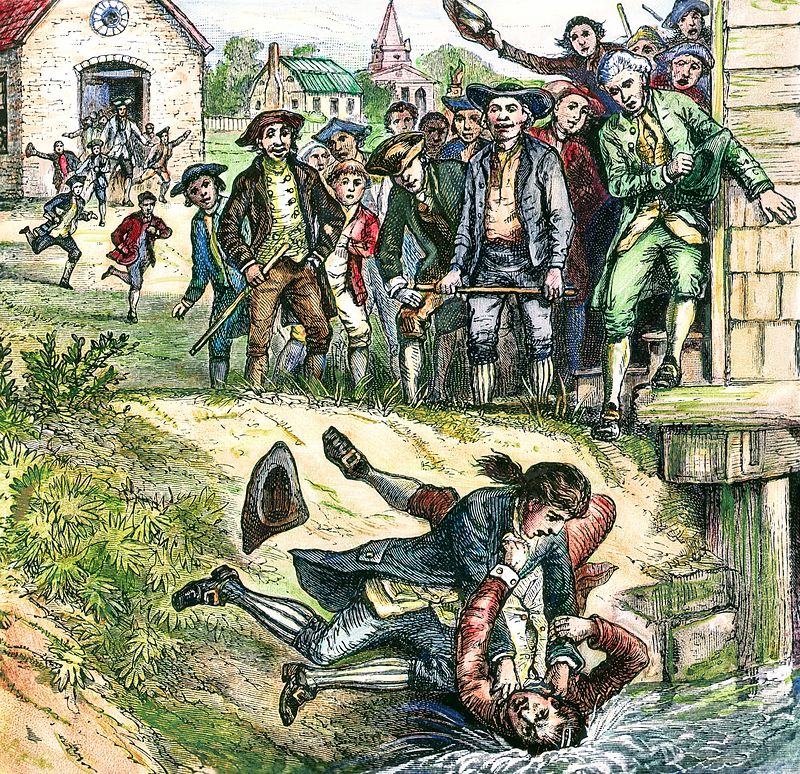
Protesters watching a debtor in a scuffle with a tax collector by the courthouse at Springfield, Massachusetts.

That autumn, groups of farmers in Massachusetts under the leadership of a former army captain, Daniel Shays, began to forcibly prevent the county courts from sitting and passing further judgments for debt – which would have resulted in the loss of property, livelihood, and the right to vote for Shays and many of his followers. In January 1787, a ragtag army of 1,200 farmers moved toward the federal arsenal at Springfield. The rebels, armed chiefly with staves and pitchforks, were repulsed by a small state militia force; General Benjamin Lincoln then arrived with reinforcements – privately funded by wealthy creditors in Boston – and routed the remaining Shaysites, whose leader escaped to Vermont. The government captured 14 rebels and sentenced them to death.  After the defeat of the rebellion, a newly elected legislature, whose majority sympathized with the rebels, met some of their demands for debt relief. The new governor even pardoned many of the resistance leaders, though not Daniel Shays – who lived out the rest of his life as a poor farmer outside of Massachusetts.

800px-Daniel_Shays_and_Job_Shattuck
Contemporary engraving depicting Daniel Shays (left) and Job Shattuck, another rebel leader; the artist intentionally rendered them in an unflattering way.

From the perspective of the wealthy, landowning founders of the new nation, anarchy threatened – the poor had effectively risen up and achieved many of their goals after resorting to armed violence. The U.S. government, under the Articles, was unable to raise an army. It was unable to reinforce the Massachusetts state militia, which had only just barely contained the violence.  And now the state government was in the hands of many of who were sympathetic to the lower classes.

Thomas Jefferson was serving as ambassador to France at the time and refused to be alarmed by Shays’ Rebellion. He argued in a letter to James Madison on January 30, 1787 that occasional rebellion serves to preserve freedoms. “The tree of liberty must be refreshed from time to time with the blood of patriots and tyrants. It is its natural manure.” In contrast, George Washington had been calling for constitutional reform for many years, and he wrote in a letter to Henry Lee, “Let us have a government by which our lives, liberties, and properties will be secured, or let us know the worst at once.”

Shortly after Shays’ Rebellion broke out, delegates from five states met in Annapolis, Maryland from September 11-14, 1786, and they concluded that vigorous steps were needed to reform the federal government, but they disbanded because of a lack of full representation and authority, calling for a convention of all the states to be held in Philadelphia in May 1787.

The article was adapted in part from:
  1. The Formation of a National Government
  2. Shays’ Rebellion

The Revolutionary War: With a Little Help from our Friends

This lesson was reported from:
A chapter of The United States: An Open Ended History, a free online textbook.  Adapted in part from open sources.

For Your Consideration:
  1. What happened at Valley Forge, Pennsylvania?
  2. Describe one role patriot women played during the Revolutionary War.
  3. Why was French help necessary for an American victory in the war?
  4. What happened at Yorktown?
  5. What were the terms of the Treaty of Paris of 1783?

Defeats and victories

Although the Americans suffered severe setbacks for months after independence was declared, their tenacity and perseverance eventually paid off. During August 1776, in the Battle of Long Island in New York, Washington’s position became untenable, and he executed a masterly retreat in small boats from Brooklyn to the Manhattan shore. British General William Howe twice hesitated and allowed the Americans to escape. By November, however, Howe had captured Fort Washington on Manhattan Island. New York City would remain under British control until the end of the war.

That December, Washington’s forces were near collapse, as supplies and promised aid failed to materialize. Howe again missed his chance to crush the Americans by deciding to wait until spring to resume fighting. On the night of December 25–26, 1776, Washington crossed the Delaware River, north of Trenton, New Jersey. In the early-morning hours of December 26, his troops surprised the British garrison there, taking more than 900 prisoners.

1024px-Washington_Crossing_the_Delaware_by_Emanuel_Leutze,_MMA-NYC,_1851
Washington Crossing the Delaware commemorates General George Washington during his famous crossing of the Delaware River with the Continental Army on the night of December 25–26, 1776, during the American Revolutionary War.

In September 1777, however, Howe defeated the American army at Brandywine in Pennsylvania and occupied Philadelphia, forcing the Continental Congress to flee. Washington had to endure the bitterly cold winter of 1777‑1778 at Valley Forge, Pennsylvania, lacking adequate food, clothing, and supplies. Local farmers and merchants exchanged their goods for British gold and silver rather than for dubious paper money issued by the Continental Congress and the states.

A reproduction hut at Valley Forge
A reproduction of a soldier’s hut at Valley Forge.

With disease and hunger rampant, Valley Forge was the lowest ebb for Washington’s Continental Army.  While the winter itself was not particularly harsh, many soldiers remained unfit for duty, owing to the lack of proper clothing and uniforms.  Years later, General Marquis de Lafayette, an early French ally to the American cause, who was present at Valley Forge, recalled that “the unfortunate soldiers were in want of everything; they had neither coats, hats, shirts, nor shoes; their feet and legs froze till they had become almost black, and it was often necessary to amputate them.”

While formal politics and warfare did not include women, ordinary domestic behaviors became charged with political significance as women confronted the Revolution. Women in the era of the Revolution were responsible for managing the household.  Halting previously everyday activities, such as drinking British tea or ordering clothes from Britain, demonstrated Colonial opposition during the years leading up to and during the war.

Patriot women continued a long tradition of weaving, and spun their own cloth to make clothing for their families. In addition to the boycotts of British textiles, the Homespun Movement served the Continental Army by producing needed clothing and blankets.

Some women were economically unable to maintain their households in their husband’s absence or wished to be by their side. Known as camp followers, these women followed the Continental Army, serving the soldiers and officers as washerwomen, cooks, nurses, seamstresses, supply scavengers, and occasionally as soldiers and spies. The women that followed the army were at times referred to as “necessary nuisances” and “baggage” by commanding officers, but at other times were widely praised. These women helped the army camps run smoothly. Prostitutes were also present, but they were a worrisome presence to military leaders particularly because of the possible spread of venereal diseases.

Wives of some of the superior officers (Martha Washington, for example) visited the camps frequently. Unlike poorer women present in the army camps, the value of these well-to-do women to the army was symbolic or spiritual, rather than practical. Their presence was a declaration that everyone made sacrifices for the war cause.

Franco-American Alliance

In France, enthusiasm for the American cause was high: The French intellectual world was itself stirring against feudalism and privilege. However, the Crown lent its support to the colonies for geopolitical rather than ideological reasons: The French government had been eager for reprisal against Britain ever since France’s defeat in 1763. To further the American cause, Benjamin Franklin was sent to Paris in 1776. His wit, guile, and intellect soon made their presence felt in the French capital, and played a major role in winning French assistance.

800px-Benjamin_Franklin's_Reception_at_the_Court_of_France_1778
Benjamin Franklin’s reception at the Court of France in 1778.

France began providing aid to the colonies in May 1776, when it sent 14 ships with war supplies to America. In fact, most of the gunpowder used by the American armies came from France. After Britain’s defeat at Saratoga, France saw an opportunity to seriously weaken its ancient enemy and restore the balance of power that had been upset by the French and Indian War. On February 6, 1778, the colonies and France signed a Treaty of Amity and Commerce, in which France recognized the United States and offered trade concessions. They also signed a Treaty of Alliance, which stipulated that if France entered the war, neither country would lay down its arms until the colonies won their independence, that neither would conclude peace with Britain without the consent of the other, and that each guaranteed the other’s possessions in America. This was the only bilateral defense treaty signed by the United States or its predecessors until 1949.

The Franco-American alliance soon broadened the conflict. In June 1778 British ships fired on French vessels, and the two countries went to war. In 1779 Spain, hoping to reacquire territories taken by Britain in the Seven Years’ War, entered the conflict on the side of France, but not as an ally of the Americans. In 1780 Britain declared war on the Dutch, who had continued to trade with the Americans. The combination of these European powers, with France in the lead, was a far greater threat to Britain than the American colonies standing alone.

Surrender at Yorktown

In July 1780 France’s King Louis XVI had sent to America an expeditionary force of 6,000 men under the Comte Jean de Rochambeau. In addition, the French fleet harassed British shipping and blocked reinforcement and resupply of British forces in Virginia. French and American armies and navies, totaling 18,000 men, parried with British General Cornwallis all through the summer and into the fall.

Soldier_in_the_Continental_Army_from_1st_Rhode_Island_Regiment
Continental soldiers at Yorktown; on the left, an African-American soldier of the 1st Rhode Island Regiment.  Most blacks fought on the patriot side; recent research concludes there were about 9000 black Patriot soldiers, counting the Continental Army and Navy, and state militia units, as well as privateers, wagoneers in the Army, servants to officers, and spies.

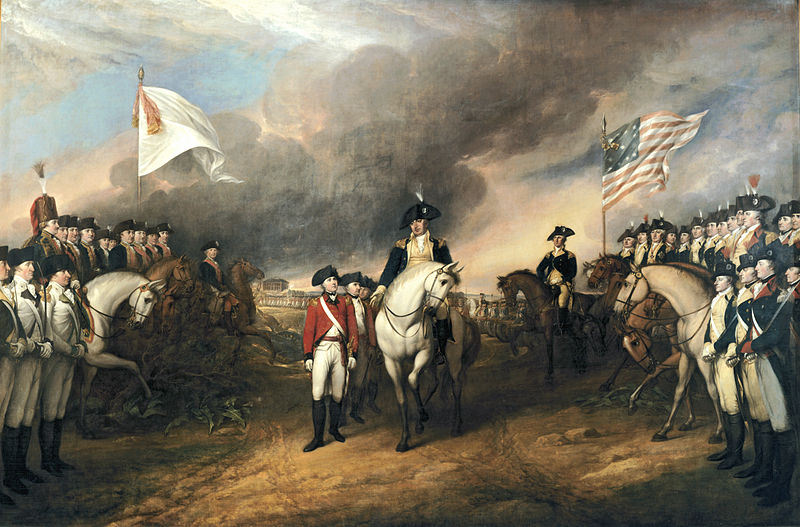
A series of battles left Cornwallis’s armies in retreat toward Yorktown, Virginia, where they expected to be rescued by a British fleet. The fleet showed up, but so did a larger French fleet, so the British fleet retreated out to sea after a brief battle, leaving Cornwallis trapped between the American and French armies on land and the French fleet at sea. Finally, on October 19, 1781, General Cornwallis surrendered his army of 8,000 British soldiers.

The British had asked for the traditional honors of war, which would allow the army to march out with flags flying, bayonets fixed, and the band playing an American or French tune as a tribute to the victors. However, Washington firmly refused to grant the British the honors that they had denied the defeated American army the year before at the Siege of Charleston. Consequently, the British and Hessian troops marched with flags furled and muskets shouldered.

Cornwallis refused to attend the surrender ceremony, citing illness. Instead, Brigadier General Charles O’Hara led the British army onto the field. O’Hara first attempted to surrender to Rochambeau, who shook his head and pointed to Washington. O’Hara then offered his sword to Washington, who also refused and motioned to Benjamin Lincoln, his own second-in-command. The surrender finally took place when Washington’s second-in-command accepted the sword of Cornwallis’ deputy.

800px-Surrender_of_Lord_Cornwallis
Surrender of Lord Cornwallis by John Trumbull, depicts the British surrendering to Benjamin Lincoln, flanked by French (left) and American troops. Oil on canvas, 1820.

For the next year, scattered fighting continued, but back in Britain, the British were crushed by this defeat. Before long, Parliament voted to cease all offensive operations in “the colonies.”

Although Cornwallis’s defeat did not immediately end the war, a new British government decided to pursue peace negotiations in Paris in early 1782, with the American side represented by Benjamin Franklin, John Adams, and John Jay. Signed on September 3, 1783 the Treaty of Paris acknowledged the independence, freedom, and sovereignty of the 13 former colonies, now states. The new United States stretched west to the Mississippi River, north to Canada, and south to Florida, which was returned to Spain.

At the conclusion of the war in 1783 large numbers of loyalists and their families relocated to the home country of England and or to the still-British colony of Canada.

The article was adapted in part from:

  1. The American Revolution
  2. The Road to Revolution
  3. The Road to Independence
  4. History of the United States
  5. Women in the American Revolution

Agitation, Taxation, and Representation by Other Means

This lesson was reported from:
A chapter of The United States: An Open Ended History, a free online textbook.  Adapted in part from open sources.

For Your Consideration:
  1. Describe the Sugar Act, the Quartering Act, and the Stamp Act.  Why did these acts of Parliament so upset American colonists?
  2. How did American colonists resist these acts?
  3. What was the Boston Massacre? How did Paul Revere and other Sons of Liberty talk about this event?
  4. What was the Boston Tea Party?  How did Parliament respond to it?
  5. What did it mean to call someone a patriot?  A loyalist?

The Stamp Act and Other Laws

The French and Indian War (1754–63) was a watershed event in the political development of the colonies.  Following Britain’s acquisition of French territory in North America, King George III issued the Royal Proclamation of 1763 limiting westward expansion of colonial settlements, all with the goal of organizing his newly enlarged North American empire and avoiding conflict with Native Americans beyond the Appalachian Mountains.  This alienated colonists who had fought the war with the promise of a new source of free or cheap land in mind.

Furthermore, the French and Indian War nearly doubled Great Britain’s national debt, and Parliament was keen to find new sources of revenue to settle this debt.

In 1764, Parliament began allowing customs officers to search random houses in the colonies for smuggled goods on which no import tax had been paid. British authorities thought that if profits from smuggled goods could be directed towards Britain, the money could help pay off debts. Colonists were horrified that they could be searched without warrant at any given moment.

Also in 1764, Parliament began to impose new taxes on the colonists. The Sugar Act of 1764 reduced taxes on sugar and molasses imposed by the earlier Molasses Act, but at the same time strengthened the enforcement of tax collection, making smuggling harder. It also provided that British judges, and not colonial juries – who, as consumers of the smuggled sugar in question, might be more sympathetic to the accused – would try cases involving violations of that Act.

The next year, Parliament passed the Quartering Act, which required the colonies to provide room and board for British soldiers stationed in North America; the soldiers would serve various purposes, chiefly to enforce the previously passed acts of Parliament.

Following the Quartering Act, Parliament passed one of the most infamous pieces of legislation: the Stamp Act. Previously, Parliament imposed only external taxes on imports, paid by the merchants who actually brought goods into the colonies. The Stamp Act provided the first internal tax paid directly by the colonists when they purchased books, newspapers, pamphlets, legal documents, playing cards, and dice. These items – important for communication and entertainment – now required an official tax stamp as proof of payment.

800px-Proof_sheet_of_one_penny_stamps_Stamp_Act_1765
Proof sheet of one-penny stamps submitted for approval to Commissioners of Stamps by engraver, May 10, 1765.

The colonial legislature of Massachusetts requested a conference on the Stamp Act; the Stamp Act Congress met in October that year, petitioning the King and Parliament to repeal the act before it went into effect at the end of the month, crying “taxation without representation.”  Specifically, these colonists argued that as English subjects, they were entitled to a voice in Parliament.  As it stood, the colonists had no right to vote – so Parliament could impose all of the unpopular laws and taxes that it liked on colonists, and they faced no consequences at the ballot box…  Without a member of Parliament working on their behalf, this was hardly the outcome of a democracy – it may as well be the act of an absolute tyrant.

istampa001p1
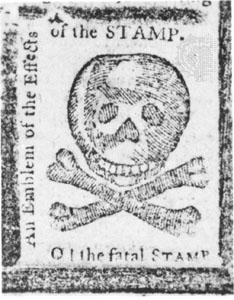
American newspapers reacted to the Stamp Act with anger and predictions of the demise of journalism.

The Stamp Act faced vehement opposition throughout the colonies. Merchants and consumers alike threatened to boycott British products. Thousands of New Yorkers rioted near the location where the stamps were stored. In Boston, the Sons of Liberty, a violent group led by radical statesman Samuel Adams, destroyed the home of Lieutenant Governor Thomas Hutchinson.  Adams wanted to free people from their awe of social and political superiors, make them aware of their own power and importance, and thus arouse them to action. Toward these objectives, he published articles in newspapers and made speeches in town meetings, instigating resolutions that appealed to the colonists’ democratic impulses.

The Sons of Liberty also popularized the use of tar and feathering to punish and humiliate offending government officials starting in 1767. This method was also used against those who threatened to break the boycott and later against British Loyalists during the American Revolution.

800px-Philip_Dawe_(attributed),_The_Bostonians_Paying_the_Excise-man,_or_Tarring_and_Feathering_(1774)_-_02
The Bostonian Paying the Excise-Man, 1774 British propaganda print, referring to the tarring and feathering, of Boston Commissioner of Customs John Malcolm four weeks after the Boston Tea Party. The men also poured hot tea down Malcolm’s throat; note the noose hanging on the Liberty Tree and the Stamp Act posted upside-down.

Parliament did indeed repeal the Stamp Act, but additionally passed the Declaratory Act, which stated that Great Britain retained the power to tax the colonists, even without representation.

Believing that the colonists only objected to internal taxes, Chancellor of the Exchequer Charles Townshend proposed bills that would later become the Townshend Acts. The Acts, passed in 1767, taxed imports of tea, glass, paint, lead, and even paper. The colonial merchants again threatened to boycott the taxed products, reducing the profits of British merchants, who in turn petitioned Parliament to repeal the Townshend Acts. Parliament eventually agreed to repeal much of the Townshend legislation. But Parliament refused to remove the tax on tea, implying that the British retained the authority to tax the colonies despite a lack of representation.

In Boston, enforcement of the new regulations provoked violence. When customs officials sought to collect duties, they were set upon by the populace and roughly handled. For this infraction, two British regiments were dispatched to protect the customs commissioners, but the presence of British troops in Boston was a standing invitation to disorder.

On March 5, 1770, a large crowd gathered around a group of British soldiers. The crowd grew threatening, throwing snowballs, rocks, and debris at them. One soldier was clubbed and fell. There was no order to fire, but the soldiers fired into the crowd anyway. They hit 11 people; three civilians died at the scene of the shooting, and two died after the incident. Crispus Attucks was an American stevedore of African and Native American descent, widely regarded as the first person killed in the Boston that day and thus the first American killed in the American Revolution.  Dubbed the “Boston Massacre,” the incident was framed as dramatic proof of British heartlessness and tyranny. Widespread – and biased – patriot propaganda such as Paul Revere’s famous print soon began to turn colonial sentiment against the British. This, in turn, began a downward spiral in the relationship between Britain and the Province of Massachusetts.

this-is-paul-reveres-engraving-it-depicts-the-boston-massacre-as-paul-revere-painting-boston-massacre
Silversmith and engraver Paul Revere created this image, which exaggerated or outright falsified certain details of the event in order to further public outrage against the British. Despite the fact that British fire was spontaneous and in response to snowballs and jeering from the American crowd, Captain Preston is shown ordering his men to fire, and a musket is seen shooting out of the window of the customs office, which is sarcastically labeled “Butcher’s Hall.” Some copies of the print show a man with two chest wounds and a somewhat darker face, matching descriptions of Attucks; others show no victim as a person of color. The image was published in the Boston Gazette, circulating widely, and became an effective piece of anti-British propaganda. The image of bright red “lobster backs” and wounded men with red blood was hung in farmhouses across New England.

Beginning in 1772, Samuel Adams in Boston set about creating new Committees of Correspondence, which linked Patriots in all 13 colonies and eventually provided the framework for a rebel government. Virginia, the largest colony, set up its Committee of Correspondence in early 1773, on which Patrick Henry and Thomas Jefferson served.

Samuel Adams
Samuel Adams, one of the colonies’ most vocal patriots.

A total of about 7000 to 8000 Patriots served on “Committees of Correspondence” at the colonial and local levels, comprising most of the leadership in their communities. Loyalists were excluded. The committees became the leaders of the American resistance to British actions, and largely determined the war effort at the state and local level. Later, when the First Continental Congress decided to boycott British products, the colonial and local Committees took charge, examining merchant records and publishing the names of merchants who attempted to defy the boycott by importing British goods.

In 1773, Parliament passed the Tea Act, which exempted the British East India Company from the Townshend taxes. Thus, the East India Company gained a great advantage over other companies when selling tea in the colonies – their tea was cheaper, and American smugglers faced the uncomfortable prospect of being undersold and put out of business entirely.  A town meeting in Boston determined that the cheap British tea would not be landed, and ignored a demand from the governor to disperse. On December 16, 1773, a group of men, led by Samuel Adams, some dressed to evoke the appearance of American Indians, boarded the ships of the British East India Company and dumped £10,000 worth of tea from their holds (around a million dollars in modern terms) into Boston Harbor. Decades later, this event became known as the Boston Tea Party and remains a significant part of American patriotic lore.

Boston_Tea_Party-Cooper
1789 engraving of the destruction of the tea.

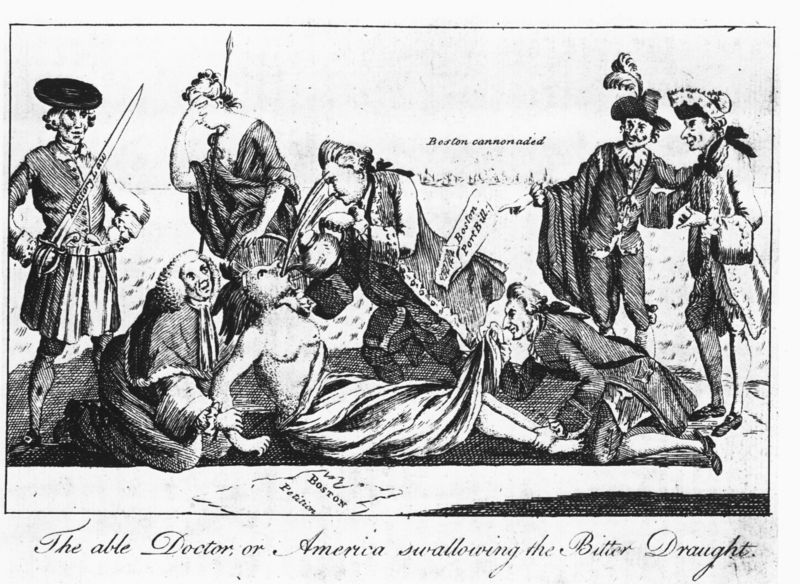
Parliament responded by passing the Coercive Acts which came to be known by colonists as the Intolerable Acts.  Intended as collective punishment to turn colonists against the Sons of Liberty and other radical patriots, they by and large had the opposite effect, further darkening colonial opinion towards the British. The Coercive Acts consisted of four laws. The first was the Massachusetts Government Act which altered the Massachusetts charter and restricted town meetings. The second act was the Administration of Justice Act which ordered that all British soldiers to be tried were to be arraigned in Britain, not in the colonies. The third Act was the Boston Port Act, which closed the port of Boston until the British had been compensated for the tea lost in the Boston Tea Party. The fourth Act was the Quartering Act of 1774, which allowed royal governors to house British troops in the homes of citizens without requiring permission of the owner.

800px-RapeBoston
This Patriot cartoon depicting the Coercive Acts as the forcing of tea by prominent British politicians on a Native American woman (a symbol of the American colonies) was copied and distributed in the Thirteen Colonies.

In late 1774, the Patriots – as colonists who wished for independence came to be known – set up their own alternative government to better coordinate their resistance efforts against Great Britain; other colonists preferred to remain aligned to the Crown and were known as Loyalists. At the suggestion of the Virginia House of Burgesses, colonial representatives met in Philadelphia on September 5, 1774, “to consult upon the present unhappy state of the Colonies.” Delegates to this meeting, known as the First Continental Congress, were chosen by provincial congresses or popular conventions. Only Georgia failed to send a delegate; the total number of 55 was large enough for diversity of opinion, but small enough for genuine debate and effective action. The division of opinion in the colonies posed a genuine dilemma for the delegates. They would have to give an appearance of firm unanimity to induce the British government to make concessions. But they also would have to avoid any show of radicalism or spirit of independence that would alarm more moderate Americans.

A cautious keynote speech, followed by a “resolve” that no obedience was due the Coercive Acts, ended with adoption of a set of resolutions affirming the right of the colonists to “life, liberty, and property,” and the right of provincial legislatures to set “all cases of taxation and internal polity.”

The article was adapted in part from:
  1. The American Revolution
  2. The Road to Revolution
  3. The Road to Independence
  4. History of the United States

Join, or Die: The French and Indian War

For centuries, France and England have been like ambitious siblings, close in age, evenly matched in most things, competitive, living in a house that’s too small for there ever to be peace.  They have repeatedly come into conflict over religion, territory, colonies, and anything else two countries might conceivably argue over…  In 1754, that rivalry came to the American frontier and set into motion a chain of events that would ultimately culminate in an American revolution…
This lesson was reported from:
A chapter of The United States: An Open Ended History, a free online textbook.  Adapted in part from open sources.

For Your Consideration:
  1. How did the French and British differ in their approach to colonization of North America?
  2. What was the Albany Plan of Union? Did it work?
  3. What were the terms of the Treaty of Paris (1763)?
  4. What was Pontiac’s Rebellion?
  5. Why did the Proclamation of 1763 anger British colonists?

A European Rivalry

Throughout most of their mutual history, France and Britain have engaged in a succession of wars. During the 1700s, these European wars spilled over into the Caribbean and the Americas, drawing in settlers, African slaves, and native peoples.

Though Britain secured certain advantages—primarily in the sugar-rich islands of the Caribbean—the struggles were generally indecisive, and France remained in a powerful position in North America. By 1754, France still had a strong relationship with a number of Native American tribes in Canada and along the Great Lakes. It controlled the Mississippi River and, by establishing a line of forts and trading posts, had marked out a great crescent-shaped empire stretching from Quebec to New Orleans. The British remained confined to the narrow belt east of the Appalachian Mountains. Thus the French threatened not only the British Empire, but also the American colonists themselves, for in holding the Mississippi Valley, France could limit their westward expansion.

New France 1754
European claims in 1748, on the eve of the French and Indian War.

Large areas of North America had no colonial settlements. The French population numbered about 75,000 and was heavily concentrated along the St. Lawrence River valley. Fewer lived in New Orleans, Biloxi, Mississippi, Mobile, Alabama, and small settlements in the Illinois Country, hugging the east side of the Mississippi River and its tributaries. French fur traders and trappers traveled throughout the St. Lawrence and Mississippi watersheds, did business with local Indian tribes, and often married Indian women. Traders married daughters of chiefs, creating high-ranking unions.  In this way, French colonial interests in North America meant coexistence, exchange, and commerce with native peoples.

In contrast, British settlers outnumbered the French 20 to 1 with a population of about 1.5 million ranged along the eastern coast of the continent from Nova Scotia and Newfoundland in the north to Georgia in the south. Many of the older colonies had land claims that extended arbitrarily far to the west, as the extent of the continent was unknown at the time when their provincial charters were granted. Their population centers were along the coast, yet the settlements were growing into the interior. Nova Scotia had been captured from France in 1713, and it still had a significant French-speaking population. Britain also claimed Rupert’s Land where the Hudson’s Bay Company traded for furs with local Indian tribes.  However, in the more southern colonies – that would one day become the United States – British interests were frequently at odds with those of the natives, as the large colonial population pressed ever westward, clearing ancestral native land for new English-style farms and towns.

Voyageurs at Dawn, 1871 by Frances Anne Hopkins (1838–1919)
Voyageurs at Dawn, 1871 by Frances Anne Hopkins. To many natives, French activity in North America often looked more like this, than like a full-scale attempt to remake the land in image of Europe.

War on the Frontier

Portrait of George Washington by Charles Willson Peale, 1772
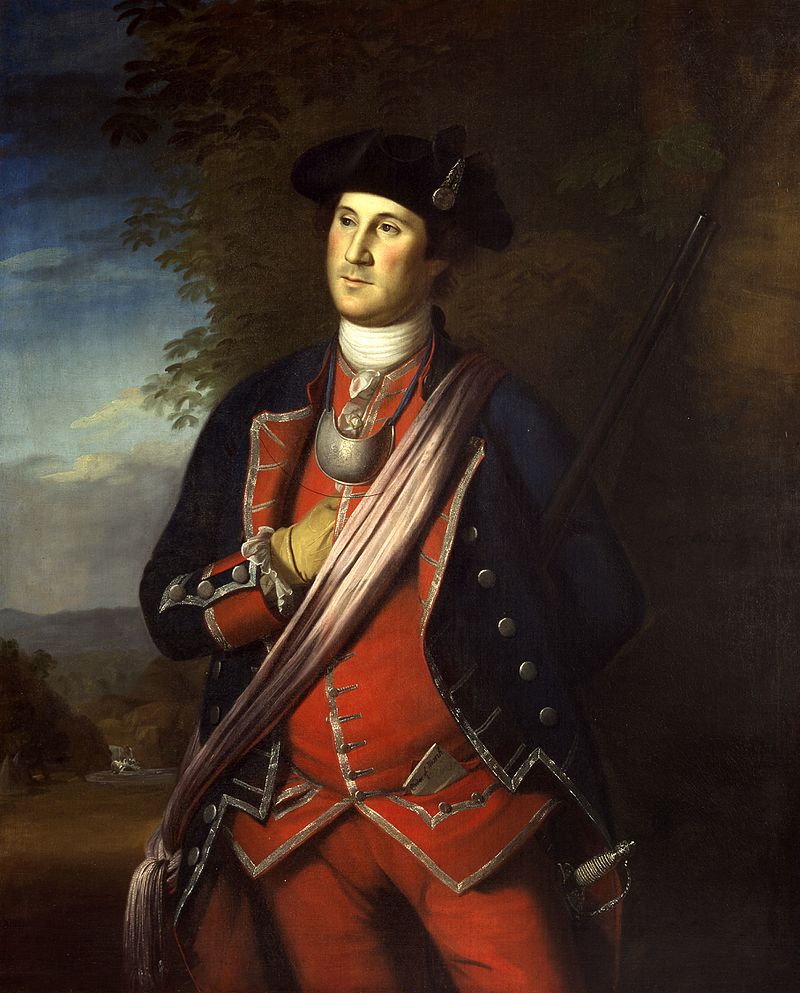
Portrait of British Lieutenant George Washington by Charles Willson Peale, 1772.

Disputes over who would control the Ohio River Valley lead to deployment of military units and the construction of forts in the area by both the British and the French, even though the area was in fact already occupied by the Iroquois Confederacy. An armed clash took place in 1754 at the French Fort Duquesne, the site where Pittsburgh, Pennsylvania, is now located, between a band of French regulars and Virginia militiamen.  The Virginians were under the command of 22-year-old George Washington, a Virginia planter and surveyor who had been sent on a mission to warn the French to leave the area.

Following an intense exchange of fire in which approximately one third of his men died, Washington surrendered and negotiated a withdrawal under arms.  This inauspicious battle is now regarded as the opening battle of a much larger war.

British colonial governments were used to operating independently of one another and of the government in London, a situation that complicated negotiations with Native American tribes, whose territories often encompassed land claimed by multiple colonies.

The British government attempted to deal with the conflict by calling a meeting of representatives from New York, Pennsylvania, Maryland, and the New England colonies. From June 19 to July 10, 1754, the Albany Congress, as it came to be known, met with the Iroquois in Albany, New York, in order to improve relations with them and secure their loyalty to the British.

But the delegates also declared a union of the American colonies “absolutely necessary for their preservation” and adopted a proposal drafted by Benjamin Franklin. The Albany Plan of Union provided for a president appointed by the king and a grand council of delegates chosen by the assemblies, with each colony to be represented in proportion to its financial contributions to the general treasury. This body would have charge of defense, Native-American relations, and trade and settlement of the west. Most importantly, it would have independent authority to levy taxes.  Franklin was a man of many inventions – his was the first serious proposal to organize and unite the colonies that would become the United States.

But in the end, none of the colonial legislatures accepted the plan, since they were not prepared to surrender either the power of taxation or control over the development of the western lands to a central authority.

220px-Benjamin_Franklin_-_Join_or_Die
Join, or Die: This 1756 political cartoon by Benjamin Franklin urged the colonies to join together during the French and Indian War.

Britain’s superior strategic position and her competent leadership ultimately brought victory in the conflict with France, known as the French and Indian War in America (named for Britain’s enemies, though some natives fought on the British side, too) and the Seven Years’ War in Europe. Really the first true world war, with conflicts stretching from Europe to Asia, only a modest portion of it was fought in the Western Hemisphere.

The Treaty of Paris (1763)

The war in North America officially ended with the signing of the Treaty of Paris in 1763. The British offered France the choice of surrendering either its continental North American possessions east of the Mississippi or the Caribbean islands of Guadeloupe and Martinique, which had been occupied by the British. France chose to cede their North American possessions. They viewed the economic value of the Caribbean islands’ sugar cane to be greater and easier to defend than the furs from the continent. French philosopher Voltaire referred to Canada disparagingly as nothing more than a few acres of snow. The British, however, were happy to take New France, as defense of their North American colonies would no longer be an issue; also, they already had ample places from which to obtain sugar. Spain traded Florida to Britain in order to regain Cuba, but they also gained Louisiana from France, including New Orleans, in compensation for their losses. Great Britain and Spain also agreed that navigation on the Mississippi River was to be open to vessels of all nations.

Treaty of Paris
North America after the Treaty of Paris in 1763.

In the aftermath of the French and Indian War, London saw a need for a new imperial design that would involve more centralized control, spread the costs of empire more equitably, and speak to the interests of both French Canadians and North American Indians, now subjects of the British Empire.

The colonies, on the other hand, long accustomed to a large measure of independence, expected more, not less, freedom. And, with the French menace eliminated, they felt far less need for a strong British presence. A scarcely comprehending Crown and Parliament on the other side of the Atlantic found itself contending with colonists trained in self‑government and impatient with interference.

Furthermore, the French and Indian War nearly doubled Great Britain’s national debt. The Crown would soon impose new taxes on its colonies in attempt to pay off this debt. These attempts were met with increasingly stiff resistance, until troops were called in to enforce the Crown’s authority. These acts ultimately led to the start of the American Revolutionary War.

The incorporation of Canada and the Ohio Valley into the empire necessitated policies that would not alienate the French and Indian inhabitants. Here London was in fundamental conflict with the interests of its American colonists. Fast increasing in population, and needing more land for settlement, they claimed the right to extend their boundaries as far west as the Mississippi River.  Hadn’t that been how this whole war started in the first place?

Proclamation of 1763

The British government, fearing a series of expensive and deadly Indian wars, believed that former French territory should be opened on a more gradual basis.  Reinforcing this belief was Pontiac’s Rebellion, a bitter conflict which came on the heels of the Treaty of Paris, launched in 1763 by a loose confederation of Native American tribes, primarily from the Great Lakes region.  Named for Pontiac, the most prominent of many native leaders in the conflict, the members of the alliance were dissatisfied with British policies after the British victory in the French and Indian War (1754–1763).

While the French had long cultivated alliances among certain of the Native Americans, the British post-war approach was essentially to treat the Native Americans as a conquered people, eliminating benefits and autonomy that the various tribes had enjoyed while the French claimed the region. While French colonists—most of whom were farmers who seasonally engaged in fur trade—had always been relatively few, there seemed to be no end of settlers in the British colonies, who wanted to clear the land of trees and occupy it. Shawnees and Delawares in the Ohio Country had been displaced by British colonists in the east, and this motivated their involvement in the war. On the other hand, Native Americans in the Great Lakes region and the Illinois Country had not been greatly affected by white settlement, although they were aware of the experiences of tribes in the east.

Before long, Native Americans who had been allies of the defeated French attacked a number of British forts and settlements.  Eight forts were destroyed, and hundreds of colonists were killed or captured, with many more fleeing the region.  Warfare on the North American frontier was brutal, and the killing of prisoners, the targeting of civilians, and other atrocities were widespread on both sides.  The ruthlessness and treachery of the conflict was a reflection of growing tensions between British colonists and Native Americans, who increasingly felt they were in a war for their very survival.

Hostilities came to an end after British Army expeditions in 1764 led to peace negotiations over the next two years. Native Americans were unable to drive away the British, but the uprising prompted the British government to modify the policies that had provoked the conflict.

The Royal Proclamation of 1763 reserved all the western territory between the Appalachian Mountains and the Mississippi River for use by Native Americans – no British settlers allowed. Thus the Crown attempted to sweep away every western land claim of the thirteen colonies and to stop westward expansion. Although never effectively enforced, this measure, in the eyes of the colonists, constituted a betrayal – what had they been fighting for the last seven years if not a right to occupy and settle western lands?  Why was King choosing Native Americans over his own loyal subjects?

Thus, the Proclamation of 1763 would rouse the latent suspicions of colonials who would increasingly see Britain as no longer a protector of their rights, but rather a danger to them.

The article was adapted in part from:

  1. The French and Indian War
  2. The Road to Revolution
  3. The Road to Independence

The United States: An Open Ended History

The United States: An Open Ended History is a free online history textbook adapted and expanded upon from open sources.  Its chapters are designed to address most state standards, splitting the difference between overarching themes, concise summary, and the kinds of vivid, personal details that make history memorable to the average student.  Please use and share freely – to supplement or replace what you have at hand.

One – A Not So-Distant Past: Native America (Until 1600)
  1. North America’s First People
  2. The Pristine Myth: How Native Americans Shaped Their World
  3. A Collision of Worlds: The Legacy of Columbus
Two – A New World: Colonial America (1600 – 1754)
  1. Jamestown: English Settlers in the Land of the Powhatan
  2. Massachusetts: Church and State in the Land of the Wampanoag
  3. An Overview of the English Colonies in America
  4. The Origins of Servitude and Slavery in Colonial America
Three – Common Sense and Independence: The Revolutionary Era (1754 – 1788)
  1. Join, or Die: The French and Indian War
  2. Agitation, Taxation, and Representation by Other Means
  3. The Shot Heard Round the World, Common Sense, and Independence
  4. The Revolutionary War: With a Little Help from our Friends
  5. A New Nation in Crisis: Shays Rebellion and the U.S. Under the Articles
  6. The Constitution: A Second Draft of American Democracy
Four – A More Perfect Union: The Early Republic (1788-1824)
  1. President Washington and the Origins of Party Politics
  2. Adams, Jefferson, and Competing Visions for the New Republic
  3. Foreign Adventures in the New Republic
  4. The Era of Good Feelings and Others Who Were Not So Lucky
Five – New Frontiers: Economic, Social, and Westward Expansion (1824-1850)
  1. Andrew Jackson, For and Against the Common Man
  2. I Will Not Retreat a Single Inch: Reformers Make Themselves Heard
  3. Manifest Destiny, Westward Expansion, and the Conquest of Mexico
Six – The Gathering Storm: Sectionalism and a Nation in Crisis (1850-1865)
  1. Sectionalism in the Fractured 1850s
  2. A Nation Divided Against Itself
  3. To Break Our Bonds of Affection: The Coming of the Civil War
  4. Gettysburg to Appomattox and Beyond: A New Birth of Freedom?
Appendix – Student Activities

THIS UNIT WAS INDEPENDENTLY FINANCED BY OPENENDEDSOCIALSTUDIES.ORG.

If you value the free resources we offer, please consider making a modest contribution to keep this site going and growing.


Massachusetts: Church and State in the Land of the Wampanoag

Imagine that you have come around the world to found a proverbial city upon a hill – a model of Christian living which you intend as an example for the world.  What happens when the experiment spins out of control?
This lesson was reported from:
A chapter of The United States: An Open Ended History, a free online textbook.  Adapted in part from open sources.

For Your Consideration:
  1. What was the Mayflower Compact?  Without such a document, what might have happened in Plymouth?
  2. Who was Squanto?  In what ways was he able to help the Pilgrims during their early days in Massachusetts?
  3. What did John Winthrop mean when he said he wanted Massachusetts to be “a city upon a hill?”
  4. How did the people of Massachusetts deal with those citizens whose ideas diverged from those of the leadership?
  5. What happened during King Phillip’s War?

The Plymouth Colony

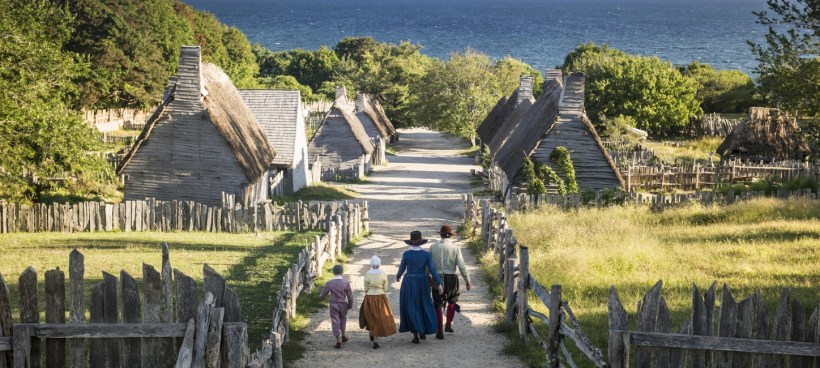
village
Plimouth Plantation is a living history park in Massachusetts that strives to recreate 17th century life in Plymouth faithfully for visitors.

During the religious upheavals of the 16th century, a body of men and women called Puritans sought to reform the Established Church of England from within. Essentially, they demanded that the rituals and structures associated with Roman Catholicism be replaced by simpler Calvinist Protestant forms of faith and worship. Their reformist ideas, by destroying the unity of the state church, threatened to divide the people and to undermine royal authority.

In 1607 a small group of Separatists—a radical sect of Puritans who did not believe the Established Church could ever be reformed—departed for Leyden, Holland, where the Dutch granted them asylum. However, the Calvinist Dutch restricted them mainly to low-paid laboring jobs. Some members of the congregation grew dissatisfied with this discrimination and resolved to emigrate to the New World.

In 1620, a group of Leyden Puritans secured a land patent from the Virginia Company. Numbering 101, they set out for Virginia on the Mayflower. A storm sent them far north and they landed in New England on Cape Cod. Believing themselves outside the jurisdiction of any organized government, the men drafted a formal agreement to abide by “just and equal laws” drafted by leaders of their own choosing. This was the Mayflower Compact.

Signing the Mayflower Compact 1620, a painting by Jean Leon Gerome Ferris 1899
The Mayflower was originally bound for the Colony of Virginia, financed by the Company of Merchant Adventurers of London. Storms forced them to anchor at the hook of Cape Cod in Massachusetts, as it was unwise to continue with provisions running short. This inspired some to proclaim that, since the settlement would not be made in the agreed-upon Virginia territory, they “would use their own liberty; for none had power to command them.” To prevent this, the Pilgrims chose to establish a government described in the Mayflower Compact. It was in essence a social contract in which the settlers consented to follow the compact’s rules and regulations for the sake of order and survival.

In December the Mayflower reached Plymouth harbor; the Pilgrims began to build their settlement during the winter. Nearly half the colonists died of exposure and disease, but come spring, neighboring Wampanoag Indians provided the information that would sustain them: how to grow maize.

The Landing of the Pilgrims, by Henry A. Bacon, 1877.

Squanto

1911 illustration of Tisquantum 'Squanto' teaching the Plymouth colonists to plant maize.
1911 illustration of Tisquantum (“Squanto”) teaching the Plymouth colonists to plant maize.

Some European expedition captains were known to increase profits by capturing natives to sell as slaves. Such was the case when Thomas Hunt kidnapped several Wampanoag in 1614 in order to sell them later in Spain. One of Hunt’s captives was a Patuxet named Tisquantum. Tisquantum eventually came to be known as Squanto (a nickname given to him by his friend William Bradford). After Squanto regained his freedom, he was able to work his way to England where he lived for several years, working with a shipbuilder.

He signed on as an interpreter for a British expedition to Newfoundland. From there Squanto went back to his home, only to discover that, in his absence, epidemics had killed everyone in his village.  Squanto was the last of the Patuxet.

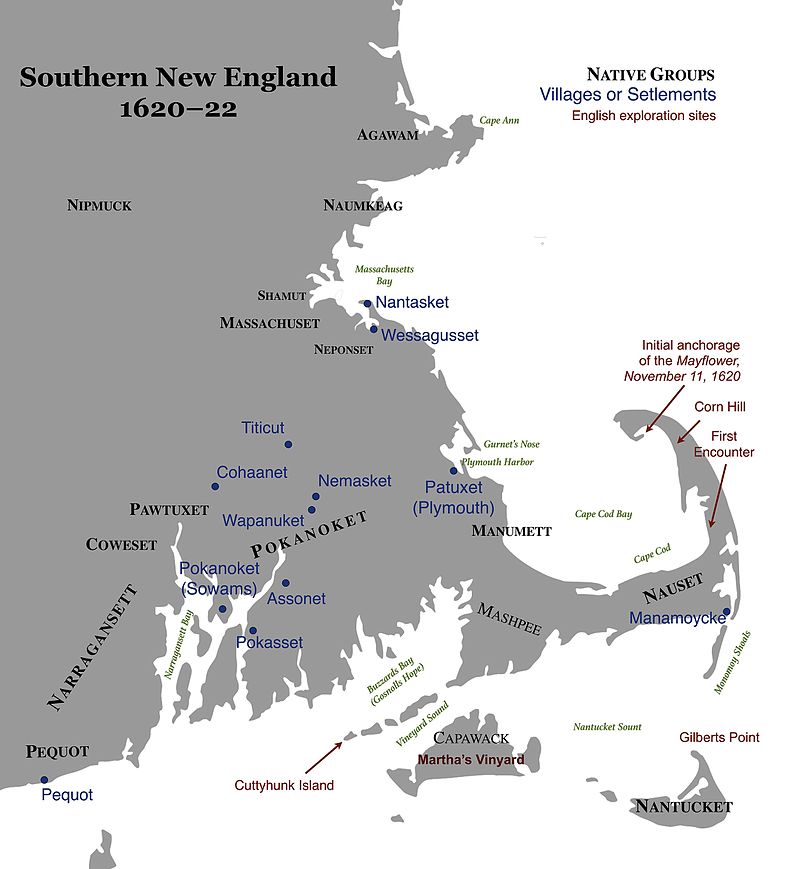
Southern_New_England,_1620–22_(rev)When the Mayflower landed in 1620, Squanto worked to broker peaceable relations between the Pilgrims and the local Pokanokets (a subgroup within the Wampanoag’s orbit). He played a key role in the early meetings in March 1621, partly because he spoke English. He then lived with the Pilgrims for 20 months, acting as a translator, guide, and adviser. He introduced the settlers to the fur trade, and taught them how to sow and fertilize native crops, which proved vital since the seeds which the Pilgrims had brought from England largely failed.  Whatever his motivations, with great kindness and patience, Squanto taught the English the skills they needed to survive, including how best to cultivate varieties of the Three Sisters: beans, maize and squash.

BONUS: Read more about The Three Sisters.
Illustration of corn cultivation in mounds by Algonquian village in North Carolina. Watercolor by John White c. 1585.

In the fall of 1621, the Plymouth colonists and Wampanoag shared an autumn harvest feast. This feast was a celebration of the first successful harvest season of the colonists.  This three-day celebration involving the entire village and about 90 Wampanoag has been celebrated as a symbol of cooperation and interaction between English colonists and Native Americans. The event later inspired 19th century Americans to establish Thanksgiving as a national holiday in the United States. The harvest celebration took place at the historic site of the Patuxet villages. Squanto’s involvement as an intermediary in negotiating the friendship treaty with Massasoit led to the joint feast between the Pilgrims and Wampanoag.

As food shortages increased, Plymouth Colony Governor William Bradford relied on Squanto to pilot a ship of settlers on a trading expedition around Cape Cod and through dangerous shoals. During that voyage, Squanto contracted what Bradford called an “Indian fever.” Bradford stayed with him for several days until he died, which Bradford described as a “great loss.”

Considerable mythology and legend has grown up around Squanto over time, largely because of early praise by Bradford and owing to the central role that the Thanksgiving festival of 1621 plays in American folk history. Squanto was less the “noble savage” that later myth portrayed him and more a practical adviser and diplomat.

The First Thanksgiving
The First Thanksgiving 1621, oil on canvas by Jean Leon Gerome Ferris (1899). The painting shows common misconceptions about the event that persist to modern times: Pilgrims did not wear such outfits, and the Wampanoag are dressed in the style of Native Americans from the Great Plains.

Massachusetts Bay Colony

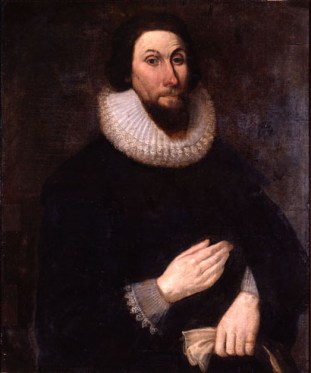
John Winthrop
John Winthrop was one of the leading figures in founding the Massachusetts Bay Colony, the second major settlement in New England, following Plymouth Colony. Winthrop led the first large wave of immigrants from England in 1630 and served as governor for 12 of the colony’s first 20 years. His writings and vision of the colony as a Puritan “city upon a hill” dominated New England colonial development, influencing the governments and religions of neighboring colonies.

A new wave of immigrants arrived on the shores of Massachusetts Bay in 1630 bearing a grant from King Charles I to establish a colony. Many of them were Puritans whose religious practices were increasingly prohibited in England. Their leader, John Winthrop, urged them to create a “city upon a hill” in the New World—a place where they would live in strict accordance with their religious beliefs and set an example for all of Christendom—an example of communal charity, affection, and unity to the world or, if the Puritans failed to uphold their covenant of God, “we shall be made a story and a by-word through the world” of God’s judgment. Winthrop’s sermon is often cited as an early example of American exceptionalism.

The Massachusetts Bay Colony was to play a significant role in the development of the entire New England region, in part because Winthrop and his Puritan colleagues were able to bring their charter with them. Thus the authority for the colony’s government resided in Massachusetts, not in England.

Under the charter’s provisions, power rested with the General Court, which was made up of “freemen,” required to be members of the Puritan, or Congregational, Church. This guaranteed that the Puritans would be the dominant political as well as religious force in the colony. The General Court elected the governor, who for most of the next generation would be John Winthrop.

The Puritan emphasis on reading directly from the Scriptures underscored the importance of literacy. In 1647 the Massachusetts Bay Colony enacted the “ye olde deluder Satan” Act, requiring every town having more than 50 families to establish a grammar school (a Latin school to prepare students for college). Shortly thereafter, all the other New England colonies, except for Rhode Island, followed its example.

The Pilgrims and Puritans had brought their own little libraries and continued to import books from London. And as early as the 1680s, Boston booksellers were doing a thriving business in works of classical literature, history, politics, philosophy, science, theology, and belles-lettres. In 1638 the first printing press in the English colonies and the second in North America was installed at Harvard College.

Harvard College in 1720
Harvard College in 1720.

Witch Trials

Like most Christians in the early modern period, Puritans believed in the active existence of the devil and demons as evil forces that could possess and cause harm to men and women. There was also widespread belief in witchcraft and witches—persons in league with the devil. “Unexplained phenomena such as the death of livestock, human disease, and hideous fits suffered by young and old” might all be blamed on the agency of the devil or a witch.

In 1692 a group of adolescent girls in Salem Village, Massachusetts, became subject to strange fits after hearing tales told by a West Indian slave. They accused several women of being witches. The townspeople were appalled but not surprised: Belief in witchcraft was widespread throughout 17th-century America and Europe. Town officials convened a court to hear the charges of witchcraft. Within a month, six women were convicted and hanged.

The hysteria grew, in large measure because the court permitted witnesses to testify that they had seen the accused as spirits or in visions. Such “spectral evidence” could neither be verified nor made subject to objective examination. By the fall of 1692, 20 victims, including several men, had been executed, and more than 100 others were in jail (where another five victims died)—among them some of the town’s most prominent citizens. When the charges threatened to spread beyond Salem, ministers throughout the colony called for an end to the trials. The governor of the colony agreed. Those still in jail were later acquitted or given reprieves.

Giles_Corey_restored
Giles Corey (Sept. 19, 1692) being pressed with heavy stones for failing to enter a plea to the charge of being a witch during the Salem Witch Trials.

Although an isolated incident, the Salem episode has long fascinated Americans. Most historians agree that Salem Village in 1692 experienced a kind of public hysteria, fueled by a genuine belief in the existence of witchcraft. While some of the girls may have been acting, many responsible adults became caught up in the frenzy as well.

Even more revealing is a closer analysis of the identities of the accused and the accusers. Salem Village, as much of colonial New England, was undergoing an economic and political transition from a largely agrarian, Puritan-dominated community to a more commercial, secular society. Many of the accusers were representatives of a traditional way of life tied to farming and the church, whereas a number of the accused witches were members of a rising commercial class of small shopkeepers and tradesmen. Salem’s obscure struggle for social and political power between older traditional groups and a newer commercial class was one repeated in communities throughout American history. It took a bizarre and deadly detour when its citizens were swept up by the conviction that the devil was loose in their homes.

The Salem witch trials also serve as a dramatic parable of the deadly consequences of making sensational, but false, charges. Three hundred years later, we still call false accusations against a large number of people a “witch hunt.”

Bridget-Bishop-Salem
Accused witch Bridget Bishop hanged at Salem.

Rhode Island

The rigid structure of the Puritan rule was not to everyone’s liking. One of the first to challenge the General Court openly was a young clergyman named Roger Williams, who objected to the colony’s seizure of Indian lands and advocated separation of church and state. Another dissenter, Anne Hutchinson, challenged key doctrines of Puritan theology. Both they and their followers were banished.

Williams purchased land from the Narragansett Indians in what is now Providence, Rhode Island, in 1636. In 1644, a sympathetic Puritan-controlled English Parliament gave him the charter that established Rhode Island as a distinct colony where complete separation of church and state as well as freedom of religion was practiced.

Roger_Williams_and_Narragansetts
Narragansett Indians receiving Roger Williams.

So‑called heretics like Williams were not the only ones who left Massachusetts. Orthodox Puritans, seeking better lands and opportunities, soon began leaving Massachusetts Bay Colony. News of the fertility of the Connecticut River Valley, for instance, attracted the interest of farmers having a difficult time with poor land. By the early 1630s, many were ready to brave the danger of Indian attack to obtain level ground and deep, rich soil. These new communities often eliminated church membership as a prerequisite for voting, thereby extending the franchise to ever larger numbers of men.

At the same time, other settlements began cropping up along the New Hampshire and Maine coasts, as more and more immigrants sought the land and liberty the New World seemed to offer.

King Philip’s War

Massasoit and governor John Carver smoking a peace pipe.
Massasoit, chief of the Wampanoag, and early Plymouth governor John Carver smoking a peace pipe.

The Pilgrims who arrived on the Mayflower and founded Plymouth Plantation expended great effort forging friendship and peace with the American Indians around Cape Cod. They traveled long distances to make peace with Massasoit, chief of the Wampanoag tribe, and Governor William Bradford made a gift of his prized red horse coat upon seeing that the chief admired it. Yet over the next 50 years, frictions and misunderstandings multiplied as wave after wave of Puritans and non-religious “strangers” (fortune-seekers not motivated by religion) kept arriving, often oblivious to the fragile peace carefully woven since the earliest arrivals. By 1675, the early efforts at friendship failed.

The Wampanoag tribe had entered into an agreement with the Plymouth Colony and believed that they could rely on the colony for protection. However, in the decades preceding the war, it became clear to them that the treaty was not stopping colonists from settling in Wampanoag territories.

Throughout the Northeast, Native Americans had suffered severe population losses as a result of pandemics of smallpox, spotted fever, typhoid, and measles, starting in about 1618, two years before the first colony at Plymouth had been settled.

The population of New England colonists totaled about 80,000 people. They lived in 110 towns, of which 64 were in the Massachusetts Bay colony, which then included the southwestern portion of the present state of Maine. The towns had about 16,000 men of military age who were almost all part of the militia, as universal training was prevalent in all colonial New England towns. Many towns had built strong garrison houses for defense, and others had stockades enclosing most of the houses. All of these were strengthened as the war progressed. Some poorly populated towns without enough men to defend them were abandoned.

Each town had local militias, based on all eligible men, who had to supply their own arms. Only those who were too old, too young, disabled, or clergy were excused from military service. The militias were usually only minimally trained and initially did relatively poorly against the warring Indians, until more effective training and tactics could be devised. Joint forces of militia volunteers and volunteer Indian allies were found to be the most effective. The officers were usually elected by popular vote of the militia members. 

Map depicting the approximate tribal territories of Native Americans around the year 1600, before the foundation of any permanent English settlements.

By 1676, the regional Indian population had decreased to about 10,000 (exact numbers are unavailable), largely because of epidemics. These included about 4,000 Narragansetts of western Rhode Island and eastern Connecticut, 2,400 Nipmucks of central and western Massachusetts, and 2,400 combined in the Massachusett and Pawtucket tribes living around Massachusetts Bay and extending northwest to Maine. The Wampanoags and Pokanokets of Plymouth and eastern Rhode Island are thought to have numbered fewer than 1,000. About one in four were considered to be warriors. By then, the Indians had almost universally adopted steel knives, tomahawks, and flintlock muskets as their weapons of choice. The various tribes had no common government. They had distinct cultures and often warred among themselves, although they all spoke related languages from the Algonquian family.

Indians Attacking a Garrison House.jpg
Indians Attacking a Garrison House, from an Old Wood Engraving This is likely a depiction of the attack on the Haynes Garrison, Sudbury, April 21, 1676.  Notice the European livestock dead in the foreground – to the Wompanoag, a frequent source of ire and a potent symbol of encroaching colonists, as cattle would graze in native fields, destroying their harvest.

Metacomet was the son of the sachem Massasoit, the Wampanoag chief who had originally made peace with the people of Plymouth colony in the 1620s.  Because of his closeness with the colonists during his youth, he adopted the name King Philip.  Unfortunately, by the time he himself became chief of the Wampanoag in 1662, the period of peaceful coexistence had become a distant memory following conflicts over land use, diminished game as a consequence of expanding European settlement, and questions of whether or not the Native Americans would submit to English rule.

Starting in 1675, in a conflict known by the colonists as King Philip’s War, Metacomet used tribal alliances to coordinate efforts to push European colonists out of New England.

The war was the single greatest calamity to occur in seventeenth-century Puritan New England and is considered by many to be the deadliest war in the history of European settlement in North America in proportion to the population. In the space of little more than a year, twelve of the region’s towns were destroyed and many more were damaged, the economy of Plymouth and Rhode Island Colonies was all but ruined and their population was decimated, losing one-tenth of all men available for military service. More than half of New England’s towns were attacked by Indians.

Philip_King_of_Mount_Hope_by_Paul_Revere
“Philip. King of Mount Hope,” a 1772 engraving of a caricature of King Philip by Paul Revere.

The war largely ended with Metacomet’s death. His head was mounted on a pike at the entrance to Plymouth, Massachusetts, where it remained for more than two decades. His body was cut into quarters and hung in trees.

More than 1,000 colonists and 3,000 Indians had died. More than half of all New England villages were attacked by Indian warriors, and many were completely destroyed. Several Indians were enslaved and transported to Bermuda, including Metacomet’s son, and numerous Bermudians today claim ancestry from the Indian exiles.

The article was adapted in part from:
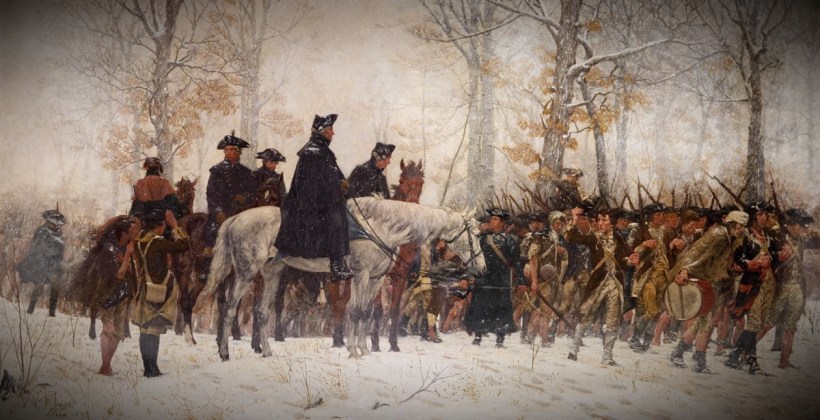
  1. The Colonial Period
  2. English Colonies
  3. Squanto
  4. Patuxet

Jamestown: English Settlers in the Land of the Powhatan

Imagine you come home from school to find that, without your permission or knowledge, someone has begun building a new home in your backyard.  When you confront them about this, they defend their right to do so – saying the space was just empty, grass and trees.  You clearly weren’t using it anyway…
This lesson was reported from:
A chapter of The United States: An Open Ended History, a free online textbook.  Adapted in part from open sources.

For Your Consideration:
  1. What is a joint stock company? Provide one specific example from the reading.
  2. What challenges did the first settlers in Jamestown face? (2 examples)
  3. What change did John Rolfe bring to Jamestown?
  4. Why did the Powhatan and English come into conflict?

A For-Profit Colony

Virginia Map
The 1608 grant to the Virginia Company of London “from sea to sea” is shown demarcated in red.

The Virginia Company of London was an English joint-stock company established in 1606 by royal charter by King James I with the purpose of establishing colonial settlements in North America.  A charter was a license granted by the king granting a person, company, or group the authority to do something.  In this case, the king granted a huge chunk of North America to the Virginia Company for the purposes of colonization, as the charter said, from “sea-to-sea” – despite the fact that the continent was already known to be populated by large numbers of Native Americans.  While the new colony would be English territory, the charter gave almost complete control of colonial government to the Virginia Company.  This was a for-profit business, first and foremost.

A joint-stock company is a business arrangement that allows many individuals to pool their savings together to undertake a large project – in this case, the colonization of North America, which would hopefully yield the kind of gold and silver that had come out of the Spanish conquest of South and Central America.  Depending on the success of the colony, each investor would receive profit based on the shares he had bought. This investment was less risky than starting an English colony from scratch.

Virginia and Jamestown

detail.jpegThe area laid out in the royal charter was named Virginia, after both the organizing Virginia Company of London and Queen Elizabeth, “the Virgin Queen.” Founded in 1607, the first settlement – a small triangular fort populated by about 100 settlers at the mouth of the James River – was named after King James I.  Jamestown was the first permanent English colony in the Americas.

The English settlement at Jamestown was established on May 24, 1607, with the arrival of three ships commanded by Captain Christopher Newport. The initial small group of 104 men and boys chose the location because it was favorable for defensive purposes, but it offered poor hunting prospects and a shortage of drinking water.  The island was swampy and isolated, and it offered limited space, was plagued by mosquitoes, and afforded only brackish tidal river water unsuitable for drinking.  Although they did some farming, few of the original settlers were accustomed to manual labor or familiar with farming. Hunting on the island was poor, and they quickly exhausted the supply of small game. The colonists were largely dependent upon trade with the Native Americans and periodic supply ships from England for their food.

A series of incidents with the Native Americans soon developed into serious conflicts, ending any hope of a commercial alliance with them. This forced the settlers into close quarters, behind fortified walls, severely limiting their ability to farm the area and trade with other Indian tribes. Various attempts at farming led to kidnappings and killings by the Powhatans, while expeditions to establish relations with other Native Americans resulted either in the emissaries being ambushed and killed by the Powhatans, or proved fruitless in gaining sufficient supplies. The combination of disease, killings, and kidnapping almost obliterated the initial English population.

Marsh_-_Colonial_National_Historical_Park_(Robin_Baranowski,_NPS_Photo)_(8426448355)
Salt marshes along Jamestown Island. The ample wetlands on the island proved to be a breeding ground for mosquitoes.

In addition, Virginia’s first government was weak, and its individuals frequently quarreled over policies. The colonists frantically searched for gold, silver, and gems, ignoring their own sicknesses.  Made up of townsmen and adventurers more interested in finding gold than farming, the group was unequipped by temperament or ability to embark upon a completely new life in the wilderness.  Indian raids further weakened defense and unification, and Jamestown began to die off. By the winter of 1609-1610, also known as the Starving Time, only 60 settlers remained from the original 500 passengers.   The famine during that harsh winter forced the colonists to eat leather from their clothes and boots and resort to cannibalism.

Describing the Starving Time, George Percy, a president of the Jamestown colony recalled: “Now all of us at James Town, beginning to feel that sharp prick of hunger, which no man [can] truly describe but he which hath tasted the bitterness thereof. A world of miseries ensued . . . [and] some, to satisfy their hunger, have robbed the store, for the which I caused them to be executed. Then having fed upon horses and other beasts as long as they lasted, we were glad to make shift with vermin, as dogs, cats, rats, and mice. All was fish that came to net to satisfy cruel hunger, as to eat boots, shoes, or any other leather some could come by. And those being spent and devoured, some were enforced to search the woods and to feed upon serpents and snakes and to dig the earth for wild and unknown roots, where many of our men were cut off and slain by the [Indians]. And now famine beginning to look ghastly and pale in every face that nothing was spared to maintain life and to do those things which seem incredible …” 

Jamestown DiagramTwo men helped the colony to survive: adventurer John Smith and businessman John Rolfe. Smith, who arrived in Virginia in 1608, introduced an ultimatum: “He that will not work, shall not eat”, equivalent to the 2nd Thessalonians 3:10 in the Bible. Under this dire threat, the colonists at last learned how to raise crops and trade with the nearby Indians, with whom Smith had made peace.

In 1612, John Rolfe discovered that Virginia had ideal conditions for growing tobacco. This discovery, and the breeding of a new, “sweeter” strain, led to the plant becoming the colony’s major cash crop. With English demand for tobacco rising, Virginia had found a way to support itself economically.

New plantations began growing up all along the James River.

Prosperity did not come quickly, however, and the death rate from disease and Indian attacks remained extraordinarily high. Between 1607 and 1624 approximately 14,000 people migrated to the colony, yet by 1624, there were only 1,132 living there.

The Powhatan

Powhatan_john_smith_map
Powhatan in a longhouse at Werowocomoco (detail of John Smith map, 1612).

The Powhatan Confederacy was where the English made their first permanent settlement in North America.  It was ruled at the time by Wahunsunacawh (known to the English as Chief Powhatan).

According to research by the National Park Service, Powhatan “men were warriors and hunters, while women were gardeners and gatherers. The English described the men, who ran and walked extensively through the woods in pursuit of enemies or game, as tall and lean and possessed of handsome physiques. The women were shorter, and were strong because of the hours they spent tending crops, pounding corn into meal, gathering nuts, and performing other domestic chores. When the men undertook extended hunts, the women went ahead of them to construct hunting camps. The Powhatan domestic economy depended on the labor of both sexes.”

The Powhatan lived east of the Fall Line in Tidewater Virginia. They built their houses, called yehakins, by bending saplings and placing woven mats or bark over top of the saplings. They supported themselves primarily by growing crops, especially maize (corn), but they also fished and hunted in the great forest in their area. Villages consisted of a number of related families organized in tribes led by a chief (weroance/werowance or weroansqua if female). They paid tribute to the paramount chief (mamanatowick), Wahunsunacawh.

800px-Jamestownsettlement
Reconstructed Powhatan village at the Jamestown Settlement living-history museum.

All of Virginia’s natives practiced agriculture. They periodically moved their villages from site to site. Villagers cleared the fields by felling, girdling, or firing trees at the base and then using fire to reduce the slash and stumps. A village became unusable as soil productivity gradually declined and local fish and game were depleted. The inhabitants then moved on. With every change in location, the people used fire to clear new land. They left more cleared land behind. The natives also used fire to maintain extensive areas of open game habitat throughout the East, later called “barrens” by European colonists. The Powhatan also had rich fishing grounds. Bison had migrated to this area by the early 15th century.

English settlers in the land of the Powhatan

jtown1607natamer.png

Conflicts began immediately between the Powhatan people and the English; the English colonists fired shots as soon as they arrived (due to a bad experience they had with the Spanish prior to their arrival). Within two weeks of the English arrival at Jamestown, deaths had occurred.

The settlers had hoped for friendly relations and had planned to trade with the Virginia Indians for food. Captain Christopher Newport led the first English exploration party up the James River in 1607, when he met Parahunt, weroance of the Powhatan proper. The English initially mistook him for the paramount Powhatan (mamanatowick), his father Wahunsunacawh, who ruled the confederacy.

john-smith-9486928-1-402
Captain John Smith led a colorful life, even if his biography sometimes exaggerated his adventures.

While on a hunting and trade mission on the Chickahominy River in December 1607, only seven months after building the fort on Jamestown Island, Captain John Smith, later president of the colony, was captured by Opechancanough, the younger brother of Wahunsunacawh. Smith became the first Englishman to meet the paramount chief Powhatan.

Captain John Smith imagined that someday the Virginia Indians would be doing all the work for the English, but Powhatan envisioned something different: he wanted Smith and the colonists to forsake the swamp and instead live in one of his satellite towns called Capahosick where they would make metal tools for him in exchange for full provision. 

800px-Pocahontas-saves-Smith-NE-Chromo-1870
In this chromolithograph credited to the New England Chromo. Lith. Company, around 1870, Pocahontas saves the life of John Smith. The scene is idealized and relies on stereotypes of Native Americans rather than reliable information about the particulars of this historical moment. There are no mountains in Tidewater Virginia, for example, and the Powhatans lived not in tipis but in thatched houses. And the scene that Smith famously described in his Generall Historie (1624) did not take place outdoors but in a longhouse.

Much later, when Smith was writing a book about his life, he claimed that during his captivity, Pocahontas, Chief Wahunsunacawh’s daughter, had dramatically saved him from Powhatan’s clubs, but historians differ as to whether or not this was propaganda, or an actual native ritual. Smith’s capture represented just an example of the diplomatic strategies employed by Wahunsunacawh to make the English cooperate with and contribute to his expanding control in this region. Smith was released when he falsely promised to move the colony to Capahosick, just as the chief wished.

BONUS INFO: Six Inaccuracies in Disney’s Pocahontas
350px-The_Coronation_of_Powhatan_John_Gadsby_Chapman
The Coronation of Powhatan, oil on canvas, John Gadsby Chapman, 1835.

In 1608, the leaders of Jamestown realized that Powhatan’s friendship was crucial to the survival of the small Jamestown colony. In the summer of that year, he tried to “crown” the paramount Chief, with a ceremonial crown, to make him an English “vassal.” They also gave Powhatan many European gifts, such as a pitcher, feather mattress, bed frame, and clothes. The coronation went badly because they asked Powhatan to kneel to receive the crown, which he refused to do. As a powerful leader, Powhatan followed two rules: “he who keeps his head higher than others ranks higher,” and “he who puts other people in a vulnerable position, without altering his own stance, ranks higher.” To finish the “coronation”, several English had to lean on Powhatan’s shoulders to get him low enough to place the crown on his head, as he was a tall man. Afterwards, the English might have thought that Powhatan had submitted to King James, whereas Powhatan likely thought nothing of the sort.

After John Smith became president of the colony, he sent a force to occupy an island in Nansemond territory and drive the inhabitants away. At the same time, he sent another force to build a fort at the James River falls. He purchased a nearby fortified Powhatan village (present site of Richmond, Virginia) from another chief named Parahunt for some copper. Smith then renamed the village “Nonsuch,” and tried to persuade English colonists to live in it. Both these attempts at settling beyond Jamestown soon failed due to Powhatan resistance. Smith left Virginia for England in October 1609, never to return, because of an injury sustained in a gunpowder accident.

From Charter Colony to Royal Colony

Pocahontas_by_Simon_van_de_Passe_1616
Portrait of Pocahontas, wearing a tall hat in the English style of the early 1600s.  After her baptism and marriage, her name was changed to Rebecca.

Prosperous and wealthy from his investment in the new tobacco trade, John Rolfe married Pocahontas, daughter of Chief Powhatan, bringing several years of peace between the English and natives. However, at the end of a public relations trip to England, Pocahontas became sick and died on March 21, 1617. The following year, her father also died. Powhatan’s brother, a fierce warrior named Opchanacanough, became head of the Powhatan Confederacy. As the English continued to appropriate more land for tobacco farming, relations with the natives worsened.

After several years of strained coexistence, Chief Opchanacanough and his Powhatan Confederacy attempted to eliminate the English colony once and for all. On the morning of March 22, 1622, they attacked outlying plantations and communities up and down the James River in what became known as the Indian Massacre of 1622. More than 300 settlers were killed in the attack, about a third of the colony’s English-speaking population.

The remarkable death rate, as well as the high demand for cheap labor created by the booming tobacco industry, meant that recruiting new colonists was at times challenging to say the least.  Most any colonist who could afford the journey had little interest in personally performing the hard labor that tobacco cultivation demanded.

Due to the high cost of the transatlantic voyage at this time, many English settlers came to Jamestown as indentured servants: in exchange for the passage, room, board, and the promise of land or money, these immigrants would agree to work for three to seven years.  Along with European indentured servants, around 20 African slaves arrived in Jamestown in 1619. These slaves were captives taken from a ship headed for Mexico. Though these Africans started in Jamestown as slaves, some were able to obtain the status of indentured servant later in life.

1619-Arrival-of-Slaves
An artist’s depiction of the arrival of the first African slaves in Jamestown, 1619.

Also in 1619, Virginia set up the House of Burgesses, the first elected legislative assembly in America. It marked the beginnings of self-government, replacing the martial law that was previously imposed on the colonists.

However, in 1624, King James revoked the Virginia Company’s charter, and Virginia became a royal colony. Its charter was transferred from the Virginia Company to the Crown of England, which meant that Jamestown was now a colony run by the English monarchy. While the House of Burgesses was still allowed to run the government, the king also appointed a royal governor to settle disputes and enforce certain British policies.

Another large-scale “Indian attack” occurred in 1644. In 1646, Opchanacanough was captured and while in custody an English guard shot him in the back—against orders—and killed him. Subsequently, the Powhatan Confederacy began to decline. Opechancanough’s successor signed the first peace treaties between the Powhatan Indians and the English. The treaties required the Powhatan to pay yearly tribute payment to the English and confined them to reservations.

This article was adapted in part from:

  1. Early America
  2. Transatlantic Encounters and Colonial Beginnings (1492 – 1620)
  3. Jamestown, Virginia
  4. Powhatan

Ideas for Teaching About Nicaragua

Openendedsocialstudies has a unit for teaching middle or high school classrooms about the history of Nicaragua, the Sandinistas, and controversial leader Daniel Ortega.  Find free readings, guided questions, and lesson plan ideas on the following subjects:

  • A Basic History of Nicaragua: A basic overview of Nicaraguan history and culture through the end of the modern period, with a focus on the post-colonial period.
  • William Walker, the Grey-Eyed Man of Destiny: William Walker was an American  who organized several private military expeditions into Latin America with the intention of establishing English-speaking colonies under his personal control, an enterprise then known as “filibustering.”
  • Augusto Sandino, National Hero: From 1927 until 1933, Gen. Augusto César Sandino led a sustained guerrilla war first against the Conservative regime and subsequently against the U.S. Marines, whom he fought for over five years. He was referred to as a “bandit” by the United States government; his exploits made him a hero throughout much of Latin America, where he became a symbol of resistance to United States’ domination.
  • The Sandinistas: The Sandinista National Liberation Front – also called the Sandinistas – are a former guerrilla army and ruling party of Nicaragua. Following a decade of single party rule, they submitted to free and fair elections in 1990, ushering in Nicaragua’s current period of period of peace, democratic stability, and relative prosperity after decades of corrupt dictatorship, civil war, and domination by the U.S. and its corporations.

One great way for students to develop a deeper understanding of a concept is to have them teach others.

  1. Choose any section from this unit and develop a lesson – in the form of a presentation, a storybook, or a worksheet – that teaches younger students about some aspect of Nicaragua’s history.  Make sure the material is age appropriate in content and approach, and create some simple questions to check your audience’s understanding.

Find more free lessons on Nicaragua at Openendsocialstudies.org.  

There are also plenty of free lessons featuring other peoples from world history.

A Note from the Editor

Creative Commons LicenseAll content on this site is offered under a Creative Commons Attribution-ShareAlike 3.0 United States License.

“My name is Thomas Kenning.  I am the creator of Openendedsocialstudies.org.  I am an educator with approximately fifteen years of experience in classrooms ranging from preschool to university, though my primary focus is on grades six to nine in the field of social studies.  I have a bachelors in secondary education from Indiana University and a masters in history from American University.  I started this website because it is the kind of resource that I am always looking for myself – digestible lessons that expand the too limited American notion of “world history,” accompanied by questions that help students to process and apply (not just regurgitate and forget) what they are reading.  If the idea is to build bridges to a broader view of the world – not wall our students in – then I hope this website is one of those bridges, rickety as it may be.

author photo

I am a firm believer that the best teachers are creative and resourceful, making dynamic use of the tools they have at hand. In that spirit, some of the basic text on this website is adapted from open sources (like Wikipedia), but every bit of it has been fact checked and cross-referenced with academic sources.  I’ve made every effort to ensure accuracy, as well as balance, across this website.  I stand by everything I have posted here – I use many of these lessons in my own classroom on a regular basis – but if you see something that strikes you as inaccurate, by all means, please let me know in the comments section of the page in question.

Thank you for choosing to use Openendedsocialstudies.org in your classroom.”

Thomas Kenning is an author, educator, and adventurer. He has written extensively about Washington, DC, including in the recently published Abandoned Washington, DC. Mr. Kenning is the creator of the award-winning Openendedsocialstudies.org, a library of free lesson plans and travel writing designed to foster a sense of wonder about the world and our place in it. When he is not travelling to some far flung corner of the Earth, he resides with his wife and daughter (a DC native!) – planning his next improbable adventure and trying to leave the planet a little bit nicer than he found it.