The Shot Heard Round the World, Common Sense, and Independence

This lesson was reported from:
A chapter of The United States: An Open Ended History, a free online textbook.  Adapted in part from open sources.

For Your Consideration:
  1. What happened at Lexington and Concord that was so different from what came before?
  2. How was the Continental Army different from the minutemen?
  3. How was the Olive Branch Petition received?
  4. What was the main argument and significance of Common Sense?
  5. What was the main argument and significance of the Declaration of Independence?

The Battle of Lexington and Concord

General Thomas Gage, an amiable English gentleman with an American-born wife, commanded the garrison at Boston, where political activity had almost wholly replaced trade. Gage’s main duty in the colonies had been to enforce the Coercive Acts. When news reached him that the Massachusetts colonists were collecting powder and military stores at the town of Concord, 32 kilometers away, Gage sent a strong detail to confiscate these munitions.

After a night of marching, the British troops reached the village of Lexington on April 19, 1775, and saw a grim band of 77 minutemen— self-trained militiamen charged with defending their hometowns, so named because they were said to be ready to fight in a minute—through the early morning mist. The Minutemen intended only a silent protest, but Marine Major John Pitcairn, the leader of the British troops, yelled, “Disperse, you damned rebels! You dogs, run!” The leader of the Minutemen, Captain John Parker, told his troops not to fire unless fired at first. The Americans were withdrawing when someone fired a shot, which led the British troops to fire at the Minutemen. The British then charged with bayonets, leaving eight dead and 10 wounded. In the often-quoted phrase of 19th century poet Ralph Waldo Emerson, this was “the shot heard round the world” – the moment at which colonial protest crossed the line into outright armed rebellion.

The skirmish at Lexington.
The skirmish at Lexington – note the Minutemen scattering in the foreground.

The British pushed on to Concord. The Americans had taken away most of the munitions, but they destroyed whatever was left. In the meantime, American forces in the countryside had mobilized to harass the British on their long return to Boston. All along the road, behind stone walls, hillocks, and houses, militiamen from “every Middlesex village and farm” made targets of the bright red coats of the British soldiers. By the time Gage’s weary detachment stumbled into Boston, it had suffered more than 250 killed and wounded. The Americans lost 93 men.
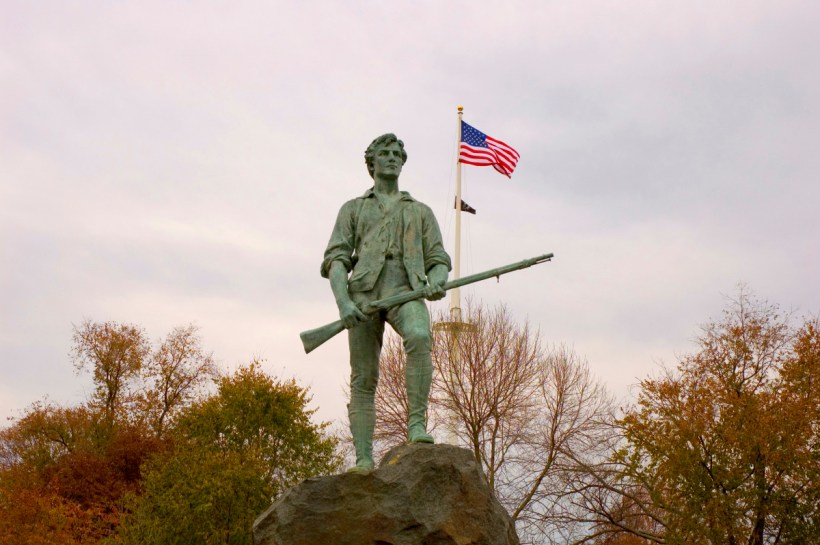
statue-at-lexington-green
The statue that now stands on Lexington green commemorating the service and sacrifice of colonial Minutemen. Some argue that this likeness is based on Captain John Parker, though that claim has never been proven.

The Battle of Bunker Hill

On the morning following the Battle of Lexington and Concord, the British woke up to find Boston surrounded by 20,000 armed colonists, occupying the neck of land extending to the peninsula on which the city stood.

The colonist’s action had changed from a battle to a siege, where one army bottles up another in a town or a city. (Though in traditional terms, the British were not besieged, since the Royal Navy controlled the harbor and supplies came in by ship.) The 6,000 to 8,000 rebels faced some 4,000 British regulars under General Thomas Gage. Boston and little else was controlled by British troops.

Lexington_Concord_Siege_of_Boston_crop
1775 map of the Boston area, relating key events from this early period of the war.

The Second Continental Congress met in Philadelphia, Pennsylvania, on May 10. The Congress voted to go to war, inducting the colonial militias into continental service. It appointed Colonel George Washington of Virginia as their commander-in-chief on June 15, promoting to him to rank of General in the Continental Army, the United States’s first national military force.

General Gage countered the siege of Boston on June 17 by attacking the colonists on Breed’s Hill and Bunker Hill. Although the British suffered tremendous casualties compared to the colonial losses, the British were eventually able to dislodge the American forces from their entrenched positions. The colonists were forced to retreat when many colonial soldiers ran out of ammunition. Soon after, the area surrounding Boston fell to the British.

Despite this early defeat for the colonists, the battle proved that they had the potential to counter British forces, which were at that time considered the best in the world.

battle of bunker hill
A stylized rendering of the Battle of Bunker Hill.

The Last Chance For Peace

Despite the outbreak of armed conflict, the idea of complete separation from England was still repugnant to many members of the Continental Congress. In July, it adopted the Olive Branch Petition, in which it the Congress affirmed its allegiance to the Crown and asked the king for peace talks. It was received in London at the same time as news of the Battle of Bunker Hill. The King refused to read the petition or to meet with its ambassadors.  King George rejected it; instead, on August 23, 1775, he issued a proclamation declaring the colonies to be in a state of rebellion.

Britain had expected the Southern colonies to remain loyal, in part because of their reliance on slavery. Many in the Southern colonies feared that a rebellion against the mother country would also trigger a slave uprising. In November 1775, Lord Dunmore, the governor of Virginia, tried to capitalize on that fear by offering freedom to all slaves who would fight for the British. Instead, his proclamation drove to the rebel side many Virginians who would otherwise have remained Loyalist.

800px-King_George_III_of_England_by_Johann_Zoffany
King George III in 1771.

The Battle for Boston

The British continued to occupy Boston, and despite British control of the harbor, the town and the army were on short rations. Salt pork was the order of the day, and prices escalated rapidly. While the American forces had some information about what was happening in the city, General Gage had no effective intelligence of rebel activities.

On July 3, 1775, George Washington arrived to take charge of the new Continental Army. Forces and supplies came in from as far away as Maryland. Trenches were built at Dorchester Neck, extending toward Boston. Washington reoccupied Bunker Hill and Breeds Hill without opposition. However, these activities had little effect on the British occupation.

1024px-Washingtoncommandarmy
George Washington taking command of the Continental Army, 1775.

In the winter of 1775– 1776, Henry Knox and his engineers, under order from George Washington, used sledges to retrieve sixty tons of heavy artillery that had been captured in surprise attack on the British Fort Ticonderoga, hundreds of miles away in upstate New York. Knox, who had come up with the idea to use sledges, believed that he would have the artillery there in eighteen days. It took six weeks to bring them across the frozen Connecticut River, and they arrived back at Cambridge on January 24, 1776. Weeks later, in an amazing feat of deception and mobility, Washington moved artillery and several thousand men overnight to take Dorchester Heights overlooking Boston.  The British fleet had become a liability, anchored in a shallow harbor with limited maneuverability, and under the American guns on Dorchester Heights.

800px-Siegeofbostonartillery
An ox team hauling Ticonderoga’s guns to the siege at Boston.

When British General Howe saw the cannons, he knew he could not hold the city. He asked that George Washington let them evacuate the city in peace. In return, they would not burn the city to the ground. Washington agreed: he had no choice. He had artillery guns, but did not have the gunpowder. The whole plan had been a masterful bluff. The siege ended when the British set sail for Halifax, Nova Scotia on March 17, 1776. The militia went home, and in April Washington took most of the Continental Army forces to fortify New York City.

As men continued to fight and die, though, the question became all the more pressing – just what were the colonies trying to achieve?  Just what were men fighting and dying for?

Common Sense and Independence

In January 1776, Thomas Paine, a radical political theorist and writer who had come to America from England in 1774, published a 50-page pamphlet, Common Sense. Within three months, it sold 100,000 copies. Paine attacked the idea of a hereditary monarchy, declaring that one honest man was worth more to society than “all the crowned ruffians that ever lived.” He presented the alternatives—continued submission to a tyrannical king and an outworn government, or liberty and happiness as a self-sufficient, independent republic. Circulated throughout the colonies, Common Sense helped to crystallize a decision for separation.

thomas_paine_1050x700
Thomas Paine and the cover to his most famous work, Common Sense.

There still remained the task, however, of gaining each colony’s approval of a formal declaration. On June 7, Richard Henry Lee of Virginia introduced a resolution in the Second Continental Congress, declaring, “That these United Colonies are, and of right ought to be, free and independent states. …” Immediately, a committee of five, headed by Thomas Jefferson of Virginia, was appointed to draft a document for a vote.

Franklin-Jefferson-and-Adams-1024x768
From left to right, Benjamin Franklin of Pennsylvania, John Adams of Massachusetts, and Thomas Jefferson of Virginia represented the three major regions of the colonies and were the three most prominent members of the committee appointed to write the Declaration of Independence. The final product, while containing contributions from the group as a whole, was largely the work of Jefferson.

Largely Jefferson’s work, the Declaration of Independence, adopted July 4, 1776, not only announced the birth of a new nation, but also set forth a philosophy of human freedom that would become a dynamic force throughout the entire world. The Declaration drew upon French and English Enlightenment political philosophy, but one influence in particular stands out: John Locke’s Second Treatise on Government. Locke took conceptions of the traditional rights of Englishmen and universalized them into the natural rights of all humankind. The Declaration’s familiar opening passage echoes Locke’s social-contract theory of government:

We hold these truths to be self‑evident, that all men are created equal, that they are endowed by their Creator with certain unalienable Rights, that among these are Life, Liberty and the pursuit of Happiness.—That to secure these rights, Governments are instituted among Men, deriving their just powers from the consent of the governed,—That whenever any Form of Government becomes destructive of these ends, it is the Right of the People to alter or to abolish it, and to institute new Government, laying its foundation on such principles and organizing its powers in such form, as to them shall seem most likely to effect their Safety and Happiness.

Jefferson linked Locke’s principles directly to the situation in the colonies. To fight for American independence was to fight for a government based on popular consent in place of a government by a king who had “combined with others to subject us to a jurisdiction foreign to our constitution, and unacknowledged by our laws. …” Only a government based on popular consent could secure natural rights to life, liberty, and the pursuit of happiness. Thus, to fight for American independence was to fight on behalf of one’s own natural rights.

1024px-Independence_Hall_Assembly_Room
The Assembly Room in Philadelphia’s Independence Hall, where the Second Continental Congress adopted the Declaration of Independence.

At the signing, Benjamin Franklin is quoted as having replied to a comment by President of the Continental Congress John Hancock that they must all hang together: “Yes, we must, indeed, all hang together, or most assuredly we shall all hang separately,” a play on words indicating that failure to stay united and succeed would lead to being tried and executed, individually, for treason.

The article was adapted in part from:

  1. The American Revolution
  2. The Road to Revolution
  3. The Road to Independence
  4. History of the United States

Agitation, Taxation, and Representation by Other Means

This lesson was reported from:
A chapter of The United States: An Open Ended History, a free online textbook.  Adapted in part from open sources.

For Your Consideration:
  1. Describe the Sugar Act, the Quartering Act, and the Stamp Act.  Why did these acts of Parliament so upset American colonists?
  2. How did American colonists resist these acts?
  3. What was the Boston Massacre? How did Paul Revere and other Sons of Liberty talk about this event?
  4. What was the Boston Tea Party?  How did Parliament respond to it?
  5. What did it mean to call someone a patriot?  A loyalist?

The Stamp Act and Other Laws

The French and Indian War (1754–63) was a watershed event in the political development of the colonies.  Following Britain’s acquisition of French territory in North America, King George III issued the Royal Proclamation of 1763 limiting westward expansion of colonial settlements, all with the goal of organizing his newly enlarged North American empire and avoiding conflict with Native Americans beyond the Appalachian Mountains.  This alienated colonists who had fought the war with the promise of a new source of free or cheap land in mind.

Furthermore, the French and Indian War nearly doubled Great Britain’s national debt, and Parliament was keen to find new sources of revenue to settle this debt.

In 1764, Parliament began allowing customs officers to search random houses in the colonies for smuggled goods on which no import tax had been paid. British authorities thought that if profits from smuggled goods could be directed towards Britain, the money could help pay off debts. Colonists were horrified that they could be searched without warrant at any given moment.

Also in 1764, Parliament began to impose new taxes on the colonists. The Sugar Act of 1764 reduced taxes on sugar and molasses imposed by the earlier Molasses Act, but at the same time strengthened the enforcement of tax collection, making smuggling harder. It also provided that British judges, and not colonial juries – who, as consumers of the smuggled sugar in question, might be more sympathetic to the accused – would try cases involving violations of that Act.

The next year, Parliament passed the Quartering Act, which required the colonies to provide room and board for British soldiers stationed in North America; the soldiers would serve various purposes, chiefly to enforce the previously passed acts of Parliament.

Following the Quartering Act, Parliament passed one of the most infamous pieces of legislation: the Stamp Act. Previously, Parliament imposed only external taxes on imports, paid by the merchants who actually brought goods into the colonies. The Stamp Act provided the first internal tax paid directly by the colonists when they purchased books, newspapers, pamphlets, legal documents, playing cards, and dice. These items – important for communication and entertainment – now required an official tax stamp as proof of payment.

800px-Proof_sheet_of_one_penny_stamps_Stamp_Act_1765
Proof sheet of one-penny stamps submitted for approval to Commissioners of Stamps by engraver, May 10, 1765.

The colonial legislature of Massachusetts requested a conference on the Stamp Act; the Stamp Act Congress met in October that year, petitioning the King and Parliament to repeal the act before it went into effect at the end of the month, crying “taxation without representation.”  Specifically, these colonists argued that as English subjects, they were entitled to a voice in Parliament.  As it stood, the colonists had no right to vote – so Parliament could impose all of the unpopular laws and taxes that it liked on colonists, and they faced no consequences at the ballot box…  Without a member of Parliament working on their behalf, this was hardly the outcome of a democracy – it may as well be the act of an absolute tyrant.

istampa001p1
American newspapers reacted to the Stamp Act with anger and predictions of the demise of journalism.

The Stamp Act faced vehement opposition throughout the colonies. Merchants and consumers alike threatened to boycott British products. Thousands of New Yorkers rioted near the location where the stamps were stored. In Boston, the Sons of Liberty, a violent group led by radical statesman Samuel Adams, destroyed the home of Lieutenant Governor Thomas Hutchinson.  Adams wanted to free people from their awe of social and political superiors, make them aware of their own power and importance, and thus arouse them to action. Toward these objectives, he published articles in newspapers and made speeches in town meetings, instigating resolutions that appealed to the colonists’ democratic impulses.

The Sons of Liberty also popularized the use of tar and feathering to punish and humiliate offending government officials starting in 1767. This method was also used against those who threatened to break the boycott and later against British Loyalists during the American Revolution.

800px-Philip_Dawe_(attributed),_The_Bostonians_Paying_the_Excise-man,_or_Tarring_and_Feathering_(1774)_-_02
The Bostonian Paying the Excise-Man, 1774 British propaganda print, referring to the tarring and feathering, of Boston Commissioner of Customs John Malcolm four weeks after the Boston Tea Party. The men also poured hot tea down Malcolm’s throat; note the noose hanging on the Liberty Tree and the Stamp Act posted upside-down.

Parliament did indeed repeal the Stamp Act, but additionally passed the Declaratory Act, which stated that Great Britain retained the power to tax the colonists, even without representation.

Believing that the colonists only objected to internal taxes, Chancellor of the Exchequer Charles Townshend proposed bills that would later become the Townshend Acts. The Acts, passed in 1767, taxed imports of tea, glass, paint, lead, and even paper. The colonial merchants again threatened to boycott the taxed products, reducing the profits of British merchants, who in turn petitioned Parliament to repeal the Townshend Acts. Parliament eventually agreed to repeal much of the Townshend legislation. But Parliament refused to remove the tax on tea, implying that the British retained the authority to tax the colonies despite a lack of representation.

In Boston, enforcement of the new regulations provoked violence. When customs officials sought to collect duties, they were set upon by the populace and roughly handled. For this infraction, two British regiments were dispatched to protect the customs commissioners, but the presence of British troops in Boston was a standing invitation to disorder.

On March 5, 1770, a large crowd gathered around a group of British soldiers. The crowd grew threatening, throwing snowballs, rocks, and debris at them. One soldier was clubbed and fell. There was no order to fire, but the soldiers fired into the crowd anyway. They hit 11 people; three civilians died at the scene of the shooting, and two died after the incident. Crispus Attucks was an American stevedore of African and Native American descent, widely regarded as the first person killed in the Boston that day and thus the first American killed in the American Revolution.  Dubbed the “Boston Massacre,” the incident was framed as dramatic proof of British heartlessness and tyranny. Widespread – and biased – patriot propaganda such as Paul Revere’s famous print soon began to turn colonial sentiment against the British. This, in turn, began a downward spiral in the relationship between Britain and the Province of Massachusetts.

this-is-paul-reveres-engraving-it-depicts-the-boston-massacre-as-paul-revere-painting-boston-massacre
Silversmith and engraver Paul Revere created this image, which exaggerated or outright falsified certain details of the event in order to further public outrage against the British. Despite the fact that British fire was spontaneous and in response to snowballs and jeering from the American crowd, Captain Preston is shown ordering his men to fire, and a musket is seen shooting out of the window of the customs office, which is sarcastically labeled “Butcher’s Hall.” Some copies of the print show a man with two chest wounds and a somewhat darker face, matching descriptions of Attucks; others show no victim as a person of color. The image was published in the Boston Gazette, circulating widely, and became an effective piece of anti-British propaganda. The image of bright red “lobster backs” and wounded men with red blood was hung in farmhouses across New England.

Beginning in 1772, Samuel Adams in Boston set about creating new Committees of Correspondence, which linked Patriots in all 13 colonies and eventually provided the framework for a rebel government. Virginia, the largest colony, set up its Committee of Correspondence in early 1773, on which Patrick Henry and Thomas Jefferson served.

Samuel Adams
Samuel Adams, one of the colonies’ most vocal patriots.

A total of about 7000 to 8000 Patriots served on “Committees of Correspondence” at the colonial and local levels, comprising most of the leadership in their communities. Loyalists were excluded. The committees became the leaders of the American resistance to British actions, and largely determined the war effort at the state and local level. Later, when the First Continental Congress decided to boycott British products, the colonial and local Committees took charge, examining merchant records and publishing the names of merchants who attempted to defy the boycott by importing British goods.

In 1773, Parliament passed the Tea Act, which exempted the British East India Company from the Townshend taxes. Thus, the East India Company gained a great advantage over other companies when selling tea in the colonies – their tea was cheaper, and American smugglers faced the uncomfortable prospect of being undersold and put out of business entirely.  A town meeting in Boston determined that the cheap British tea would not be landed, and ignored a demand from the governor to disperse. On December 16, 1773, a group of men, led by Samuel Adams, some dressed to evoke the appearance of American Indians, boarded the ships of the British East India Company and dumped £10,000 worth of tea from their holds (around a million dollars in modern terms) into Boston Harbor. Decades later, this event became known as the Boston Tea Party and remains a significant part of American patriotic lore.

Boston_Tea_Party-Cooper
1789 engraving of the destruction of the tea.

Parliament responded by passing the Coercive Acts which came to be known by colonists as the Intolerable Acts.  Intended as collective punishment to turn colonists against the Sons of Liberty and other radical patriots, they by and large had the opposite effect, further darkening colonial opinion towards the British. The Coercive Acts consisted of four laws. The first was the Massachusetts Government Act which altered the Massachusetts charter and restricted town meetings. The second act was the Administration of Justice Act which ordered that all British soldiers to be tried were to be arraigned in Britain, not in the colonies. The third Act was the Boston Port Act, which closed the port of Boston until the British had been compensated for the tea lost in the Boston Tea Party. The fourth Act was the Quartering Act of 1774, which allowed royal governors to house British troops in the homes of citizens without requiring permission of the owner.

800px-RapeBoston
This Patriot cartoon depicting the Coercive Acts as the forcing of tea by prominent British politicians on a Native American woman (a symbol of the American colonies) was copied and distributed in the Thirteen Colonies.

In late 1774, the Patriots – as colonists who wished for independence came to be known – set up their own alternative government to better coordinate their resistance efforts against Great Britain; other colonists preferred to remain aligned to the Crown and were known as Loyalists. At the suggestion of the Virginia House of Burgesses, colonial representatives met in Philadelphia on September 5, 1774, “to consult upon the present unhappy state of the Colonies.” Delegates to this meeting, known as the First Continental Congress, were chosen by provincial congresses or popular conventions. Only Georgia failed to send a delegate; the total number of 55 was large enough for diversity of opinion, but small enough for genuine debate and effective action. The division of opinion in the colonies posed a genuine dilemma for the delegates. They would have to give an appearance of firm unanimity to induce the British government to make concessions. But they also would have to avoid any show of radicalism or spirit of independence that would alarm more moderate Americans.

A cautious keynote speech, followed by a “resolve” that no obedience was due the Coercive Acts, ended with adoption of a set of resolutions affirming the right of the colonists to “life, liberty, and property,” and the right of provincial legislatures to set “all cases of taxation and internal polity.”

The article was adapted in part from:

  1. The American Revolution
  2. The Road to Revolution
  3. The Road to Independence
  4. History of the United States

Join, or Die: The French and Indian War

For centuries, France and England have been like ambitious siblings, close in age, evenly matched in most things, competitive, living in a house that’s too small for there ever to be peace.  They have repeatedly come into conflict over religion, territory, colonies, and anything else two countries might conceivably argue over…  In 1754, that rivalry came to the American frontier and set into motion a chain of events that would ultimately culminate in an American revolution…
This lesson was reported from:
A chapter of The United States: An Open Ended History, a free online textbook.  Adapted in part from open sources.

For Your Consideration:
  1. How did the French and British differ in their approach to colonization of North America?
  2. What was the Albany Plan of Union? Did it work?
  3. What were the terms of the Treaty of Paris (1763)?
  4. What was Pontiac’s Rebellion?
  5. Why did the Proclamation of 1763 anger British colonists?

A European Rivalry

Throughout most of their mutual history, France and Britain have engaged in a succession of wars. During the 1700s, these European wars spilled over into the Caribbean and the Americas, drawing in settlers, African slaves, and native peoples.

Though Britain secured certain advantages—primarily in the sugar-rich islands of the Caribbean—the struggles were generally indecisive, and France remained in a powerful position in North America. By 1754, France still had a strong relationship with a number of Native American tribes in Canada and along the Great Lakes. It controlled the Mississippi River and, by establishing a line of forts and trading posts, had marked out a great crescent-shaped empire stretching from Quebec to New Orleans. The British remained confined to the narrow belt east of the Appalachian Mountains. Thus the French threatened not only the British Empire, but also the American colonists themselves, for in holding the Mississippi Valley, France could limit their westward expansion.

New France 1754
European claims in 1748, on the eve of the French and Indian War.

Large areas of North America had no colonial settlements. The French population numbered about 75,000 and was heavily concentrated along the St. Lawrence River valley. Fewer lived in New Orleans, Biloxi, Mississippi, Mobile, Alabama, and small settlements in the Illinois Country, hugging the east side of the Mississippi River and its tributaries. French fur traders and trappers traveled throughout the St. Lawrence and Mississippi watersheds, did business with local Indian tribes, and often married Indian women. Traders married daughters of chiefs, creating high-ranking unions.  In this way, French colonial interests in North America meant coexistence, exchange, and commerce with native peoples.

In contrast, British settlers outnumbered the French 20 to 1 with a population of about 1.5 million ranged along the eastern coast of the continent from Nova Scotia and Newfoundland in the north to Georgia in the south. Many of the older colonies had land claims that extended arbitrarily far to the west, as the extent of the continent was unknown at the time when their provincial charters were granted. Their population centers were along the coast, yet the settlements were growing into the interior. Nova Scotia had been captured from France in 1713, and it still had a significant French-speaking population. Britain also claimed Rupert’s Land where the Hudson’s Bay Company traded for furs with local Indian tribes.  However, in the more southern colonies – that would one day become the United States – British interests were frequently at odds with those of the natives, as the large colonial population pressed ever westward, clearing ancestral native land for new English-style farms and towns.

Voyageurs at Dawn, 1871 by Frances Anne Hopkins (1838–1919)
Voyageurs at Dawn, 1871 by Frances Anne Hopkins. To many natives, French activity in North America often looked more like this, than like a full-scale attempt to remake the land in image of Europe.

War on the Frontier

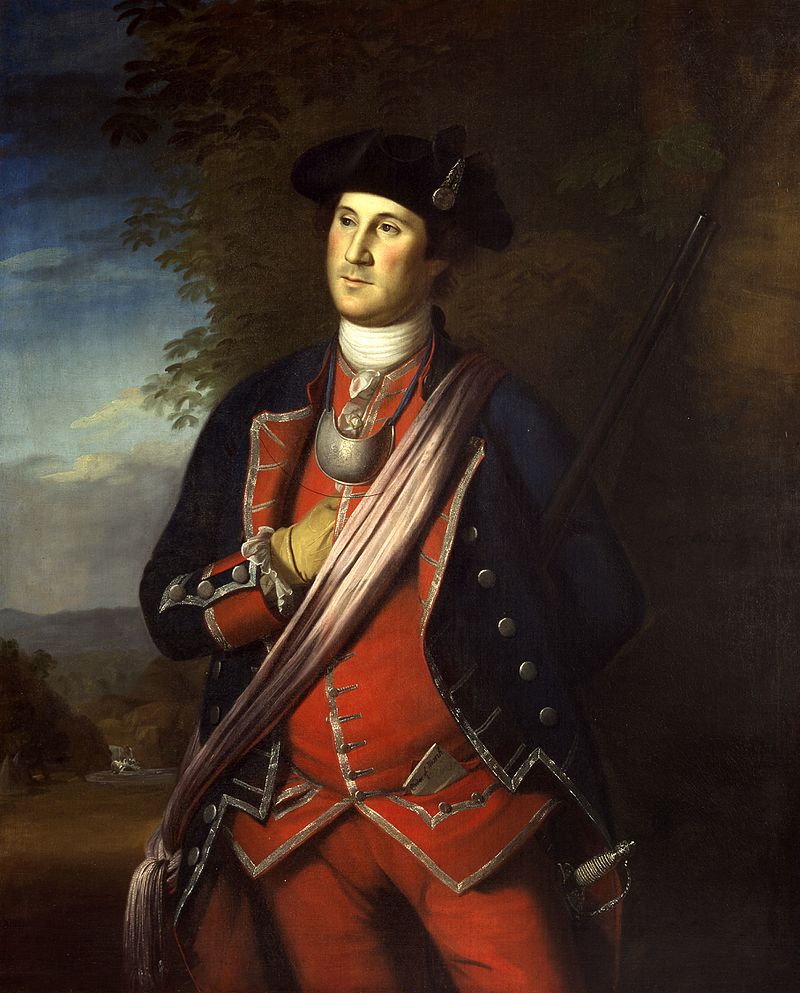
Portrait of George Washington by Charles Willson Peale, 1772
Portrait of British Lieutenant George Washington by Charles Willson Peale, 1772.

Disputes over who would control the Ohio River Valley lead to deployment of military units and the construction of forts in the area by both the British and the French, even though the area was in fact already occupied by the Iroquois Confederacy. An armed clash took place in 1754 at the French Fort Duquesne, the site where Pittsburgh, Pennsylvania, is now located, between a band of French regulars and Virginia militiamen.  The Virginians were under the command of 22-year-old George Washington, a Virginia planter and surveyor who had been sent on a mission to warn the French to leave the area.

Following an intense exchange of fire in which approximately one third of his men died, Washington surrendered and negotiated a withdrawal under arms.  This inauspicious battle is now regarded as the opening battle of a much larger war.

British colonial governments were used to operating independently of one another and of the government in London, a situation that complicated negotiations with Native American tribes, whose territories often encompassed land claimed by multiple colonies.

The British government attempted to deal with the conflict by calling a meeting of representatives from New York, Pennsylvania, Maryland, and the New England colonies. From June 19 to July 10, 1754, the Albany Congress, as it came to be known, met with the Iroquois in Albany, New York, in order to improve relations with them and secure their loyalty to the British.

But the delegates also declared a union of the American colonies “absolutely necessary for their preservation” and adopted a proposal drafted by Benjamin Franklin. The Albany Plan of Union provided for a president appointed by the king and a grand council of delegates chosen by the assemblies, with each colony to be represented in proportion to its financial contributions to the general treasury. This body would have charge of defense, Native-American relations, and trade and settlement of the west. Most importantly, it would have independent authority to levy taxes.  Franklin was a man of many inventions – his was the first serious proposal to organize and unite the colonies that would become the United States.

But in the end, none of the colonial legislatures accepted the plan, since they were not prepared to surrender either the power of taxation or control over the development of the western lands to a central authority.

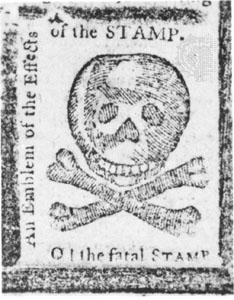
220px-Benjamin_Franklin_-_Join_or_Die
Join, or Die: This 1756 political cartoon by Benjamin Franklin urged the colonies to join together during the French and Indian War.

Britain’s superior strategic position and her competent leadership ultimately brought victory in the conflict with France, known as the French and Indian War in America (named for Britain’s enemies, though some natives fought on the British side, too) and the Seven Years’ War in Europe. Really the first true world war, with conflicts stretching from Europe to Asia, only a modest portion of it was fought in the Western Hemisphere.

The Treaty of Paris (1763)

The war in North America officially ended with the signing of the Treaty of Paris in 1763. The British offered France the choice of surrendering either its continental North American possessions east of the Mississippi or the Caribbean islands of Guadeloupe and Martinique, which had been occupied by the British. France chose to cede their North American possessions. They viewed the economic value of the Caribbean islands’ sugar cane to be greater and easier to defend than the furs from the continent. French philosopher Voltaire referred to Canada disparagingly as nothing more than a few acres of snow. The British, however, were happy to take New France, as defense of their North American colonies would no longer be an issue; also, they already had ample places from which to obtain sugar. Spain traded Florida to Britain in order to regain Cuba, but they also gained Louisiana from France, including New Orleans, in compensation for their losses. Great Britain and Spain also agreed that navigation on the Mississippi River was to be open to vessels of all nations.

Treaty of Paris
North America after the Treaty of Paris in 1763.

In the aftermath of the French and Indian War, London saw a need for a new imperial design that would involve more centralized control, spread the costs of empire more equitably, and speak to the interests of both French Canadians and North American Indians, now subjects of the British Empire.

The colonies, on the other hand, long accustomed to a large measure of independence, expected more, not less, freedom. And, with the French menace eliminated, they felt far less need for a strong British presence. A scarcely comprehending Crown and Parliament on the other side of the Atlantic found itself contending with colonists trained in self‑government and impatient with interference.

Furthermore, the French and Indian War nearly doubled Great Britain’s national debt. The Crown would soon impose new taxes on its colonies in attempt to pay off this debt. These attempts were met with increasingly stiff resistance, until troops were called in to enforce the Crown’s authority. These acts ultimately led to the start of the American Revolutionary War.

The incorporation of Canada and the Ohio Valley into the empire necessitated policies that would not alienate the French and Indian inhabitants. Here London was in fundamental conflict with the interests of its American colonists. Fast increasing in population, and needing more land for settlement, they claimed the right to extend their boundaries as far west as the Mississippi River.  Hadn’t that been how this whole war started in the first place?

Proclamation of 1763

The British government, fearing a series of expensive and deadly Indian wars, believed that former French territory should be opened on a more gradual basis.  Reinforcing this belief was Pontiac’s Rebellion, a bitter conflict which came on the heels of the Treaty of Paris, launched in 1763 by a loose confederation of Native American tribes, primarily from the Great Lakes region.  Named for Pontiac, the most prominent of many native leaders in the conflict, the members of the alliance were dissatisfied with British policies after the British victory in the French and Indian War (1754–1763).

While the French had long cultivated alliances among certain of the Native Americans, the British post-war approach was essentially to treat the Native Americans as a conquered people, eliminating benefits and autonomy that the various tribes had enjoyed while the French claimed the region. While French colonists—most of whom were farmers who seasonally engaged in fur trade—had always been relatively few, there seemed to be no end of settlers in the British colonies, who wanted to clear the land of trees and occupy it. Shawnees and Delawares in the Ohio Country had been displaced by British colonists in the east, and this motivated their involvement in the war. On the other hand, Native Americans in the Great Lakes region and the Illinois Country had not been greatly affected by white settlement, although they were aware of the experiences of tribes in the east.

Before long, Native Americans who had been allies of the defeated French attacked a number of British forts and settlements.  Eight forts were destroyed, and hundreds of colonists were killed or captured, with many more fleeing the region.  Warfare on the North American frontier was brutal, and the killing of prisoners, the targeting of civilians, and other atrocities were widespread on both sides.  The ruthlessness and treachery of the conflict was a reflection of growing tensions between British colonists and Native Americans, who increasingly felt they were in a war for their very survival.

Hostilities came to an end after British Army expeditions in 1764 led to peace negotiations over the next two years. Native Americans were unable to drive away the British, but the uprising prompted the British government to modify the policies that had provoked the conflict.

The Royal Proclamation of 1763 reserved all the western territory between the Appalachian Mountains and the Mississippi River for use by Native Americans – no British settlers allowed. Thus the Crown attempted to sweep away every western land claim of the thirteen colonies and to stop westward expansion. Although never effectively enforced, this measure, in the eyes of the colonists, constituted a betrayal – what had they been fighting for the last seven years if not a right to occupy and settle western lands?  Why was King choosing Native Americans over his own loyal subjects?

Thus, the Proclamation of 1763 would rouse the latent suspicions of colonials who would increasingly see Britain as no longer a protector of their rights, but rather a danger to them.

The article was adapted in part from:
  1. The French and Indian War
  2. The Road to Revolution
  3. The Road to Independence

New World Colonist Recruitment Infomercial

This lesson can be used with The United States: An Open Ended History, a free online textbook.  Adapted in part from open sources.

Each settlement in colonial America had its own identity and reason for being, whether that reason was economic, religious, or social, or some blend of the three – and they were all usually intensely competitive with their neighbors in these aims. Imagine that you are a representative from what we would today call that colony’s “Welcome Center,” trying to attract new settlers. These didn’t exist in the 1600s, per se, but if they did, what kind of ad campaign might they have created to lure settlers to their colony?

Create a comprehensive, informational commercial. You can act it out or record it and play it back.

You are responsible for creating a factually robust and informative presentation – that is also persuasive.  It may be filmed, but only if your recorded volume is loud enough for the class to hear and understand.  It may also be performed live.  Be sure to illustrate each segment with stimulating visuals.

Students should also be creative in their commercial while remaining historically accurate. 

Your commercial should be between one and two minutes in length.

The following features must be in the commercial—

  1. Map of your colony circa the 17th century
  2. Geography: description of land, sights, and climate
  3. People that settlers will encounter
  4. Occupations: How will settlers support themselves? What kind of work will they find?
  5. Mentions of history: When and why was the colony founded? (up to about 1700)
  6. Food: What will the travelers eat? What foods are native to the area?
  7. Transportation: How will the travelers get to the colony? How will they travel around the colony?  What are the major transportation routes and hubs in your colony?
  8. Religion: What churches have been established in the colony, or what are the practices of the indigenous people?  What religious groups are banned?
  9. Persuasion: Be sure to encourage settlers to travel and stay in the colony – why here and not a different colony?

Use at least one of the following…  The seven most common techniques of propaganda used in advertising:

  • Testimonial – The ever-popular celebrity endorsement.
  • Glittering Generalities – Praise and positive words that are hard to measure or quantify – think “best,” “great,” “I’m lovin’ it.”
  • Transfer – The qualities of the product transfer to the consumer – think of a sports car or soda commercial.  You, too, can be cool, if you have the right cell phone.
  • Plain Folks – An appeal to values, working class, family, nationalism, thrift – “Made in America,” “fair trade,” “real men,” or “the best value for your dollar.”
  • Bandwagon – Everybody’s doing it – don’t be left out or left behind!
  • Name Calling – Trash talking or put downs toward the competition.
  • Card Stacking – The omission of inconvenient or unflattering facts about your own product; the emphasis of those same kind of facts when talking about competing products.

For inspiration (see if you can spot the techniques listed above in action): 

Hawaii Chair.

Americans will buy ANYTHING 4! Top 10 Worst Infomercials.

The Evolution of the Virginia Laws of Servitude and Slavery (1643-1691)

This lesson can be used with The United States: An Open Ended History, a free online textbook.  Adapted in part from open sources.

Virginia laws of servitude and slavery (1643-1691): These laws attempted to set boundaries between different categories of people in Virginia.

  1. In your own words, briefly summarize what each law is saying.
  2. What categories of people are described in these laws?  Note especially when the category of a “white” person was invented, as well as words used to describe people of European descent before its first use. 
  3. According to these laws, how does a child become a slave?
  4. By 1691, is there a such thing as a free black person legally living in Virginia?
  5. Was there a “white” before there was slavery?  What does this evidence seem to suggest about race in America – did it occur naturally or was it invented?

March 1643

Whereas there are divers loytering runaways in the collony who very often absent themselves from their masters service, And sometimes in two or three monthes cannot be found, whereby their said masters are at great charge in finding them, And many times even to the loss of their year’s labour before they be had, Be it therefore enacted and confirmed that all runaways that shall absent themselves from their said masters service shall be lyable to make satisfaction by service at the end of their tymes by indenture double the tyme of service soe neglected, And in some cases more if the comissioners for the place appointed shall find it requisite and convenient. And if such runaways shall be found to transgresse the second time or oftener (if it shall be duely proved against them) that then they shall be branded in the cheek with the letter R. and passe under the statute of incorrigible rogues.

December 1662

WHEREAS some doubts have arrisen whether children got by any Englishman upon a negro woman should be slave or ffree, Be it therefore enacted and declared by this present grand assembly, that all children borne in this country shalbe held bond or free only according to the condition of the mother, And that if any christian shall committ ffornication with a negro man or woman, hee or shee soe offending shall pay double the ffines imposed by the former act.

September 1667

WHEREAS some doubts have risen whether children that are slaves by birth, and by the charity and piety of their owners made pertakers of the blessed sacrament of baptisme, should by vertue of their baptisme be made ffree; It is enacted and declared by this grand assembly, and the authority thereof, that the conferring of baptisme doth not alter the condition of the person as to his bondage or ffreedome; that diverse masters, ffreed from this doubt, may more carefully endeavour the propagation of christianity by permitting children, though slaves, or those of greater growth if capable to be admitted to that sacrament.

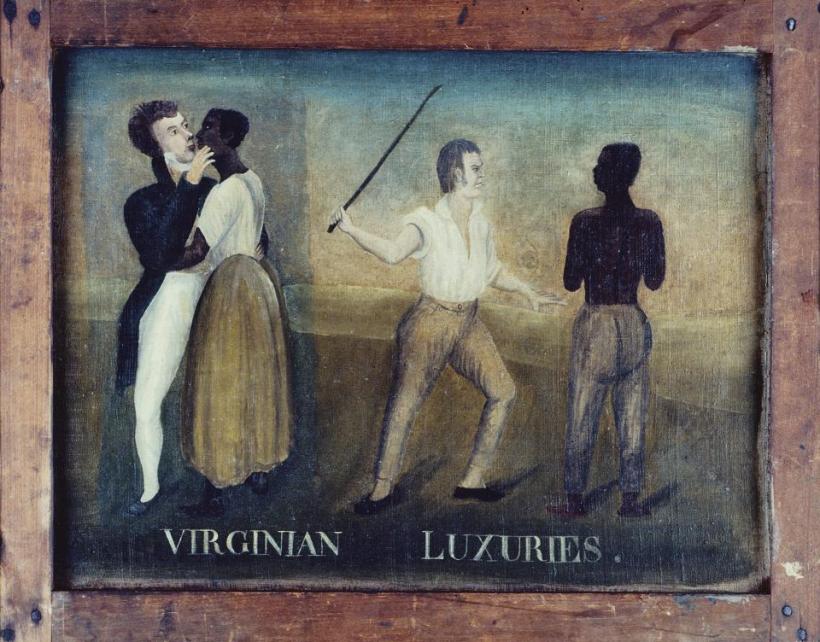
virginian-luxuries-1810
Virginian Luxuries, a painting by an anonymous artist, 1810.

October 1670

WHEREAS it hath beene questioned whither Indians or negroes manumited, or otherwise free, could be capable of purchasing christian servants, It is enacted that noe negroe or Indian though baptised and enjoyned their owne ffreedome shall be capable of any such purchase of christians, but yet not debarred from buying any of their owne nation.

June 1680

WHEREAS the frequent meeting of considerbale numbers of negroe slaves under pretence of feasts and burialls is judged of dangerous consequence; for prevention whereof for the future, Bee it enacted by the kings most excellent majestie by and with the consent of the generall assembly, and it is hereby enacted by the authority foresaid, that from and after the publication of this law, it shall not be lawfull for any negroe or other slave to carry or arme himselfe with any club, staffe, gunn, sword or any other weapon of defence or offence, nor to goe or depart from of his masters ground without a certificate from his master, mistris or overseer and such permission not to be granted but upon perticuler and necessary occasions; and every negroe or slave soe offending not haveing a certificate as aforesaid shalbe sent to the next constable, who is hereby enjoyned and required to give the said negroe twenty lashes on his bare back well layd on, and soe sent home to his said master, mistris or overseer. And it is further enacted by the authority aforesaid that if any negroe or other slave shall presume to lift up his hand in opposition against any christian, shall for every such offence, upon due proofe made thereof by the oath of the party before a magistrate, have and receive thirty lashes on his bare back well laid on. And it is hereby further enacted by the authority aforesaid that if any negroe or other slave shall absent himself from his masters service and lye hid and lurking in obscure places, comitting injuries to the inhabitants, and shall resist any person or persons that shalby any lawfull authority by imployed to apprehend and take the said negroe, that then in case of such resistance, it shalbe lawfull for such person or persons to kill the said negroe or slave soe lying out and resisting, and that this law be once every six months published at the respective county courts and parish churches within this colony.

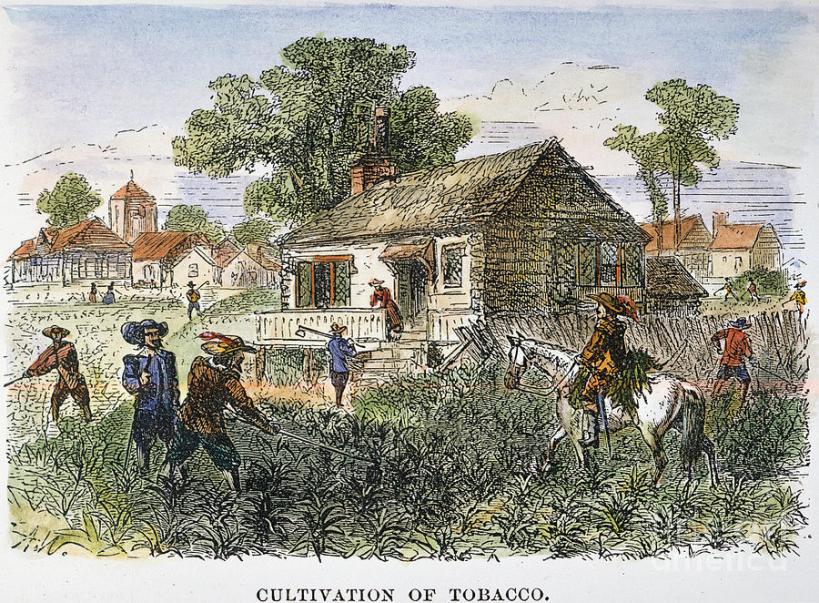
3-tobacco-plantation-granger

April 1691

And for prevention of that abominable mixture and spurious issue which hereafter may encrease in this dominion, as well by negroes, mulattoes, and Indians intermarrying with English, or other white women, as by their unlawfull accompanying with one another, Be it enacted by the authoritie aforesaid, and it is hereby enacted, that for the time to come, whatsoever English or other white man or woman being free shall intermarry with a negroe, mulatto, or Indian man or woman bond or free shall within three months after such marriage be banished and removed from this dominion forever, and that the justices of each respective countie within this dominion make it their perticular care that this act be put in effectuall execution. And be it further enacted by the authoritie aforesaid, and it is hereby enacted, That if any English woman being free shall have a bastard child by any negro or mulatto, she pay the sume of fifteen pounds sterling, within one moneth after such bastard child be born, to the Church wardens of the parish where she shall be delivered of such child, and in default of such payment she shall be taken into the possession of the said Church wardens and disposed of for five yeares, and the said fine of fifteen pounds, or whatever the woman shall be disposed of for, shall be paid, one third part to their majesties for and towards the support of the government and the contingent charges thereof, and one other third part to the use of the parish where the offence is committed, and the other third part to the informer, and that such bastard child be bound out as a servant by the said Church wardens untill he or she shall attaine the age of thirty yeares, and in case such English woman that shall have such bastard child be a servant, she shall be sold by the said church wardens, (after her time is expired that she ought by law to serve her master) for five yeares, and the money she shall be sold for divided as is before appointed, and the child to serve as
aforesaid.

And forasmuch as great inconveniences may happen to this country by the setting of negroes and mulattoes free, by their either entertaining negro slaves from their masters service, or receiveing stolen goods, or being grown old bringing a charge upon the country; for prevention thereof, Be it enacted by the authority aforesaid, and it is hereby enacted, That no negro or mulatto be after the end of this present session of assembly set free by any person or persons whatsoever, unless such person or persons, their heires, executors or administrators pay for the transportation of such negro or negroes out of the countrey within six moneths after such setting them free, upon penalty of paying of tenn pounds sterling to the Church wardens of the parish where such person shall dwell with, which money, or so much thereof as shall be necessary, the said Church wardens are to cause the said negro or mulatto to be transported out of the countrey, and the remainder of the said money to imploy to the use of the poor of the parish.


The Origins of Servitude and Slavery in Colonial America

How does society fill jobs that no one wants to do?  One choice is that you can pay workers in these positions extremely well, making these hard jobs desirable.  That is expensive, making it hard or impossible to turn a profit.  The other option is to coerce people into performing that labor – through financial, legal, or violent means…  In which way did landowners in colonial America solve this dilemma?
This lesson was reported from:
A chapter of The United States: An Open Ended History, a free online textbook.  Adapted in part from open sources.

For Your Consideration:
  1. What was indentured servitude? What kind of rules governed the lives of servants?
  2. Briefly describe the transatlantic slave trade.
  3. Identify two ways in which slavery was different from indentured servitude.
  4. How did slaves resist their masters?
  5. What was Bacon’s Rebellion?

Indentured Servitude

Indentured servitude was a system by which immigrants, typically young Europeans under 25, both men and women, came to the English colonies.

Farmers, merchants, and shopkeepers in the British colonies found it very difficult to hire free workers, primarily because it was easy for potential workers to set up their own farms by moving to frontier lands. Consequently, a common solution was to transport a young worker from Britain or a German state, who would work for several years to pay off the debt of their travel costs. During the indenture period the servants were not paid cash wages, but were provided with food, accommodation, clothing and training. The indenture document specified how many years the servant would be required to work, after which they would be free. Terms of indenture ranged from one to seven years with typical terms of four or five years.

just arrived
Virginia Gazette, March 18, 1775.

Servants could not marry without the permission of their owner, were subject to physical punishment (like many young ordinary servants), and saw their obligation to labor enforced by the courts. To ensure uninterrupted work by the female servants, the law lengthened the term of their indenture if they became pregnant. But unlike slaves, servants were guaranteed to be eventually released from bondage. At the end of their term they received a payment known as “freedom dues” (typically a small parcel of land or a new suit of clothes) and become free members of society. One could buy and sell indentured servants’ contracts, and the right to their labor would change hands, but not the person as a piece of property.

Both male and female laborers could be subject to violence, occasionally even resulting in death. Historian Richard Hofstadter notes that, as slaves arrived in greater numbers after 1700, white laborers in Virginia became a “privileged stratum, assigned to lighter work and more skilled tasks.” He also notes that “Runaways were regularly advertised in the newspapers, rewards were offered, and both sheriffs and the general public were enlisted to secure their return. … The standard penalty in the North, not always rigorously enforced, was extra service of twice the time the master had lost, though whipping was also common.”

Pennsylvania-Gazette-11-25-1762-5-indentured-girls
Pennsylvania Gazette, November 25, 1762.

Transatlantic Slave Trade

triangle-trade1
The triangular trade. While slave labor was not widely practiced in New England, the region’s merchants participated and profited off of the trade directly – transporting enslaved Africans into slavery in the Americas, and carrying the fruits of slave labor, such as tobacco and sugar, to to consumers outside of the American South.

The transatlantic slave trade was the forced transportation of enslaved African people, mainly to the Americas. The slave trade regularly used the triangular trade route and its Middle Passage, and existed from the 16th to the 19th centuries. The vast majority of those who were enslaved and transported in the transatlantic slave trade were Africans from central and western Africa, who had been sold by other West Africans to Western European slave traders (with a small number being captured directly by the slave traders in coastal raids), who brought them to the Americas.  South Atlantic and Caribbean economies especially were dependent on the supply of secure labor for the production of commodity crops such as tobacco, sugar, and cotton to sell elsewhere in the colonies and in Europe.

The duration of the transatlantic voyage varied widely, from one to six months depending on weather conditions. The journey became more efficient over the centuries; while an average transatlantic journey of the early 16th century lasted several months, by the 19th century the crossing often required fewer than six weeks.

It is believed that African kings, warlords and private kidnappers sold captives to Europeans who held several coastal forts. The captives were usually force-marched to these ports along the western coast of Africa, where they were held for sale to the European or American slave traders. Typical slave ships contained several hundred slaves with about 30 crew members.

lossless-page1-800px-Thomas-Clarkson-De-kreet-der-Afrikanen_MG_1315.tif
Diagram of a large slave ship. Thomas Clarkson: The cries of Africa to the inhabitants of Europe, 1822.

The male captives were normally chained together in pairs to save space; right leg to the next man’s left leg — while the women and children may have had somewhat more room. At best, captives were fed beans, corn, yams, rice, and palm oil. Slaves were typically fed one meal a day with water, if at all.

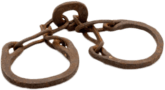
bilboeSlaves lived below the decks in conditions of squalor and indescribable horror. Disease spread and ill health was one of the biggest killers. Mortality rates were high, and death made conditions even worse. Many crew members avoided going into the hold because of the smell, the sights, and the sounds below deck.  Even though the corpses were thrown overboard, living slaves might be shackled for hours and sometimes days to someone who was dead.

Current estimates are that about 12 million Africans were shipped across the Atlantic, although the number purchased by the traders was considerably higher, as the passage had a high death rate. Disease and starvation due to the length of the passage were the main contributors to the death toll, as diseases spread rapidly in the close-quarter compartments of the slave ships.

As a way to counteract disease, slaves were forced onto the deck of the ship for exercise.  This frequently resulted in beatings from the crew because the slaves would be unwilling to dance for them or interact. These beatings would often be severe and could result in the slave dying or becoming more susceptible to diseases.

Slaves resisted in many ways. The two most common types of resistance were refusal to eat and suicide. Suicide was a frequent occurrence, often by refusal of food or medicine or jumping overboard, as well as by a variety of other opportunistic means. 

Ottobah Cugoano, who was taken from Africa as a slave when he was a child, later wrote a book of his life and in it described an uprising aboard the ship on which he was transported to the West Indies:

“When we found ourselves at last taken away, death was more preferable than life, and a plan was concerted amongst us, that we might burn and blow up the ship, and to perish all together in the flames.”

Slave ships were designed and operated to prevent the slaves from revolting. Resistance among slaves usually ended in failure and participants in a rebellion were punished severely.  Despite this, about one out of ten ships experienced some sort of rebellion.

Slavery

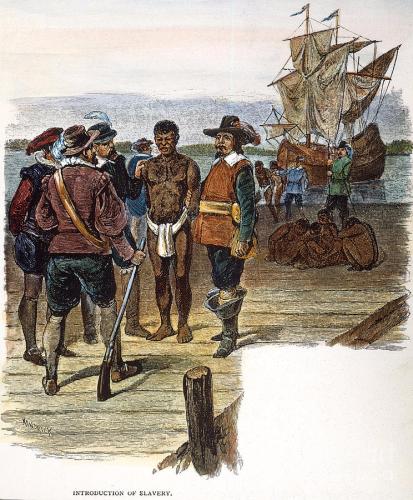
The first Africans to be brought to British North America landed in Virginia in 1619. They arrived on a Dutch ship that had captured them from the Spanish. These approximately 20 individuals appear to have been treated as indentured servants, and a significant number of enslaved Africans earned freedom by fulfilling a work contract or for converting to Christianity.  Like European indentured servants at the completion of their contract, many of these first African Americans were each granted 50 acres (200,000 m2) of land when freed from their indentures, so they could raise their own tobacco or other crops.

By 1650, there were about 300 Africans living in Virginia, about 1% of an estimated 30,000 population of people of English and European ancestry.  Some successful free people of color, such as Anthony Johnson, in turn acquired slaves or indentured servants for workers. Some historians say this evidence suggests that racial attitudes were much more flexible in 17th-century Virginia than they would later become.

Jamestown 1619From this early start, American slavery was born.  Slavery was an institution that lasted for more than three hundred years under which African Americans could expect to be held for life as the property of their masters.  This system evolved over time, gradually becoming more strict and regulated.  It also varied from owner to owner – some masters may have been more gentle or cruel than others, more generous or stingy with food, etc…  But at the end of the day, an enslaved person was regarded by the law as little more than a piece of livestock – property that was totally at the mercy, or lack thereof, of their master.

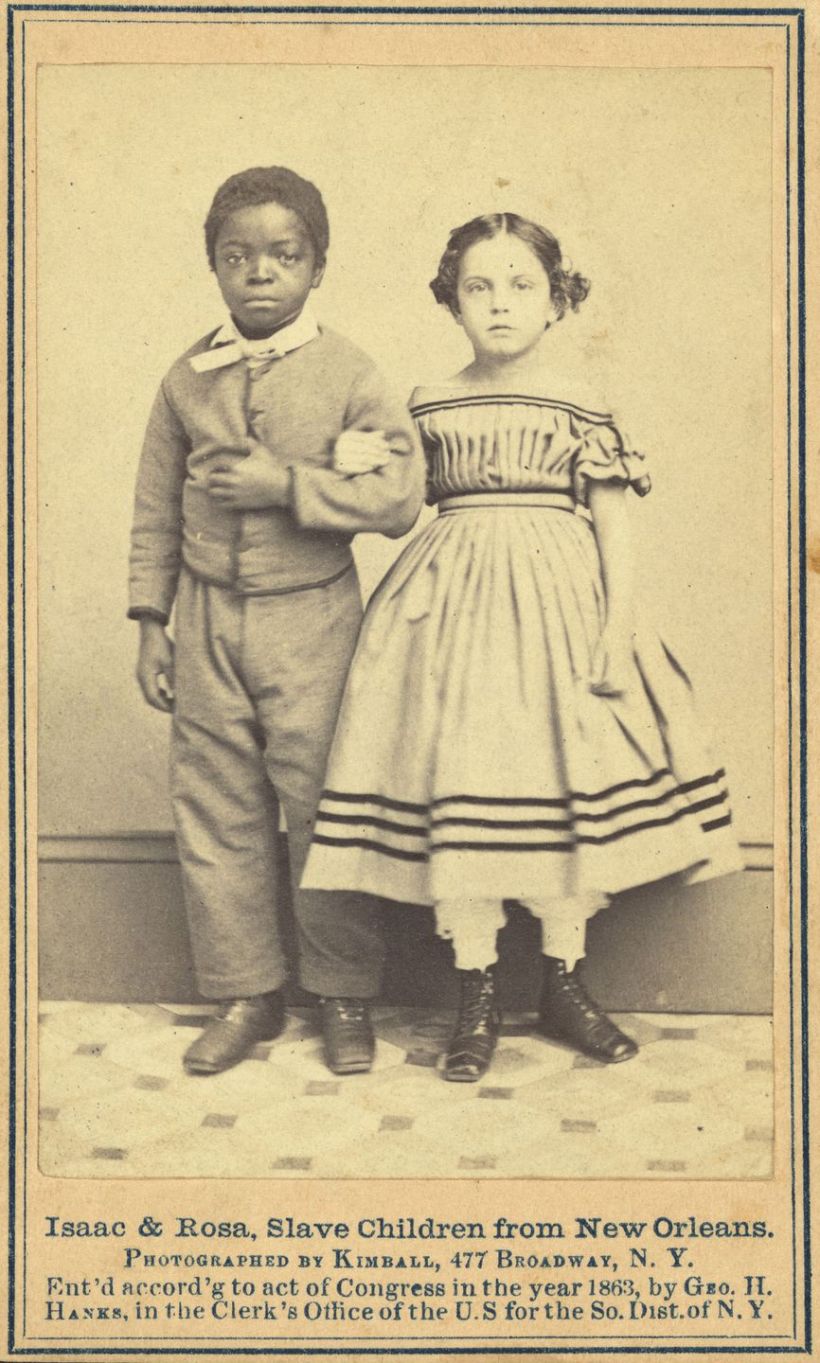
In the 1660s, the colonial legislature adopted a law stating that all children born in the colony would take the status of their mothers, regardless of who their father was. Thus children born to enslaved mothers would be enslaved, regardless of their ethnicity or paternity. This was contrary to English common law for children of parents who are both English subjects, in which the child takes status from the father. But the law also meant that mixed-race children born to white women were born free, and many families of free African Americans were descended from unions between white women and ethnic African men during the colonial era.

Slavery became a racial caste – a status determined at birth, for life.

You can see this process for yourself – Primary Source Analysis: The Evolution of the Virginia Laws of Servitude and Slavery (1643-1691).

slave children
The law developed in Virginia and later adopted in other colonies said that one’s status as either slave or free derived from one’s mother. This meant that both of the children depicted in this photo – from New Orleans in 1863 – were enslaved, despite the obvious European heritage of the girl on the right.

During the early 17th century, Virginia planters developed the commodity crop of tobacco as their chief export. It was a labor-intensive crop, and demand for it in England and Europe led to an increase in the importation of African slaves in the colony. By the mid-eighteenth century, there were 145,000 slaves in the Chesapeake Bay region, spread mostly on large plantations, as compared to 50,000 in the Spanish colony of Cuba, where they worked in urbanized settlements.

slave quarters assessment image
Enslaved African-Americans near their quarters during the middle of the nineteenth century.

The treatment of slaves in the varied by time and place, but was generally nothing that you would wish to experience – slavery was brutal and degrading.  Slaves were punished by whipping, shackling, beating, mutilation, branding and/or imprisonment. Punishment was most often meted out in response to disobedience or perceived infractions, but masters or overseers sometimes abused slaves to assert dominance.

An 1850 publication provided slaveholders with guidance on how to produce the “ideal slave:”

  1. Maintain strict discipline and unconditional submission.
  2. Create a sense of personal inferiority, so that slaves “know their place.”
  3. Instill fear.
  4. Teach servants to take interest in their master’s enterprise.
  5. Deprive access to education and recreation, to ensure that slaves remain uneducated, helpless, and dependent.
f0bc610831260ad329c158421ca5999a
While conditions varied across time and place, slave quarters were usually very simple.  This space would likely be occupied by an entire family.

Under slavery, planters and other slaveholders owned, controlled and sold entire families of slaves. The slave population increased in the southern United States as native-born slaves produced large families.  Slaves were at a continual risk of losing family members if their owners decided to sell them for profit, punishment or to pay debts. Slaveholders also made gifts of slaves to grown children (or other family members), such as on the occasion of their marriage. Masters considered slave children ready to work and leave home as young as age 12 or 14.

A few slaves retaliated by murdering their owners and overseers, burning barns, and killing horses. These acts were rare, however, given the strong, harsh reactions from neighboring whites who worried that any act of defiance might lead to a full-scale slave rebellion.  Work slowdowns were probably the most frequent form of resistance and hard to control – slaves deliberately worked at a pace fast enough not to get in trouble, but no faster.

Martin's_Best_Virginia_tobacco_advertisement
Enslaved Africans were not a hidden secret – they were included in the advertisements for Virginia tobacco.

Bacon’s Rebellion

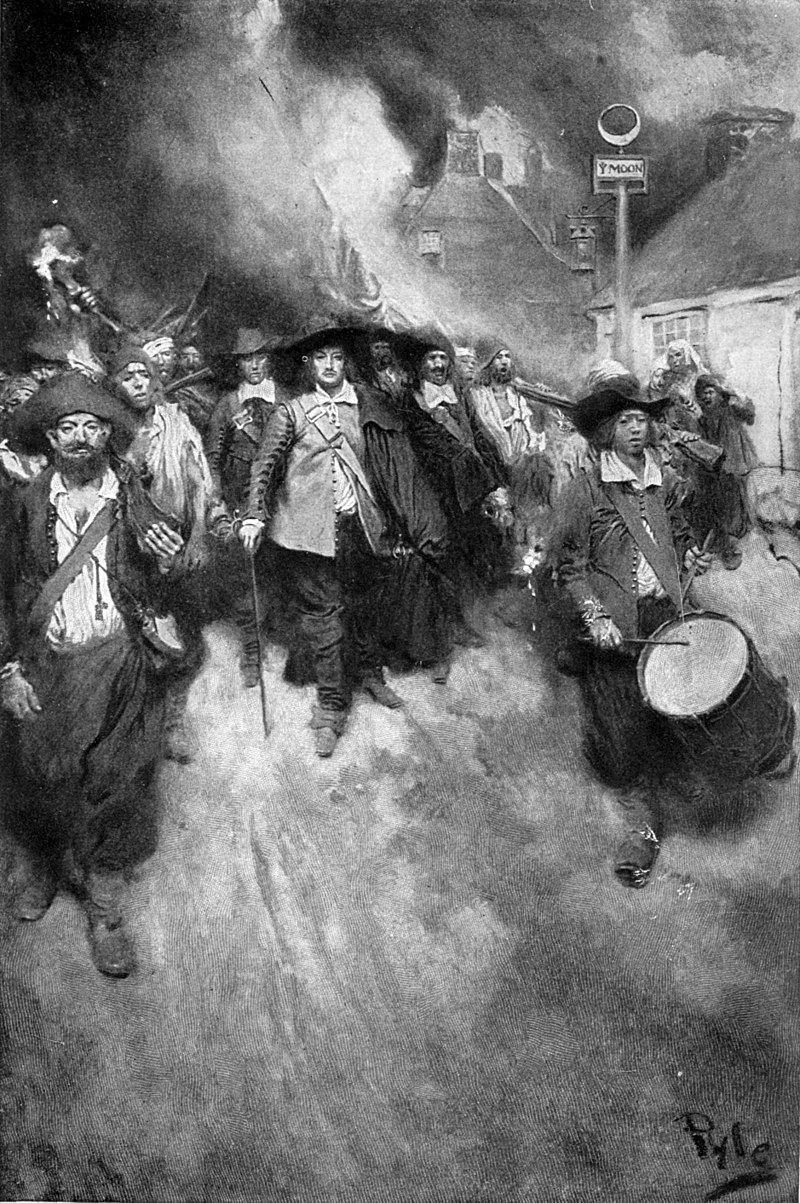
The Burning of Jamestown by Howard Pyle, c. 1905
The Burning of Jamestown by Howard Pyle, c. 1905.

Bacon’s Rebellion was an armed rebellion in 1676 by Virginia settlers led by Nathaniel Bacon against the rule of Royal Governor William Berkeley. The governor’s dismissive policy with regard to land on its western frontier, along with other challenges including leaving Bacon out of his inner circle, refusing to allow Bacon to be a part of his fur trade with the Native Americans, and a lack of colonial response to Doeg American Indian attacks, helped to motivate a popular uprising against Berkeley, who had failed to address the demands of the colonists regarding their safety.

A thousand Virginians of all classes and races rose up in arms against Berkeley, attacking Indians, chasing Berkeley from Jamestown, Virginia, and ultimately torching the capital. The rebellion was first suppressed by a few armed merchant ships from London whose captains sided with Berkeley and the loyalists. Government forces from England arrived soon after and spent several years defeating pockets of resistance and reforming the colonial government to be once more under direct royal control.

It was the first rebellion in the American colonies in which discontented frontiersmen took part.  The alliance between indentured servants and Africans (most enslaved until death or freed), united by their bond-servitude, disturbed the ruling class, who responded by hardening the racial caste of slavery in an attempt to divide the two races from subsequent united uprisings with the passage of the Virginia Slave Codes of 1705. While the farmers did not succeed in their initial goal of driving the Indians from Virginia, the rebellion did result in Berkeley being recalled to England.

The article was adapted in part from:

  1. Indentured Servitude in the Americas
  2. History of Slavery in Virginia
  3. The Middle Passage
  4. Bacon’s Rebellion

An Overview of the English Colonies in America

This lesson was reported from:
A chapter of The United States: An Open Ended History, a free online textbook.  Adapted in part from open sources.

For Your Consideration:
  1. For what reasons were emigrants leaving Europe?  Why was North America an attractive destination?
  2. Compare and contrast corporate colonies, proprietary colonies, and royal colonies.
  3. What was the triangular trade?  How did it link three continents? What different roles did the New England and Southern Colonies play in this trade?
  4. How did the Quakers differ from those who lived in other regions of North America?
  5. Describe the economic divisions that shaped the Southern Colonies.

Early settlements

The early 1600s saw the beginning of a great tide of emigration from Europe to North America. Spanning more than three centuries, this movement grew from a trickle of a few hundred English colonists to a flood of millions of newcomers. Impelled by powerful and diverse motivations, they built a new civilization on the northern part of the continent.

The first English immigrants to what is now the United States crossed the Atlantic long after thriving Spanish colonies had been established in Mexico, the West Indies, and South America. Like all early travelers to the New World, they came in small, overcrowded ships. During their six-to 12-week voyages, they lived on meager rations. Many died of disease, ships were often battered by storms, and some were lost at sea.

Most European emigrants left their homelands to escape political oppression, to seek the freedom to practice their religion, or to find opportunities denied them at home. Between 1620 and 1635, economic difficulties swept England. Many people could not find work. Even skilled artisans could earn little more than a bare living. Poor crop yields added to the distress. In addition, the Commercial Revolution had created a burgeoning textile industry, which demanded an ever-increasing supply of wool to keep the looms running. Landlords enclosed farmlands and evicted the peasants in favor of sheep cultivation. Colonial expansion became an outlet for this displaced peasant population.

The colonists’ first glimpse of the new land was a vista of dense woods. The settlers might not have survived had it not been for the help of friendly Indians, who taught them how to grow native plants—pumpkin, squash, beans, and corn. In addition, the vast, virgin forests, extending nearly 2,100 kilometers along the Eastern seaboard, proved a rich source of game and firewood. They also provided abundant raw materials used to build houses, furniture, ships, and profitable items for export.

Although the new continent was remarkably endowed by nature, trade with Europe was vital for articles the settlers could not produce. The coast served the immigrants well. The whole length of shore provided many inlets and harbors. Only two areas—North Carolina and southern New Jersey—lacked harbors for ocean-going vessels.

Majestic rivers—the Kennebec, Hudson, Delaware, Susquehanna, Potomac, and numerous others—linked lands between the coast and the Appalachian Mountains with the sea. Only one river, however, the St. Lawrence—dominated by the French in Canada—offered a water passage to the Great Lakes and the heart of the continent. Dense forests, the resistance of some Indian tribes, and the formidable barrier of the Appalachian Mountains discouraged settlement beyond the coastal plain. Only trappers and traders ventured into the wilderness. For the first hundred years the colonists built their settlements compactly along the coast.

Political considerations influenced many people to move to America. In the 1630s, arbitrary rule by England’s Charles I gave impetus to the migration. The subsequent revolt and triumph of Charles’ opponents under Oliver Cromwell in the 1640s led many cavaliers—“king’s men”—to cast their lot in Virginia. In the German-speaking regions of Europe, the oppressive policies of various petty princes—particularly with regard to religion—and the devastation caused by a long series of wars helped swell the movement to America in the late 17th and 18th centuries.

The journey entailed careful planning and management, as well as considerable expense and risk. Settlers had to be transported nearly 5,000 kilometers across the sea. They needed utensils, clothing, seed, tools, building materials, livestock, arms, and ammunition.

English colonies were organized in three different ways. In one plan, corporate colonies were established by joint stock companies. A joint stock company was a project in which people would invest shares of stock into building a new colony. Depending on the success of the colony, each investor would receive profit based on the shares he had bought. This investment was less risky than starting a colony from scratch, and each investor influenced how the colony was run. These investors often elected their own public officials. (An example of a joint stock company on another continent was the British East India Company.) Virginia was settled in this way.

Proprietary colonies were owned by a person or family who made laws and appointed officials as he or they pleased. Development was often a direct result of this ownership. Charles II granted William Penn the territory now known as Pennsylvania. Penn’s new colony gave refuge to Quakers, a group of millennial Protestants who opposed the Church of England. (Quakers did not have ministers and did not hold to civil or religious inequality, making them a dangerous element in hierarchical societies.) Penn was an outspoken Quaker and had written many pamphlets defending the Quaker faith. He also invited settlers from other countries and other Protestant minorities, and even some Catholics.

Finally, royal colonies were under the direct control of the King, who appointed a Royal Governor. The resulting settlement was not always identical to England. For example, England had broken with Catholicism during the reign of Henry the Eighth, and the Old Faith was seen not only as religious heresy but the prelude to domination by other countries. Yet Maryland’s grant of toleration of Catholics was granted as a boon from the British Crown. In 1634, Lord Baltimore appointed George Calvert of England to settle a narrow strip of land north of Virginia and south of Pennsylvania as a Catholic colony via a royal charter. Fifteen years later, in 1649, he signed the Act of Toleration, which proclaimed religious freedom for its colonists.

Portrait of the British Colonies

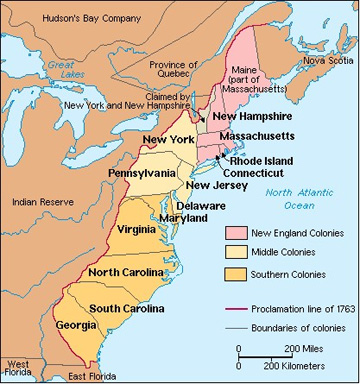
The Colonies are often considered as three groups: New England (New Hampshire, Massachusetts, Rhode Island, Connecticut), the Southern Colonies (Maryland, Virginia, the Carolinas, and Georgia), and the Middle Colonies (New York, New Jersey, Pennsylvania and Delaware). Sometimes the Carolinas and Georgia are counted as separate from the Chesapeake Colonies.13colonies

New peoples

Most settlers who came to America in the 17th century were English, but there were also Dutch, Swedes, and Germans in the middle region, a few French Huguenots in South Carolina and elsewhere, slaves from Africa, primarily in the South, and a scattering of Spaniards, Italians, and Portuguese throughout the colonies. After 1680 England ceased to be the chief source of immigration, supplanted by Scots and “Scots-Irish” (Protestants from Northern Ireland). In addition, tens of thousands of refugees fled northwestern Europe to escape war, oppression, and absentee-landlordism. By 1690 the American population had risen to a quarter of a million. From then on, it doubled every 25 years until, in 1775, it numbered more than 2.5 million. Although families occasionally moved from one colony to another, distinctions between individual colonies were marked. They were even more so among the three regional groupings of colonies.

The New England Colonies

The northeastern New England colonies had generally thin, stony soil, relatively little level land, and long winters, making it difficult to make a living from farming. Turning to other pursuits, the New Englanders harnessed waterpower and established grain mills and sawmills. Good stands of timber encouraged shipbuilding. Excellent harbors promoted trade, and the sea became a source of great wealth. In Massachusetts, the cod industry alone quickly furnished a basis for prosperity.

With the bulk of the early settlers living in villages and towns around the harbors, many New Englanders carried on some kind of trade or business. Common pastureland and woodlots served the needs of townspeople, who worked small farms nearby. Compactness made possible the village school, the village church, and the village or town hall, where citizens met to discuss matters of common interest.

The Massachusetts Bay Colony continued to expand its commerce. From the middle of the 17th century onward it grew prosperous, so that Boston became one of America’s greatest ports.

Oak timber for ships’ hulls, tall pines for spars and masts, and pitch for the seams of ships came from the Northeastern forests. Building their own vessels and sailing them to ports all over the world, the shipmasters of Massachusetts Bay laid the foundation for a trade that was to grow steadily in importance. By the end of the colonial period, one-third of all vessels under the British flag were built in New England. Fish, ship’s stores, and woodenware swelled the exports. New England merchants and shippers soon discovered that rum and slaves were profitable commodities. One of their most enterprising—if unsavory—trading practices of the time was the “triangular trade.” Traders would purchase slaves off the coast of Africa for New England rum, then sell the slaves in the West Indies where they would buy molasses to bring home for sale to the local rum producers.

triangle-trade1
The triangular trade. While slave labor was not widely practiced in New England, the region’s merchants participated and profited off of the trade directly – transporting enslaved Africans into slavery in the Americas, and carrying the fruits of slave labor, such as tobacco and sugar, to consumers outside of the American South.

The Middle Colonies

Society in the middle colonies was far more varied, cosmopolitan, and tolerant than in New England. Under William Penn, Pennsylvania functioned smoothly and grew rapidly. By 1685, its population was almost 9,000. The heart of the colony was Philadelphia, a city of broad, tree-shaded streets, substantial brick and stone houses, and busy docks. By the end of the colonial period, nearly a century later, 30,000 people lived there, representing many languages, creeds, and trades. Their talent for successful business enterprise made the city one of the thriving centers of the British Empire.

William Penn founded Pennsylvania in large part as a refuge for Quakers.  Quakers (or Friends) were a Christian group formally known as the Religious Society of Friends. Members of the various Quaker movements are all generally united in a belief  that there is God in every one.

This idea challenged and threatened the Puritan leaders of New England whose authority was based on their status in the Church.

The persecution of Quakers in North America began in 1656 when English Quaker missionaries Mary Fisher and Ann Austin began preaching in Boston. They were considered heretics because of their insistence on individual obedience to the Inner light. They were imprisoned and banished by the Massachusetts Bay Colony. In 1660, English Quaker Mary Dyer was hanged on Boston Common for repeatedly defying a Puritan law banning Quakers from the colony.  Their books were burned, and most of their property was confiscated. They were imprisoned in terrible conditions, then deported.

Quaker Beliefs

Penn first called the area “New Wales,” then “Sylvania” (Latin for “forests” or “woods”), which King Charles II changed to “Pennsylvania.” On March 4, 1681, the King signed the charter and the following day Penn jubilantly wrote, “It is a clear and just thing, and my God who has given it me through many difficulties, will, I believe, bless and make it the seed of a nation.” Penn then traveled to America and while there, he negotiated Pennsylvania’s first land-purchase with the Lenape Indian tribe. Penn drafted a charter of liberties for the settlement creating a political utopia guaranteeing free and fair trial by jury, freedom of religion, freedom from unjust imprisonment and free elections.

Though the Quakers dominated in Philadelphia, elsewhere in Pennsylvania other groups were well represented. Germans became the colony’s most skillful farmers. Important, too, were cottage industries such as weaving, shoemaking, cabinetmaking, and other crafts. Pennsylvania was also the principal gateway into the New World for the Scots-Irish, who moved into the colony in the early 18th century. “Bold and indigent strangers,” as one Pennsylvania official called them, they hated the English and were suspicious of all government. The Scots-Irish tended to settle in the backcountry, where they cleared land and lived by hunting and subsistence farming.

New York best illustrated the polyglot nature of America. By 1646 the population along the Hudson River included Dutch, French, Danes, Norwegians, Swedes, English, Scots, Irish, Germans, Poles, Bohemians, Portuguese, and Italians. The Dutch continued to exercise an important social and economic influence on the New York region long after the fall of New Netherland and their integration into the British colonial system. Their sharp‑stepped gable roofs became a permanent part of the city’s architecture, and their merchants gave Manhattan much of its original bustling, commercial atmosphere.

The Southern Colonies

tobacco
Tobacco, primarily cultivated on large plantations by slave labor, was the staple crop of the Southern economy.

In contrast to New England and the middle colonies, the Southern colonies were predominantly rural settlements.

By the late 17th century, Virginia’s and Maryland’s economic and social structure rested on the great planters and the yeoman farmers. The planters of the Tidewater region, supported by slave labor, held most of the political power and the best land. They built great houses, adopted an aristocratic way of life, and kept in touch as best they could with the world of culture overseas.

The yeoman farmers, who worked smaller tracts, sat in popular assemblies and found their way into political office. Their outspoken independence was a constant warning to the oligarchy of planters not to encroach too far upon the rights of free men.

The settlers of the Carolinas quickly learned to combine agriculture and commerce, and the marketplace became a major source of prosperity. Dense forests brought revenue: Lumber, tar, and resin from the longleaf pine provided some of the best shipbuilding materials in the world. Not bound to a single crop as was Virginia, North and South Carolina also produced and exported rice and indigo, a blue dye obtained from native plants that was used in coloring fabric. By 1750 more than 100,000 people lived in the two colonies of North and South Carolina. Charleston, South Carolina, was the region’s leading port and trading center.

In the southernmost colonies, as everywhere else, population growth in the backcountry had special significance. German immigrants and Scots-Irish, unwilling to live in the original Tidewater settlements where English influence was strong, pushed inland. Those who could not secure fertile land along the coast, or who had exhausted the lands they held, found the hills farther west a bountiful refuge. Although their hardships were enormous, restless settlers kept coming; by the 1730s they were pouring into the Shenandoah Valley of Virginia. Soon the interior was dotted with farms.

Living on the edge of Native-American country, frontier families built cabins, cleared the wilderness, and cultivated maize and wheat. The men wore leather made from the skin of deer or sheep, known as buckskin; the women wore garments of cloth they spun at home. Their food consisted of venison, wild turkey, and fish. They had their own amusements—great barbecues, dances, housewarmings for newly married couples, shooting matches, and contests for making quilted blankets. Quilt-making remains an American tradition today.

The article was adapted in part from:

  1. The Colonial Period
  2. English Colonies
  3. William Penn

The United States: An Open Ended History

The United States: An Open Ended History is a free online history textbook adapted and expanded upon from open sources.  Its chapters are designed to address most state standards, splitting the difference between overarching themes, concise summary, and the kinds of vivid, personal details that make history memorable to the average student.  Please use and share freely – to supplement or replace what you have at hand.

One – A Not So-Distant Past: Native America (Until 1600)
  1. North America’s First People
  2. The Pristine Myth: How Native Americans Shaped Their World
  3. A Collision of Worlds: The Legacy of Columbus
Two – A New World: Colonial America (1600 – 1754)
  1. Jamestown: English Settlers in the Land of the Powhatan
  2. Massachusetts: Church and State in the Land of the Wampanoag
  3. An Overview of the English Colonies in America
  4. The Origins of Servitude and Slavery in Colonial America
Three – Common Sense and Independence: The Revolutionary Era (1754 – 1788)
  1. Join, or Die: The French and Indian War
  2. Agitation, Taxation, and Representation by Other Means
  3. The Shot Heard Round the World, Common Sense, and Independence
  4. The Revolutionary War: With a Little Help from our Friends
  5. A New Nation in Crisis: Shays Rebellion and the U.S. Under the Articles
  6. The Constitution: A Second Draft of American Democracy
Four – A More Perfect Union: The Early Republic (1788-1824)
  1. President Washington and the Origins of Party Politics
  2. Adams, Jefferson, and Competing Visions for the New Republic
  3. Foreign Adventures in the New Republic
  4. The Era of Good Feelings and Others Who Were Not So Lucky
Five – New Frontiers: Economic, Social, and Westward Expansion (1824-1850)
  1. Andrew Jackson, For and Against the Common Man
  2. I Will Not Retreat a Single Inch: Reformers Make Themselves Heard
  3. Manifest Destiny, Westward Expansion, and the Conquest of Mexico
Six – The Gathering Storm: Sectionalism and a Nation in Crisis (1850-1865)
  1. Sectionalism in the Fractured 1850s
  2. A Nation Divided Against Itself
  3. To Break Our Bonds of Affection: The Coming of the Civil War
  4. Gettysburg to Appomattox and Beyond: A New Birth of Freedom?
Appendix – Student Activities

THIS UNIT WAS INDEPENDENTLY FINANCED BY OPENENDEDSOCIALSTUDIES.ORG.

If you value the free resources we offer, please consider making a modest contribution to keep this site going and growing.


Massachusetts: Church and State in the Land of the Wampanoag

Imagine that you have come around the world to found a proverbial city upon a hill – a model of Christian living which you intend as an example for the world.  What happens when the experiment spins out of control?
This lesson was reported from:
A chapter of The United States: An Open Ended History, a free online textbook.  Adapted in part from open sources.

For Your Consideration:
  1. What was the Mayflower Compact?  Without such a document, what might have happened in Plymouth?
  2. Who was Squanto?  In what ways was he able to help the Pilgrims during their early days in Massachusetts?
  3. What did John Winthrop mean when he said he wanted Massachusetts to be “a city upon a hill?”
  4. How did the people of Massachusetts deal with those citizens whose ideas diverged from those of the leadership?
  5. What happened during King Phillip’s War?

The Plymouth Colony

village
Plimouth Plantation is a living history park in Massachusetts that strives to recreate 17th century life in Plymouth faithfully for visitors.

During the religious upheavals of the 16th century, a body of men and women called Puritans sought to reform the Established Church of England from within. Essentially, they demanded that the rituals and structures associated with Roman Catholicism be replaced by simpler Calvinist Protestant forms of faith and worship. Their reformist ideas, by destroying the unity of the state church, threatened to divide the people and to undermine royal authority.

In 1607 a small group of Separatists—a radical sect of Puritans who did not believe the Established Church could ever be reformed—departed for Leyden, Holland, where the Dutch granted them asylum. However, the Calvinist Dutch restricted them mainly to low-paid laboring jobs. Some members of the congregation grew dissatisfied with this discrimination and resolved to emigrate to the New World.

In 1620, a group of Leyden Puritans secured a land patent from the Virginia Company. Numbering 101, they set out for Virginia on the Mayflower. A storm sent them far north and they landed in New England on Cape Cod. Believing themselves outside the jurisdiction of any organized government, the men drafted a formal agreement to abide by “just and equal laws” drafted by leaders of their own choosing. This was the Mayflower Compact.

Signing the Mayflower Compact 1620, a painting by Jean Leon Gerome Ferris 1899
The Mayflower was originally bound for the Colony of Virginia, financed by the Company of Merchant Adventurers of London. Storms forced them to anchor at the hook of Cape Cod in Massachusetts, as it was unwise to continue with provisions running short. This inspired some to proclaim that, since the settlement would not be made in the agreed-upon Virginia territory, they “would use their own liberty; for none had power to command them.” To prevent this, the Pilgrims chose to establish a government described in the Mayflower Compact. It was in essence a social contract in which the settlers consented to follow the compact’s rules and regulations for the sake of order and survival.

In December the Mayflower reached Plymouth harbor; the Pilgrims began to build their settlement during the winter. Nearly half the colonists died of exposure and disease, but come spring, neighboring Wampanoag Indians provided the information that would sustain them: how to grow maize.

The Landing of the Pilgrims, by Henry A. Bacon, 1877.

Squanto

1911 illustration of Tisquantum 'Squanto' teaching the Plymouth colonists to plant maize.
1911 illustration of Tisquantum (“Squanto”) teaching the Plymouth colonists to plant maize.

Some European expedition captains were known to increase profits by capturing natives to sell as slaves. Such was the case when Thomas Hunt kidnapped several Wampanoag in 1614 in order to sell them later in Spain. One of Hunt’s captives was a Patuxet named Tisquantum. Tisquantum eventually came to be known as Squanto (a nickname given to him by his friend William Bradford). After Squanto regained his freedom, he was able to work his way to England where he lived for several years, working with a shipbuilder.

He signed on as an interpreter for a British expedition to Newfoundland. From there Squanto went back to his home, only to discover that, in his absence, epidemics had killed everyone in his village.  Squanto was the last of the Patuxet.

Southern_New_England,_1620–22_(rev)When the Mayflower landed in 1620, Squanto worked to broker peaceable relations between the Pilgrims and the local Pokanokets (a subgroup within the Wampanoag’s orbit). He played a key role in the early meetings in March 1621, partly because he spoke English. He then lived with the Pilgrims for 20 months, acting as a translator, guide, and adviser. He introduced the settlers to the fur trade, and taught them how to sow and fertilize native crops, which proved vital since the seeds which the Pilgrims had brought from England largely failed.  Whatever his motivations, with great kindness and patience, Squanto taught the English the skills they needed to survive, including how best to cultivate varieties of the Three Sisters: beans, maize and squash.

BONUS: Read more about The Three Sisters.
Illustration of corn cultivation in mounds by Algonquian village in North Carolina. Watercolor by John White c. 1585.

In the fall of 1621, the Plymouth colonists and Wampanoag shared an autumn harvest feast. This feast was a celebration of the first successful harvest season of the colonists.  This three-day celebration involving the entire village and about 90 Wampanoag has been celebrated as a symbol of cooperation and interaction between English colonists and Native Americans. The event later inspired 19th century Americans to establish Thanksgiving as a national holiday in the United States. The harvest celebration took place at the historic site of the Patuxet villages. Squanto’s involvement as an intermediary in negotiating the friendship treaty with Massasoit led to the joint feast between the Pilgrims and Wampanoag.

As food shortages increased, Plymouth Colony Governor William Bradford relied on Squanto to pilot a ship of settlers on a trading expedition around Cape Cod and through dangerous shoals. During that voyage, Squanto contracted what Bradford called an “Indian fever.” Bradford stayed with him for several days until he died, which Bradford described as a “great loss.”

Considerable mythology and legend has grown up around Squanto over time, largely because of early praise by Bradford and owing to the central role that the Thanksgiving festival of 1621 plays in American folk history. Squanto was less the “noble savage” that later myth portrayed him and more a practical adviser and diplomat.

The First Thanksgiving
The First Thanksgiving 1621, oil on canvas by Jean Leon Gerome Ferris (1899). The painting shows common misconceptions about the event that persist to modern times: Pilgrims did not wear such outfits, and the Wampanoag are dressed in the style of Native Americans from the Great Plains.

Massachusetts Bay Colony

John Winthrop
John Winthrop was one of the leading figures in founding the Massachusetts Bay Colony, the second major settlement in New England, following Plymouth Colony. Winthrop led the first large wave of immigrants from England in 1630 and served as governor for 12 of the colony’s first 20 years. His writings and vision of the colony as a Puritan “city upon a hill” dominated New England colonial development, influencing the governments and religions of neighboring colonies.

A new wave of immigrants arrived on the shores of Massachusetts Bay in 1630 bearing a grant from King Charles I to establish a colony. Many of them were Puritans whose religious practices were increasingly prohibited in England. Their leader, John Winthrop, urged them to create a “city upon a hill” in the New World—a place where they would live in strict accordance with their religious beliefs and set an example for all of Christendom—an example of communal charity, affection, and unity to the world or, if the Puritans failed to uphold their covenant of God, “we shall be made a story and a by-word through the world” of God’s judgment. Winthrop’s sermon is often cited as an early example of American exceptionalism.

The Massachusetts Bay Colony was to play a significant role in the development of the entire New England region, in part because Winthrop and his Puritan colleagues were able to bring their charter with them. Thus the authority for the colony’s government resided in Massachusetts, not in England.

Under the charter’s provisions, power rested with the General Court, which was made up of “freemen,” required to be members of the Puritan, or Congregational, Church. This guaranteed that the Puritans would be the dominant political as well as religious force in the colony. The General Court elected the governor, who for most of the next generation would be John Winthrop.

The Puritan emphasis on reading directly from the Scriptures underscored the importance of literacy. In 1647 the Massachusetts Bay Colony enacted the “ye olde deluder Satan” Act, requiring every town having more than 50 families to establish a grammar school (a Latin school to prepare students for college). Shortly thereafter, all the other New England colonies, except for Rhode Island, followed its example.

The Pilgrims and Puritans had brought their own little libraries and continued to import books from London. And as early as the 1680s, Boston booksellers were doing a thriving business in works of classical literature, history, politics, philosophy, science, theology, and belles-lettres. In 1638 the first printing press in the English colonies and the second in North America was installed at Harvard College.

Harvard College in 1720
Harvard College in 1720.

Witch Trials

Like most Christians in the early modern period, Puritans believed in the active existence of the devil and demons as evil forces that could possess and cause harm to men and women. There was also widespread belief in witchcraft and witches—persons in league with the devil. “Unexplained phenomena such as the death of livestock, human disease, and hideous fits suffered by young and old” might all be blamed on the agency of the devil or a witch.

In 1692 a group of adolescent girls in Salem Village, Massachusetts, became subject to strange fits after hearing tales told by a West Indian slave. They accused several women of being witches. The townspeople were appalled but not surprised: Belief in witchcraft was widespread throughout 17th-century America and Europe. Town officials convened a court to hear the charges of witchcraft. Within a month, six women were convicted and hanged.

The hysteria grew, in large measure because the court permitted witnesses to testify that they had seen the accused as spirits or in visions. Such “spectral evidence” could neither be verified nor made subject to objective examination. By the fall of 1692, 20 victims, including several men, had been executed, and more than 100 others were in jail (where another five victims died)—among them some of the town’s most prominent citizens. When the charges threatened to spread beyond Salem, ministers throughout the colony called for an end to the trials. The governor of the colony agreed. Those still in jail were later acquitted or given reprieves.

Giles_Corey_restored
Giles Corey (Sept. 19, 1692) being pressed with heavy stones for failing to enter a plea to the charge of being a witch during the Salem Witch Trials.

Although an isolated incident, the Salem episode has long fascinated Americans. Most historians agree that Salem Village in 1692 experienced a kind of public hysteria, fueled by a genuine belief in the existence of witchcraft. While some of the girls may have been acting, many responsible adults became caught up in the frenzy as well.

Even more revealing is a closer analysis of the identities of the accused and the accusers. Salem Village, as much of colonial New England, was undergoing an economic and political transition from a largely agrarian, Puritan-dominated community to a more commercial, secular society. Many of the accusers were representatives of a traditional way of life tied to farming and the church, whereas a number of the accused witches were members of a rising commercial class of small shopkeepers and tradesmen. Salem’s obscure struggle for social and political power between older traditional groups and a newer commercial class was one repeated in communities throughout American history. It took a bizarre and deadly detour when its citizens were swept up by the conviction that the devil was loose in their homes.

The Salem witch trials also serve as a dramatic parable of the deadly consequences of making sensational, but false, charges. Three hundred years later, we still call false accusations against a large number of people a “witch hunt.”

Bridget-Bishop-Salem
Accused witch Bridget Bishop hanged at Salem.

Rhode Island

The rigid structure of the Puritan rule was not to everyone’s liking. One of the first to challenge the General Court openly was a young clergyman named Roger Williams, who objected to the colony’s seizure of Indian lands and advocated separation of church and state. Another dissenter, Anne Hutchinson, challenged key doctrines of Puritan theology. Both they and their followers were banished.

Williams purchased land from the Narragansett Indians in what is now Providence, Rhode Island, in 1636. In 1644, a sympathetic Puritan-controlled English Parliament gave him the charter that established Rhode Island as a distinct colony where complete separation of church and state as well as freedom of religion was practiced.

Roger_Williams_and_Narragansetts
Narragansett Indians receiving Roger Williams.

So‑called heretics like Williams were not the only ones who left Massachusetts. Orthodox Puritans, seeking better lands and opportunities, soon began leaving Massachusetts Bay Colony. News of the fertility of the Connecticut River Valley, for instance, attracted the interest of farmers having a difficult time with poor land. By the early 1630s, many were ready to brave the danger of Indian attack to obtain level ground and deep, rich soil. These new communities often eliminated church membership as a prerequisite for voting, thereby extending the franchise to ever larger numbers of men.

At the same time, other settlements began cropping up along the New Hampshire and Maine coasts, as more and more immigrants sought the land and liberty the New World seemed to offer.

King Philip’s War

Massasoit and governor John Carver smoking a peace pipe.
Massasoit, chief of the Wampanoag, and early Plymouth governor John Carver smoking a peace pipe.

The Pilgrims who arrived on the Mayflower and founded Plymouth Plantation expended great effort forging friendship and peace with the American Indians around Cape Cod. They traveled long distances to make peace with Massasoit, chief of the Wampanoag tribe, and Governor William Bradford made a gift of his prized red horse coat upon seeing that the chief admired it. Yet over the next 50 years, frictions and misunderstandings multiplied as wave after wave of Puritans and non-religious “strangers” (fortune-seekers not motivated by religion) kept arriving, often oblivious to the fragile peace carefully woven since the earliest arrivals. By 1675, the early efforts at friendship failed.

The Wampanoag tribe had entered into an agreement with the Plymouth Colony and believed that they could rely on the colony for protection. However, in the decades preceding the war, it became clear to them that the treaty was not stopping colonists from settling in Wampanoag territories.

Throughout the Northeast, Native Americans had suffered severe population losses as a result of pandemics of smallpox, spotted fever, typhoid, and measles, starting in about 1618, two years before the first colony at Plymouth had been settled.

The population of New England colonists totaled about 80,000 people. They lived in 110 towns, of which 64 were in the Massachusetts Bay colony, which then included the southwestern portion of the present state of Maine. The towns had about 16,000 men of military age who were almost all part of the militia, as universal training was prevalent in all colonial New England towns. Many towns had built strong garrison houses for defense, and others had stockades enclosing most of the houses. All of these were strengthened as the war progressed. Some poorly populated towns without enough men to defend them were abandoned.

Each town had local militias, based on all eligible men, who had to supply their own arms. Only those who were too old, too young, disabled, or clergy were excused from military service. The militias were usually only minimally trained and initially did relatively poorly against the warring Indians, until more effective training and tactics could be devised. Joint forces of militia volunteers and volunteer Indian allies were found to be the most effective. The officers were usually elected by popular vote of the militia members. 

Map depicting the approximate tribal territories of Native Americans around the year 1600, before the foundation of any permanent English settlements.

By 1676, the regional Indian population had decreased to about 10,000 (exact numbers are unavailable), largely because of epidemics. These included about 4,000 Narragansetts of western Rhode Island and eastern Connecticut, 2,400 Nipmucks of central and western Massachusetts, and 2,400 combined in the Massachusett and Pawtucket tribes living around Massachusetts Bay and extending northwest to Maine. The Wampanoags and Pokanokets of Plymouth and eastern Rhode Island are thought to have numbered fewer than 1,000. About one in four were considered to be warriors. By then, the Indians had almost universally adopted steel knives, tomahawks, and flintlock muskets as their weapons of choice. The various tribes had no common government. They had distinct cultures and often warred among themselves, although they all spoke related languages from the Algonquian family.

Indians Attacking a Garrison House.jpg
Indians Attacking a Garrison House, from an Old Wood Engraving This is likely a depiction of the attack on the Haynes Garrison, Sudbury, April 21, 1676.  Notice the European livestock dead in the foreground – to the Wompanoag, a frequent source of ire and a potent symbol of encroaching colonists, as cattle would graze in native fields, destroying their harvest.

Metacomet was the son of the sachem Massasoit, the Wampanoag chief who had originally made peace with the people of Plymouth colony in the 1620s.  Because of his closeness with the colonists during his youth, he adopted the name King Philip.  Unfortunately, by the time he himself became chief of the Wampanoag in 1662, the period of peaceful coexistence had become a distant memory following conflicts over land use, diminished game as a consequence of expanding European settlement, and questions of whether or not the Native Americans would submit to English rule.

Starting in 1675, in a conflict known by the colonists as King Philip’s War, Metacomet used tribal alliances to coordinate efforts to push European colonists out of New England.

The war was the single greatest calamity to occur in seventeenth-century Puritan New England and is considered by many to be the deadliest war in the history of European settlement in North America in proportion to the population. In the space of little more than a year, twelve of the region’s towns were destroyed and many more were damaged, the economy of Plymouth and Rhode Island Colonies was all but ruined and their population was decimated, losing one-tenth of all men available for military service. More than half of New England’s towns were attacked by Indians.

Philip_King_of_Mount_Hope_by_Paul_Revere
“Philip. King of Mount Hope,” a 1772 engraving of a caricature of King Philip by Paul Revere.

The war largely ended with Metacomet’s death. His head was mounted on a pike at the entrance to Plymouth, Massachusetts, where it remained for more than two decades. His body was cut into quarters and hung in trees.

More than 1,000 colonists and 3,000 Indians had died. More than half of all New England villages were attacked by Indian warriors, and many were completely destroyed. Several Indians were enslaved and transported to Bermuda, including Metacomet’s son, and numerous Bermudians today claim ancestry from the Indian exiles.

The article was adapted in part from:

  1. The Colonial Period
  2. English Colonies
  3. Squanto
  4. Patuxet

Jamestown: English Settlers in the Land of the Powhatan

Imagine you come home from school to find that, without your permission or knowledge, someone has begun building a new home in your backyard.  When you confront them about this, they defend their right to do so – saying the space was just empty, grass and trees.  You clearly weren’t using it anyway…
This lesson was reported from:
A chapter of The United States: An Open Ended History, a free online textbook.  Adapted in part from open sources.

For Your Consideration:
  1. What is a joint stock company? Provide one specific example from the reading.
  2. What challenges did the first settlers in Jamestown face? (2 examples)
  3. What change did John Rolfe bring to Jamestown?
  4. Why did the Powhatan and English come into conflict?

A For-Profit Colony

Virginia Map
The 1608 grant to the Virginia Company of London “from sea to sea” is shown demarcated in red.

The Virginia Company of London was an English joint-stock company established in 1606 by royal charter by King James I with the purpose of establishing colonial settlements in North America.  A charter was a license granted by the king granting a person, company, or group the authority to do something.  In this case, the king granted a huge chunk of North America to the Virginia Company for the purposes of colonization, as the charter said, from “sea-to-sea” – despite the fact that the continent was already known to be populated by large numbers of Native Americans.  While the new colony would be English territory, the charter gave almost complete control of colonial government to the Virginia Company.  This was a for-profit business, first and foremost.

A joint-stock company is a business arrangement that allows many individuals to pool their savings together to undertake a large project – in this case, the colonization of North America, which would hopefully yield the kind of gold and silver that had come out of the Spanish conquest of South and Central America.  Depending on the success of the colony, each investor would receive profit based on the shares he had bought. This investment was less risky than starting an English colony from scratch.

Virginia and Jamestown

detail.jpegThe area laid out in the royal charter was named Virginia, after both the organizing Virginia Company of London and Queen Elizabeth, “the Virgin Queen.” Founded in 1607, the first settlement – a small triangular fort populated by about 100 settlers at the mouth of the James River – was named after King James I.  Jamestown was the first permanent English colony in the Americas.

The English settlement at Jamestown was established on May 24, 1607, with the arrival of three ships commanded by Captain Christopher Newport. The initial small group of 104 men and boys chose the location because it was favorable for defensive purposes, but it offered poor hunting prospects and a shortage of drinking water.  The island was swampy and isolated, and it offered limited space, was plagued by mosquitoes, and afforded only brackish tidal river water unsuitable for drinking.  Although they did some farming, few of the original settlers were accustomed to manual labor or familiar with farming. Hunting on the island was poor, and they quickly exhausted the supply of small game. The colonists were largely dependent upon trade with the Native Americans and periodic supply ships from England for their food.

A series of incidents with the Native Americans soon developed into serious conflicts, ending any hope of a commercial alliance with them. This forced the settlers into close quarters, behind fortified walls, severely limiting their ability to farm the area and trade with other Indian tribes. Various attempts at farming led to kidnappings and killings by the Powhatans, while expeditions to establish relations with other Native Americans resulted either in the emissaries being ambushed and killed by the Powhatans, or proved fruitless in gaining sufficient supplies. The combination of disease, killings, and kidnapping almost obliterated the initial English population.

Marsh_-_Colonial_National_Historical_Park_(Robin_Baranowski,_NPS_Photo)_(8426448355)
Salt marshes along Jamestown Island. The ample wetlands on the island proved to be a breeding ground for mosquitoes.

In addition, Virginia’s first government was weak, and its individuals frequently quarreled over policies. The colonists frantically searched for gold, silver, and gems, ignoring their own sicknesses.  Made up of townsmen and adventurers more interested in finding gold than farming, the group was unequipped by temperament or ability to embark upon a completely new life in the wilderness.  Indian raids further weakened defense and unification, and Jamestown began to die off. By the winter of 1609-1610, also known as the Starving Time, only 60 settlers remained from the original 500 passengers.   The famine during that harsh winter forced the colonists to eat leather from their clothes and boots and resort to cannibalism.

Describing the Starving Time, George Percy, a president of the Jamestown colony recalled: “Now all of us at James Town, beginning to feel that sharp prick of hunger, which no man [can] truly describe but he which hath tasted the bitterness thereof. A world of miseries ensued . . . [and] some, to satisfy their hunger, have robbed the store, for the which I caused them to be executed. Then having fed upon horses and other beasts as long as they lasted, we were glad to make shift with vermin, as dogs, cats, rats, and mice. All was fish that came to net to satisfy cruel hunger, as to eat boots, shoes, or any other leather some could come by. And those being spent and devoured, some were enforced to search the woods and to feed upon serpents and snakes and to dig the earth for wild and unknown roots, where many of our men were cut off and slain by the [Indians]. And now famine beginning to look ghastly and pale in every face that nothing was spared to maintain life and to do those things which seem incredible …” 

Jamestown DiagramTwo men helped the colony to survive: adventurer John Smith and businessman John Rolfe. Smith, who arrived in Virginia in 1608, introduced an ultimatum: “He that will not work, shall not eat”, equivalent to the 2nd Thessalonians 3:10 in the Bible. Under this dire threat, the colonists at last learned how to raise crops and trade with the nearby Indians, with whom Smith had made peace.

In 1612, John Rolfe discovered that Virginia had ideal conditions for growing tobacco. This discovery, and the breeding of a new, “sweeter” strain, led to the plant becoming the colony’s major cash crop. With English demand for tobacco rising, Virginia had found a way to support itself economically.

New plantations began growing up all along the James River.

Prosperity did not come quickly, however, and the death rate from disease and Indian attacks remained extraordinarily high. Between 1607 and 1624 approximately 14,000 people migrated to the colony, yet by 1624, there were only 1,132 living there.

The Powhatan

Powhatan_john_smith_map
Powhatan in a longhouse at Werowocomoco (detail of John Smith map, 1612).

The Powhatan Confederacy was where the English made their first permanent settlement in North America.  It was ruled at the time by Wahunsunacawh (known to the English as Chief Powhatan).

According to research by the National Park Service, Powhatan “men were warriors and hunters, while women were gardeners and gatherers. The English described the men, who ran and walked extensively through the woods in pursuit of enemies or game, as tall and lean and possessed of handsome physiques. The women were shorter, and were strong because of the hours they spent tending crops, pounding corn into meal, gathering nuts, and performing other domestic chores. When the men undertook extended hunts, the women went ahead of them to construct hunting camps. The Powhatan domestic economy depended on the labor of both sexes.”

The Powhatan lived east of the Fall Line in Tidewater Virginia. They built their houses, called yehakins, by bending saplings and placing woven mats or bark over top of the saplings. They supported themselves primarily by growing crops, especially maize (corn), but they also fished and hunted in the great forest in their area. Villages consisted of a number of related families organized in tribes led by a chief (weroance/werowance or weroansqua if female). They paid tribute to the paramount chief (mamanatowick), Wahunsunacawh.

800px-Jamestownsettlement
Reconstructed Powhatan village at the Jamestown Settlement living-history museum.

All of Virginia’s natives practiced agriculture. They periodically moved their villages from site to site. Villagers cleared the fields by felling, girdling, or firing trees at the base and then using fire to reduce the slash and stumps. A village became unusable as soil productivity gradually declined and local fish and game were depleted. The inhabitants then moved on. With every change in location, the people used fire to clear new land. They left more cleared land behind. The natives also used fire to maintain extensive areas of open game habitat throughout the East, later called “barrens” by European colonists. The Powhatan also had rich fishing grounds. Bison had migrated to this area by the early 15th century.

English settlers in the land of the Powhatan

jtown1607natamer.png

Conflicts began immediately between the Powhatan people and the English; the English colonists fired shots as soon as they arrived (due to a bad experience they had with the Spanish prior to their arrival). Within two weeks of the English arrival at Jamestown, deaths had occurred.

The settlers had hoped for friendly relations and had planned to trade with the Virginia Indians for food. Captain Christopher Newport led the first English exploration party up the James River in 1607, when he met Parahunt, weroance of the Powhatan proper. The English initially mistook him for the paramount Powhatan (mamanatowick), his father Wahunsunacawh, who ruled the confederacy.

john-smith-9486928-1-402
Captain John Smith led a colorful life, even if his biography sometimes exaggerated his adventures.

While on a hunting and trade mission on the Chickahominy River in December 1607, only seven months after building the fort on Jamestown Island, Captain John Smith, later president of the colony, was captured by Opechancanough, the younger brother of Wahunsunacawh. Smith became the first Englishman to meet the paramount chief Powhatan.

Captain John Smith imagined that someday the Virginia Indians would be doing all the work for the English, but Powhatan envisioned something different: he wanted Smith and the colonists to forsake the swamp and instead live in one of his satellite towns called Capahosick where they would make metal tools for him in exchange for full provision. 

800px-Pocahontas-saves-Smith-NE-Chromo-1870
In this chromolithograph credited to the New England Chromo. Lith. Company, around 1870, Pocahontas saves the life of John Smith. The scene is idealized and relies on stereotypes of Native Americans rather than reliable information about the particulars of this historical moment. There are no mountains in Tidewater Virginia, for example, and the Powhatans lived not in tipis but in thatched houses. And the scene that Smith famously described in his Generall Historie (1624) did not take place outdoors but in a longhouse.

Much later, when Smith was writing a book about his life, he claimed that during his captivity, Pocahontas, Chief Wahunsunacawh’s daughter, had dramatically saved him from Powhatan’s clubs, but historians differ as to whether or not this was propaganda, or an actual native ritual. Smith’s capture represented just an example of the diplomatic strategies employed by Wahunsunacawh to make the English cooperate with and contribute to his expanding control in this region. Smith was released when he falsely promised to move the colony to Capahosick, just as the chief wished.

BONUS INFO: Six Inaccuracies in Disney’s Pocahontas
350px-The_Coronation_of_Powhatan_John_Gadsby_Chapman
The Coronation of Powhatan, oil on canvas, John Gadsby Chapman, 1835.

In 1608, the leaders of Jamestown realized that Powhatan’s friendship was crucial to the survival of the small Jamestown colony. In the summer of that year, he tried to “crown” the paramount Chief, with a ceremonial crown, to make him an English “vassal.” They also gave Powhatan many European gifts, such as a pitcher, feather mattress, bed frame, and clothes. The coronation went badly because they asked Powhatan to kneel to receive the crown, which he refused to do. As a powerful leader, Powhatan followed two rules: “he who keeps his head higher than others ranks higher,” and “he who puts other people in a vulnerable position, without altering his own stance, ranks higher.” To finish the “coronation”, several English had to lean on Powhatan’s shoulders to get him low enough to place the crown on his head, as he was a tall man. Afterwards, the English might have thought that Powhatan had submitted to King James, whereas Powhatan likely thought nothing of the sort.

After John Smith became president of the colony, he sent a force to occupy an island in Nansemond territory and drive the inhabitants away. At the same time, he sent another force to build a fort at the James River falls. He purchased a nearby fortified Powhatan village (present site of Richmond, Virginia) from another chief named Parahunt for some copper. Smith then renamed the village “Nonsuch,” and tried to persuade English colonists to live in it. Both these attempts at settling beyond Jamestown soon failed due to Powhatan resistance. Smith left Virginia for England in October 1609, never to return, because of an injury sustained in a gunpowder accident.

From Charter Colony to Royal Colony

Pocahontas_by_Simon_van_de_Passe_1616
Portrait of Pocahontas, wearing a tall hat in the English style of the early 1600s.  After her baptism and marriage, her name was changed to Rebecca.

Prosperous and wealthy from his investment in the new tobacco trade, John Rolfe married Pocahontas, daughter of Chief Powhatan, bringing several years of peace between the English and natives. However, at the end of a public relations trip to England, Pocahontas became sick and died on March 21, 1617. The following year, her father also died. Powhatan’s brother, a fierce warrior named Opchanacanough, became head of the Powhatan Confederacy. As the English continued to appropriate more land for tobacco farming, relations with the natives worsened.

After several years of strained coexistence, Chief Opchanacanough and his Powhatan Confederacy attempted to eliminate the English colony once and for all. On the morning of March 22, 1622, they attacked outlying plantations and communities up and down the James River in what became known as the Indian Massacre of 1622. More than 300 settlers were killed in the attack, about a third of the colony’s English-speaking population.

The remarkable death rate, as well as the high demand for cheap labor created by the booming tobacco industry, meant that recruiting new colonists was at times challenging to say the least.  Most any colonist who could afford the journey had little interest in personally performing the hard labor that tobacco cultivation demanded.

Due to the high cost of the transatlantic voyage at this time, many English settlers came to Jamestown as indentured servants: in exchange for the passage, room, board, and the promise of land or money, these immigrants would agree to work for three to seven years.  Along with European indentured servants, around 20 African slaves arrived in Jamestown in 1619. These slaves were captives taken from a ship headed for Mexico. Though these Africans started in Jamestown as slaves, some were able to obtain the status of indentured servant later in life.

1619-Arrival-of-Slaves
An artist’s depiction of the arrival of the first African slaves in Jamestown, 1619.

Also in 1619, Virginia set up the House of Burgesses, the first elected legislative assembly in America. It marked the beginnings of self-government, replacing the martial law that was previously imposed on the colonists.

However, in 1624, King James revoked the Virginia Company’s charter, and Virginia became a royal colony. Its charter was transferred from the Virginia Company to the Crown of England, which meant that Jamestown was now a colony run by the English monarchy. While the House of Burgesses was still allowed to run the government, the king also appointed a royal governor to settle disputes and enforce certain British policies.

Another large-scale “Indian attack” occurred in 1644. In 1646, Opchanacanough was captured and while in custody an English guard shot him in the back—against orders—and killed him. Subsequently, the Powhatan Confederacy began to decline. Opechancanough’s successor signed the first peace treaties between the Powhatan Indians and the English. The treaties required the Powhatan to pay yearly tribute payment to the English and confined them to reservations.

This article was adapted in part from:
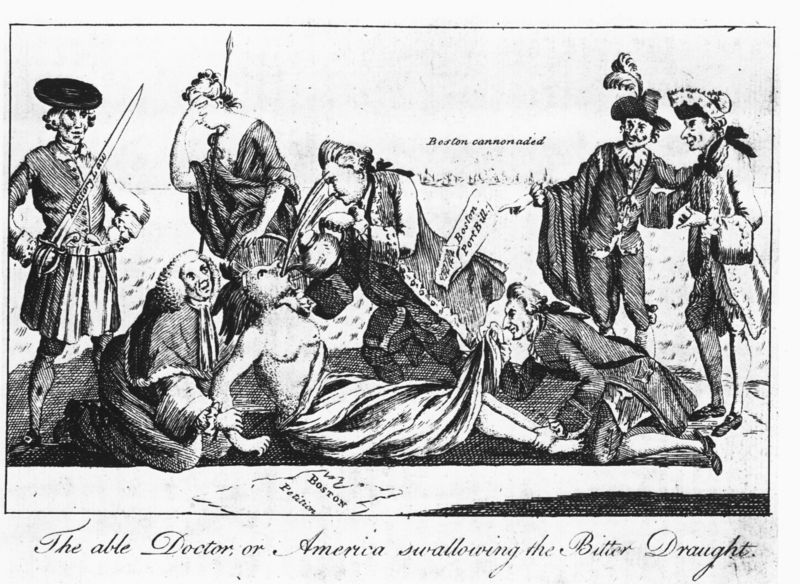
  1. Early America
  2. Transatlantic Encounters and Colonial Beginnings (1492 – 1620)
  3. Jamestown, Virginia
  4. Powhatan