Adams, Jefferson, and Competing Visions for the New Republic

This lesson was reported from:
A chapter of The United States: An Open Ended History, a free online textbook.  Adapted in part from open sources.

For Your Consideration:
  1. What did the Alien and Sedition Acts do? (Name at least two things)
  2. How did Madison and Jefferson respond?
  3. What happened in the case of Marbury v Madison?
  4. What factors caused the use of slavery to increase in the early 1800s?
  5. Why did Jefferson purchase Louisiana?

The Adams Presidency

800px-John_Trumbull_-_John_Adams_-_Google_Art_Project_(498015)
John Adams, 2nd President of the United States.

Washington announced his retirement in 1796, firmly declining to serve for more than eight years as the nation’s head. Thomas Jefferson of Virginia (Republican) and John Adams (Federalist) vied to succeed him. Adams won a narrow election victory.

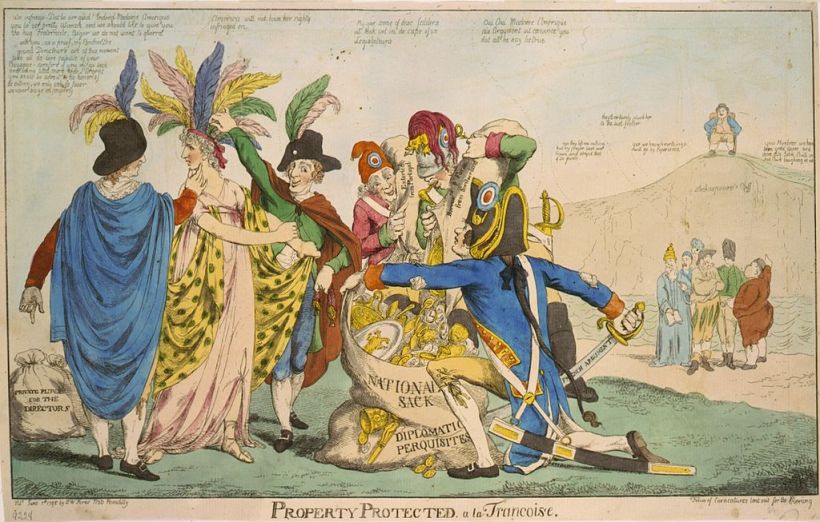
Adams faced serious international difficulties. France, at war with Britain and angered by the fact that the U.S. refused to cut off ties with Britain, began to seize American merchant ships there. By 1797 France had snatched 300 American ships and broken off diplomatic relations with the United States. When Adams sent three commissioners to Paris to negotiate, agents of Foreign Minister Charles Maurice de Talleyrand (whom Adams labeled X, Y, and Z in his report to Congress) informed the Americans that negotiations could only begin if the United States loaned France $12 million and bribed officials of the French government. American hostility to France rose to an excited pitch. Federalists called for war.

These events – the so-called XYZ Affair – led to the strengthening of the fledgling U.S. Armies and Navy.Congress authorized the acquisition of twelve frigates, and made other appropriations to increase military readiness. Despite calls for a formal war declaration, Adams remembered Washington’s farewell address, which warned against getting involved in European conflict, and steadfastly refused to ask Congress for one.
1024px-Property_protected_à_la_françoise
A political cartoon depicts the XYZ Affair – America is a female being plundered by Frenchmen. (1798)

In 1799, after a series of sea battles with the French, war seemed inevitable. In this crisis, Adams rejected the guidance of Hamilton, who wanted war, and reopened negotiations with France. Napoleon, who had just come to power, received them cordially. The danger of conflict subsided with the negotiation of the Convention of 1800, which formally released the United States from its 1778 defense alliance with France. However, reflecting American weakness, France refused to pay $20 million in compensation for American ships taken by the French Navy.

Thomas_Jefferson_by_Rembrandt_Peale,_1800
Vice President Thomas Jefferson actively worked against his own president, arguing that states had the right to nullify or ignore those federal laws with which they disagreed.

Hostility to France led the Federalist controlled Congress to pass the Alien and Sedition Acts, which had severe repercussions for American civil liberties. The Naturalization Act, which changed the requirement for citizenship from five to 14 years, was targeted at Irish and French immigrants suspected of supporting the Republicans. The Alien Act, operative for two years only, gave the president the power to expel or imprison aliens in time of war. The Sedition Act forbid writing, speaking, or publishing anything of “a false, scandalous, and malicious” nature against the president or Congress. The few convictions won under it created martyrs to the cause of civil liberties and aroused support for the Republicans.

The acts met with resistance. Jefferson – Adams’s own vice-president – and James Madison sponsored the passage of the Kentucky and Virginia Resolutions by the legislatures of these two states in November and December 1798. As extreme declarations of states’ rights, the resolutions asserted that states could ignore federal actions if they disagreed with them.  This concept of nullification would be used later for the Southern states’ resistance to protective tariffs (favored by the North), and, more ominously, slavery.

Industry and Slavery

Powerloom_weaving_in_1835
A Roberts loom in a weaving shed in 1835. Textiles were the leading industry of the Industrial Revolution and mechanized factories, powered by a central water wheel or steam engine, were the new workplace.

In the 1790s certain New England weavers began building large, automated looms, driven by water power. To house them they created the first American factories. Working the looms required less skill and more speed than household laborers could provide. The looms needed people brought to them; and they also required laborers who did not know the origin of the word sabotage. These factories sought out young women.

The factory owners said they wanted to hire these women just for a few years, with the ideal being that they could raise a dowry for their wedding. They were carefully supervised, with their time laid out for them. Some mill owners created evening classes to teach these women how to write and how to organize a household.

The factories provided a cheaper source of cotton cloth, sent out on ships and on roads improved by a stronger government. For the first time some people could afford more than two outfits, work and Sunday best. They also provided an outlet for cotton from the slave states in the South. Cotton was at that time one among many crops. Many slaves had to work to separate cotton from the seeds of the cotton plant, and to ship it to cloth-hungry New England. This was made simpler by Eli Whitney’s invention of the cotton gin in 1793. Cotton became a profitable crop, and many Southern farms now made it their only crop. Growing and picking cotton was long, difficult labor, and the Southern plantation made it the work for slaves. Northern factories became part of the economy of slavery.

eli-whitney-and-the-cotton-gin-8
Two slaves operate one of Eli Whitney’s cotton gins. Whitney invented his cotton gin in 1793. He began to work on this project after moving to Georgia in search of work. Whitney created two cotton gins: a small one that could be hand-cranked and a large one that could be driven by a horse or water power. Thanks to the cotton gin, the production of raw cotton doubled each decade after 1800.

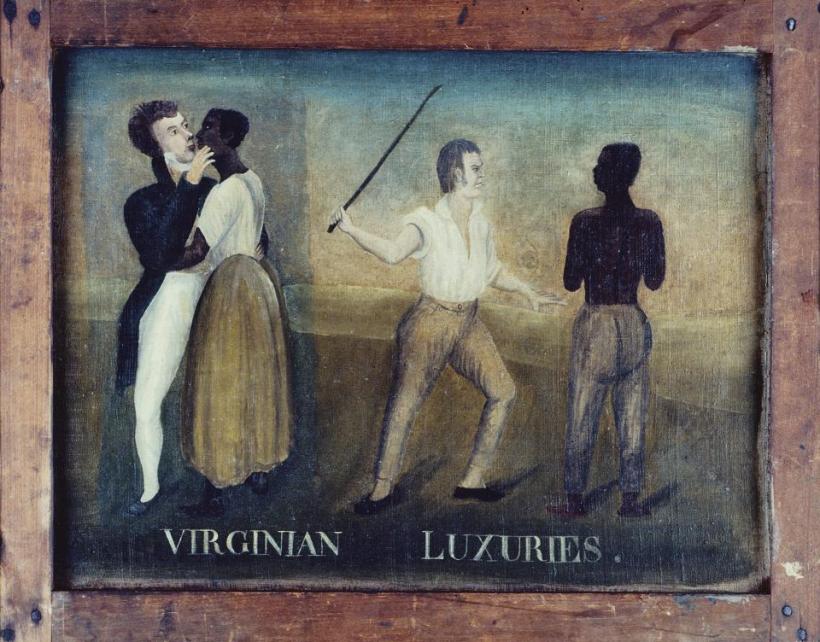
This renewed reliance on slavery went against the trend in other parts of the country. Vermont had prohibited slavery in its state constitution in 1777. Pennsylvania passed laws for the gradual abolition of the condition in 1780, and New York State in 1799. Education, resources, and economic development created the beginnings of industrialization in many Northern states and plantations and slavery and less development in states in the Deep South.

The Election of 1800

By 1800 the American people were ready for a change. Under Washington and Adams, the Federalists had established a strong government, but sometimes they had followed policies that alienated large groups. For example, in 1798 they had enacted a tax on houses, land, and slaves, affecting every property owner in the country.

The campaign of 1800 was bitter – Jefferson’s allies suggested that President Adams of having a “hideous hermaphroditical character, which has neither the force and firmness of a man, nor the gentleness and sensibility of a woman.”  Adams’s supporters called Vice President Jefferson “a mean-spirited, low-lived fellow, the son of a half-breed Indian squaw, sired by a Virginia mulatto father.”  The two men didn’t speak to each other for another decade.

The Constitution originally called for the individual with the most votes in an election to become President, and for the runner-up to become Vice President. George Washington, who had approved of this system, had justified it by the belief that it worked against factionalism in political parties. However, it had already resulted in the alienation of Vice President Thomas Jefferson under the Adams administration.

In 1800, Thomas Jefferson and Aaron Burr ran against Adams and his running mate. The two Republican candidates would have preferred for Jefferson to become President and Burr to become Vice President. But the Electoral College vote was tied between the two of them. The Federalist-controlled House of Representatives was called upon to chose between them. It had to vote thirty-six times before Jefferson was chosen to be President, and then only with the reluctant agreement of Alexander Hamilton – to stop Burr, who had refused to concede the presidency to Jefferson as planned. Congress later approved a Constitutional amendment allowing for separate balloting for President and Vice President in the Electoral College.

800px-Duel_between_Aaron_Burr_and_Alexander_Hamilton
Vice President Aaron Burr bore a grudge against Hamilton for this. In 1804, when the two ran for Governor of New York, they dueled, and Burr killed Hamilton.

In Jefferson’s inaugural address, the first such speech in the new capital of Washington, D.C., he promised “a wise and frugal government” that would preserve order among the inhabitants but leave people “otherwise free to regulate their own pursuits of industry, and improvement.”  He also spoke of reconciliation after the bitter campaign saying, “We have called by different names brethren of the same principle. We are all Republicans, we are all Federalists.”

Marbury v. Madison

On March 2, 1801, just two days before his presidential term was to end, Adams nominated nearly 60 Federalist supporters to circuit judge and justice of the peace positions the Federalist-controlled Congress had newly created. These appointees—whom Jefferson’s supporters derisively referred to as “the Midnight Judges”—included William Marbury, an ardent Federalist and a vigorous supporter of the Adams presidency.

On March 4, 1801, Thomas Jefferson was sworn in and became the 3rd President of the United States. As soon as he was able, Jefferson instructed his new Secretary of State, James Madison, to withhold the undelivered appointments. In Jefferson’s opinion, the commissions were void because they had not been delivered in time.  Without the commissions, the appointees were unable to assume the offices and duties to which they had been appointed. In December 1801, Marbury filed suit against Madison in the Supreme Court, asking the Court to force Madison to deliver Marbury’s commission. This lawsuit resulted in the case of Marbury v. Madison.

The Court did not order Madison to comply. Marshall examined the law Congress had passed that gave the Supreme Court jurisdiction over types of cases like Marbury’s, and found that it had expanded the definition of the Supreme Court’s jurisdiction beyond what was originally set down in the U.S. Constitution. Marshall then struck down the law. This is the origin of the concept of judicial review – the idea that American courts have the power to strike down laws or actions of the government found to violate the Constitution.  If the Supreme Court has a super power, it is this, and they discovered it here.

800px-Plaque_of_Marbury_v._Madison_at_SCOTUS_Building
Inscription on the wall of the Supreme Court Building from Marbury v. Madison, in which Chief Justice John Marshall outlined the concept of judicial review.

The Louisiana Purchase

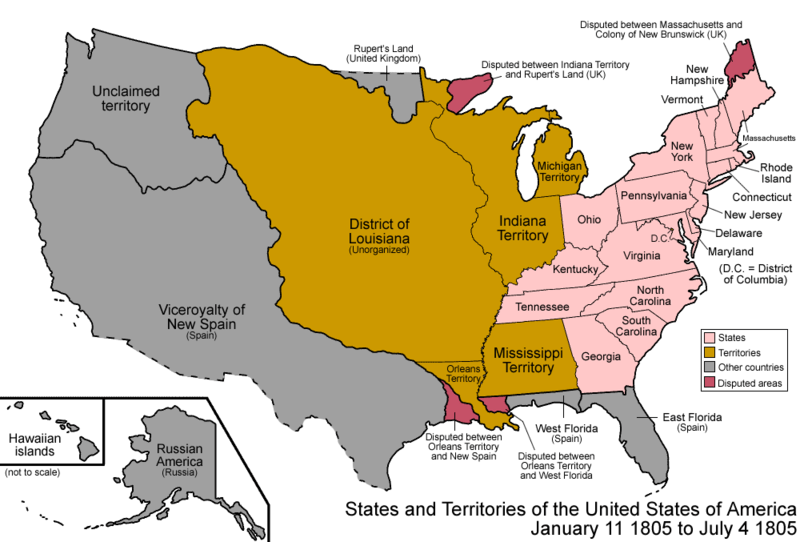
One of Jefferson’s acts doubled the area of the country. At the end of the Seven Years’ War, France had ceded its territory west of the Mississippi River to Spain. Access to the port of New Orleans near its mouth was vital for the shipment of American products from the Ohio and Mississippi river valleys. Shortly after Jefferson became president, Napoleon forced a weak Spanish government to cede this great tract, the Louisiana Territory, back to France. The move filled Americans with apprehension and indignation. French plans for a huge colonial empire just west of the United States seriously threatened the future development of the United States. Jefferson asserted that if France took possession of Louisiana, “from that moment we must marry ourselves to the British fleet and nation.”

Napoleon, however, lost interest after the French were expelled from Haiti by a slave revolt. Knowing that another war with Great Britain was impending, he resolved to fill his treasury and put Louisiana beyond the reach of Britain by selling it to the United States. His offer presented Jefferson with a dilemma: The Constitution conferred no explicit power to purchase territory. At first the president wanted to propose an amendment, but delay might lead Napoleon to change his mind. Advised that the power to purchase territory was an implied power, suggested by the enumerated power to make treaties, Jefferson relented, saying that “the good sense of our country will correct the evil of loose construction when it shall produce ill effects.”

All of this sidestepped the question of whether this land was France’s to sell in the first place – barely any of it was occupied by French people let alone the French army.  Instead, it was filled with millions of Native Americans living across hundreds of independent tribes, most of whom had likely never heard of France or the United States.

The United States obtained the “Louisiana Purchase” for $15 million in 1803. It contained more than 2,600,000 square kilometers as well as the port of New Orleans. Once the natives who occupied it had been conquered and removed, the nation would gain a sweep of rich plains, mountains, forests, and river systems that within 80 years would become its heartland—and a breadbasket for the world.
800px-United_States_1805-01-1805-07
The 1803 Louisiana Purchase totaled 827,987 square miles (2,144,480 square kilometers), doubling the size of the United States.

Jefferson commissioned the  Lewis and Clark Expedition (1) to explore and map the newly acquired territory, (2) to find a practical route across the western half of the continent, and (3) to establish an American presence in this territory before Britain and other European powers tried to claim it. The campaign’s secondary objectives were scientific and economic: (4) to study the area’s plants, animal life, and geography, and (5) to establish trade with local American Indian tribes.

From May 1804 to September 1806, the Corps of Discovery under the command of Captain Meriwether Lewis and his close friend Second Lieutenant William Clark, was the first American expedition to cross the western portion of the United States. Also along for the mission was York, Clark’s slave, who who carried a gun and hunted on behalf of the expedition and was also accorded a vote during group decisions, more than half a century before African Americans could actually participate in American democracy.  Along the way, the Corps picked up they met a French-Canadian fur trapper named Toussaint Charbonneau, and his teenage Shoshone wife Sacagawea, who had purchased as a slave and who was pregnant with their child.  The Shoshone lived in the Rocky Mountains, and Sacagawea’s knowledge of nature, geography, language, and culture proved to be invaluable to the expedition.

Lewis_and_clark-expedition
Lewis and Clark on the Lower Columbia depicts the meeting between the Corps of Discovery and the Chinook people on the Lower Columbia River in October 1805.  Sacagawea is depicted with arms outstretched.

The Corps met their objective of reaching the Pacific, mapping, and establishing their presence for a legal claim to the land. They established diplomatic relations and trade with at least two dozen indigenous nations. They did not find a continuous waterway to the Pacific Ocean (mostly because one does not exist!) but located an Indian trail that led from the upper end of the Missouri River to the Columbia River which ran to the Pacific Ocean. They gained information about the natural habitat, flora and fauna, bringing back various plant, seed and mineral specimens. They mapped the topography of the land, designating the location of mountain ranges, rivers and the many Indian tribes during the course of their journey. They also learned and recorded much about the language and customs of the American Indian tribes they encountered, and brought back many of their artifacts, including bows, clothing and ceremonial robes.

The article was adapted in part from:
  1. The Formation of a National Government
  2. The Early Years of the Republic
  3. The Lewis and Clark Expedition

President Washington and the Origins of Party Politics

This lesson was reported from:
A chapter of The United States: An Open Ended History, a free online textbook.  Adapted in part from open sources.

For Your Consideration:
  1. Name one presidential tradition that originated with George Washington.
  2. How did the Federalists differ from the Democratic-Republicans?
  3. What was the Compromise of 1790?
  4. Describe one American reaction to the events of the French Revolution.
  5. Compare and contrast the government response to Shays’ Rebellion and the Whiskey Rebellion.

President Washington

One of the last acts of the Congress of the Confederation was to arrange for the first presidential election, setting March 4, 1789, as the date that the new government would come into being. One name was on everyone’s lips for the new chief of state—George Washington. He was unanimously chosen president and took the oath of office at his inauguration on April 30, 1789. In words spoken by every president since, Washington pledged to execute the duties of the presidency faithfully and, to the best of his ability, to “preserve, protect, and defend the Constitution of the United States.”

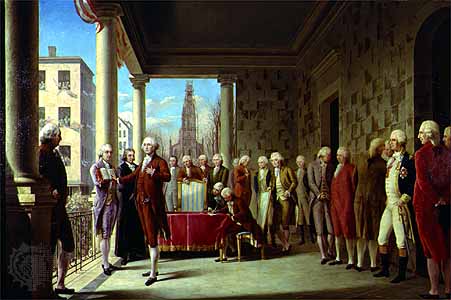
Washington's_Inauguration
George Washington’s inauguration as the first President of the United States which took place in New York City on April 30, 1789.

When Washington took office, the new Constitution enjoyed neither tradition nor the full backing of organized public opinion. The new government had to create its own machinery and legislate a system of taxation that would support it. Until a judiciary could be established, laws could not be enforced. The army was small. The navy had ceased to exist.

Congress quickly created the departments of State and Treasury, with Thomas Jefferson and Alexander Hamilton as their respective secretaries. Departments of War and Justice were also created. Since Washington preferred to make decisions only after consulting those men whose judgment he valued, the American presidential Cabinet came into existence, consisting of the heads of all the departments that Congress might create. Simultaneously, Congress provided for a federal judiciary—a Supreme Court, with one chief justice and five associate justices, three circuit courts, and 13 district courts.

Meanwhile, the country was growing steadily and immigration from Europe was increasing. Americans were moving westward: New Englanders and Pennsylvanians into Ohio; Virginians and Carolinians into Kentucky and Tennessee. Good farms were to be had for small sums; labor was in strong demand. The rich valley stretches of upper New York, Pennsylvania, and Virginia soon became great wheat-growing areas.

Although many items were still homemade, the Industrial Revolution was dawning in the United States. Massachusetts and Rhode Island were laying the foundation of important textile industries; Connecticut was beginning to turn out tinware and clocks; New York, New Jersey, and Pennsylvania were producing paper, glass, and iron. Shipping had grown to such an extent that on the seas the United States was second only to Britain. Even before 1790, American ships were traveling to China to sell furs and bring back tea, spices, and silk.

Washington’s two-term administration set many policies and traditions that survive today. He was again unanimously elected in 1792. But after his second term expired, Washington again voluntarily relinquished power, thereby establishing an important precedent that was to serve as an example for the United States and also for other future republics. Washington also abjured titles. He didn’t want to be called “Your Excellency” or “Your Majesty.” He insisted on being called “Mr. President,” and referred to as “The President of the United States”. Because of his central role in the founding of the United States, Washington is often called the “Father of his Country.” Scholars rank him with Abraham Lincoln among the greatest of United States presidents.

Hamilton vs. Jefferson: Strong or Weak Central Government?

Over the course of Washington’s two terms as president, rivalries arose between his closest advisers, particularly between Secretary of State Thomas Jefferson and Secretary of the Treasury Alexander Hamilton. Out of these developments evolved two new political parties: The Federalists, who shared the same name as the earlier pro-ratification party, and the Democratic-Republican Party, also known as the Jeffersonian party, or as the Anti-Federalists.

722px-Federalist_Cockade.svg
Federalists used a black and white cockade as a symbol.

Led by Alexander Hamilton, the Federalists represented the interests of trade and manufacturing, which they saw as forces of progress in the world. They believed these could be advanced only by a strong central government capable of establishing sound public credit and a stable currency. Openly distrustful of the latent radicalism of the masses, they could nonetheless credibly appeal to workers and artisans. Their political stronghold was in the New England states. Seeing England as an example the United States should try to emulate, they favored good relations with their former mother country.

The Democratic-Republicans, led by Thomas Jefferson, spoke primarily for agricultural interests and values. They distrusted bankers, cared little for commerce and manufacturing, and believed that freedom and democracy flourished best in a rural society composed of self-sufficient farmers. They felt little need for a strong central government; in fact, they tended to see it as a potential source of oppression. Thus they favored states’ rights. They were strongest in the South and in the West.

722px-Tricolour_Cockade.svg
Republicans used a red, white, and blue cockade as a symbol.

The conflict between the Federalist party and the Democratic-Republican party can be seen in the debate on how to pay off Revolutionary War debts. Alexander Hamilton and the Federalists wanted to put state debts and federal debts into one huge national debt. The Treasury would issue bonds that rich people would buy, thereby giving the rich a tangible stake in the success of the national government.  When the new federal government had succeeded in paying off this debt, it would increase confidence in the stability of the central government, encouraging foreign governments to loan money to the U.S. Hamilton also proposed a National Bank to help stabilize the national economy. This private Bank of the United States would serve as a place to put the government’s money, increasing central financial power and economic control.

Jefferson did not agree with Hamilton’s idea of a national bank. Jefferson’s faction envisioned an America more similar to ancient Athens or pre-Imperial Rome, with independent farming households following their own interests and nurturing liberty. Jefferson believed America should teach people to be self-sufficient farmers, and he wanted the federal government to stop interfering in state matters. In the end, in what came to be known as the Compromise of 1790, Jefferson agreed to Hamilton’s plan in exchange for Hamilton’s agreement to locate the government’s permanent capital in the South, on the Potomac River in what would become Washington, D.C.

The good credit established by this deal later allowed Jefferson to borrow in Europe to finance the Louisiana Purchase in 1803, as well as to borrow to finance the War of 1812.

Compromise_of_1790
Jefferson and Hamilton met in private with James Madison to hammer out the deal that came to be known as the Compromise of 1790.

The French Revolution

The French Revolution broke out in 1789, a few months after the American Constitution had gone into effect. At first, as France overthrew the monarchy and declared itself a republic, many Americans supported the revolution. They believed their own revolt against England had spurred France to republicanism. But as the Reign of Terror began, and thousands of French aristocrats went to the guillotine, many Americans were shocked at the revolution’s excesses. By the mid-1790s, as France went to war against neighboring monarchies, the revolution polarized American public opinion. Federalists viewed England, France’s traditional enemy, as the bastion of stable government against a growing tide of French anarchy. Members of the emerging Democratic Republican Party, on the other hand, who took their party’s name in part from the French Republic, believed the Terror to be a temporary excess and continued to view England as the true enemy of liberty.

President Washington’s policy was neutrality. He knew that England, France, or even Spain, would be happy to eat up American resources and territory. The United States in the 1790s was still new and frail. He hoped that America could stay out of European conflicts until it was strong enough to withstand any serious foreign threat. Yet both England and France found opportunities to each use American resources against the other.

Hamilton and Jefferson clashed here as well. The former argued that the mutual defense treaty that the United States had signed with France in 1778 was no longer binding, as the French regime that had made that treaty no longer existed. The latter disagreed. But Washington sided with Hamilton, issuing a formal Proclamation of Neutrality in 1793. Washington repeated his belief in neutrality and argued against factionalism in his Farewell Address of 1796.

That same year, Citizen Edmund Charles Genêt arrived as the French minister to the United States. He soon began issuing commissions to captains of American ships who were willing to serve as privateers for France. This blatant disregard of American neutrality angered Washington, who demanded and got Genêt’s recall.

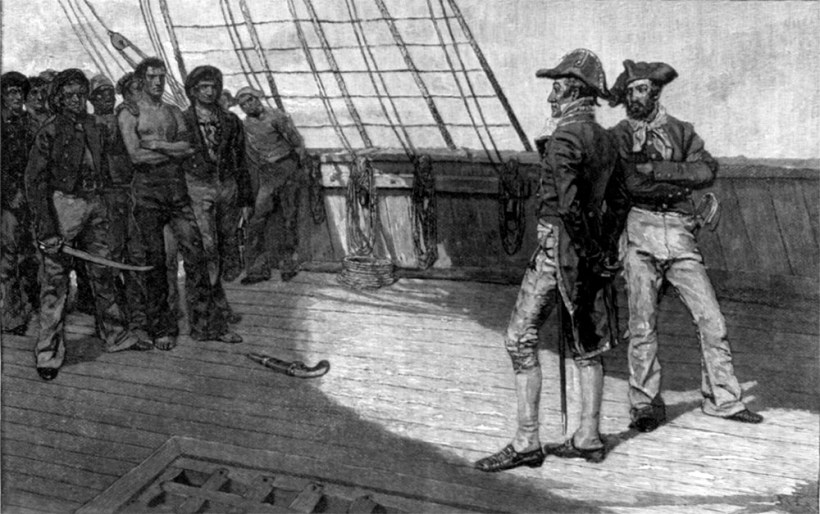
The British Royal Navy, meanwhile, began a policy of impressment – forcing ordinary sailors into military service, including sailors on American merchant ships. Many English sailors had been lured into the American merchant service by high wages and comparatively good standards of living, and England needed these sailors to man its own fleet, on which England’s national security depended. This violation of the American flag, however, infuriated Americans, as did the fact that England had not yet withdrawn its soldiers from posts in the Northwest Territory, as required by the Treaty of Paris of 1783.

1812-impressment-pyle-l
British officers inspect a group of American sailors for impressment into the British navy, ca. 1810, in a drawing by Howard Pyle. The practice angered Americans – and was left unaddressed by the Jay Treaty, angering them further.

In response, President Washington sent Supreme Court Chief Justice John Jay to negotiate a treaty with England. But Jay had little leverage with which to negotiate: the final treaty did require immediate English evacuation of the frontier forts, but it said nothing about the matter of impressments. The Jay Treaty provoked an outcry among American citizens, and although the Senate ratified it narrowly, the debate it sparked was the final blow which solidified the Federalist and Republican factions into full-scale political parties, Federalists agreeing to the treaty, and Republicans viewing it as a sell-out to England (and against France).

The Whiskey Rebellion

Whiskey_Insurrection
“Famous Whiskey Insurrection in Pennsylvania,” an 1880 illustration of a tarred and feathered tax collector being made to ride the rail.

The Whiskey Rebellion of 1794 proved to be one of the most visible challenges of Washington’s time in office. The new Republic needed funds. This motivated Alexander Hamilton to press Congress to pass an excise tax on the sale of whiskey. Rural Pennsylvania farmers, who had never known a centralized American authority, were horrified by a call on what they considered their own profit and refused to pay the tax. A mob of 500 men attacked a tax collector’s house. In response, Washington and Hamilton led an army of 15,000 men to quell the rebellion, an army larger than the force Washington had commanded in the American Revolution. When the army showed up, the rebels dispersed.

In leading the militia against the Whiskey Rebellion, Washington became one of only two sitting U.S. presidents to exercise battlefield authority.

The suppression of the Whiskey Rebellion met with widespread popular approval. This was the first time the new government had been directly opposed, and through a clear show of federal authority, Washington established the principle that federal law is the supreme law of the land, and demonstrated that the federal government had both the ability and willingness to suppress violent resistance to the nation’s laws. The government’s response to the rebellion was, therefore, viewed by the Washington administration as a success, a view that has generally been endorsed by historians.

After crushing the Whiskey Rebellion, Washington publicly blamed the Democratic-Republican Party for the rebellion, and Jefferson began to view Washington as “the head of a party” rather than “the head of a nation.” Hamilton’s followers, who coalesced into the Federalist Party, were thrilled by Washington’s remarks, and the party sought to closely associate itself with Washington.

The article was adapted in part from:
  1. The Formation of a National Government
  2. The Early Years of the Republic
  3. The Whiskey Rebellion

The Constitution: A Second Draft of American Democracy

This lesson was reported from:
A chapter of The United States: An Open Ended History, a free online textbook.  Adapted in part from open sources.

For Your Consideration:
  1. What was the goal of the Constitutional Convention?
  2. Name and describe one compromise at the convention.
  3. What are checks and balances?
  4. Who were the Federalists and what did they believe?
  5. What is the Bill of Rights, and what is one right it protects?

Constitutional Convention

By the time the Northwest Ordinance was enacted, American leaders were in the midst of drafting a new and stronger constitution to replace the Articles of Confederation. Already a legend in his own lifetime, George Washington was a vocal critic of the Articles, had written accurately that the states were united only by a “rope of sand.” Disputes between Maryland and Virginia over navigation on the Potomac River led to a conference of representatives of five states at Annapolis, Maryland, in 1786. One of the delegates, Alexander Hamilton of New York, convinced his colleagues that commerce was bound up with large political and economic questions. What was required was a fundamental rethinking of the Confederation.

The Annapolis conference issued a call for all the states to appoint representatives to a convention to be held the following spring in Philadelphia. The Continental Congress was at first indignant over this bold step, but it acquiesced after Washington gave the project his backing and was elected a delegate. During the next fall and winter, elections were held in all states but Rhode Island.

A remarkable gathering of notables assembled at what came to be called the Constitutional Convention – a gathering of delegates with the goal of creating a new plan of government for the United States – in May 1787. The state legislatures sent leaders with experience in colonial and state governments, in Congress, on the bench, and in the army. Washington, regarded as the country’s first citizen because of his integrity and his military leadership during the Revolution, was chosen as presiding officer.

1024px-Scene_at_the_Signing_of_the_Constitution_of_the_United_States
The signing of the Constitution of the United States

From Pennsylvania came Benjamin Franklin, nearing the end of an extraordinary career of public service and scientific achievement. From Virginia came James Madison, a practical young statesman, a thorough student of politics and history, and, according to a colleague, “from a spirit of industry and application … the best-informed man on any point in debate.” He would be recognized as the “Father of the Constitution.”

From New York came Alexander Hamilton, who had proposed the meeting. Absent from the Convention were Thomas Jefferson, who was serving as minister representing the United States in France, and John Adams, serving in the same capacity in Great Britain. Youth predominated among the 55 delegates—the average age was 42.

Congress had authorized the Convention merely to draft amendments to the Articles of Confederation but, as Madison later wrote, the delegates, “with a manly confidence in their country,” simply threw the Articles aside and went ahead with the building of a wholly new form of government.

1024px-Independence_Hall_10
Independence Hall’s Assembly Room, where the delegates worked through summer heat in 1787.

They recognized that the paramount need was to reconcile two different powers—the power of local control, which was already being exercised by the 13 semi-independent states, and the power of a central government. They adopted the principle that the functions and powers of the national government—being new, general, and inclusive—had to be carefully defined and stated, while all other functions and powers were to be understood as belonging to the states. But realizing that the central government had to have real power, the delegates also generally accepted the fact that the government should be authorized, among other things, to coin money, to regulate commerce, to declare war, and to make peace.

Debate and Compromise

The 18th-century statesmen who met in Philadelphia were adherents of Montesquieu’s concept of the separation of powers in politics. This principle was supported by colonial experience and strengthened by the writings of Montesquieu, with which most of the delegates were familiar. These influences led to the conviction that three equal and coordinate branches of government should be established. Legislative, executive, and judicial powers were to be so harmoniously balanced that no one could ever gain control. The delegates agreed that the legislative branch, like the colonial legislatures and the British Parliament, should be bicameral, consisting of two houses.

On these points there was unanimity within the assembly. But sharp differences also arose. Representatives of the small states—New Jersey, for instance—objected to changes that would reduce their influence in the national government by basing representation upon population rather than upon statehood, as was the case under the Articles of Confederation.

On the other hand, representatives of large states, like Virginia, argued for proportionate representation. This debate threatened to go on endlessly until Roger Sherman came forward with a plan that came to be known as the Great Compromise – for representation in proportion to the population of the states in one house of Congress, the House of Representatives, and equal representation in the other, the Senate.

JohnDickinson4
Quaker John Dickinson argued forcefully against slavery during the Convention. Once Delaware’s largest slaveholder, he had freed all of his slaves by 1787.

Almost every succeeding question raised new divisions, to be resolved only by new compromises. Northerners wanted slaves counted when determining each state’s tax share, but not in determining the number of seats a state would have in the House of Representatives. According to the Three-Fifths Compromise reached with little dissent, tax levies and House membership would be apportioned according to the number of free inhabitants plus three-fifths of the slaves.

Laboring through a hot Philadelphia summer, the convention finally achieved a draft incorporating in a brief document the organization of the most complex government yet devised – one which could only carry out enumerated powers, those powers listed in the Constitution. It would have full power to levy taxes, borrow money, establish uniform duties and excise taxes, coin money, regulate interstate commerce, fix weights and measures, grant patents and copyrights, set up post offices, and build post roads. It also was authorized to raise and maintain an army and navy, manage Native-American affairs, conduct foreign policy, and wage war. It could pass laws for naturalizing foreigners and controlling public lands; it could admit new states on a basis of absolute equality with the old. The power to pass all necessary and proper laws for executing these clearly defined powers rendered the federal government able to meet the needs of later generations and of a greatly expanded body politic.

The principle of separation of powers had already been given a fair trial in most state constitutions and had proved sound. Accordingly, the convention set up a governmental system with separate legislative, executive, and judiciary branches, each with powers of checks and balances to limit each other. Thus congressional enactments were not to become law until approved by the president. And the president was to submit the most important of his appointments and all his treaties to the Senate for confirmation. The president, in turn, could be impeached and removed by Congress. The judiciary was to hear all cases arising under federal laws and the Constitution; in effect, the courts were empowered to interpret both the fundamental and the statute law. But members of the judiciary, appointed by the president and confirmed by the Senate, could also be impeached by Congress.

checks

Ratification and the Bill of Rights

rising-sun-chair2
The Rising Sun Chair George Washington used during the Constitutional Convention.

On September 17, 1787, after 16 weeks of deliberation, the finished Constitution was signed by 39 of the 42 delegates present. Franklin, pointing to the half‑sun painted in brilliant gold on the back of Washington’s chair, said:

I have often in the course of the session … looked at that [chair] behind the president, without being able to tell whether it was rising or setting; but now, at length, I have the happiness to know that it is a rising, and not a setting, sun.

The convention was over; the members “adjourned to the City Tavern, dined together, and took a cordial leave of each other.” Yet a crucial part of the struggle for a more perfect union remained to be faced. The consent of popularly elected state conventions was still required before the document could become effective.

The convention had decided that the Constitution would take effect upon ratification by conventions in nine of the 13 states. By June 1788 the required nine states had ratified the Constitution, but the large states of Virginia and New York had not. Most people felt that without their support the Constitution would never be honored. To many, the document seemed full of dangers: Would not the strong central government that it established tyrannize them, oppress them with heavy taxes, and drag them into wars?

Differing views on these questions brought into existence two parties, the Federalists, who favored a strong central government, and the Antifederalists, who preferred a loose association of separate states. Impassioned arguments on both sides were voiced by the press, the legislatures, and the state conventions.

In Virginia, the Antifederalists attacked the proposed new government by challenging the opening phrase of the Constitution: “We the People of the United States.” Without using the individual state names in the Constitution, the delegates argued, the states would not retain their separate rights or powers. Virginia Antifederalists were led by Patrick Henry, who became the chief spokesman for back-country farmers who feared the powers of the new central government. Wavering delegates were persuaded by a proposal that the Virginia convention recommend a bill of rights, and Antifederalists joined with the Federalists to ratify the Constitution on June 25.

An_Advertisement_of_The_Federalist_-_Project_Gutenberg_eText_16960
An advertisement for The Federalist, 1787, using the pseudonym “Philo-Publius.”

In New York, Alexander Hamilton, John Jay, and James Madison pushed for the ratification of the Constitution in a series of essays known as The Federalist Papers. The essays, published in New York newspapers, provided a now-classic argument for a central federal government, with separate executive, legislative, and judicial branches that checked and balanced one another. With The Federalist Papers influencing the New York delegates, the Constitution was ratified on July 26.

Fear of a strong central government was only one concern among those opposed to the Constitution; of equal concern to many was the fear that the Constitution did not protect individual rights and freedoms sufficiently. Virginian George Mason, author of Virginia’s Declaration of Rights of 1776, was one of three delegates to the Constitutional Convention who had refused to sign the final document because it did not enumerate individual rights. Together with Patrick Henry, he campaigned vigorously against ratification of the Constitution by Virginia. Indeed, five states, including Massachusetts, ratified the Constitution on the condition that such amendments be added immediately.

When the first Congress convened in New York City in September 1789, the calls for amendments protecting individual rights were virtually unanimous. Congress quickly adopted 12 such amendments; by December 1791, enough states had ratified 10 amendments to make them part of the Constitution. Collectively, they are known as the Bill of Rights. Among their provisions: freedom of speech, press, religion, and the right to assemble peacefully, protest, and demand changes (First Amendment); protection against unreasonable searches, seizures of property, and arrest (Fourth Amendment); due process of law in all criminal cases (Fifth Amendment); right to a fair and speedy trial (Sixth Amendment); protection against cruel and unusual punishment (Eighth Amendment); and provision that the people retain additional rights not listed in the Constitution (Ninth Amendment).

Since the adoption of the Bill of Rights, only 17 more amendments have been added to the Constitution. Although a number of the subsequent amendments revised the federal government’s structure and operations, most followed the precedent established by the Bill of Rights – they expanded rather than limited individual rights and freedoms, in particular to the women and people of color who had originally been excluded when Jefferson wrote the words “All men are created equal…”

The article was adapted in part from:

  1. The Formation of a National Government

A New Nation in Crisis: Shays Rebellion and the U.S. Under the Articles

This lesson was reported from:
A chapter of The United States: An Open Ended History, a free online textbook.  Adapted in part from open sources.

For Your Consideration:
  1. What were the Articles of Confederation?
  2. What was one weakness of the Articles of Confederation?
  3. What did the Northwest Ordinance say about slavery?
  4. Why was Daniel Shays upset?
  5. Why wasn’t the government easily able to stop Shays’ Rebellion?

The Articles of Confederation

The struggle with England had done much to change colonial attitudes. Local assemblies had rejected the Albany Plan of Union in 1754, refusing to surrender even the smallest part of their autonomy to any other body, even one they themselves had elected. But in the course of the Revolution, mutual aid had proved effective, and the fear of relinquishing individual authority had lessened to a large degree.

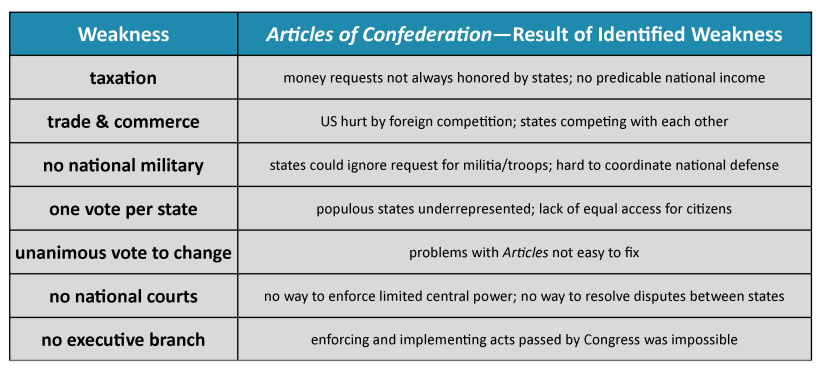
John Dickinson produced the “Articles of Confederation and Perpetual Union” in 1776. The Continental Congress adopted them in November 1777, and they went into effect in 1781, having been ratified by all the states. Reflecting the fragility of a nascent sense of nationhood, the Articles provided only for a very loose union. The national government lacked the authority to set up tariffs, to regulate commerce, and to levy taxes. It possessed scant control of international relations: A number of states had begun their own negotiations with foreign countries. Nine states had their own armies, several their own navies, and there was no U.S. army. In the absence of a sound common currency, the new nation conducted its commerce with a curious hodgepodge of coins and a bewildering variety of state and national paper bills, all fast depreciating in value.

weakness of the articles
The Articles of Confederation were meant to create a weak national government. However, as time went on, these weaknesses came to threaten the very existence of the United States.

Westward Expansion

With the end of the Revolution, the United States again had to face the old unsolved Western question, the problem of expansion, with its complications of land, fur trade, Indians, settlement, and local government. Lured by the richest land yet found in the country, pioneers poured over the Appalachian Mountains and beyond. By 1775 the far-flung outposts scattered along the waterways had tens of thousands of settlers. Separated by mountain ranges and hundreds of kilometers from the centers of political authority in the East, the inhabitants established their own governments. Settlers from all the Tidewater states pressed on into the fertile river valleys, hardwood forests, and rolling prairies of the interior. By 1790 the population of the trans-Appalachian region numbered well over 120,000.

Before the war, several colonies had laid extensive and often overlapping claims to land beyond the Appalachians. To those without such claims this rich territorial prize seemed unfairly apportioned. Maryland, speaking for the latter group, introduced a resolution that the western lands be considered common property to be parceled by the Congress into free and independent governments. This idea was not received enthusiastically. Nonetheless, in 1780 New York led the way by ceding its claims. In 1784 Virginia, which held the grandest claims, relinquished all land north of the Ohio River. Other states ceded their claims, and it became apparent that Congress would come into possession of all the lands north of the Ohio River and west of the Allegheny Mountains. This common possession of millions of hectares was the most tangible evidence yet of nationality and unity, and gave a certain substance to the idea of national sovereignty. At the same time, these vast territories were a problem that required solution.

Northwest-territory-usa-1787
Northwest Territory created by the Northwest Ordinance (1787).

The Confederation Congress established a system of limited self-government for this new national Northwest Territory. The Northwest Ordinance of 1787 provided for its organization, initially as a single district, ruled by a governor and judges appointed by the Congress. When this territory had 5,000 free male inhabitants of voting age, it was to be entitled to a legislature of two chambers, itself electing the lower house. In addition, it could at that time send a nonvoting delegate to Congress. Three to five states would be formed as the territory was settled. Whenever any one of them had 60,000 free inhabitants, it was to be admitted to the Union “on an equal footing with the original states in all respects.” The ordinance guaranteed civil rights and liberties, encouraged education, and prohibited slavery or other forms of involuntary servitude.

The new policy repudiated the time-honored concept that colonies existed for the benefit of the mother country, were politically subordinate, and peopled by social inferiors. Instead, it established the principle that colonies (“territories”) were an extension of the nation and entitled, not as a privilege but as a right, to all the benefits of equality.

State Constitutions

The success of the Revolution gave Americans the opportunity to give legal form to their ideals as expressed in the Declaration of Independence, and to remedy some of their grievances through state constitutions. As early as May 10, 1776, Congress had passed a resolution advising the colonies to form new governments “such as shall best conduce to the happiness and safety of their constituents.” Some of them had already done so, and within a year after the Declaration of Independence, all but three had drawn up constitutions.

The new constitutions showed the impact of democratic ideas. None made any drastic break with the past, since all were built on the solid foundation of colonial experience and English practice. But each was also animated by the spirit of republicanism, an ideal that had long been praised by Enlightenment philosophers.

Naturally, the first objective of the framers of the state constitutions was to secure those “unalienable rights” whose violation had caused the former colonies to repudiate their connection with Britain. Thus, each constitution began with a declaration or bill of rights. Virginia’s, which served as a model for all the others, included a declaration of principles: popular sovereignty, rotation in office, freedom of elections, and an enumeration of fundamental liberties: moderate bail and humane punishment, speedy trial by jury, freedom of the press and of conscience, and the right of the majority to reform or alter the government.

Other states enlarged the list of liberties to freedom of speech, of assembly, and of petition. Their constitutions frequently included such provisions as the right to bear arms, to a writ of habeas corpus, to inviolability of domicile, and to equal protection under the law. Moreover, all prescribed a three-branch structure of government—executive, legislative, and judiciary—each checked and balanced by the others. Pennsylvania’s constitution was the most radical. In that state, Philadelphia artisans, Scots-Irish frontiersmen, and German-speaking farmers had taken control. The provincial congress adopted a constitution that permitted every male taxpayer and his sons to vote, required rotation in office (no one could serve as a representative more than four years out of every seven), and set up a single-chamber legislature.

The state constitutions had some glaring limitations, particularly by more recent standards. Constitutions established to guarantee people their natural rights did not secure for everyone the most fundamental natural right—equality. The colonies south of Pennsylvania excluded their slave populations from their inalienable rights as human beings. Women had no political rights. No state went so far as to permit universal male suffrage, and even in those states that permitted all taxpayers to vote (Delaware, North Carolina, and Georgia, in addition to Pennsylvania), office-holders were required to own a certain amount of property.

Shays’ Rebellion

Economic difficulties after the war prompted calls for change to this precarious system. The end of the war had a severe effect on merchants who supplied the armies of both sides and who had lost the advantages deriving from participation in the British mercantile system. The states gave preference to American goods in their tariff policies, but these were inconsistent, leading to the demand for a stronger central government to implement a uniform policy.

Farmers probably suffered the most from economic difficulties following the revolution. The supply of farm produce exceeded demand; taxes, even on small landowners, were actually higher under many new state governments than they were under the British. Small farmers wanted economic reforms to avoid foreclosure on their property and imprisonment for debt, as was the law at the time. Courts were clogged with suits for payment filed by their creditors. All through the summer of 1786, popular conventions and peaceful gatherings in several states demanded tax and monetary reform.

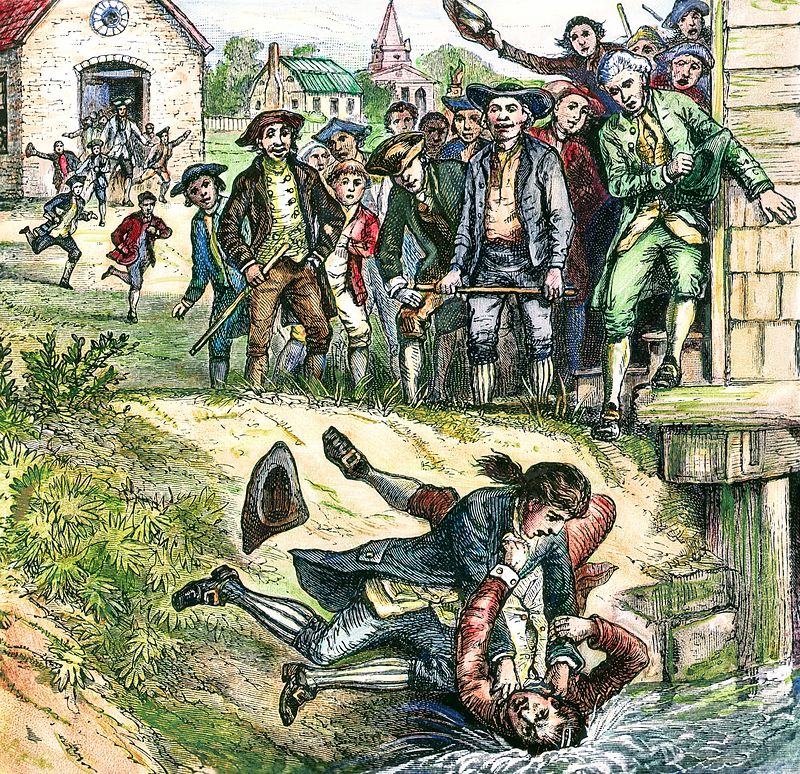
Protesters watching a debtor in a scuffle with a tax collector by the courthouse at Springfield, Massachusetts.

That autumn, groups of farmers in Massachusetts under the leadership of a former army captain, Daniel Shays, began to forcibly prevent the county courts from sitting and passing further judgments for debt – which would have resulted in the loss of property, livelihood, and the right to vote for Shays and many of his followers. In January 1787, a ragtag army of 1,200 farmers moved toward the federal arsenal at Springfield. The rebels, armed chiefly with staves and pitchforks, were repulsed by a small state militia force; General Benjamin Lincoln then arrived with reinforcements – privately funded by wealthy creditors in Boston – and routed the remaining Shaysites, whose leader escaped to Vermont. The government captured 14 rebels and sentenced them to death.  After the defeat of the rebellion, a newly elected legislature, whose majority sympathized with the rebels, met some of their demands for debt relief. The new governor even pardoned many of the resistance leaders, though not Daniel Shays – who lived out the rest of his life as a poor farmer outside of Massachusetts.

800px-Daniel_Shays_and_Job_Shattuck
Contemporary engraving depicting Daniel Shays (left) and Job Shattuck, another rebel leader; the artist intentionally rendered them in an unflattering way.

From the perspective of the wealthy, landowning founders of the new nation, anarchy threatened – the poor had effectively risen up and achieved many of their goals after resorting to armed violence. The U.S. government, under the Articles, was unable to raise an army. It was unable to reinforce the Massachusetts state militia, which had only just barely contained the violence.  And now the state government was in the hands of many of who were sympathetic to the lower classes.

Thomas Jefferson was serving as ambassador to France at the time and refused to be alarmed by Shays’ Rebellion. He argued in a letter to James Madison on January 30, 1787 that occasional rebellion serves to preserve freedoms. “The tree of liberty must be refreshed from time to time with the blood of patriots and tyrants. It is its natural manure.” In contrast, George Washington had been calling for constitutional reform for many years, and he wrote in a letter to Henry Lee, “Let us have a government by which our lives, liberties, and properties will be secured, or let us know the worst at once.”

Shortly after Shays’ Rebellion broke out, delegates from five states met in Annapolis, Maryland from September 11-14, 1786, and they concluded that vigorous steps were needed to reform the federal government, but they disbanded because of a lack of full representation and authority, calling for a convention of all the states to be held in Philadelphia in May 1787.

The article was adapted in part from:

  1. The Formation of a National Government
  2. Shays’ Rebellion

The Revolutionary War: With a Little Help from our Friends

This lesson was reported from:
A chapter of The United States: An Open Ended History, a free online textbook.  Adapted in part from open sources.

For Your Consideration:
  1. What happened at Valley Forge, Pennsylvania?
  2. Describe one role patriot women played during the Revolutionary War.
  3. Why was French help necessary for an American victory in the war?
  4. What happened at Yorktown?
  5. What were the terms of the Treaty of Paris of 1783?

Defeats and victories

Although the Americans suffered severe setbacks for months after independence was declared, their tenacity and perseverance eventually paid off. During August 1776, in the Battle of Long Island in New York, Washington’s position became untenable, and he executed a masterly retreat in small boats from Brooklyn to the Manhattan shore. British General William Howe twice hesitated and allowed the Americans to escape. By November, however, Howe had captured Fort Washington on Manhattan Island. New York City would remain under British control until the end of the war.

That December, Washington’s forces were near collapse, as supplies and promised aid failed to materialize. Howe again missed his chance to crush the Americans by deciding to wait until spring to resume fighting. On the night of December 25–26, 1776, Washington crossed the Delaware River, north of Trenton, New Jersey. In the early-morning hours of December 26, his troops surprised the British garrison there, taking more than 900 prisoners.

1024px-Washington_Crossing_the_Delaware_by_Emanuel_Leutze,_MMA-NYC,_1851
Washington Crossing the Delaware commemorates General George Washington during his famous crossing of the Delaware River with the Continental Army on the night of December 25–26, 1776, during the American Revolutionary War.

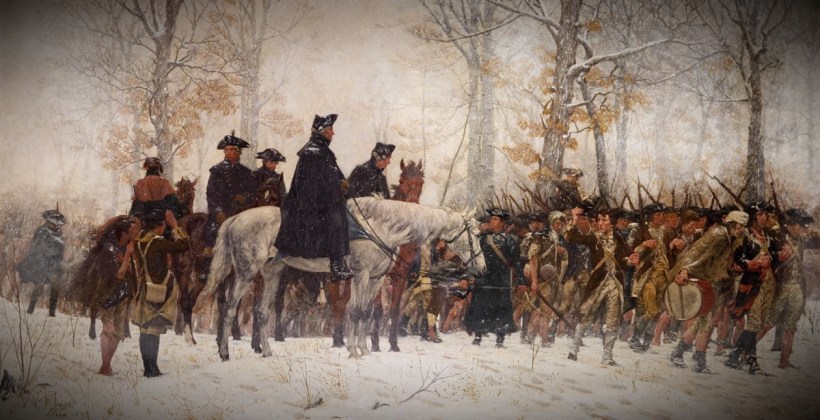
In September 1777, however, Howe defeated the American army at Brandywine in Pennsylvania and occupied Philadelphia, forcing the Continental Congress to flee. Washington had to endure the bitterly cold winter of 1777‑1778 at Valley Forge, Pennsylvania, lacking adequate food, clothing, and supplies. Local farmers and merchants exchanged their goods for British gold and silver rather than for dubious paper money issued by the Continental Congress and the states.

A reproduction hut at Valley Forge
A reproduction of a soldier’s hut at Valley Forge.

With disease and hunger rampant, Valley Forge was the lowest ebb for Washington’s Continental Army.  While the winter itself was not particularly harsh, many soldiers remained unfit for duty, owing to the lack of proper clothing and uniforms.  Years later, General Marquis de Lafayette, an early French ally to the American cause, who was present at Valley Forge, recalled that “the unfortunate soldiers were in want of everything; they had neither coats, hats, shirts, nor shoes; their feet and legs froze till they had become almost black, and it was often necessary to amputate them.”

While formal politics and warfare did not include women, ordinary domestic behaviors became charged with political significance as women confronted the Revolution. Women in the era of the Revolution were responsible for managing the household.  Halting previously everyday activities, such as drinking British tea or ordering clothes from Britain, demonstrated Colonial opposition during the years leading up to and during the war.

Patriot women continued a long tradition of weaving, and spun their own cloth to make clothing for their families. In addition to the boycotts of British textiles, the Homespun Movement served the Continental Army by producing needed clothing and blankets.

Some women were economically unable to maintain their households in their husband’s absence or wished to be by their side. Known as camp followers, these women followed the Continental Army, serving the soldiers and officers as washerwomen, cooks, nurses, seamstresses, supply scavengers, and occasionally as soldiers and spies. The women that followed the army were at times referred to as “necessary nuisances” and “baggage” by commanding officers, but at other times were widely praised. These women helped the army camps run smoothly. Prostitutes were also present, but they were a worrisome presence to military leaders particularly because of the possible spread of venereal diseases.

Wives of some of the superior officers (Martha Washington, for example) visited the camps frequently. Unlike poorer women present in the army camps, the value of these well-to-do women to the army was symbolic or spiritual, rather than practical. Their presence was a declaration that everyone made sacrifices for the war cause.

Franco-American Alliance

In France, enthusiasm for the American cause was high: The French intellectual world was itself stirring against feudalism and privilege. However, the Crown lent its support to the colonies for geopolitical rather than ideological reasons: The French government had been eager for reprisal against Britain ever since France’s defeat in 1763. To further the American cause, Benjamin Franklin was sent to Paris in 1776. His wit, guile, and intellect soon made their presence felt in the French capital, and played a major role in winning French assistance.

800px-Benjamin_Franklin's_Reception_at_the_Court_of_France_1778
Benjamin Franklin’s reception at the Court of France in 1778.

France began providing aid to the colonies in May 1776, when it sent 14 ships with war supplies to America. In fact, most of the gunpowder used by the American armies came from France. After Britain’s defeat at Saratoga, France saw an opportunity to seriously weaken its ancient enemy and restore the balance of power that had been upset by the French and Indian War. On February 6, 1778, the colonies and France signed a Treaty of Amity and Commerce, in which France recognized the United States and offered trade concessions. They also signed a Treaty of Alliance, which stipulated that if France entered the war, neither country would lay down its arms until the colonies won their independence, that neither would conclude peace with Britain without the consent of the other, and that each guaranteed the other’s possessions in America. This was the only bilateral defense treaty signed by the United States or its predecessors until 1949.

The Franco-American alliance soon broadened the conflict. In June 1778 British ships fired on French vessels, and the two countries went to war. In 1779 Spain, hoping to reacquire territories taken by Britain in the Seven Years’ War, entered the conflict on the side of France, but not as an ally of the Americans. In 1780 Britain declared war on the Dutch, who had continued to trade with the Americans. The combination of these European powers, with France in the lead, was a far greater threat to Britain than the American colonies standing alone.

Surrender at Yorktown

In July 1780 France’s King Louis XVI had sent to America an expeditionary force of 6,000 men under the Comte Jean de Rochambeau. In addition, the French fleet harassed British shipping and blocked reinforcement and resupply of British forces in Virginia. French and American armies and navies, totaling 18,000 men, parried with British General Cornwallis all through the summer and into the fall.

Soldier_in_the_Continental_Army_from_1st_Rhode_Island_Regiment
Continental soldiers at Yorktown; on the left, an African-American soldier of the 1st Rhode Island Regiment.  Most blacks fought on the patriot side; recent research concludes there were about 9000 black Patriot soldiers, counting the Continental Army and Navy, and state militia units, as well as privateers, wagoneers in the Army, servants to officers, and spies.

A series of battles left Cornwallis’s armies in retreat toward Yorktown, Virginia, where they expected to be rescued by a British fleet. The fleet showed up, but so did a larger French fleet, so the British fleet retreated out to sea after a brief battle, leaving Cornwallis trapped between the American and French armies on land and the French fleet at sea. Finally, on October 19, 1781, General Cornwallis surrendered his army of 8,000 British soldiers.

The British had asked for the traditional honors of war, which would allow the army to march out with flags flying, bayonets fixed, and the band playing an American or French tune as a tribute to the victors. However, Washington firmly refused to grant the British the honors that they had denied the defeated American army the year before at the Siege of Charleston. Consequently, the British and Hessian troops marched with flags furled and muskets shouldered.

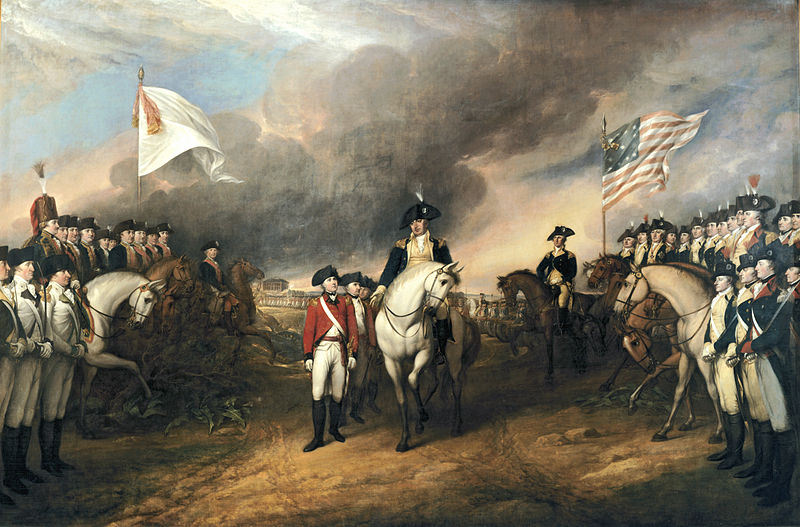
Cornwallis refused to attend the surrender ceremony, citing illness. Instead, Brigadier General Charles O’Hara led the British army onto the field. O’Hara first attempted to surrender to Rochambeau, who shook his head and pointed to Washington. O’Hara then offered his sword to Washington, who also refused and motioned to Benjamin Lincoln, his own second-in-command. The surrender finally took place when Washington’s second-in-command accepted the sword of Cornwallis’ deputy.

800px-Surrender_of_Lord_Cornwallis
Surrender of Lord Cornwallis by John Trumbull, depicts the British surrendering to Benjamin Lincoln, flanked by French (left) and American troops. Oil on canvas, 1820.

For the next year, scattered fighting continued, but back in Britain, the British were crushed by this defeat. Before long, Parliament voted to cease all offensive operations in “the colonies.”

Although Cornwallis’s defeat did not immediately end the war, a new British government decided to pursue peace negotiations in Paris in early 1782, with the American side represented by Benjamin Franklin, John Adams, and John Jay. Signed on September 3, 1783 the Treaty of Paris acknowledged the independence, freedom, and sovereignty of the 13 former colonies, now states. The new United States stretched west to the Mississippi River, north to Canada, and south to Florida, which was returned to Spain.

At the conclusion of the war in 1783 large numbers of loyalists and their families relocated to the home country of England and or to the still-British colony of Canada.

The article was adapted in part from:

  1. The American Revolution
  2. The Road to Revolution
  3. The Road to Independence
  4. History of the United States
  5. Women in the American Revolution

The Shot Heard Round the World, Common Sense, and Independence

This lesson was reported from:
A chapter of The United States: An Open Ended History, a free online textbook.  Adapted in part from open sources.

For Your Consideration:
  1. What happened at Lexington and Concord that was so different from what came before?
  2. How was the Continental Army different from the minutemen?
  3. How was the Olive Branch Petition received?
  4. What was the main argument and significance of Common Sense?
  5. What was the main argument and significance of the Declaration of Independence?

The Battle of Lexington and Concord

General Thomas Gage, an amiable English gentleman with an American-born wife, commanded the garrison at Boston, where political activity had almost wholly replaced trade. Gage’s main duty in the colonies had been to enforce the Coercive Acts. When news reached him that the Massachusetts colonists were collecting powder and military stores at the town of Concord, 32 kilometers away, Gage sent a strong detail to confiscate these munitions.

After a night of marching, the British troops reached the village of Lexington on April 19, 1775, and saw a grim band of 77 minutemen— self-trained militiamen charged with defending their hometowns, so named because they were said to be ready to fight in a minute—through the early morning mist. The Minutemen intended only a silent protest, but Marine Major John Pitcairn, the leader of the British troops, yelled, “Disperse, you damned rebels! You dogs, run!” The leader of the Minutemen, Captain John Parker, told his troops not to fire unless fired at first. The Americans were withdrawing when someone fired a shot, which led the British troops to fire at the Minutemen. The British then charged with bayonets, leaving eight dead and 10 wounded. In the often-quoted phrase of 19th century poet Ralph Waldo Emerson, this was “the shot heard round the world” – the moment at which colonial protest crossed the line into outright armed rebellion.

The skirmish at Lexington.
The skirmish at Lexington – note the Minutemen scattering in the foreground.

The British pushed on to Concord. The Americans had taken away most of the munitions, but they destroyed whatever was left. In the meantime, American forces in the countryside had mobilized to harass the British on their long return to Boston. All along the road, behind stone walls, hillocks, and houses, militiamen from “every Middlesex village and farm” made targets of the bright red coats of the British soldiers. By the time Gage’s weary detachment stumbled into Boston, it had suffered more than 250 killed and wounded. The Americans lost 93 men.

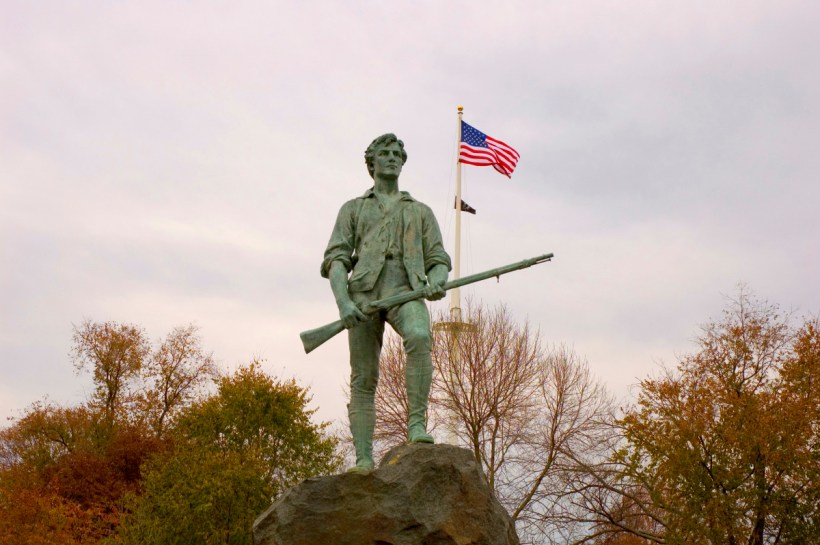
statue-at-lexington-green
The statue that now stands on Lexington green commemorating the service and sacrifice of colonial Minutemen. Some argue that this likeness is based on Captain John Parker, though that claim has never been proven.

The Battle of Bunker Hill

On the morning following the Battle of Lexington and Concord, the British woke up to find Boston surrounded by 20,000 armed colonists, occupying the neck of land extending to the peninsula on which the city stood.

The colonist’s action had changed from a battle to a siege, where one army bottles up another in a town or a city. (Though in traditional terms, the British were not besieged, since the Royal Navy controlled the harbor and supplies came in by ship.) The 6,000 to 8,000 rebels faced some 4,000 British regulars under General Thomas Gage. Boston and little else was controlled by British troops.

Lexington_Concord_Siege_of_Boston_crop
1775 map of the Boston area, relating key events from this early period of the war.

The Second Continental Congress met in Philadelphia, Pennsylvania, on May 10. The Congress voted to go to war, inducting the colonial militias into continental service. It appointed Colonel George Washington of Virginia as their commander-in-chief on June 15, promoting to him to rank of General in the Continental Army, the United States’s first national military force.

General Gage countered the siege of Boston on June 17 by attacking the colonists on Breed’s Hill and Bunker Hill. Although the British suffered tremendous casualties compared to the colonial losses, the British were eventually able to dislodge the American forces from their entrenched positions. The colonists were forced to retreat when many colonial soldiers ran out of ammunition. Soon after, the area surrounding Boston fell to the British.

Despite this early defeat for the colonists, the battle proved that they had the potential to counter British forces, which were at that time considered the best in the world.

battle of bunker hill
A stylized rendering of the Battle of Bunker Hill.

The Last Chance For Peace

Despite the outbreak of armed conflict, the idea of complete separation from England was still repugnant to many members of the Continental Congress. In July, it adopted the Olive Branch Petition, in which it the Congress affirmed its allegiance to the Crown and asked the king for peace talks. It was received in London at the same time as news of the Battle of Bunker Hill. The King refused to read the petition or to meet with its ambassadors.  King George rejected it; instead, on August 23, 1775, he issued a proclamation declaring the colonies to be in a state of rebellion.

Britain had expected the Southern colonies to remain loyal, in part because of their reliance on slavery. Many in the Southern colonies feared that a rebellion against the mother country would also trigger a slave uprising. In November 1775, Lord Dunmore, the governor of Virginia, tried to capitalize on that fear by offering freedom to all slaves who would fight for the British. Instead, his proclamation drove to the rebel side many Virginians who would otherwise have remained Loyalist.

800px-King_George_III_of_England_by_Johann_Zoffany
King George III in 1771.

The Battle for Boston

The British continued to occupy Boston, and despite British control of the harbor, the town and the army were on short rations. Salt pork was the order of the day, and prices escalated rapidly. While the American forces had some information about what was happening in the city, General Gage had no effective intelligence of rebel activities.

On July 3, 1775, George Washington arrived to take charge of the new Continental Army. Forces and supplies came in from as far away as Maryland. Trenches were built at Dorchester Neck, extending toward Boston. Washington reoccupied Bunker Hill and Breeds Hill without opposition. However, these activities had little effect on the British occupation.

1024px-Washingtoncommandarmy
George Washington taking command of the Continental Army, 1775.

In the winter of 1775– 1776, Henry Knox and his engineers, under order from George Washington, used sledges to retrieve sixty tons of heavy artillery that had been captured in surprise attack on the British Fort Ticonderoga, hundreds of miles away in upstate New York. Knox, who had come up with the idea to use sledges, believed that he would have the artillery there in eighteen days. It took six weeks to bring them across the frozen Connecticut River, and they arrived back at Cambridge on January 24, 1776. Weeks later, in an amazing feat of deception and mobility, Washington moved artillery and several thousand men overnight to take Dorchester Heights overlooking Boston.  The British fleet had become a liability, anchored in a shallow harbor with limited maneuverability, and under the American guns on Dorchester Heights.

800px-Siegeofbostonartillery
An ox team hauling Ticonderoga’s guns to the siege at Boston.

When British General Howe saw the cannons, he knew he could not hold the city. He asked that George Washington let them evacuate the city in peace. In return, they would not burn the city to the ground. Washington agreed: he had no choice. He had artillery guns, but did not have the gunpowder. The whole plan had been a masterful bluff. The siege ended when the British set sail for Halifax, Nova Scotia on March 17, 1776. The militia went home, and in April Washington took most of the Continental Army forces to fortify New York City.

As men continued to fight and die, though, the question became all the more pressing – just what were the colonies trying to achieve?  Just what were men fighting and dying for?

Common Sense and Independence

In January 1776, Thomas Paine, a radical political theorist and writer who had come to America from England in 1774, published a 50-page pamphlet, Common Sense. Within three months, it sold 100,000 copies. Paine attacked the idea of a hereditary monarchy, declaring that one honest man was worth more to society than “all the crowned ruffians that ever lived.” He presented the alternatives—continued submission to a tyrannical king and an outworn government, or liberty and happiness as a self-sufficient, independent republic. Circulated throughout the colonies, Common Sense helped to crystallize a decision for separation.

thomas_paine_1050x700
Thomas Paine and the cover to his most famous work, Common Sense.

There still remained the task, however, of gaining each colony’s approval of a formal declaration. On June 7, Richard Henry Lee of Virginia introduced a resolution in the Second Continental Congress, declaring, “That these United Colonies are, and of right ought to be, free and independent states. …” Immediately, a committee of five, headed by Thomas Jefferson of Virginia, was appointed to draft a document for a vote.

Franklin-Jefferson-and-Adams-1024x768
From left to right, Benjamin Franklin of Pennsylvania, John Adams of Massachusetts, and Thomas Jefferson of Virginia represented the three major regions of the colonies and were the three most prominent members of the committee appointed to write the Declaration of Independence. The final product, while containing contributions from the group as a whole, was largely the work of Jefferson.

Largely Jefferson’s work, the Declaration of Independence, adopted July 4, 1776, not only announced the birth of a new nation, but also set forth a philosophy of human freedom that would become a dynamic force throughout the entire world. The Declaration drew upon French and English Enlightenment political philosophy, but one influence in particular stands out: John Locke’s Second Treatise on Government. Locke took conceptions of the traditional rights of Englishmen and universalized them into the natural rights of all humankind. The Declaration’s familiar opening passage echoes Locke’s social-contract theory of government:

We hold these truths to be self‑evident, that all men are created equal, that they are endowed by their Creator with certain unalienable Rights, that among these are Life, Liberty and the pursuit of Happiness.—That to secure these rights, Governments are instituted among Men, deriving their just powers from the consent of the governed,—That whenever any Form of Government becomes destructive of these ends, it is the Right of the People to alter or to abolish it, and to institute new Government, laying its foundation on such principles and organizing its powers in such form, as to them shall seem most likely to effect their Safety and Happiness.

Jefferson linked Locke’s principles directly to the situation in the colonies. To fight for American independence was to fight for a government based on popular consent in place of a government by a king who had “combined with others to subject us to a jurisdiction foreign to our constitution, and unacknowledged by our laws. …” Only a government based on popular consent could secure natural rights to life, liberty, and the pursuit of happiness. Thus, to fight for American independence was to fight on behalf of one’s own natural rights.

1024px-Independence_Hall_Assembly_Room
The Assembly Room in Philadelphia’s Independence Hall, where the Second Continental Congress adopted the Declaration of Independence.

At the signing, Benjamin Franklin is quoted as having replied to a comment by President of the Continental Congress John Hancock that they must all hang together: “Yes, we must, indeed, all hang together, or most assuredly we shall all hang separately,” a play on words indicating that failure to stay united and succeed would lead to being tried and executed, individually, for treason.

The article was adapted in part from:
  1. The American Revolution
  2. The Road to Revolution
  3. The Road to Independence
  4. History of the United States

Agitation, Taxation, and Representation by Other Means

This lesson was reported from:
A chapter of The United States: An Open Ended History, a free online textbook.  Adapted in part from open sources.

For Your Consideration:
  1. Describe the Sugar Act, the Quartering Act, and the Stamp Act.  Why did these acts of Parliament so upset American colonists?
  2. How did American colonists resist these acts?
  3. What was the Boston Massacre? How did Paul Revere and other Sons of Liberty talk about this event?
  4. What was the Boston Tea Party?  How did Parliament respond to it?
  5. What did it mean to call someone a patriot?  A loyalist?

The Stamp Act and Other Laws

The French and Indian War (1754–63) was a watershed event in the political development of the colonies.  Following Britain’s acquisition of French territory in North America, King George III issued the Royal Proclamation of 1763 limiting westward expansion of colonial settlements, all with the goal of organizing his newly enlarged North American empire and avoiding conflict with Native Americans beyond the Appalachian Mountains.  This alienated colonists who had fought the war with the promise of a new source of free or cheap land in mind.

Furthermore, the French and Indian War nearly doubled Great Britain’s national debt, and Parliament was keen to find new sources of revenue to settle this debt.

In 1764, Parliament began allowing customs officers to search random houses in the colonies for smuggled goods on which no import tax had been paid. British authorities thought that if profits from smuggled goods could be directed towards Britain, the money could help pay off debts. Colonists were horrified that they could be searched without warrant at any given moment.

Also in 1764, Parliament began to impose new taxes on the colonists. The Sugar Act of 1764 reduced taxes on sugar and molasses imposed by the earlier Molasses Act, but at the same time strengthened the enforcement of tax collection, making smuggling harder. It also provided that British judges, and not colonial juries – who, as consumers of the smuggled sugar in question, might be more sympathetic to the accused – would try cases involving violations of that Act.

The next year, Parliament passed the Quartering Act, which required the colonies to provide room and board for British soldiers stationed in North America; the soldiers would serve various purposes, chiefly to enforce the previously passed acts of Parliament.

Following the Quartering Act, Parliament passed one of the most infamous pieces of legislation: the Stamp Act. Previously, Parliament imposed only external taxes on imports, paid by the merchants who actually brought goods into the colonies. The Stamp Act provided the first internal tax paid directly by the colonists when they purchased books, newspapers, pamphlets, legal documents, playing cards, and dice. These items – important for communication and entertainment – now required an official tax stamp as proof of payment.

800px-Proof_sheet_of_one_penny_stamps_Stamp_Act_1765
Proof sheet of one-penny stamps submitted for approval to Commissioners of Stamps by engraver, May 10, 1765.

The colonial legislature of Massachusetts requested a conference on the Stamp Act; the Stamp Act Congress met in October that year, petitioning the King and Parliament to repeal the act before it went into effect at the end of the month, crying “taxation without representation.”  Specifically, these colonists argued that as English subjects, they were entitled to a voice in Parliament.  As it stood, the colonists had no right to vote – so Parliament could impose all of the unpopular laws and taxes that it liked on colonists, and they faced no consequences at the ballot box…  Without a member of Parliament working on their behalf, this was hardly the outcome of a democracy – it may as well be the act of an absolute tyrant.

istampa001p1
American newspapers reacted to the Stamp Act with anger and predictions of the demise of journalism.

The Stamp Act faced vehement opposition throughout the colonies. Merchants and consumers alike threatened to boycott British products. Thousands of New Yorkers rioted near the location where the stamps were stored. In Boston, the Sons of Liberty, a violent group led by radical statesman Samuel Adams, destroyed the home of Lieutenant Governor Thomas Hutchinson.  Adams wanted to free people from their awe of social and political superiors, make them aware of their own power and importance, and thus arouse them to action. Toward these objectives, he published articles in newspapers and made speeches in town meetings, instigating resolutions that appealed to the colonists’ democratic impulses.

The Sons of Liberty also popularized the use of tar and feathering to punish and humiliate offending government officials starting in 1767. This method was also used against those who threatened to break the boycott and later against British Loyalists during the American Revolution.

800px-Philip_Dawe_(attributed),_The_Bostonians_Paying_the_Excise-man,_or_Tarring_and_Feathering_(1774)_-_02
The Bostonian Paying the Excise-Man, 1774 British propaganda print, referring to the tarring and feathering, of Boston Commissioner of Customs John Malcolm four weeks after the Boston Tea Party. The men also poured hot tea down Malcolm’s throat; note the noose hanging on the Liberty Tree and the Stamp Act posted upside-down.

Parliament did indeed repeal the Stamp Act, but additionally passed the Declaratory Act, which stated that Great Britain retained the power to tax the colonists, even without representation.

Believing that the colonists only objected to internal taxes, Chancellor of the Exchequer Charles Townshend proposed bills that would later become the Townshend Acts. The Acts, passed in 1767, taxed imports of tea, glass, paint, lead, and even paper. The colonial merchants again threatened to boycott the taxed products, reducing the profits of British merchants, who in turn petitioned Parliament to repeal the Townshend Acts. Parliament eventually agreed to repeal much of the Townshend legislation. But Parliament refused to remove the tax on tea, implying that the British retained the authority to tax the colonies despite a lack of representation.

In Boston, enforcement of the new regulations provoked violence. When customs officials sought to collect duties, they were set upon by the populace and roughly handled. For this infraction, two British regiments were dispatched to protect the customs commissioners, but the presence of British troops in Boston was a standing invitation to disorder.

On March 5, 1770, a large crowd gathered around a group of British soldiers. The crowd grew threatening, throwing snowballs, rocks, and debris at them. One soldier was clubbed and fell. There was no order to fire, but the soldiers fired into the crowd anyway. They hit 11 people; three civilians died at the scene of the shooting, and two died after the incident. Crispus Attucks was an American stevedore of African and Native American descent, widely regarded as the first person killed in the Boston that day and thus the first American killed in the American Revolution.  Dubbed the “Boston Massacre,” the incident was framed as dramatic proof of British heartlessness and tyranny. Widespread – and biased – patriot propaganda such as Paul Revere’s famous print soon began to turn colonial sentiment against the British. This, in turn, began a downward spiral in the relationship between Britain and the Province of Massachusetts.

this-is-paul-reveres-engraving-it-depicts-the-boston-massacre-as-paul-revere-painting-boston-massacre
Silversmith and engraver Paul Revere created this image, which exaggerated or outright falsified certain details of the event in order to further public outrage against the British. Despite the fact that British fire was spontaneous and in response to snowballs and jeering from the American crowd, Captain Preston is shown ordering his men to fire, and a musket is seen shooting out of the window of the customs office, which is sarcastically labeled “Butcher’s Hall.” Some copies of the print show a man with two chest wounds and a somewhat darker face, matching descriptions of Attucks; others show no victim as a person of color. The image was published in the Boston Gazette, circulating widely, and became an effective piece of anti-British propaganda. The image of bright red “lobster backs” and wounded men with red blood was hung in farmhouses across New England.

Beginning in 1772, Samuel Adams in Boston set about creating new Committees of Correspondence, which linked Patriots in all 13 colonies and eventually provided the framework for a rebel government. Virginia, the largest colony, set up its Committee of Correspondence in early 1773, on which Patrick Henry and Thomas Jefferson served.

Samuel Adams
Samuel Adams, one of the colonies’ most vocal patriots.

A total of about 7000 to 8000 Patriots served on “Committees of Correspondence” at the colonial and local levels, comprising most of the leadership in their communities. Loyalists were excluded. The committees became the leaders of the American resistance to British actions, and largely determined the war effort at the state and local level. Later, when the First Continental Congress decided to boycott British products, the colonial and local Committees took charge, examining merchant records and publishing the names of merchants who attempted to defy the boycott by importing British goods.

In 1773, Parliament passed the Tea Act, which exempted the British East India Company from the Townshend taxes. Thus, the East India Company gained a great advantage over other companies when selling tea in the colonies – their tea was cheaper, and American smugglers faced the uncomfortable prospect of being undersold and put out of business entirely.  A town meeting in Boston determined that the cheap British tea would not be landed, and ignored a demand from the governor to disperse. On December 16, 1773, a group of men, led by Samuel Adams, some dressed to evoke the appearance of American Indians, boarded the ships of the British East India Company and dumped £10,000 worth of tea from their holds (around a million dollars in modern terms) into Boston Harbor. Decades later, this event became known as the Boston Tea Party and remains a significant part of American patriotic lore.

Boston_Tea_Party-Cooper
1789 engraving of the destruction of the tea.

Parliament responded by passing the Coercive Acts which came to be known by colonists as the Intolerable Acts.  Intended as collective punishment to turn colonists against the Sons of Liberty and other radical patriots, they by and large had the opposite effect, further darkening colonial opinion towards the British. The Coercive Acts consisted of four laws. The first was the Massachusetts Government Act which altered the Massachusetts charter and restricted town meetings. The second act was the Administration of Justice Act which ordered that all British soldiers to be tried were to be arraigned in Britain, not in the colonies. The third Act was the Boston Port Act, which closed the port of Boston until the British had been compensated for the tea lost in the Boston Tea Party. The fourth Act was the Quartering Act of 1774, which allowed royal governors to house British troops in the homes of citizens without requiring permission of the owner.

800px-RapeBoston
This Patriot cartoon depicting the Coercive Acts as the forcing of tea by prominent British politicians on a Native American woman (a symbol of the American colonies) was copied and distributed in the Thirteen Colonies.

In late 1774, the Patriots – as colonists who wished for independence came to be known – set up their own alternative government to better coordinate their resistance efforts against Great Britain; other colonists preferred to remain aligned to the Crown and were known as Loyalists. At the suggestion of the Virginia House of Burgesses, colonial representatives met in Philadelphia on September 5, 1774, “to consult upon the present unhappy state of the Colonies.” Delegates to this meeting, known as the First Continental Congress, were chosen by provincial congresses or popular conventions. Only Georgia failed to send a delegate; the total number of 55 was large enough for diversity of opinion, but small enough for genuine debate and effective action. The division of opinion in the colonies posed a genuine dilemma for the delegates. They would have to give an appearance of firm unanimity to induce the British government to make concessions. But they also would have to avoid any show of radicalism or spirit of independence that would alarm more moderate Americans.

A cautious keynote speech, followed by a “resolve” that no obedience was due the Coercive Acts, ended with adoption of a set of resolutions affirming the right of the colonists to “life, liberty, and property,” and the right of provincial legislatures to set “all cases of taxation and internal polity.”

The article was adapted in part from:
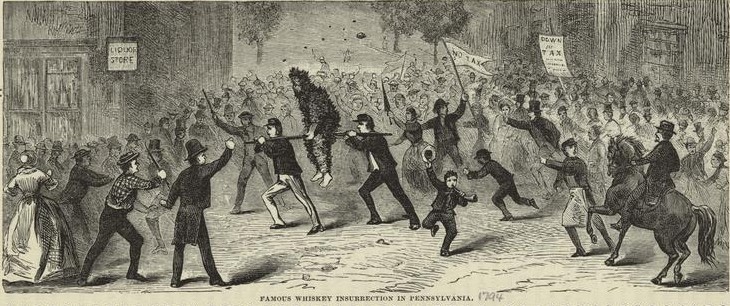
  1. The American Revolution
  2. The Road to Revolution
  3. The Road to Independence
  4. History of the United States

Join, or Die: The French and Indian War

For centuries, France and England have been like ambitious siblings, close in age, evenly matched in most things, competitive, living in a house that’s too small for there ever to be peace.  They have repeatedly come into conflict over religion, territory, colonies, and anything else two countries might conceivably argue over…  In 1754, that rivalry came to the American frontier and set into motion a chain of events that would ultimately culminate in an American revolution…
This lesson was reported from:
A chapter of The United States: An Open Ended History, a free online textbook.  Adapted in part from open sources.

For Your Consideration:
  1. How did the French and British differ in their approach to colonization of North America?
  2. What was the Albany Plan of Union? Did it work?
  3. What were the terms of the Treaty of Paris (1763)?
  4. What was Pontiac’s Rebellion?
  5. Why did the Proclamation of 1763 anger British colonists?

A European Rivalry

Throughout most of their mutual history, France and Britain have engaged in a succession of wars. During the 1700s, these European wars spilled over into the Caribbean and the Americas, drawing in settlers, African slaves, and native peoples.

Though Britain secured certain advantages—primarily in the sugar-rich islands of the Caribbean—the struggles were generally indecisive, and France remained in a powerful position in North America. By 1754, France still had a strong relationship with a number of Native American tribes in Canada and along the Great Lakes. It controlled the Mississippi River and, by establishing a line of forts and trading posts, had marked out a great crescent-shaped empire stretching from Quebec to New Orleans. The British remained confined to the narrow belt east of the Appalachian Mountains. Thus the French threatened not only the British Empire, but also the American colonists themselves, for in holding the Mississippi Valley, France could limit their westward expansion.

New France 1754
European claims in 1748, on the eve of the French and Indian War.

Large areas of North America had no colonial settlements. The French population numbered about 75,000 and was heavily concentrated along the St. Lawrence River valley. Fewer lived in New Orleans, Biloxi, Mississippi, Mobile, Alabama, and small settlements in the Illinois Country, hugging the east side of the Mississippi River and its tributaries. French fur traders and trappers traveled throughout the St. Lawrence and Mississippi watersheds, did business with local Indian tribes, and often married Indian women. Traders married daughters of chiefs, creating high-ranking unions.  In this way, French colonial interests in North America meant coexistence, exchange, and commerce with native peoples.

In contrast, British settlers outnumbered the French 20 to 1 with a population of about 1.5 million ranged along the eastern coast of the continent from Nova Scotia and Newfoundland in the north to Georgia in the south. Many of the older colonies had land claims that extended arbitrarily far to the west, as the extent of the continent was unknown at the time when their provincial charters were granted. Their population centers were along the coast, yet the settlements were growing into the interior. Nova Scotia had been captured from France in 1713, and it still had a significant French-speaking population. Britain also claimed Rupert’s Land where the Hudson’s Bay Company traded for furs with local Indian tribes.  However, in the more southern colonies – that would one day become the United States – British interests were frequently at odds with those of the natives, as the large colonial population pressed ever westward, clearing ancestral native land for new English-style farms and towns.

Voyageurs at Dawn, 1871 by Frances Anne Hopkins (1838–1919)
Voyageurs at Dawn, 1871 by Frances Anne Hopkins. To many natives, French activity in North America often looked more like this, than like a full-scale attempt to remake the land in image of Europe.

War on the Frontier

Portrait of George Washington by Charles Willson Peale, 1772
Portrait of British Lieutenant George Washington by Charles Willson Peale, 1772.

Disputes over who would control the Ohio River Valley lead to deployment of military units and the construction of forts in the area by both the British and the French, even though the area was in fact already occupied by the Iroquois Confederacy. An armed clash took place in 1754 at the French Fort Duquesne, the site where Pittsburgh, Pennsylvania, is now located, between a band of French regulars and Virginia militiamen.  The Virginians were under the command of 22-year-old George Washington, a Virginia planter and surveyor who had been sent on a mission to warn the French to leave the area.

Following an intense exchange of fire in which approximately one third of his men died, Washington surrendered and negotiated a withdrawal under arms.  This inauspicious battle is now regarded as the opening battle of a much larger war.

British colonial governments were used to operating independently of one another and of the government in London, a situation that complicated negotiations with Native American tribes, whose territories often encompassed land claimed by multiple colonies.

The British government attempted to deal with the conflict by calling a meeting of representatives from New York, Pennsylvania, Maryland, and the New England colonies. From June 19 to July 10, 1754, the Albany Congress, as it came to be known, met with the Iroquois in Albany, New York, in order to improve relations with them and secure their loyalty to the British.

But the delegates also declared a union of the American colonies “absolutely necessary for their preservation” and adopted a proposal drafted by Benjamin Franklin. The Albany Plan of Union provided for a president appointed by the king and a grand council of delegates chosen by the assemblies, with each colony to be represented in proportion to its financial contributions to the general treasury. This body would have charge of defense, Native-American relations, and trade and settlement of the west. Most importantly, it would have independent authority to levy taxes.  Franklin was a man of many inventions – his was the first serious proposal to organize and unite the colonies that would become the United States.

But in the end, none of the colonial legislatures accepted the plan, since they were not prepared to surrender either the power of taxation or control over the development of the western lands to a central authority.

220px-Benjamin_Franklin_-_Join_or_Die
Join, or Die: This 1756 political cartoon by Benjamin Franklin urged the colonies to join together during the French and Indian War.

Britain’s superior strategic position and her competent leadership ultimately brought victory in the conflict with France, known as the French and Indian War in America (named for Britain’s enemies, though some natives fought on the British side, too) and the Seven Years’ War in Europe. Really the first true world war, with conflicts stretching from Europe to Asia, only a modest portion of it was fought in the Western Hemisphere.

The Treaty of Paris (1763)

The war in North America officially ended with the signing of the Treaty of Paris in 1763. The British offered France the choice of surrendering either its continental North American possessions east of the Mississippi or the Caribbean islands of Guadeloupe and Martinique, which had been occupied by the British. France chose to cede their North American possessions. They viewed the economic value of the Caribbean islands’ sugar cane to be greater and easier to defend than the furs from the continent. French philosopher Voltaire referred to Canada disparagingly as nothing more than a few acres of snow. The British, however, were happy to take New France, as defense of their North American colonies would no longer be an issue; also, they already had ample places from which to obtain sugar. Spain traded Florida to Britain in order to regain Cuba, but they also gained Louisiana from France, including New Orleans, in compensation for their losses. Great Britain and Spain also agreed that navigation on the Mississippi River was to be open to vessels of all nations.

Treaty of Paris
North America after the Treaty of Paris in 1763.

In the aftermath of the French and Indian War, London saw a need for a new imperial design that would involve more centralized control, spread the costs of empire more equitably, and speak to the interests of both French Canadians and North American Indians, now subjects of the British Empire.

The colonies, on the other hand, long accustomed to a large measure of independence, expected more, not less, freedom. And, with the French menace eliminated, they felt far less need for a strong British presence. A scarcely comprehending Crown and Parliament on the other side of the Atlantic found itself contending with colonists trained in self‑government and impatient with interference.

Furthermore, the French and Indian War nearly doubled Great Britain’s national debt. The Crown would soon impose new taxes on its colonies in attempt to pay off this debt. These attempts were met with increasingly stiff resistance, until troops were called in to enforce the Crown’s authority. These acts ultimately led to the start of the American Revolutionary War.

The incorporation of Canada and the Ohio Valley into the empire necessitated policies that would not alienate the French and Indian inhabitants. Here London was in fundamental conflict with the interests of its American colonists. Fast increasing in population, and needing more land for settlement, they claimed the right to extend their boundaries as far west as the Mississippi River.  Hadn’t that been how this whole war started in the first place?

Proclamation of 1763

The British government, fearing a series of expensive and deadly Indian wars, believed that former French territory should be opened on a more gradual basis.  Reinforcing this belief was Pontiac’s Rebellion, a bitter conflict which came on the heels of the Treaty of Paris, launched in 1763 by a loose confederation of Native American tribes, primarily from the Great Lakes region.  Named for Pontiac, the most prominent of many native leaders in the conflict, the members of the alliance were dissatisfied with British policies after the British victory in the French and Indian War (1754–1763).

While the French had long cultivated alliances among certain of the Native Americans, the British post-war approach was essentially to treat the Native Americans as a conquered people, eliminating benefits and autonomy that the various tribes had enjoyed while the French claimed the region. While French colonists—most of whom were farmers who seasonally engaged in fur trade—had always been relatively few, there seemed to be no end of settlers in the British colonies, who wanted to clear the land of trees and occupy it. Shawnees and Delawares in the Ohio Country had been displaced by British colonists in the east, and this motivated their involvement in the war. On the other hand, Native Americans in the Great Lakes region and the Illinois Country had not been greatly affected by white settlement, although they were aware of the experiences of tribes in the east.

Before long, Native Americans who had been allies of the defeated French attacked a number of British forts and settlements.  Eight forts were destroyed, and hundreds of colonists were killed or captured, with many more fleeing the region.  Warfare on the North American frontier was brutal, and the killing of prisoners, the targeting of civilians, and other atrocities were widespread on both sides.  The ruthlessness and treachery of the conflict was a reflection of growing tensions between British colonists and Native Americans, who increasingly felt they were in a war for their very survival.

Hostilities came to an end after British Army expeditions in 1764 led to peace negotiations over the next two years. Native Americans were unable to drive away the British, but the uprising prompted the British government to modify the policies that had provoked the conflict.

The Royal Proclamation of 1763 reserved all the western territory between the Appalachian Mountains and the Mississippi River for use by Native Americans – no British settlers allowed. Thus the Crown attempted to sweep away every western land claim of the thirteen colonies and to stop westward expansion. Although never effectively enforced, this measure, in the eyes of the colonists, constituted a betrayal – what had they been fighting for the last seven years if not a right to occupy and settle western lands?  Why was King choosing Native Americans over his own loyal subjects?

Thus, the Proclamation of 1763 would rouse the latent suspicions of colonials who would increasingly see Britain as no longer a protector of their rights, but rather a danger to them.

The article was adapted in part from:

  1. The French and Indian War
  2. The Road to Revolution
  3. The Road to Independence

New World Colonist Recruitment Infomercial

This lesson can be used with The United States: An Open Ended History, a free online textbook.  Adapted in part from open sources.

Each settlement in colonial America had its own identity and reason for being, whether that reason was economic, religious, or social, or some blend of the three – and they were all usually intensely competitive with their neighbors in these aims. Imagine that you are a representative from what we would today call that colony’s “Welcome Center,” trying to attract new settlers. These didn’t exist in the 1600s, per se, but if they did, what kind of ad campaign might they have created to lure settlers to their colony?

Create a comprehensive, informational commercial. You can act it out or record it and play it back.

You are responsible for creating a factually robust and informative presentation – that is also persuasive.  It may be filmed, but only if your recorded volume is loud enough for the class to hear and understand.  It may also be performed live.  Be sure to illustrate each segment with stimulating visuals.

Students should also be creative in their commercial while remaining historically accurate. 

Your commercial should be between one and two minutes in length.

The following features must be in the commercial—

  1. Map of your colony circa the 17th century
  2. Geography: description of land, sights, and climate
  3. People that settlers will encounter
  4. Occupations: How will settlers support themselves? What kind of work will they find?
  5. Mentions of history: When and why was the colony founded? (up to about 1700)
  6. Food: What will the travelers eat? What foods are native to the area?
  7. Transportation: How will the travelers get to the colony? How will they travel around the colony?  What are the major transportation routes and hubs in your colony?
  8. Religion: What churches have been established in the colony, or what are the practices of the indigenous people?  What religious groups are banned?
  9. Persuasion: Be sure to encourage settlers to travel and stay in the colony – why here and not a different colony?

Use at least one of the following…  The seven most common techniques of propaganda used in advertising:

  • Testimonial – The ever-popular celebrity endorsement.
  • Glittering Generalities – Praise and positive words that are hard to measure or quantify – think “best,” “great,” “I’m lovin’ it.”
  • Transfer – The qualities of the product transfer to the consumer – think of a sports car or soda commercial.  You, too, can be cool, if you have the right cell phone.
  • Plain Folks – An appeal to values, working class, family, nationalism, thrift – “Made in America,” “fair trade,” “real men,” or “the best value for your dollar.”
  • Bandwagon – Everybody’s doing it – don’t be left out or left behind!
  • Name Calling – Trash talking or put downs toward the competition.
  • Card Stacking – The omission of inconvenient or unflattering facts about your own product; the emphasis of those same kind of facts when talking about competing products.

For inspiration (see if you can spot the techniques listed above in action): 

Hawaii Chair.

Americans will buy ANYTHING 4! Top 10 Worst Infomercials.

The Evolution of the Virginia Laws of Servitude and Slavery (1643-1691)

This lesson can be used with The United States: An Open Ended History, a free online textbook.  Adapted in part from open sources.

Virginia laws of servitude and slavery (1643-1691): These laws attempted to set boundaries between different categories of people in Virginia.

  1. In your own words, briefly summarize what each law is saying.
  2. What categories of people are described in these laws?  Note especially when the category of a “white” person was invented, as well as words used to describe people of European descent before its first use. 
  3. According to these laws, how does a child become a slave?
  4. By 1691, is there a such thing as a free black person legally living in Virginia?
  5. Was there a “white” before there was slavery?  What does this evidence seem to suggest about race in America – did it occur naturally or was it invented?

March 1643

Whereas there are divers loytering runaways in the collony who very often absent themselves from their masters service, And sometimes in two or three monthes cannot be found, whereby their said masters are at great charge in finding them, And many times even to the loss of their year’s labour before they be had, Be it therefore enacted and confirmed that all runaways that shall absent themselves from their said masters service shall be lyable to make satisfaction by service at the end of their tymes by indenture double the tyme of service soe neglected, And in some cases more if the comissioners for the place appointed shall find it requisite and convenient. And if such runaways shall be found to transgresse the second time or oftener (if it shall be duely proved against them) that then they shall be branded in the cheek with the letter R. and passe under the statute of incorrigible rogues.

December 1662

WHEREAS some doubts have arrisen whether children got by any Englishman upon a negro woman should be slave or ffree, Be it therefore enacted and declared by this present grand assembly, that all children borne in this country shalbe held bond or free only according to the condition of the mother, And that if any christian shall committ ffornication with a negro man or woman, hee or shee soe offending shall pay double the ffines imposed by the former act.

September 1667

WHEREAS some doubts have risen whether children that are slaves by birth, and by the charity and piety of their owners made pertakers of the blessed sacrament of baptisme, should by vertue of their baptisme be made ffree; It is enacted and declared by this grand assembly, and the authority thereof, that the conferring of baptisme doth not alter the condition of the person as to his bondage or ffreedome; that diverse masters, ffreed from this doubt, may more carefully endeavour the propagation of christianity by permitting children, though slaves, or those of greater growth if capable to be admitted to that sacrament.

virginian-luxuries-1810
Virginian Luxuries, a painting by an anonymous artist, 1810.

October 1670

WHEREAS it hath beene questioned whither Indians or negroes manumited, or otherwise free, could be capable of purchasing christian servants, It is enacted that noe negroe or Indian though baptised and enjoyned their owne ffreedome shall be capable of any such purchase of christians, but yet not debarred from buying any of their owne nation.

June 1680

WHEREAS the frequent meeting of considerbale numbers of negroe slaves under pretence of feasts and burialls is judged of dangerous consequence; for prevention whereof for the future, Bee it enacted by the kings most excellent majestie by and with the consent of the generall assembly, and it is hereby enacted by the authority foresaid, that from and after the publication of this law, it shall not be lawfull for any negroe or other slave to carry or arme himselfe with any club, staffe, gunn, sword or any other weapon of defence or offence, nor to goe or depart from of his masters ground without a certificate from his master, mistris or overseer and such permission not to be granted but upon perticuler and necessary occasions; and every negroe or slave soe offending not haveing a certificate as aforesaid shalbe sent to the next constable, who is hereby enjoyned and required to give the said negroe twenty lashes on his bare back well layd on, and soe sent home to his said master, mistris or overseer. And it is further enacted by the authority aforesaid that if any negroe or other slave shall presume to lift up his hand in opposition against any christian, shall for every such offence, upon due proofe made thereof by the oath of the party before a magistrate, have and receive thirty lashes on his bare back well laid on. And it is hereby further enacted by the authority aforesaid that if any negroe or other slave shall absent himself from his masters service and lye hid and lurking in obscure places, comitting injuries to the inhabitants, and shall resist any person or persons that shalby any lawfull authority by imployed to apprehend and take the said negroe, that then in case of such resistance, it shalbe lawfull for such person or persons to kill the said negroe or slave soe lying out and resisting, and that this law be once every six months published at the respective county courts and parish churches within this colony.

3-tobacco-plantation-granger

April 1691

And for prevention of that abominable mixture and spurious issue which hereafter may encrease in this dominion, as well by negroes, mulattoes, and Indians intermarrying with English, or other white women, as by their unlawfull accompanying with one another, Be it enacted by the authoritie aforesaid, and it is hereby enacted, that for the time to come, whatsoever English or other white man or woman being free shall intermarry with a negroe, mulatto, or Indian man or woman bond or free shall within three months after such marriage be banished and removed from this dominion forever, and that the justices of each respective countie within this dominion make it their perticular care that this act be put in effectuall execution. And be it further enacted by the authoritie aforesaid, and it is hereby enacted, That if any English woman being free shall have a bastard child by any negro or mulatto, she pay the sume of fifteen pounds sterling, within one moneth after such bastard child be born, to the Church wardens of the parish where she shall be delivered of such child, and in default of such payment she shall be taken into the possession of the said Church wardens and disposed of for five yeares, and the said fine of fifteen pounds, or whatever the woman shall be disposed of for, shall be paid, one third part to their majesties for and towards the support of the government and the contingent charges thereof, and one other third part to the use of the parish where the offence is committed, and the other third part to the informer, and that such bastard child be bound out as a servant by the said Church wardens untill he or she shall attaine the age of thirty yeares, and in case such English woman that shall have such bastard child be a servant, she shall be sold by the said church wardens, (after her time is expired that she ought by law to serve her master) for five yeares, and the money she shall be sold for divided as is before appointed, and the child to serve as
aforesaid.

And forasmuch as great inconveniences may happen to this country by the setting of negroes and mulattoes free, by their either entertaining negro slaves from their masters service, or receiveing stolen goods, or being grown old bringing a charge upon the country; for prevention thereof, Be it enacted by the authority aforesaid, and it is hereby enacted, That no negro or mulatto be after the end of this present session of assembly set free by any person or persons whatsoever, unless such person or persons, their heires, executors or administrators pay for the transportation of such negro or negroes out of the countrey within six moneths after such setting them free, upon penalty of paying of tenn pounds sterling to the Church wardens of the parish where such person shall dwell with, which money, or so much thereof as shall be necessary, the said Church wardens are to cause the said negro or mulatto to be transported out of the countrey, and the remainder of the said money to imploy to the use of the poor of the parish.