November 21, 2016: The Foreign Service Explains the Day

One of the best aspects of this fellowship is the access it grants to the US embassy in each country that we visit.  Outside of a tragic terrorist attack in Libya, most Americans probably haven’t given much thought to the fine, knowledgable folks who represent US interests in hundreds of countries around the world. Continue reading “November 21, 2016: The Foreign Service Explains the Day”

November 20, 2016: Living History in the UAE

If you look around Openendedsocialstudies.org, you’ll find that I love history. Continue reading “November 20, 2016: Living History in the UAE”

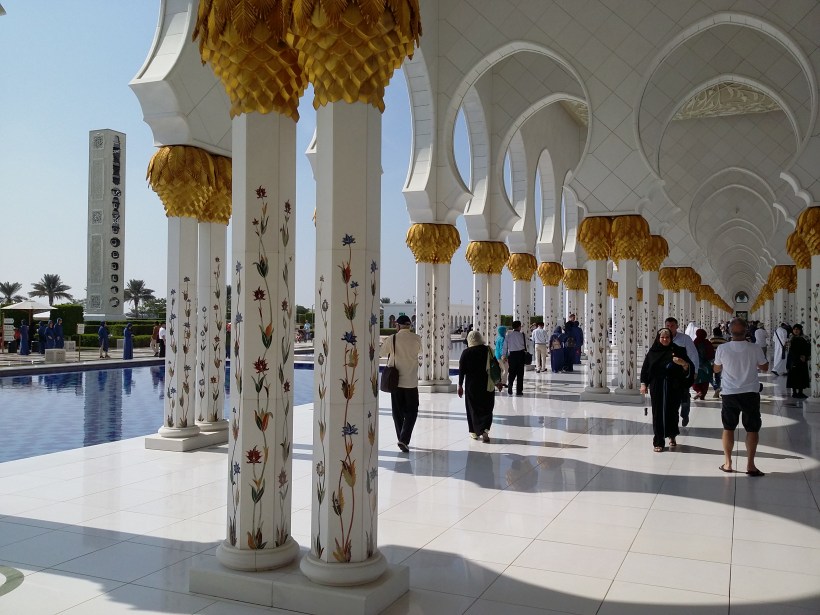
November 19, 2016: Grand Mosques and Grand Desert Adventure in Abu Dhabi

The Sheikh Zayed Grand Mosque is located in Abu Dhabi, and is the largest mosque in the United Arab Emirates.  It holds up to 40,000 worshippers, has four massive minarets, each 106 meters tall with designs incorporating elements from major periods in Islamic history, and 82 domes, each inscribed in gold with verses from the Holy Quran.   Continue reading “November 19, 2016: Grand Mosques and Grand Desert Adventure in Abu Dhabi”

November 17 and 18, 2016: The Burj, the Palm, and the Dubai Brand

I haven’t been able to write much since I arrived in Dubai.  This place is a sensual onslaught of glamour – colored lights and stunning views, rich food and richer cars, hot sun and cool AC, full burka and lots of leg.  I’ve been overwhelmed. Continue reading “November 17 and 18, 2016: The Burj, the Palm, and the Dubai Brand”

November 16, 2016: Opening Eyes in Dubai

After bidding Bahrain a fond adieu, our TEACH Fellowship delegation proceded to the global crossroads of the region – Dubai, the richest of the United Arab Emirates.  On first blush, the city itself is sprawling and urban and at the remove of the airport gives no sense of the opulance and glamor with which it has branded itself.  Though it definitely seems prosperous.   Continue reading “November 16, 2016: Opening Eyes in Dubai”

November 15, 2016: Bon Voyage, Bahrain!

It’s been a wild whirlwind through Bahrain, a country of 1.3 million, half of whom are guest workers and not really Bahraini at all.  This is a country that is at its core a conservative, traditional Muslim country – at once eager and willing to accommodate its many resident aliens, who range from American and British expats to Filipino nannies and Indian laborers.   Continue reading “November 15, 2016: Bon Voyage, Bahrain!”

November 14, 2016: Big Buildings and Bigger Ideas in Bahrain

What is the purpose of education?  Is it solely for the individual’s benefit – so that he or she can get a good job and have a successful career?  Or is it to produce a socially conscious citizen, someone who is curious and compassionate about the world and the people in it? Continue reading “November 14, 2016: Big Buildings and Bigger Ideas in Bahrain”

Preparing for Departure with the Bilateral US-Arab Chamber’s Teachers Educating Across Cultures in Harmony (TEACH) Fellowship.

Proud to be participating in the Bilateral US-Arab Chamber’s Teachers Educating Across Cultures in Harmony (TEACH) Fellowship. I leave for Bahrain, UAE and Qatar in just over two weeks, and I’ve been reading up on the history of the Middle East and Islam with the following books: Continue reading “Preparing for Departure with the Bilateral US-Arab Chamber’s Teachers Educating Across Cultures in Harmony (TEACH) Fellowship.”

What if people told European history like they told Native American history?

Kai's avatarAn Indigenous History of North America

The first immigrants to Europe arrived thousands of years ago from central Asia. Most pre-contact Europeans lived together in small villages. Because the continent was very crowded, their lives were ruled by strict hierarchies within the family and outside it to control resources. Europe was highly multi-ethnic, and most tribes were ruled by hereditary leaders who commanded the majority “commoners.” These groups were engaged in near constant warfare.

Pre-contact Europeans wore clothing made of natural materials such as animal skin and plant and animal-based textiles. Women wore long dresses and covered their hair, and men wore tunics and leggings. Both men and women liked to wear jewelry made from precious stones and metals as a sign of status. Before contact, Europeans had very poor diets. Most people were farmers and grew wheat and vegetables and raised cows and sheep to eat. They rarely washed themselves, and had many diseases because…

View original post 431 more words

The Inca: Church, State, and the Arc of History in the Realm of the Four Parts

Continue reading “The Inca: Church, State, and the Arc of History in the Realm of the Four Parts”