This morning our group met with Aleksey Pushkov, an outspoken and prominent Russian politician, in a Soviet-vintage government meeting space set above a nondescript strip mall. He opened our audience in this wood paneled conference room with a humble, “What do you want from me?”
He then launched into a thoughtful outline of the world from Russia’s point of view, speaking immaculate English without an interpreter or even notes for reference. It was all that I could ask for…
To summarize, hopefully without oversimplifying, he pointed out that the world order has been in a state of transition for years. The US may still be the single most influential country by most measures – but it certainly has less claim to unchallenged dominance than it once had… His commentary was far reaching, but for me, the key take away was that Americans must consider how it sounds and feels to the rest of the world when we talk about our exceptionalism.
We tell ourselves that we know what it is right. That we are the good guys – the late arriving hero in world history. And this self-righteous attitude often makes us blind to other points of view. After all, if we are the good guys – and Russia disagrees with us about something – then logically, they must be the bad guys. Right?
We also refuse to learn from history.
Combine these traits, and you get a situation like Syria. The US espouses regime change in Syria. Russia does not. To hear Pushkov tell it, this has less to do with Russia liking Assad – and much more to do with lessons learned from Iraq. In Iraq the US made regime change our business, upending the Middle East, incubating ISIS, helping along the Syrian civil war, which has fueled the refugee risks that is now driving the EU apart… And now we want to topple the Syrian government, brutal as it may be, with no clear plan for what comes next… Pushkov calls that irresponsible, and it is tough to disagree.
The Russians certainly subscribe to a realpolitik view of the world… But US willingness to pursue ideals that are not grounded in reality – however well-intentioned those ideals may be – can lead to some very serious consequences…
When your default position is I’m the good guy, and I mean well, you don’t tend to examine your own actions quite so closely… You are not so self-aware.
In the second half of the day, I learned I was not fully aware of Russia’s past either. I visited a museum near Gorky Park, full of Russia’s 20th century art. I went for the social realism – the signature style of the USSR’s public and propagandistic art, but I was so pleasantly surprised to see a plethora of other styles created under Soviet rule… The work ranged from abstract to surprisingly personal… It was at times evocative and in moments, it hinted at subversion.
I have been taught to think of Soviet artists as closely managed and repressed, but I have found that many managed to produce expressive, diverse work. I know there were things that they were forbidden to say expressly in their art – but sometimes limitations push artists to communicate their message more subtly, right under the noses of their censors.
That said, the gallery featuring work from the 1990s – the years after the USSR collapsed and Russia became a more open society – is full of jokes these artists must have been waiting decades to share. And there is a heck of a lot of glee to be found in the work from this period as well. Just look:
How we choose to tell our stories sometimes matters more than the story itself.
If there is a theme for today, that is it.
Spent the morning at RT studios. In case you haven’t caught it somewhere on the high end of your satellite TV package, RT is a Russian news service that broadcasts in the English language. If you ever want to know how Russia is talking about Syria, Trump, or any of the other Russia-proximate stories that seem to dominate the American news cycle these days, RT is the place to find out. It isn’t a propaganda vehicle, per se. And yet, most of their coverage has a way of looking slightly off model to the American viewer.
But in truth, I think that is just how things look from this side of the planet.
Everyone we meet is very earnest – idealistic, even. They are excited about reporting the news. But the media’s relationship to power in this country is very different from America. Whereas there is an expectation in the US that the media should adopt a skeptical, even adversarial posture relative to the government, there is no strong tradition of this in Russia. None.
Not in czarist times. Not in Soviet. Maybe briefly in 90s, but all that got them was chaos, corruption, and unpredictability. And that is a high price to pay for an independent media.
Maybe Russians are naive for believing what they see on TV. Or maybe they are more sophisticated than the average American for taking it with a grain of salt.
So RT is telling a Russian story. But that doesn’t necessarily mean it is propaganda. Or maybe it is propaganda, but that doesn’t mean that it is not also true.
The same could be said for the story told in the Victory Museum, which we visit after a fine lunch in restaurant devoted to Soviet-era nostalgia. Just as certain Americans remember the racially polarized, repressive 50s with fondness, despite those negatives, there is a big market here for golden warm memories of years past…
The Victory Museum outlines the broad strokes of Russia’s World War II experience – its struggle for survival against the Nazis, to whom it nearly succumbed. Most of the world had their money on the Nazis. It looked like Russia’s number was up. But through superhuman sacrifice – to the tune of more than 20 million lives – the Russians prevailed, breaking the back of the German army before a single boot hit the sand at Normandy.
Is the version of events portrayed in the museum self-serving? Sure. It leaves out many of the more egregious Soviet actions – the retribution against Nazi collaborators, for example… The ways in which the very telegraphed Nazi attack still managed to catch Stalin off guard…
But to be fair, most American stories about the war ignore the Russians more or less entirely. The invasion of Normandy is D-Day, which decided the war in Europe. We sort of saved the Russians, to hear it laid out in most history books or Hollywood films.
So we all tell stories.
Moscow is like one big monument to the past. It is full of hammers and sickles, and grand, imposing Soviet-era statues. The so-called Seven Sisters – Stalin-era skyscrapers that were supposed to make Moscow look like the capital of a modern superpower – now look dated. They haunt the city’s skyline like testaments to a world that might have been… Imagine what the world would have been like had the USSR poured its resources into further developing that unique form of architecture, instead of a generation or so of nuclear and missile development… Instead of a generation of backing satellite regimes and leftist revolutionaries the world over.
With reference to all of that Cold War stuff, I could write the same things about my own country… What if the United States had declined to pursue those same provocative actions? What if instead we had looked inward and gotten serious about, say, a War on Poverty?
Well, the world would be a different place in so many ways… Not the least of which is that this mini-Cold War we are now reliving – typified by election hacking and assassinations by nerve toxins – would likely be the stuff of fiction instead of fact.
And Vladimir Putin, whose fourth inauguration is tomorrow, would probably be an anonymous government functionary in some modified, but still socialist USSR.
It is a strange coincidence that I am in Moscow for this moment. I’m here to commemorate Victory Day – May 9 – the anniversary of the surrender of Nazi Germany to the Allied Powers at the end of World War II. What we used to call V-E Day. The last moment where the United States and Russia could plausibly claim to be standing shoulder-to-shoulder on anything.
On May 6, as I was landing at Moscow’s Domodedovo airport, more than a thousand anti-Putin demonstrators were arrested for protesting against Putin’s impending inauguration. They see him as corrupt – as a man who has held on to office in part by preventing free and open elections in his own country. By encouraging the same thing in mine.
Putin is a man who has learned from history.
Competition, not collaboration, was the story of the Twentieth Century. And that winners don’t need to play fair, because they can retell the story of their triumph anyway they please.
More missiles mean more security.
More guns mean more safety.
Poverty isn’t a social problem, it is a personal one.
Why am I in Russia this week?
Because I’m trying to remember that fleeting moment when collaboration was necessary for survival – when both Russia and the United States found themselves with their back to each other, fighting for their very existence.
I wonder how dire things must get in our present before we can see each other in that light once more.
More funky, dated skyscrapers more 1945 and all of the missed potential it carried… Less missiles, less stolen elections, less climate change, less 2018.
May 9 marks the 73rd anniversary of Victory Day, the surrender of Nazi Germany to the Allied powers. A mere footnote in much of the West, it is a grand national holiday in modern Russia.
All next week, Open Ended Social Studies founder Thomas Kenning will be coming to you live from Moscow.
Check this page for daily posts covering the festivities.
Follow Openendedsocialstudies on Instagram to get the whole picture.
Describe the two groups that make up society as Karl Marx and Friedrich Engels see it.
According to Marx and Engels, how would communism arise from capitalism?
Taken as a whole, no society in the world today practices either pure capitalism or pure communism. Consider your own society – what elements are more capitalist, and what elements more closely resemble communism?
The philosopher John Locke wrote that “no one ought to harm another in his life, health, liberty, or possessions.” How do you think Marx would respond to this idea?
Evaluate the pros and cons of communism – who would be better off? Who would be worse off?
What are some potential problems that might arise under a communist system?
How does Leninism differ from Marx’s theory of communism?
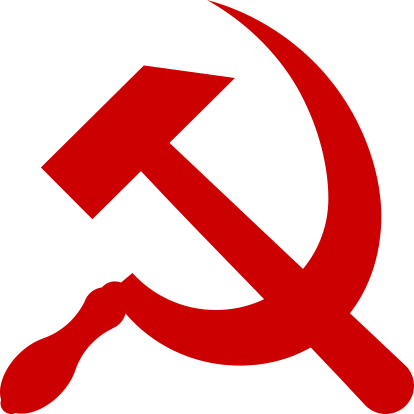
The hammer and sickle symbol of communism came into being during the Russian Revolution. It symbolized the alliance between industrial workers and rural peasants who together make up the working class.
Communism a movement whose ultimate goal is a society structured upon the common ownership of the means of production (factories, technology, farms) and the absence of social classes, money, and the state. More simply put, communism is the idea that basic needs – food, shelter, healthcare – should be shared evenly between every member of society, and that common people should look past artificial divisions like nationality, race, or personal wealth in pursuit of the common betterment of all mankind.
Communism stands most directly in contrast to capitalism, a system which arose in the early 1800s alongside the Industrial Revolution. Capitalism is a form of social and economic organization that assigns access to basic needs according to an individual’s ability to pay for them, which ultimately divides people into categories of haves and have-nots – those that can pay for food, and those who cannot; those who can afford to buy a house, and those who cannot; those who can afford to go to the doctor, and those who cannot.
According to communist theory, capitalism is a system that unfairly rewards a small, greedy group of wealthy business owners, usually referred to as the bourgeoisie. This capitalist class is a minority who derives its unfair share of society’s wealth by exploiting the poverty of the working class, orproletariat – the class of urban factory workers who labor for subsistence-level wages under often-hazardous conditions and who make up the majority within society. Think of the CEO worth billions of dollars while his lowest level employs work for minimum wage and don’t receive adequate healthcare.
The core philosophies of communism were developed and popularized by Karl Marx and Friedrich Engels, who published their famous pamphlet, The Communist Manifesto, in 1848as the Industrial Revolution was in full swing throughout much of Europe. Marx and Engels saw history as a continuous conflict between the capitalist and working classes.
A monument to Karl Marx and his colleague Friedrich Engels in Berlin, Germany. The park was created by the authorities of the former German Democratic Republic (GDR) in 1986. (Berlin, Germany, 2007.)
Marx predicted that this situation would ultimately be resolved through a social revolution in which the majority working class would overthrow the minority capitalist class – and the capitalist system itself. The triumphant workers, he believed, would redistribute wealth and the means of production equally among themselves – and all human beings would be entitled to an equal share of what they collectively produced.
As Marx put it, “From each according to his ability, to each according to his needs.”
There would be no more rich or poor, no more upper or lower class – even nations and racial distinctions would melt away – and all would receive an equal share, while hard work and selflessness would become the most exalted virtues to which anyone could strive.
Let the ruling classes tremble at a communist revolution. The proletarians have nothing to lose but their chains. They have a world to win. Workingmen of all countries, unite! – Karl Marx
It should be noted that Marx was only a theorist, not an active revolutionary himself. Aside from writing and publishing, he never took any concrete steps to enact these ideas, which he believed would happen when the majority of the working class recognized just how unfair capitalism was… That no matter how many extra hours they worked, no matter how many 2% cost-of-living raises they secured, they would always be denied a fair share of the wealth that they produced through their labor.
This condition has never really been met.
“Smash the Old World. Establish the New World” (People’s Republic of China, 1967)
In the real world, every large-scale communist revolution that has come to pass has been led by a minority within a society still largely committed to capitalism. Too often, communist revolutions the world over have been carried out without the consent of a country’s working class – they have not been true popular revolutions. In Russia, China, and Cuba, communist reforms have typically been enacted from the top of society down, instead of from the bottom up, by popular demand, as Marx predicted.
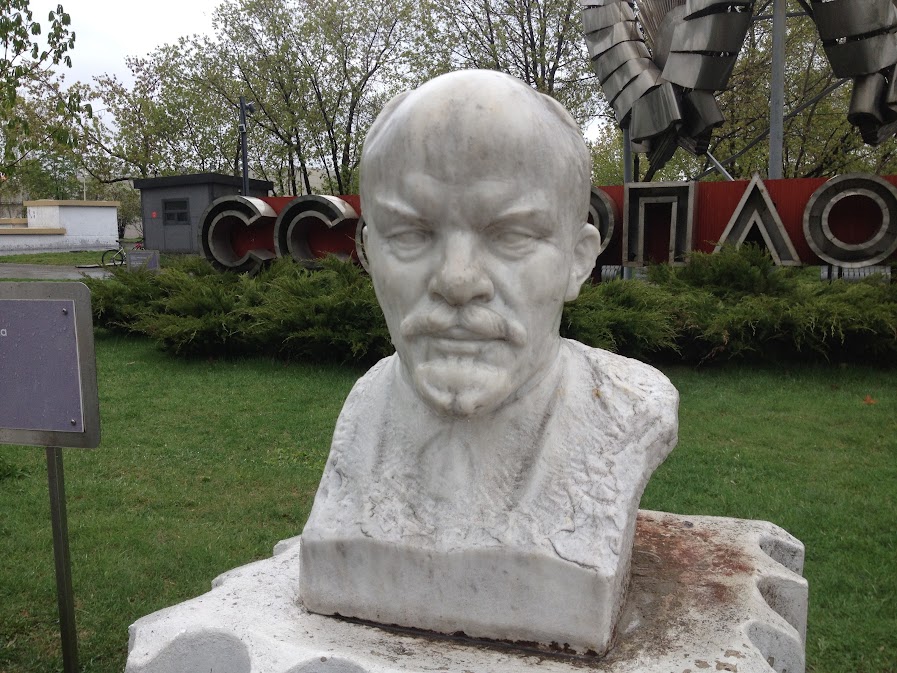
A bust of Vladimir Lenin, founder of the Soviet Union, the first communist nation on earth. (Moscow, Russia, 2017.)
This has led to a great deal of violence, oppression, famine, and hardship as communist leaders have attempted to force a communist revolution upon a society that was not ready for it, a philosophy known as Leninism, after the revolutionary Vladimir Lenin, who brought communism to a largely unprepared Russia in 1917.
Leninism’s willingness to force communism upon a society “for its own good and by any means necessary” has tarnished the legacy of Marxism, a philosophy that at its heart aspired to elevate humanity beyond its selfish tenancies toward greed, poverty, war, and conflict.
(Click to enlarge)
Activities
Create a students’ paradise in your own classroom. When you walked in today, your classroom was likely organized according to a capitalist model, in which each individual student controls his or her own school supplies. Create an inventory of all of the supplies brought to class today – the sum total of all of the pencils, pens, erasers, calculators, notebooks, etc… If these supplies were divided evenly between all classmates, how many of each would an individual student receive? Which classmates are better off under this new distribution of supplies? Which are worse off? Which system is more fair? Which system would lead to a more productive classroom?
Marx once famously wrote, “Religion is the sigh of the oppressed creature, the heart of a heartless world, and the soul of soulless conditions. It is the opium of the people.” Unpack this metaphor and explain why Marx would be critical of religion’s role in the lives of the working class. What else might serve a similar role in the modern day? Create a communist-style propaganda poster warning your peers about the dangers of this other opium of the people.
Marx was moved to develop his theories after witnessing the vast gulf between the rich and the poor during the Industrial Revolution. He was appalled at the way the working class suffered – working long hours in dangerous conditions for low pay that often failed to provide them with a stable or dignified quality of life. Research the ways that poverty manifests itself in your community and report back to your class. Possible starting questions include:
How many people are homeless in my community? What kind of options do they have for shelter, food, and medical care?
What does the phrase “working poor” mean? How many people in my community fit this definition? Who are their employers?
How does my government work to meet the needs of the poor? What are the conditions in my state to qualify for medical, food, or unemployment assistance?
What charities are at work in my community, filling the roles that capitalism and the government don’t?
THIS LESSON WAS MADE POSSIBLE THROUGH GENEROUS SUPPORT AND COOPERATION FROM ROSSOTRUDNICHESTVO.
Fallen Monument Park in Moscow is a repository of communist era sculptures. (Moscow, Russia, 2018.)
You can actually visit parts of the world featured in this lesson:
A Guided Tour of Moscow is a curated photo essay for use in middle and high school social studies classrooms.The essay offers a brief, completely non-comprehensive overview of Russian history and culture circa 2017 and is meant to present these topics in an unconventional way – that is, as if the student were travelling through, wandering, and exploring Moscow on their own. Explore Red Square and Gorky Park, commute through the Moscow Metro, and participate in the 2017 Victory Day celebrations commemorating the end of World War II.
Openendedsocialstudies.org is pleased to announce that Thomas Kenning, founder and chief creative officer, will be undertaking several research expeditions in the coming months, all with the aim of producing new content and resources for this site.
In May, Mr. Kenning will be traveling to Moscow to participate in the annual Victory Day celebration. While there, he will be gathering information for further lessons in our proposed open source Russia textbook.
In June, Mr. Kenning will be in residence in the Philippines, developing a new curriculum unit on this fascinating syncretic culture.
Also in June, Mr. Kenning has scheduled a working trip to Tokyo with the aim of realizing long gestating plans for several lessons on the history and culture of Japan.
Finally, in July, Mr. Kenning returns to Cuba to complete work on new lessons documenting that nation’s colonial past.
Summer is traditionally the season that sees the most research and development at Openendedsocialstudies.org, and this is turning out to be one of our most exciting seasons yet!
Travel really can make you a better person – why not use it to teach right in your own classroom with some of these great lesson ideas from Openendedsocialstudies?
A Guided Tour of Bolivia, 2016– Explore the streets of La Paz and El Alto, scramble through the 500 year-old silver mines of Potosi, or race across the barren salt flats of Uyuni. Supplementary photos and information on Bolivia, past and present.
A Guided Tour of Peru, 2016– Explore the streets of Cusco and Lima, scramble through Inca ruins from Machu Picchu on down, take a slow boat up the Amazon River from Iquitos, and an even slower boat across Lake Titicaca to the floating man-made islands of the Uros. Supplementary photos and information on Peru, past and present.
TEACH in Bahrain, Qatar, and the United Arab Emirates, Travel Writing:
A Guided Tour of the Gulf States is a curated photo essay. Stroll the streets of Manama and Doha, ride to the top of the Burj Khalifa in Dubai, witness the grandeur of Islamic architecture at the Sheikh Zayed Mosque before spending the evening dune bashing with high-paying tourists in the sands of Abu Dhabi.
A Guided Tour of Maya Mexico, 2017– Explore the ruins of Ek’ Balam, Uxmal, and Chichen Itza, scramble through streets of colonial Merida, and sample the cuisine and culture of Mexico’s Yucatan Peninsula. Supplementary photos and information on the Yucatan, past and present.
A Guided Tour of Moscow, 2017– Explore Red Square and Gorky Park, race through the Moscow Metro, and participate in the 2017 Victory Day celebrations commemorating the end of World War II. Supplementary photos and information about Moscow, Russia.
Scenes from South Korea, 2015– From the glistening towers of Seoul to the DMZ, from the bustle of downtown to the sanctuary of its Buddhist monasteries – supplementary photos to enhance a sense of place.
Here’s a perennial question facing the idealistic youth of any nation: What would you do if you found yourself surrounded by a violent, unjust system? What if your society was rife with rampant inequality? What if you were a beneficiary of this system – if your privilege came at the cost of others’ suffering?
Bartolomé de Las Casas found himself living in such a society – conquest-era colonial Spain – and he risked everything to speak out.
Would you have done the same?
Would you do the same today?
Ask your students —
Bartolomé de Las Casas and the Atrocities of the Spanish Conquistadors (Free online text suited for middle or high school classroom use, guided reading questions, and suggested activities): What would you do if you found yourself surrounded by a violent, unjust system? In the early Spanish conquest of the Americas, Bartolomé de Las Casas spoke out.
How and why do social norms and laws in Muslim majority countries differ from those in countries like the United States? Would students still want to visit greatest mall in the world if it meant following a different set of rules than they’re used to?
“Cultures are like books, the anthropologist Claude Lévi-Strauss once remarked, each a volume in the great library of humankind. In the sixteenth century, more books were burned than ever before or since. How many Homers vanished? How many Hesiods? What great works of painting, sculpture, architecture, and music vanished or never were created? Languages, prayers, dreams, habits, and hopes—all gone. And not just once, but over and over again. In our antibiotic era, how can we imagine what it means to have entire ways of life hiss away like steam? How can one assay the total impact of the unprecedented calamity that gave rise to the world we live in? It seems important to try.” – Charles C. Mann, author of 1491.
Openendsocialstudies.org is bringing the remnants of these vibrant cultures to life in your classroom – check out our library of free readings, lessons, and activities on precolumbian American civilizations.
The Three Sisters: Background information on the agricultural combination of maize (corn), beans, and squash that formed the backbone of the Mesoamerican and North American civilization, plus suggested activities.
The Maya: Illuminated Offspring of the Makers (Free online text suited for middle or high school classroom use, guided reading questions, and suggested activities): The Maya people’s rich history can be traced back nearly four thousand years, during which time they have refined and extraordinary and vibrant culture all their own.
Teotihuacan: The Place Where the Gods were Born (Free online text suited for middle or high school classroom use, guided reading questions, and suggested activities): Who built these incredible ruins outside of present day Mexico City, which include one of the largest pyramids in all of history? How did this mysterious civilization influence its neighbors and successors?
The Aztec: Life Under the Fifth Sun in Old Mexico: A basic overview of the Aztec-Mexica, one of the final great civilizations to arise in the western hemisphere before the paradigm shifting Columbian Exchange, including the dramatic ways in which they harnessed and changed the environment around them to grow their capital city into one of the largest in the world.
The Inca: Andean Civilization in the Realm of the Four Parts (Free online text suited for middle or high school classroom use, guided reading questions, and suggested activities): The tremendous success of the Inca was attained by harnessing and adapting the incredible achievements of the earlier peoples of the Andes, one of only six places in the world where civilization developed independently.A lesson in two parts:
Unrecognized Potential: Terra Preta, Ancient Orchards, and Life in the Amazon: Until relatively recently, was widely believed that the Amazon Rainforest was incapable of sustaining large scale human development. New findings have challenged this view, and evidence of ancient agriculture suggests that humans once developed this fragile region in ways so subtle that – in the form of carefully managed soils and prehistoric orchards – they have been hiding in plain sight all this time, challenging the basic tenants of “agriculture” as western eyes tend to recognize it.

 He then launched into a thoughtful outline of the world from Russia’s point of view, speaking immaculate English without an interpreter or even notes for reference. It was all that I could ask for…








 open ended social studies
You must be logged in to post a comment.